


A ready-to-present whole-school assembly for World Mental Health Day (10 October), built around this year’s official WHO theme: “Lived experiences heard: real voices, real change”.
Students learn what “lived experience” means, why it counts as real expertise, and how everyday listening and language can break stigma. The tone is calm and respectful, and the assembly ends with clear signposting to help.
WHAT’S INCLUDED
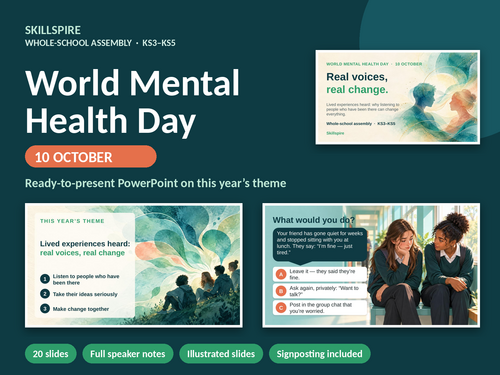
• 20-slide editable PowerPoint (16:9)
• Full speaker notes on every slide: a word-for-word script, background knowledge, timing tips and safeguarding prompts
• Minimum 24pt text throughout, easy to read from the back of the hall
• Runs in 15–20 minutes
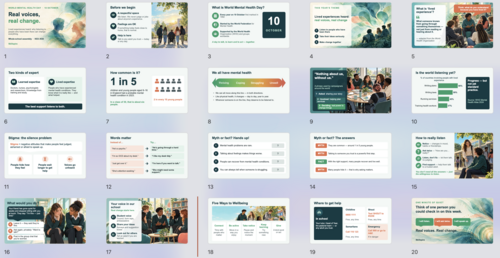
SLIDE BY SLIDE
- Title: Real voices, real change
- Before we begin: setting a safe, respectful tone
- What is World Mental Health Day?
- This year’s theme explained in three simple ideas
- What is “lived experience”? (think-pair prompt)
- Two kinds of expert: learned expertise and lived expertise
- How common is it? 1 in 5 young people (NHS England data)
- We all have mental health: the mental health continuum
- “Nothing about us, without us”: asked, involved, deciding
- Is the world listening yet? WHO Mental Health Atlas data chart
- Stigma: the silence problem
- Words matter: everyday language swaps
13–14. Myth or fact? Whole-hall vote with answers - How to really listen: Notice, Ask twice, Listen, Find support
- What would you do? Friendship scenario
- Your voice in our school (editable for your student voice groups)
- Five Ways to Wellbeing
- Where to get help: in school, Childline, Shout, Samaritans, emergency
- One minute of reflection and a three-part pledge
WHY TEACHERS USE IT
• No prep. Open it and present.
• Safeguarding-aware: sets ground rules, avoids graphic content, and signposts clearly
• Interactive moments (voting, a scenario, reflection) keep KS3 engaged, with extension prompts for sixth form
• Supports PSHE (Health & Wellbeing), SMSC, personal development and student voice
Statistics come from NHS England (2023) and the WHO Mental Health Atlas 2024, and sources are given in the speaker notes. UK helpline numbers are included; edit slide 19 if you teach outside the UK.
Honest reviews help other teachers decide whether a resource is right for them.
Something went wrong, please try again later.
This resource hasn't been reviewed yet
To ensure quality for our reviews, only customers who have purchased this resource can review it
Report this resourceto let us know if it violates our terms and conditions.
Our customer service team will review your report and will be in touch.
£3.00