GCSE D&T Core Materials Mega-Bundle 11 lessons: Woods, Metals, Plastics, Textiles, paper &card
This CloudForge GCSE D&T Mega-Bundle delivers every lesson required to teach the full Edexcel Core Materials content, with complete coverage of woods, metals, plastics, papers & boards, textiles, and joining methods. Each lesson is designed for clarity, dual coding and low cognitive load, ideal for KS3–KS4 theory, revision or cover work.
Students learn where materials come from, how they are formed, their properties and uses, and the processes used to cut, shape and join them. Retrieval practice features throughout, with exam-style questions and self-marking slides to build confidence for written assessments.
Ideal for:
• Edexcel GCSE D&T (complete Core Materials coverage)
• AQA GCSE D&T (foundation materials knowledge)
• KS4 theory sequences, revision lessons or non-specialist delivery
What’s included:
Timbers: hardwoods, softwoods, sustainability, felling, uses, common species
Manufactured boards: plywood, MDF, chipboard, OSB, blockboard, veneers, laminates
Metals: ferrous, non-ferrous, alloys, stock forms, extraction, heat treatment, joining
Plastics: sources and origins, polymerisation, crude oil processing, thermoplastics vs thermosets, biodegradable plastics
Plastics processing: vacuum forming, injection moulding, extrusion, blow moulding, rotational moulding, line bending
Paper & board: types, GSM, corrugated fibreboard, printing processes, die-cutting, creasing, finishes
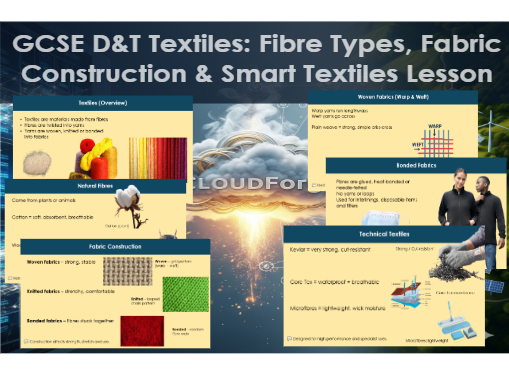
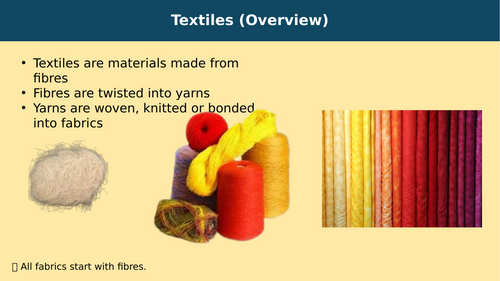
Textiles: fibre origins, woven/knitted/bonded fabrics, technical & smart textiles
Textile joining: machine stitches, seams, fastenings, bonding techniques, method selection
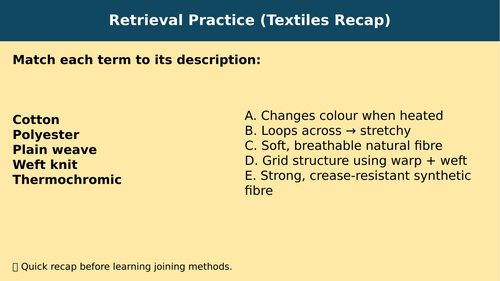
Built-in retrieval practice across PowerPoints
Exam-style questions with model self-marking slides
Teacher notes written for non-specialists (Say / Ask / Remind / Watch For)
Clean dual-coded diagrams throughout
Designed to match the visual clarity and accessibility of the free CloudForge Natural Timbers lesson.
Edexcel Core Requirement Covered In Notes
1. Sources & origins of materials Textiles Sources & Origins, Plastics Sources & Origins, Papers & Boards, Natural Timbers Covers: raw materials, extraction, growth, crude oil → polymers, pulp → paper.
2. Categories of materials (woods, metals, polymers, fibres, boards) Timbers, Metals, Plastics, Textiles, Papers & Boards Fully covered with definitions, examples, and dual-coded diagrams.
3. Properties of materials & performance characteristics Timbers, Metals, Plastics, Textiles Includes hardness, toughness, elasticity, grain, corrosion, malleability, strength, flexibility, absorbency, permeability etc.
4. Environmental impact of materials Timbers, Manufactured Boards, Plastics, Textiles Sustainability, recycling, biodegradability, responsible sourcing, deforestation, energy use.
5. Stock forms, types & sizes Metals (stock forms), Timbers (stock forms), Papers & Boards Bars, sheets, boards, rods, tubes, planks, GSM, thicknesses.
6. Material uses and typical applications All material-specific PPTs Real-world examples across all categories.
7. Forces & stresses in materials & ways to resist them Metals, Timbers, Plastics Includes strengthening, lamination, reinforcement, composites (basic), structural considerations.
8. How materials are cut, shaped, formed and joined Metals Processes, Plastics Processes, Timber Joining, Textile Joining One of the strongest areas of your bundle.
9. Forming processes Plastics Processes, Metals Processing Injection moulding, vacuum forming, extrusion, rolling, casting, etc.
10. Joining methods (mechanical, permanent, temporary) Timber Joints, KD Fittings, Metals Processes (welding, brazing, riveting), Textile Joining Fully covered across all material areas.
11. Finishing processes Metals (heat treatment & finishing), Plastics (finishing), Papers & Boards Includes sanding, polishing, lacquering, coatings, printing, heat treatments.
12. Smart & modern materials Textiles Sources (smart textiles), Plastics (biodegradable polymers), Metals (alloys) Meets core-level expectations; deeper content optional.
13. Technical textiles & functional materials Textiles: technical fibres/fabrics Covers microfibres, Gore-Tex, Kevlar, conductive fabrics.
14. Quality control & quality assurance (basic awareness) Papers & Boards (printing alignment), Metals/Timbers processes Light touch — appropriate for core.
15. Selecting materials based on properties, function & cost All PPTs, especially Retrieval & Exam Questions Reinforced throughout with application tasks.