


Overview:
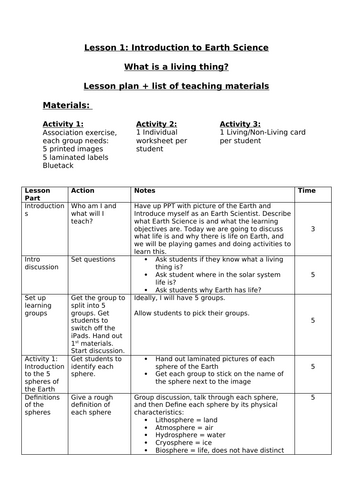
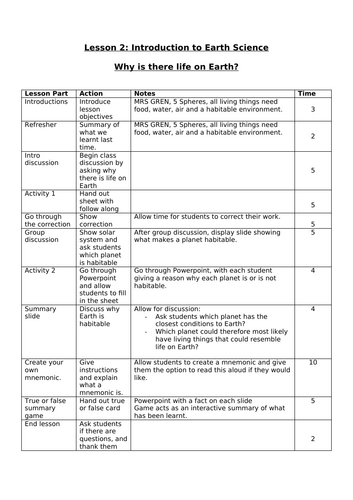
Lessons 1 “What is a living thing?” and 2 “Why is there life on Earth?” were created with a neurodiversity-friendly framework, grounded in research on inclusive teaching methods. The lessons teach planetary habitability and the necessary conditions for life using interactive and multisensory methods such as games and mnemonics, and individual, paired and group activities. The aim is to make complex scientific concepts accessible and engaging for all learners, therefore addressing systemic gaps in current teaching practices.
Background:
This resource was created for an S1 geography class of mixed-ability learners at Portobello High School. It was made to be inclusive to all learners, both neurodiverse and neurotypical, so can be used on any group containing either of these types of learners. This resource has been created for use as an Open Educational Resource (OER) by the OER Service, at the Information Services Group at the University of Edinburgh. As an OER, teachers are welcome to make any changes to their resources according to their needs.
Objectives and Success Criteria:
- I know that the Earth can be divided into 5 spheres, and that these are the cryosphere, hydrosphere, atmosphere, lithosphere and that these enable the biosphere. I can name examples of animals living in each sphere.
- I can tell the difference between living and non-living things.
- I know living things need water, food, air and a suitable habitat to survive.
- I can name some of the things that living things can do (move, grow, reproduce, react to their environment, breathe, excrete, and eat).
- I know the key features of the solar system: sun, and 8 planets. I know the role of the sun and have learnt the names and some of the features of other planets. I know that Earth has the right temperature for liquid water, and I know that the characteristics on Earth allow life to be present.
- Using my knowledge, I can think of where life is most likely to exist if not on Earth.
Experiences and Outcomes:
SCN 3-01a: I can sample and identify living things from different habitats to compare their biodiversity and can suggest reasons for their distribution.
SCN 3-06a: By using my knowledge of our solar system and the basic needs of living things, I can produce a reasoned argument on the likelihood of life existing elsewhere in the universe.
This Pack Includes:
Lesson 1
- Lesson 1 Plan.docx
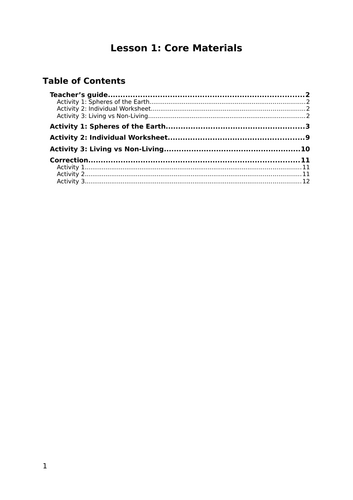
- Lesson 1 Core Materials.docx
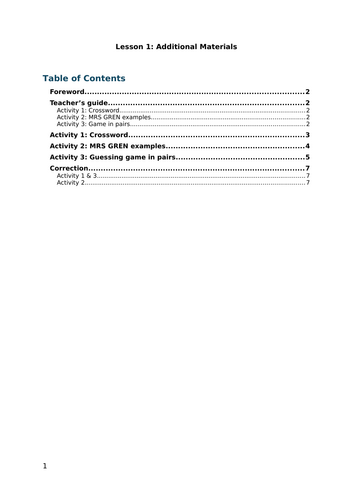
- Lesson 1 Additional Materials.docx
- Lesson 1.pptx
Lesson 2
- Lesson 2 Plan.docx
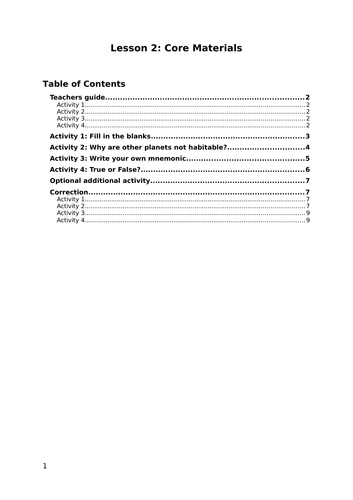
- Lesson 2 Core Materials.docx
- Lesson 2.pptx
‘Inclusive Introduction to Earth Science’ was developed by Anabelle Wilson-Smith, and all content in this package is available under a CC BY-SA 4.0 license unless otherwise stated.
Something went wrong, please try again later.
This resource hasn't been reviewed yet
To ensure quality for our reviews, only customers who have downloaded this resource can review it
Report this resourceto let us know if it violates our terms and conditions.
Our customer service team will review your report and will be in touch.
£0.00