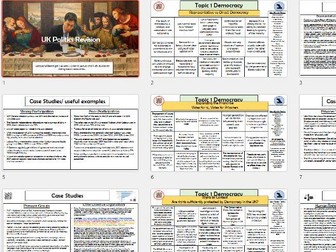
Newly updated for 2025! New Cabinet and Govt info plus updated info on elections.
Edexcel Government and Politics ALevel lesson 1 Intro and Democracy
First lesson in the Democracy topic for the Edexcel board but could be used for AQA and OCR too. Includes powerpoint, work sheets and other resources needed for outstanding teaching. Lesson is approx 2 hours plus homework.
Lesson 1: Introduction to Government and Politics- what is Politics?
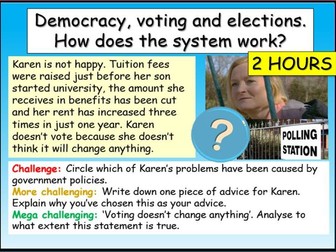
Includes a detailed introduction to the UK system of Democracy, debates about equality in UK to get students into thinking politically. Starter looking at election results and seats from 2024 election to introduce students to concept of over-rewarding winners and by-elections.
Developmental timeline of rights in the UK, Starter/ intro quiz including some key figures in UK politics / govt and how the system works simply e.g. bicameral, electoral system, how many seats in each country, simple info on referendums etc.
The quiz answers are designed to be used with the UK govt diagram so students can get a completed info system for their folders whilst checking what they know so far.
Also includes an introduction to Power, Authority and Legitimacy featuring Hobbes and Locke
An overview of elections in the UK and a diagram showing how Representative Democracy works in UK to be used with it to fill in key features on electoral systems used, how often etc.
Also includes a topic check list and glossary sheet as well as case studies sheets for students to log case studies/ examples whilst they study.
Also includes a short homework for students to do to strengthen/ widen their knowledge using UK Parliament website.
Please note: PNG files for illustrative purposes only. All documents shown are included as fully editable word/ powerpoint documents.
EdexcelALevel Politics but can be used for AQA too. UPDATED for 2025.
What is Democracy and Representative vs Direct Democracy. This is a two hour lesson which introduces the origins and concept of Democracy from its origins in Ancient Greece and the the different systems of both REP and DIRECT Democracy. Introduces the criteria by which to evaluate democracy as “pillars” in keeping with Ancient Greek theme to aid student memory. Has an introduction to methods of Political Participation and a discussion on whether some forms are more impactful than others.
The main focus of the lesson is on the features of and benefits and drawbacks of Representative and Direct Democracy looking at the UK and referendums using a venn diagram. Also includes ideas about how Swiss use Direct Dem for a comparison to UK referenda.
Also has a comprehensive diagram to show students the different levels of representation in UK alongside a table of the different elections e.g. for devolved bodies.
Quick plenaries; colour code (print slide) and a summative and evaluative paragraph conclusion following class discussion and debate which is framed by the resources. Also includes homework for student’s to make case studies using the guided note sheet with examples.
Includes powerpoint and all worksheets needed for teaching an outstanding lesson- where there is reference to the textbook, alternative worksheet can be handed out instead OR students can use the slides which can be handed out.
Please note: PNG files are for illustrative purposes only, all files included are fully editable and adaptable word or powerpoint documents.
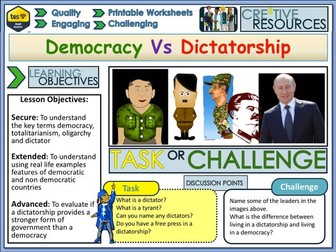
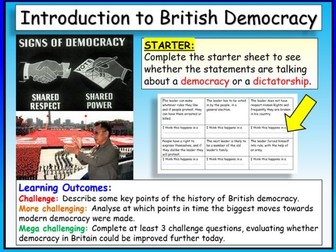
A detailed lesson comparing living in a democracy to living in a dictatorship. This lesson evaluates the strengths and weaknesses of both forms of government. PowerPoint Lesson for Citizenship Studies. (60-120 Minutes worth of Material) suitable for KS3 or KS4 students.
Learning Outcomes:
Secure: To understand the key terms democracy, totalitarianism, oligarchy and dictator
Extended: To understand using real life examples features of democratic and non democratic countries
Advanced: To evaluate if a dictatorship provides a stronger form of government than a democracy
Made by a team of Specialist Practicing Humanities Teachers as part of one of the leading PSHE & Citizenship Resource Providers in the UK - Cre8tive Resources .
What is included in this product?
Fully editable 22 slide PowerPoint Lesson 60-120 minutes
Student 20 Entrance Tickets
Revision Question Tree handout
Answer Keys:
Student input creates some of the answers. Product Code CIT/C8/LS/121
Description of Product
Ready-to-Use pack of classroom activities will enthuse and engage students! This lesson material is designed to be used for between one and two teaching periods and includes; activities, challenging and thoughtful questions, student hand-out (for use during lesson or as a homework), embedded URL links (where appropriate), differentiated tasks and, all relevant information to help students learn about issues relating to the topic.
N.B This lesson can be taught with no printing (For those on tight budgets :)
Our Philosophy
We aim to help you equip students with the knowledge and skills to take ownership of their own learning. Products come ‘Ready-to-Teach’ with everything you need to teach fun and creative lessons. Our products are teacher-designed, classroom tested & student approved.
With over 600 Citizenship and PSHE Products to pick from why not try looking at one of these:
British Values Quiz
Comparing electoral systems
Voting systems and electoral reform
GCSE CItizenship UNIT
What is Identity
Edexcel Spec 2017- updated to 2025 with recent and relevant political examples and 2024 election. I have been updating and improving my files this year. Lessons are FAR more comprehensive.
Entire Democracy topic including topic check list and detailed knowledge organiser. Note does not include rights as I teach these with Judiciary however some Pressure groups examples relate to rights :)
This is a unit of work with over 20 hours of lessons.
All resources for each lesson included - powerpoint, worksheets, extra reading etc. If you want more detail regarding what is included for each lesson check the individual lesson files:
All lessons 2 hours plus hwk:
Lesson 1: https://www.tes.com/teaching-resource/politics-democracy-intro-to-uk-system-12392354
Lesson 2: https://www.tes.com/teaching-resource/representative-and-direct-democracy-12392361
Lesson 3: https://www.tes.com/teaching-resource/representative-democracy-12392362
Lesson 4: https://www.tes.com/teaching-resource/is-the-uk-suffering-from-a-participation-crisis-12919447
Lesson 5: https://www.tes.com/teaching-resource/politics-does-the-uk-need-reform-12392365
Lesson 6: https://www.tes.com/teaching-resource/extending-franchise-and-debates-on-democratic-reform-uk-12393291
Lesson 7: https://www.tes.com/teaching-resource/pressure-groups-intro-democratic-functions-types-and-examples-13318637
Lesson 8 and 9: https://www.tes.com/teaching-resource/resource-13318646
KS3 PSHE/ Citizenship/ History. Complete lesson (enough for 2 hours) with resources.
Checking understanding- interactive using red/green flashcards or mini whiteboards. Students look at description and identify democracy or dictatorship.
Democracy video from BBC bitesize and comprehension questions
Create timeline of history in uk (images and text matching activity)
Democracy in practice - live voting
How does democracy link to human rights
How can you participate in democracy.
Project work/ Home learning: Create petition or letter to MP or poster
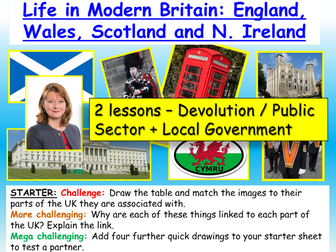
This is a Y9 SOW focusing on the GCSE content learning about the UK democratic system.
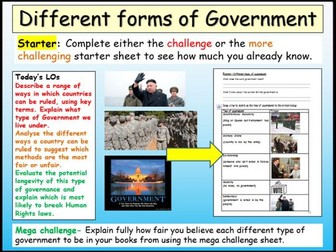
L1) Types of government - democracy, dictatorship, monarchy, federal, anarchy, totalitarian etc.
L2) Elections, manifestos and political parties
L3) Elections and voting - first past the post and proportional representation - what's the difference?
L4) The difference between parliament and government, how power is shared in the UK
L5) How laws are made in the UK
L6) What MPs do
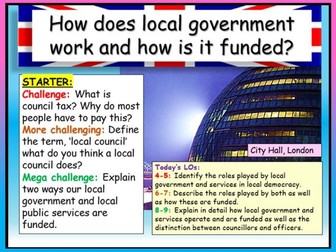
L7) Local and regional government
Government: Dictatorships Citizenship ( or Citizenship GCSE) 1 hour lesson including detailed PowerPoint, worksheets, clips, all well differentiated, KS3/ KS4.
These resources have been designed to be engaging, detailed and easy to follow. All our resources are editable (so easy to adapt for your classes) and are designed to last one hour each.
Check out the EC Publishing website for full, affordable PSHE, Citizenship and RE Packages for all year groups including the new 2026 Complete PSHE Package. You can contact us at info@ecpublishing.co.uk
Or you can check out some of our most popular PSHE, Citizenship and RE resources below:
Mental Health PSHE Bundle
1 Whole Year of PSHE Resources
British Values Citizenship Bundle
Careers, Employment and Enterprise Bundle
Islam Bundle
Sex and Relationships Education
Topic 1: Representative & Direct Democracy (Lessons 1a, 1b, 1c):
LIST OF LESSONS IN THIS RESOURCE
01a What is the nature of politics?
01b What is democracy?
01c What different forms does democracy take? (PLUS H/W)
To teach the Edexcel A Level I have created 125 lessons for UK Politics, based on the model of one teacher (easily adapted for two). These lessons go beyond the minimum requirements of the specification (e.g. studying more pressure groups, more elections, more minor parties and more prime ministers than required) and include:
LIST OF MATERIALS IN THE FULL 125-LESSON BUNDLE
Between 2 and 4 homeworks set per week;
16 assessment opportunities (8 in class, 8 as homework);
An exam technique sheet;
8 substantial knowledge tests, each out of 100 marks;
Further reading integrated (although you will need to purchase the relevant books yourself).
The core textbook for students to use is UK Government and Politics for AS/A-Level, 5th ed. by Philip Lynch, Paul Fairclough and Toby Cooper. I recommend buying enough for all students.
On rare occasions, activities will reference the Pearson textbook. If you wish to do these activities, this book is Edexcel GCSE Politics AS and A-Level Student Book and eBook - worth snapping up a copy of this also.
Further reading homeworks make use of the following books (all easily found on Amazon and not expensive): UK Politics Annual Update 2020, UK Politics Annual Update 2019, UK Government & Politics Annual Update 2018, UK Government & Politics Annual Update 2017, Isabel Hardman’s Why We Get the Wrong Politicians and Steve Richards’ The Prime Ministers: Reflections on Leadership from Wilson to May.
Lessons 1-20 are on Democracy and Political Participation.
LIST OF LESSONS IN THIS BUNDLE
01a What is the nature of politics?
01b What is democracy?
01c What different forms does democracy take? (PLUS H/W)
02ab [2 hours] How effectively does democracy operate in the UK? (PLUS H/W)
03a How has the franchise been extended?
03b Should the franchise be further extended? (PLUS H/W)
03c Is there a participation crisis in the UK? (PLUS H/W)
04a What are pressure groups?
04b Why do pressure groups use different methods? (PLUS H/W)
04c Why do pressure groups succeed or fail?
04d What explains the methods and extent of success of the BMA and Extinction Rebellion? (PLUS H/W)
04e What explains the methods and extent of success of the RMT Union and Greenpeace?
04f How do other organisations promote democracy and political participation? (PLUS H/W)
04g Assessment
05a What are rights? (PLUS H/W)
05b How effective has the Human Rights Act been?
05c Who can better defend rights? (PLUS H/W)
05d What could be done to improve democracy in the UK? (PLUS H/W)
05e Knowledge test 1
To teach the Edexcel A Level I have created 125 lessons for UK Politics, based on the model of one teacher (easily adapted for two). These lessons go beyond the minimum requirements of the specification (e.g. studying more pressure groups, more elections, more minor parties and more prime ministers than required) and include:
LIST OF MATERIALS IN THE FULL 125-LESSON BUNDLE
Between 2 and 4 homeworks set per week;
16 assessment opportunities (8 in class, 8 as homework);
An exam technique sheet;
8 substantial knowledge tests, each out of 100 marks;
Further reading integrated (although you will need to purchase the relevant books yourself).
The core textbook for students to use is UK Government and Politics for AS/A-Level, 5th ed. by Philip Lynch, Paul Fairclough and Toby Cooper. I recommend buying enough for all students.
On rare occasions, activities will reference the Pearson textbook. If you wish to do these activities, this book is Edexcel GCSE Politics AS and A-Level Student Book and eBook - worth snapping up a copy of this also.
Further reading homeworks make use of the following books (all easily found on Amazon and not expensive): UK Politics Annual Update 2020, UK Politics Annual Update 2019, UK Government & Politics Annual Update 2018, UK Government & Politics Annual Update 2017, Isabel Hardman’s Why We Get the Wrong Politicians and Steve Richards’ The Prime Ministers: Reflections on Leadership from Wilson to May.
An easy info booklet about 'What is Democracy' it explores the main concepts then asks students to consider if democracy is always appropriate - there is a homework/extension task encouraging research on different types of Democracy
Updated for 2025!
2 Hour lesson on Representative Democracy in UK
Edexcel GCE Politics but can be used for AQA or other specifications. This is my Lesson 3 Representative Democracy UK (Really lesson 5 and 6 as all are two hours)
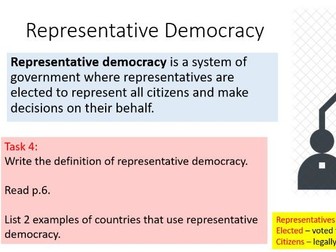
Complete lesson on Representative Democracy and its Features in the UK including analysis and evaluation of how effective it is. Including up to date examples from 2019-2025
Looks at different levels of representation e.g. constituency, national and social representation with independent reading and an evaluative analysis task for students for each level of representation.
Includes powerpoint and all documents needed including links to some relevant video clips and also both HPA and LPA level reading for independent work by Year 12.
Please note: PNG files are for illustrative purposes only. All files are included as Word or powerpoint documents and can be fully edited.
Part of my entire Democracy topic priced £20, if you wish to buy the complete topic at a discounted price. Very high quality resources.
UPDATED FOR 2026! British Values / Democracy and Voting Citizenship Resources, focusing on the different policies of the main UK political parties and how people decide to vote for them: Covers every aspect of policies (education, defense, health, economy, education etc) - the information is all written up in student speak, you don't need the students to have access to the internet to find them beforehand.
Well differentiated and detailed PowerPoint lesson with accompanying worksheets, clip links and questions. Perfect for teaching about political parties, elections, voting and policies. Suitable for KS3 or KS4.
These resources have been designed to be engaging, detailed and easy to follow. All our resources are editable (so easy to adapt for your classes) and are designed to last one hour each.
Find many, many more affordable or free PSHE, Citizenship, RE resources and much more at my Tes store or the EC Publishing website.
Were the Chartists dangerous revolutionaries or peaceful pioneers of modern democracy?
This History lesson covers the rise of the Chartist movement, Britain’s first mass working-class political campaign.
It is designed for KS3 or as an introductory session for GCSE studies on 19th-century democracy, protest, and reform, helping students examine how working people responded to being excluded from the 1832 Great Reform Act.
The lesson starts with the economic and political context of Victorian Britain, looking at the industrial unrest and poverty that drove the movement. Students will investigate the creation of The People’s Charter and its six core demands, including universal male suffrage and the secret ballot.
The session then explores the tactical divide within the movement, contrasting William Lovett’s peaceful “Moral Force” approach with the “Physical Force” advocated by radicals like Feargus O’Connor.
Classes will track the massive petitions presented to Parliament, the Newport Rising, and the government’s military preparations for the Kennington Common rally.
Finally, students will evaluate the long-term impact of the movement. Through source analysis, classroom debate, and scaffolded writing tasks, students will use historical evidence to develop key skills in interpretation, causation, and significance.
:
Included in this lesson:
Fully editable Powerpoint
Timeline Activity:.
Source Analysis:.
Scaffolded Writing:
Retrieval & Plenaries:
Fully differentiated resources
Thank you for choosing this resource. If you find this lesson useful, please take a moment to leave a review. Your feedback is greatly appreciated.
Different Types of Government Bundle. Made for KS4 but easily adapted (all resources are editable). Suitable for Citizenship drop down days, Citizenship lessons (each lesson is at least one hour) or can be used for Citizenship GCSE 9-1 as many of the topics in the new spec are covered.
7 (more now added) x fully resourced, highly-rated lesson packs. All 7 lesson packs are complete with a one or two hour-long powerpoint, accompanying differentiated worksheets, clip links with questions, plenaries, clear LOs and starters. All are well differentiated to three levels throughout to enable clear evidence of progress for all students.
The lessons are:
Absolute and Constitutional monarchies vs Republics and the history behind how Britain came to be a constitutional monarchy.
The differences between communism and capitalism as forms of government, their advantages and disadvantages.
The diffference between democracies and dictatorships and what it's like to live in a dictatorship.
The different systems of voting and electoral reform and how different governments use different systems to stay in power.
The US election - how do American elections work? Who are the Republicans and Democrats?
Many more inexpensive and free resources inclluding GCSE Citizenship 9-1 at my shop:
EC_Resources
Created by and experienced teacher and examiner of A Level Government and Politics, this comprehensive bundle covers the whole of Edexcel Politics Chapter 1: Democracy and Participation in 10 lessons.
Check out Lesson 1 of the bundle for FREE to get a taster of the quality of the rest of the lessons
Each lesson includes:
•Clear objectives, incorporating differentiated, higher-order thinking skills
•Starter task, linking today’s topic to a contemporary issue for relevance, whilst recaping last lesson
•Example of an exam-style question for today’s topic
•Context slide and video link to ‘set the scene’
•In-depth reading, based on Edexcel textbook chapters
•Comprehension tasks to acquire knowledge and understanding
•A conclusion-writing activity, with writing frame, to help develop exam writing skills
•Plenary to assess learning and to challenge evaluative critical-thinking
This PowerPoint defines the different types of democracy.
It allows pupils to record key definitions and notes.
There are also tasks related to the textbook.
It encourages discussion and supports extended writing.
It was made by an experienced teacher of IGCSE Global Citizenship using their own research and the textbook.
A vibrant and engaging presentation with activities and handouts following the Edexcel A Level Politics specification for 2017+. This presentation gives an overview of democracy in the UK - the different forms of governance and representation in the UK, the role of political parties and their mandates and manifestos, and an activity to evaluate the democratic system of the UK using 10 key criteria.
Alongside the PowerPoint comes a PDF printable version of the presentation, handouts for students with mandate strengths & weaknesses and the key criteria for evaluating the UK’s democratic system, and an activity for class or small group discussion with worksheet.
The presentation and resources are designed to be bright, engaging, and illustrative to keep the attention of students and disseminating important information in a structured way.
Learning Objectives:
List the different forms of governance in the UK.
Explain the role of political party mandate.
Evaluate the UK democratic system using key criteria.
9 slides long, widescreen format.
This bundle contains the complete series of lessons I have created for AQA GCSE 9–1 Germany 1890–1945: Democracy and Dictatorship, providing a comprehensive teaching sequence covering the Kaiserreich, the First World War, the Weimar Republic, the rise of Hitler and Nazi Germany 1933–1945.
Designed specifically for the AQA GCSE History specification, the complete bundle combines strong subject knowledge with regular GCSE examination practice, helping students develop the historical knowledge, understanding and examination skills needed to access the highest grades.
Throughout the unit, students build secure (AO1) knowledge and understanding of key events, individuals and developments, from Kaiser Wilhelm II, Weltpolitik and the impact of the First World War through to the weaknesses of the Weimar Republic, Hitler’s rise to power and the creation and development of Nazi dictatorship.
The lessons also develop students’ understanding of (AO2) second-order concepts including change and continuity, cause and consequence and significance. Students are repeatedly challenged to explain why events happened, assess their consequences, identify developments over time and reach supported judgements about the most important factors affecting Germany between 1890 and 1945.
Source analysis and evaluation (AO3) are embedded throughout the series, with students examining a wide range of historical sources and developing the skills required to interpret, analyse and evaluate historical evidence. Opportunities for (AO4) are also built into the lessons, allowing students to develop substantiated judgements and practise extended written answers using GCSE exam-style questions.
The lessons are designed to be engaging, challenging and academically rigorous, while remaining fully editable and ready to teach. They include a wide variety of activities, retrieval practice, differentiated tasks, enquiry-based learning, suggested teaching strategies, source work, higher-order thinking activities and regular GCSE examination practice.
The lessons are as follows:
Part 1: Kaiser Germany and the Weimar Republic
L1 Kaiser Wilhelm II (Free resource)
L2 The Kaiser’s Government and Weltpolitik
L3 The Impact of the First World War on Germany (Free resource)
L4 The Weimar Constitution and Political Parties
L5 The Treaty of Versailles
L6 Political Uprisings - The Spartacists and the Kapp Putsch (Free resource)
L7 The Ruhr Crisis and Hyperinflation
L8 The Munich Beer Hall Putsch
L9 Stresemann and Recovery
L10 The Golden Years
Part 2: The Rise of Hitler and the Creation of Nazi Dictatorship
L11 The Wall Street Crash
L12 The Rise of the Nazis and the Transformation of the Nazi Party
L13 How Did Hitler Become Chancellor? (Free resource)
L14 How Did Hitler Consolidate His Power?
L15 The Night of the Long Knives
L16 The Nazi Police State
Part 3: Nazi Germany 1933–1945
L17 The Nazis and the Economy
L18 The Hitler Youth
L19 Women in Nazi Germany
L20 The Nazis and the Churches
L21 Hitler’s Hate List
L22 The Nuremberg Laws and Kristallnacht
L23 The Final Solution
L24 Opposition in Nazi Germany
L25 The German Home Front, 1939–45 (Free resource)
Included within this Complete Bundle:
Fully editable PowerPoint lessons
Complete teaching sequence covering Germany 1890–1945
GCSE examination practice throughout, with model answers to support students
Retrieval practice activities
Source analysis and evaluation activities
Higher-order thinking tasks
Enquiry-based learning activities
Suggested teaching strategies
Supported judgement and evaluation tasks
Differentiated materials suitable for mixed-ability GCSE classes
Regular opportunities to practise GCSE exam-style questions
5 free resources included within the complete series
The lessons are designed to build students’ knowledge, understanding and examination skills progressively, making this complete bundle particularly useful for teachers looking for ready-to-use AQA GCSE Germany 1890–1945 resources covering the entire course from Kaiser Wilhelm II to the German Home Front in 1939–45.
The complete series provides a logical teaching sequence, allowing students to develop their understanding of how Germany changed from the Kaiserreich, through the Weimar Republic, to Hitler’s Nazi dictatorship.
After completing the full unit, I strongly recommend setting a full GCSE mock examination to consolidate students’ knowledge, assess progress and identify areas requiring further revision.
The official examination questions and mark schemes referenced in these resources remain the copyright of AQA. They are not reproduced as original AQA materials and can be accessed directly from the AQA website.
Please leave a review if you find this resource useful. Your feedback would be greatly appreciated.
Please note that due to Bundle restrictions of 20 lessons, the free resources (L1, L3, L6, L13, L25) need to be downloaded separately. Please click on the following links:
L1: https://www.tes.com/teaching-resource/resource-12118023
L3: https://www.tes.com/teaching-resource/resource-12021728
L6: https://www.tes.com/teaching-resource/resource-12016232
L13: https://www.tes.com/teaching-resource/resource-12043426
L25: https://www.tes.com/teaching-resource/resource-12050172
This was designed for Y9 - three part HW project building on concepts learned in lesson
1 - Make your own country, choose your government and explain why
2 - FPTP or PR? Choose your voting system
3 - Make your own laws
Differentiated versions for low literacy/EAL learners included.
Topic Revision booklet used to aid pupils' revision of key content for the democracy and participation topic taught at AS for Edexcel Unit 1; People Politics and Participation