Legal Studies - Criminal Law – Unit IntroductionQuick View
Aussie_resources

Legal Studies - Criminal Law – Unit Introduction

(0)
A PPT designed to introduce 10 Legal studies students to criminal law. It begins with the Rule of Law pyramid and an explanation of the main principles of the legal system (fairness and equality before the law). Students are introduce to some key terms to write in their glossary (common law and doctrine of precedent). They are introduced to the Queensland Criminal Code Act 1899 as well as a list of some other Acts which deal with specific criminal offences, such as drug offences and traffic offences. They are then introduced to the investigation process after an alleged criminal situation is reported. The various potential stakeholders in a crime are explained. Students are introduced to the concept of evidence and the process required for collecting evidence (as outlined in the Police Powers and Responsibilities Act of Queensland). The difference between direct and circumstantial evidence is explained. There is a video for students to watch to understand their rights when engaging with police. Information is provided about what happens when you are charged with an offence. This is followed by information about the rights of Police. Information is provided about Legal Aid (legal assistance available to people from low socio-economic backgrounds in Queensland). NB: In my PPTs I typically underline the information that I want students to write. The rest I use as talking points / visual aids. A resource which I think Legal Studies / Civics teachers will find helpful. If you use it, and like it, please give me a positive star rating / review. NB: My lessons have been designed for use in Australian classrooms and will often feature examples from Queensland legislation.
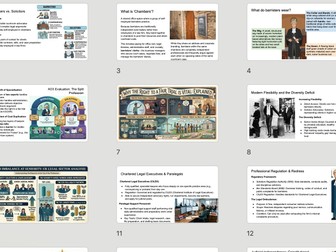
A-Level Law Bundle – The English Legal SystemQuick View
bweeirias

A-Level Law Bundle – The English Legal System

10 Resources
A-Level Law Unit 1 Bundle – The English Legal System A comprehensive bundle of PowerPoint presentations covering the core content of Unit 1 of the WJEC A-Level Law specification. Designed to provide students with detailed knowledge and strong AO3 evaluation skills, these resources are also suitable for AQA, OCR and other A-Level Law courses covering the English legal system. Topics included: • Law Making and Parliamentary Law Making • Law Reform • Delegated Legislation • Statutory Interpretation • Judicial Precedent • The Civil Courts and Civil Justice • The Criminal Courts and Sentencing • Magistrates and Juries • Legal Personnel (Barristers, Solicitors, Legal Executives and the Judiciary) • Access to Justice and Funding Each presentation contains clear explanations, key cases, legislation, contemporary developments and extensive evaluation to support both AO1 knowledge and AO3 analysis. Ideal for classroom teaching, revision, independent study, flipped learning and exam preparation. The resources are fully editable and designed to help students develop the understanding and critical evaluation skills required for success in A-Level Law.
English legal systems revision resourcesQuick View
KVRagan

English legal systems revision resources

(0)
Revision handouts for student completion for English Legal Systems topics in Papers 1-3. Completed versions attached for some. Selection of short answer exam questions for each topic included.
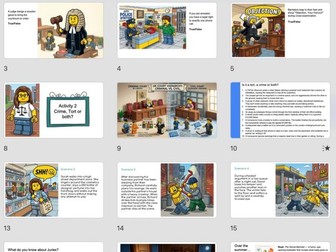
Introduction to A-Level Law: First Lesson/Taster Session/Transition LessonQuick View
bweeirias

Introduction to A-Level Law: First Lesson/Taster Session/Transition Lesson

(0)
A fun, engaging and fully editable introduction to A-Level Law, ideal for transition lessons, induction days, open evenings, taster sessions and first lessons with new students. This toy figure-themed resource is designed to introduce students to key legal concepts while challenging common misconceptions about the legal system. No prior legal knowledge is required, making it perfect for prospective A-Level Law students. The resource includes: • A 20-slide PowerPoint presentation • Accompanying student worksheet • Interactive activities and discussion tasks throughout • Detailed teacher notes included on every slide • Suitable for all A-Level Law specifications (WJEC, AQA, OCR and Eduqas) Activities include: • A true-or-false law quiz exploring common myths and misconceptions about the legal system • Criminal vs civil law sorting activities • Tort or crime classification tasks • A sentencing activity where students act as judges and decide appropriate punishments for a range of scenarios before comparing their decisions with real legal outcomes • A discussion-based introduction to juries, including the fascinating case of R v Young and the infamous Ouija board incident • Recommended books, documentaries, podcasts and research tasks for students considering studying Law further Comprehensive and user-friendly teacher notes accompany every slide, making this resource particularly suitable for non-specialist teachers, cover lessons, and departments introducing A-Level Law for the first time. The notes provide clear explanations, suggested answers, background information and guidance for leading discussions, ensuring the lesson can be delivered confidently by teachers with little or no prior experience of teaching Law. This lesson is designed to spark curiosity, encourage discussion and give students a realistic insight into the study of Law at A-Level. Perfect for schools, colleges and sixth forms looking to promote the subject in an engaging and accessible way.
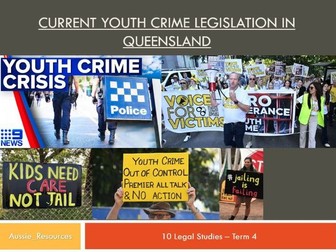
Legal Studies - Criminal Law – Youth Crime Laws in QueenslandQuick View
Aussie_resources

Legal Studies - Criminal Law – Youth Crime Laws in Queensland

(0)
A PPT designed to introduce 10 Legal studies students to terminology and concepts needed for an exam about criminal law (some short response and an extended response Q about youth crime). This could run over a couple of lessons / you could choose the sections relevant to your class. Students are introduced to key legislation including the Penalties and Sentences Act 1992 (Qld) as well as things that judges take into account when sentencing are explained e.g. nature/gravity of offence, prior convictions etc. There is an overview of different types of punishment / consequences (e.g. fines, community service). Then I provided statics from the ABS (Australian Bureau of Statistics) about rates of youth crime in Australia and the most common offences for people 15-24. The age of criminal responsibility in various Australian states and territories is explained. Then some key aspects of the Youth Justice Act 1992 (Qld) are included e.g. the meaning of serious offences, police officer’s power of arrest, the process for cautioning a child etc. Then I used an infographic from SBS which showed where young people were being detained in June 2022 (each state). I included images of a youth detention facility (inside and outside) and information about the experiences of those in youth detention. Two viewpoints about the current status quo were included from Cheryl Axelby (co-chair of Change the Record), Monique Hurley (managing lawyer at the Human Rights Law Centre). There were also a series of clips from news programs about Youth Crime. A discussion around whether juvenile offenders should be named in the media . NB: In my PPTs I typically underline the information that I want students to write. The rest I use as talking points / visual aids. A resource which I think Legal Studies / Civics teachers will find helpful. If you use it, and like it, please give me a positive star rating / review. NB: My lessons have been designed for use in Australian classrooms and will often feature examples from Queensland legislation.
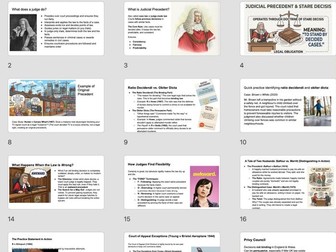
A-Level Law: PowerPoint Judicial Precedent (WJEC/Eduqas/OCR/AQA)Quick View
bweeirias

A-Level Law: PowerPoint Judicial Precedent (WJEC/Eduqas/OCR/AQA)

(0)
A comprehensive and engaging PowerPoint covering judicial precedent within the English and Welsh legal systems. Designed specifically for the WJEC A-Level Law specification, but easily adaptable for AQA, OCR, Eduqas and other post-16 Law courses. This resource introduces students to the doctrine of judicial precedent and explores how courts create, follow and develop case law. Complex legal principles are broken down into clear, accessible explanations, with extensive use of case law and regular opportunities for evaluation and critical discussion. What’s Included: • The meaning and purpose of judicial precedent • The doctrine of stare decisis • The court hierarchy and binding authority • Accurate law reporting and the role of legal databases • The relationship between precedent and statutory interpretation • Binding, persuasive and original precedent • Ratio decidendi and obiter dicta • Key cases including R v Howe, R v Gotts and Hunter v Canary Wharf • Techniques of following, overruling, reversing and distinguishing (FORD) • Balfour v Balfour and Merritt v Merritt • The Practice Statement 1966 and judicial flexibility • Key cases including Herrington, Shivpuri and Jogee • The Court of Appeal and the Young v Bristol Aeroplane exceptions • The role of the Criminal and Civil Divisions of the Court of Appeal • The Privy Council as a source of persuasive precedent • Judicial law-making and its constitutional limits • Advantages and disadvantages of judicial precedent • The role of the Supreme Court in developing and modernising the law • Evaluation of certainty, consistency, flexibility and judicial creativity throughout Key Features: • PowerPoint presentation • Student-friendly and highly accessible explanations • Strong focus on AO3 evaluation and critical analysis • Teacher notes included throughout with additional explanations and teaching guidance • Extensive use of key cases and contemporary examples • Ideal for classroom teaching, revision, homework and independent learning • Designed to support both knowledge recall and higher-level legal analysis Perfect For: • WJEC A-Level Law students • AQA, OCR and Eduqas Law courses • Teachers delivering Judicial Precedent, Law Making and the Legal System topics • Revision and examination preparation • Students seeking to strengthen both legal knowledge and evaluative skills
Legal Studies – Australian context – Introduction to Criminal Law and navigating legal documentsQuick View
Aussie_resources

Legal Studies – Australian context – Introduction to Criminal Law and navigating legal documents

(0)
A PowerPoint which I think Legal Studies / Civics teachers will find helpful. If you use it, and like it, please give me a positive star rating / review. A warm up question for students to answer in paragraph form about the importance of impartiality and fairness in legal trials. This lesson begins by defining criminal law and its purpose. It introduces the main source of laws in QLD – the Criminal Code of 1899. The categories of criminal law are explained – offences against the person; offences against property; drug crime and motor vehicle offences. The different reasons for punishment are explained – retribution; deterrence; rehabilitation; denunciation; community protection. Then students learn how to navigate legal documents and how to read the subsections. This is modelled for students using ‘Wilful Damage’ in the QLD criminal code. Students have to write a summary of what they learn (teaching synthesis skill). Following this, public order offences are explained. A list of illegal activities from the Summary Offences Act (2005) are shown in dot point form. Students then have to look up ‘public nuisance’ and write a summary of what it involves and what the punishment is. The meaning of the term penalty unit is explained. Finally, there is a viewing activity about public nuisance. NB: My lessons have been designed for use in Australian classrooms and will often feature examples from Queensland legislation.
Legal Studies - Criminal Law – Activity BookletQuick View
Aussie_resources

Legal Studies - Criminal Law – Activity Booklet

(0)
A 6 page end of term activity booklet for students to complete while some of their peers went on work experience. It includes: A match the definition activity for the following words: accessory, jury duty, summary offence, indictable offence, admissible evidence, white collar crime, burglary, bail, criminal intent (mens rea), prisoner and presumption of innocence. A table for students to research the age of criminal responsibility for juveniles for each state and territory in Australia. Some questions about driving laws for students to research the answers to. An image of a courtroom with the various people labelled which students are to use to explain the key roles within a court. Information about who can and cannot serve on a jury A match the definitions for the following terms: doctrine of precedent, barrister, custodial sentence, prosecutor, non-custodial sentence, special order, concurrent sentencing, cumulative sentencing, the Penalties and Sentences Act 1992 (Qld), community service, recidivism, antecedent Information about what bail is an da series of scenarios for students to read and decide whether they would grant bail in that case. I have included a scan of my answers for the match the definitions pages. NB: My lessons have been designed for use in Australian classrooms and will often feature examples from Queensland legislation.
Legal Studies - Criminal Law – Hearing Criminal MattersQuick View
Aussie_resources

Legal Studies - Criminal Law – Hearing Criminal Matters

(0)
A PPT designed to introduce 10 Legal studies students to terminology needed for an exam about criminal law (some short response and an extended response Q about youth crime). This lesson should equip students with the ability to: • Define the following terms: adversarial system, crime, prosecution, standard of proof, beyond reasonable doubt • Know the difference between summary and indictable offences • Explain how to behave in court • Explain how juries are selected • Name some of the roles in the court system NB: In my PPTs I typically underline the information that I want students to write. The rest I use as talking points / visual aids. A resource which I think Legal Studies / Civics teachers will find helpful. If you use it, and like it, please give me a positive star rating / review. NB: My lessons have been designed for use in Australian classrooms and will often feature examples from Queensland legislation.
Legal Studies - Criminal Law – Revision SheetQuick View
Aussie_resources

Legal Studies - Criminal Law – Revision Sheet

(0)
An 8 page revision sheet which can be used in classes as well as for homework in the lead up to an exam which has Part A (short response about criminal law) and Part B (extended response about Youth Crime). An answer sheet is also provided. The revision booklet includes: • Match the definitions (retribution, deterrence, rehabilitation, denunciation, community protection). • Multiple choice questions (could be turned into a Blooket / Kahoot). • Explaining processes (e.g. phases of a criminal trial / how a jury is selected). • Short response comprehension questions. • Key terms to define • Concepts to explain e.g. rule of law • Identifying key terms and labelling them with words from a word bank (adversarial system, evidence, beyond reasonable doubt, prosecution, jurisdiction, search warrant, restorative justice, fines, non-custodial sentence, the age of criminal responsibility) A resource which I think Legal Studies / Civics teachers will find helpful. If you use it, and like it, please give me a positive star rating / review. NB: My lessons have been designed for use in Australian classrooms and will often feature examples from Queensland legislation.
Legal Studies - Criminal Law – Practice ExamQuick View
Aussie_resources

Legal Studies - Criminal Law – Practice Exam

(0)
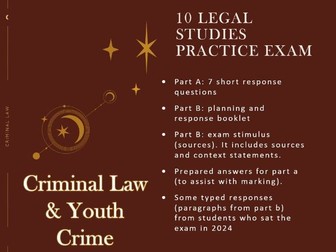
A Practice exam designed for 10 Legal Studies (a unit focusing on criminal law and youth crime). For this assessment students were allowed to see the sources for the extended response one week before the exam. Included documents: • Part A: 7 short response questions • Part B: Planning and response booklet • Part B: Exam Stimulus (sources). It includes sources and context statements. • Prepared answers for Part A (to assist with marking). • Some typed responses (paragraphs from Part B) from students who sat the exam in 2024 A resource which I think Legal Studies / Civics teachers will find helpful. If you use it, and like it, please give me a positive star rating / review. NB: My lessons have been designed for use in Australian classrooms and will often feature examples from Queensland legislation.
Legal Studies - Criminal Law – Combination Response ExamQuick View
Aussie_resources

Legal Studies - Criminal Law – Combination Response Exam

(0)
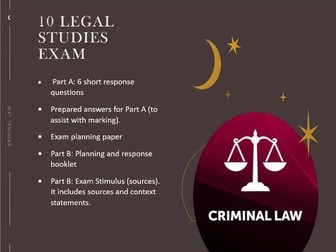
An exam designed for 10 Legal Studies (a unit focusing on criminal law and youth crime). For this assessment students were allowed to see the sources for the extended response one week before the exam. Included documents: • Part A: 6 short response questions • Prepared answers for Part A (to assist with marking). • Exam planning paper • Part B: Planning and response booklet • Part B: Exam Stimulus (sources). It includes sources and context statements. A resource which I think Legal Studies / Civics teachers will find helpful. If you use it, and like it, please give me a positive star rating / review.
English Legal System Guide and Study AidQuick View
Simonccx

English Legal System Guide and Study Aid

(17)
This Booklet is designed to support staff and students through the topic. It makes an excellent revision guide and can be used to support lessons and promote independent learning. The booklet contains detailed explanations of each aspect of the law, relevant cases and questions to promote learning. Note, the page layout is designed for printing a double sided booklet.
Criminal Law Guide and Study TextbookQuick View
Simonccx

Criminal Law Guide and Study Textbook

(18)
As the name says, this is a guide/textbook of the major elements of criminal law taught in most A levels and BTEC courses. The booklet can be given to students, taught from or to help provide a structure to your course. It contains detailed explanations of the major offences, their elements, cases and often gives revision aids and questions or tasks to achieve.
Legal Studies – Australian context – Legal foundations – jeopardy revision gameQuick View
Aussie_resources

Legal Studies – Australian context – Legal foundations – jeopardy revision game

(0)
A resource which I think Legal Studies / Civics teachers will find helpful. If you use it, and like it, please give me a positive star rating / review. It is a jeopardy game (template freely available from slides carnival websites). It provides definitions and students have to know the term. (I have placed the answers in the notes section of the PPT slides). Information about the rules of jeopardy can be found via Google or on Wikipedia.