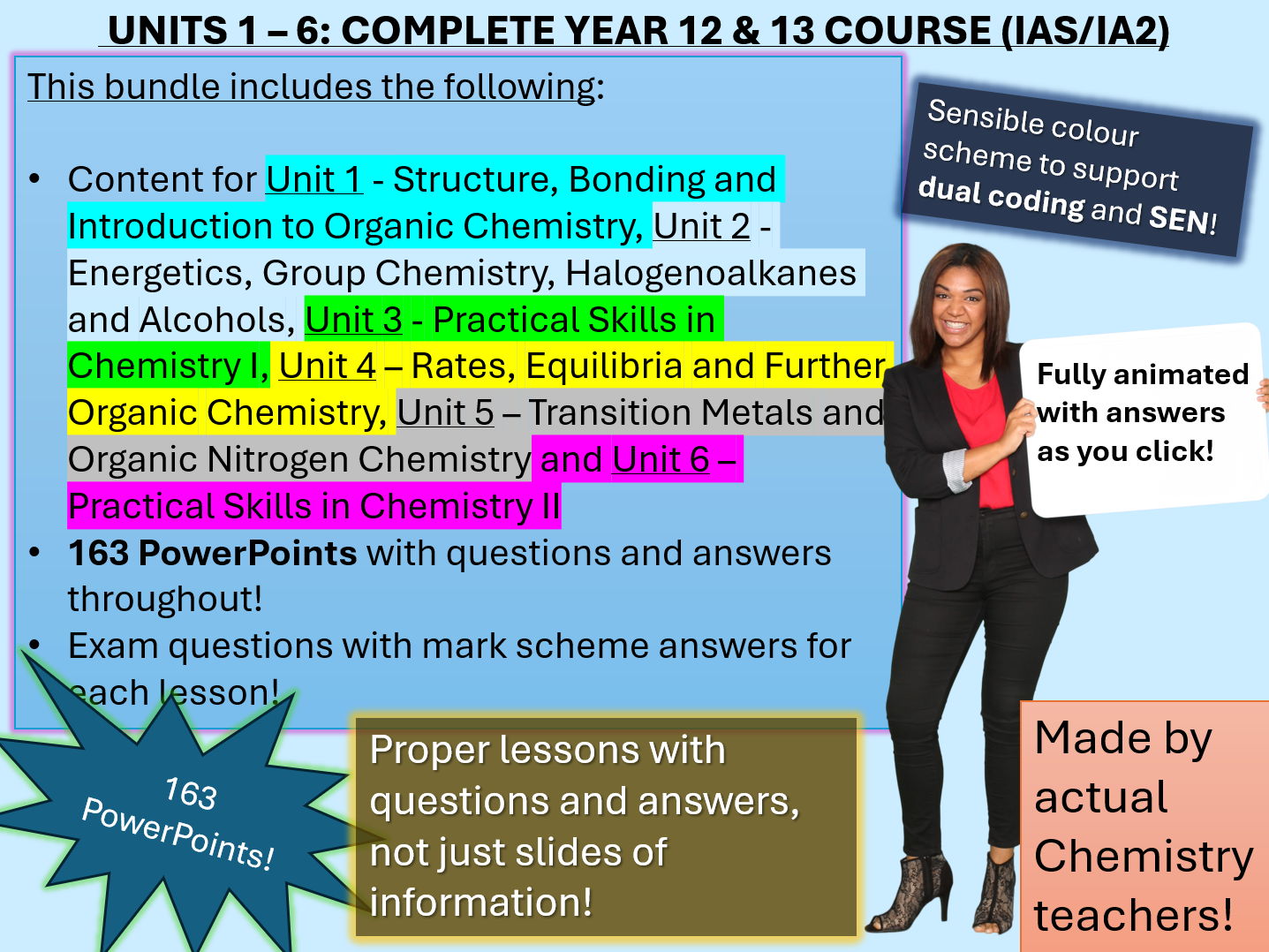
Bundle is comprised of 163 PowerPoint lessons covering all the units for the Edexcel International A level Chemistry course: Unit 1 - Structure, Bonding and Introduction to Organic Chemistry, Unit 2 - Energetics, Group Chemistry, Halogenoalkanes and Alcohols, Unit 3 - Practical Skills in Chemistry I, Unit 4 - Organic Chemistry: Carbonyls, Carboxylic Acids and Chirality, Unit 5 – Transition Metal Chemistry and Organic Nitrogen Chemistry and Unit 6 – Practical Skills in Chemistry II. The course codes are as follows: Unit 1 – WCH11/01, Unit 2 – WCH12/01, Unit 3 – WCH13/01, Unit 4 – WCH14/01, Unit 5 – WCH15/01 and Unit 6 – WCH16/01. The bundle can be used for all UK exam boards which have similar units, especially Edexcel. The PowerPoints are as follows:
- Atoms, Elements and Molecules
- Ionic Equation
- Reactions of acids
- Displacement Reactions
- Precipitation Reactions
- Comparing mass of substance
- Reacting masses
- Yield of reaction
- Atom Economy
- Empirical Formula
- Molecular formula and ideal gas equation
- Gas Volume calculations
- Molar gas volume calculations
- Concentration of solutions
- Atomic Structure
- Mass spectrometry
- Atomic orbitals and electronic configuration
- Ionisation energy
- Periodicity
- Ionic bonding
- Covalent bonding
- Polar covalent bonds
- Shapes of molecules
- Metallic bonding
- Solid lattices
- Structures and properties
- Types of formula
- Nomenclature and homologous series
- Structural isomerism
- Types of reactions
- Hazards and Risks
- Alkanes from crude oil
- Alkanes as fuels
- Alternative fuels
- Free radical substitution
- Alkenes and bonding
- Geometric isomerism
- Addition reactions
- Electrophilic addition mechanism
- Polymers
- Introduction to enthalpy
- Enthalpy level diagrams
- Enthalpy change of combustion
- Enthalpy change of neutralisation
- Enthalpy change of formation
- Bond enthalpies
- Intermolecular Forces
- Intermolecular Forces and Physical Properties
- Dissolving and Solubility
- Redox and Oxidation Numbers
- Oxidation Numbers and Nomenclature
- Ionic Half Equations
- Reaction of Group 1 Metals
- Reaction of Group 2 Metals
- Oxides and hydroxides of group 1 and group 2
- Thermal Stability of Group 1 and Group 2 Carbonates and Nitrates
- Tests for cations
- Trends in Group 7
- Redox reactions in group 7
- Reactions of halides with sulfuric acid
- Other reactions of halides
- Making standard solutions
- How to do a titration
- Titration Calculations
- Mistakes and Errors
- Errors and Uncertainties
- Rate of Reaction
- Factors affecting rate of reaction
- Rate of reaction – catalysts
- Dynamic Equilibrium
- Reversible Reactions in Industry
- Halogenoalkanes Introduction
- Comparing Rates of Hydrolysis
- Halogenoalkanes reaction mechanisms
- Alcohols and their reactions
- Oxidation reactions of alcohols
- Purifying an organic liquid
- Mass spectrometry of organic compounds
- Infrared Spectroscopy
- Core Practical 1
- Core Practical 2
- Core Practical 3
- Core Practical 4
- Core Practical 5
- Core Practical 6
- Core Practical 7
- Core Practical 8
- Techniques for measuring rate of reaction
- Rate equation
- Determining orders of reaction
- Rate equation and reaction mechanisms
- Activation energy and catalysis
- Arrhenius equation
- Introduction to entropy
- Total entropy change
- Understanding entropy changes
- Lattice energy
- Experimental and Theoretical Lattice energy
- Enthalpy change of solution
- Equilibrium constant – Kc
- Equilibrium constant – Kp
- Factors affecting equilibrium constants
- Entropy and equilibrium constant
- Bronsted-Lowry theory
- pH and pKa
- Ionic product of water
- Analysing data from pH measurements
- Buffer solutions
- pH curves
- Optical isomerism
- Optical activity and reaction mechanisms
- Carbonyl compounds
- Nucleophilic addition
- Carboxylic acids
- Acyl chlorides
- Esters
- Polyesters
- Simple chromatography
- Mass spectra (high resolution)
- HPLC, GC and GC-MS
- Carbon NMR
- Proton NMR
- Standard electrode potential
- Electrochemical cells | Cell Diagrams
- Standard electrode potential and thermodynamic feasibility
- Fuel cells
- Redox titrations
- Transition metals
- Ligands and complexes
- Colours in complexes
- Shapes of complexes
- Multidentate ligands
- Transition metal reactions – copper
- Transition metal reactions – cobalt and iron
- Transition metal reactions – chromium and manganese
- Transition metal reactions – vanadium
- Transition metal reactions – nickel and zinc
- Heterogeneous catalysis
- Homogeneous catalysis
- Benzene’s structure
- Benzene’s reactions
- Phenol
- Amines
- Acid-base reaction reactions of amines
- More reactions of amines
- Amides and polyamides
- Amino acids
- Peptides and proteins
- Organic analysis
- Organic synthesis
- Hazards, risks and control measures
- Practical Techniques Part 1
- Practical Techniques Part 2
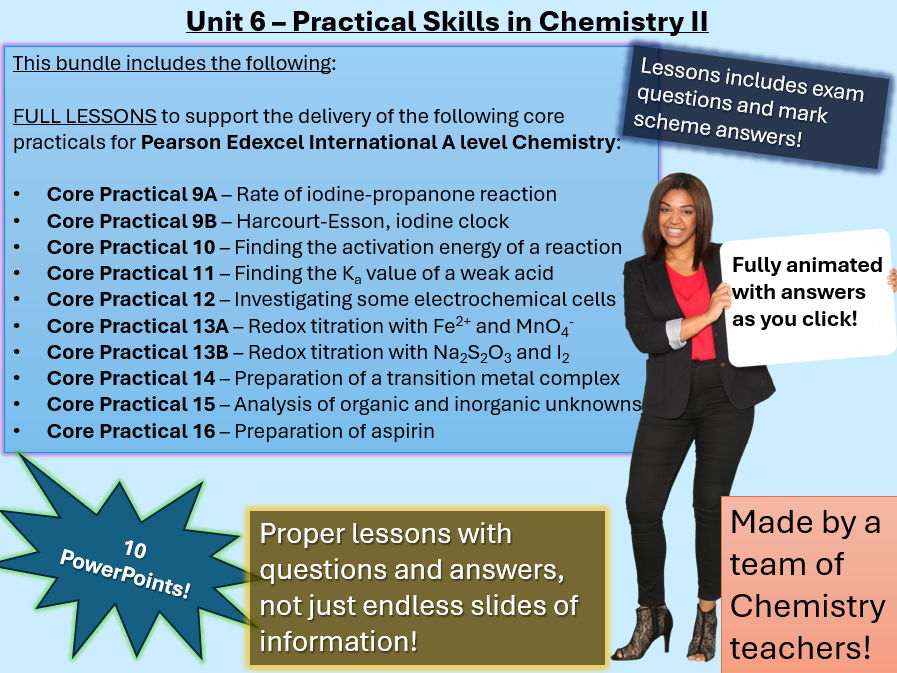
- Core Practical 9A
- Core Practical 9B
- Core Practical 10
- Core Practical 11
- Core Practical 12
- Core Practical 13A
- Core Practical 13B
- Core Practical 14
- Core Practical 15
- Core Practical 16
Each lesson is exactly that . . . a lesson. There is a starter slide, lesson objectives slide, introduction of new knowledge slides, worked examples and then opportunities for students to try independent practice through mini plenary tasks comprised of several questions of graded difficulties. Questions are interspersed through the lessons at regular intervals and always have answers that animate on to the screen when you click. THESE ARE NOT THE INFORMATION ONLY TYPE SLIDES THAT SOME PEOPLE SELL, which are useless for delivering a lesson. We are a team of teachers, and these lessons have been made by actual Chemistry teachers who currently teach in secondary schools in England. We know exactly what you need, trust us.
The Core Practical PowerPoints are structured in the following way: starter slide, lesson objectives slide, a recap quiz, equipment list, health and safety information for the experiment, numbered method, results table template, a section which explains all the steps in the method (very important for the paper 3 exam), sample results (in case things go pear shaped), analysis and evaluation questions, all with answers included!!
Almost every lesson has exam questions included as word documents which were made using Exam wizard. The mark scheme and examiner’s report is at the end of the exam question and the answers have been screen shotted and pasted into the PowerPoint at the end.
If in any doubt about any of the lessons in this package, check the individual resource first, as most of the lessons have a video preview.
All the slides in every lesson are fully animated and include answers to every mini plenary question and exam question.
Please consider leaving a review! It really helps promote our store! Thank you!