Recent
Most read


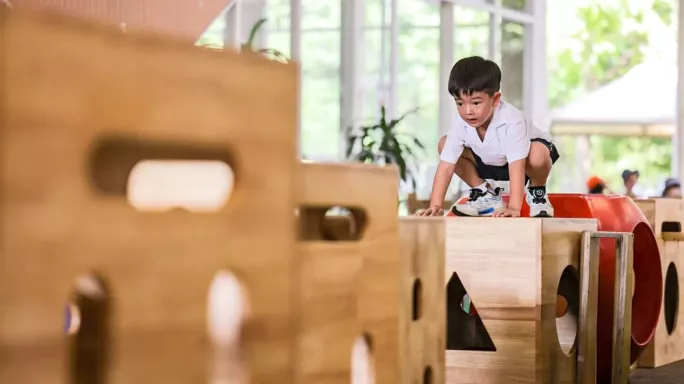
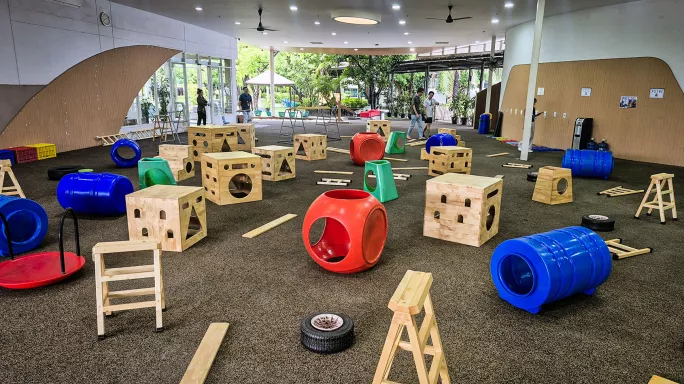
Wooden barrels, ladders, steps, crates, wheels, planks and cubes dominate the covered exterior play space for nursery children at Bangkok Patana School, a British and International Baccalaureate curriculum school in Thailand.
These big, robust pieces of play equipment, which have been gradually introduced over more than a year and a half, are turned into pirate ships and houses - or obstacle courses that can be clambered over - by the children who come here to learn and play.
For Sarah Gaughan, leader of learning in the foundation stage at the school, it is the culmination of years of research and careful planning.
But now she is delighting in seeing the school’s three- to five-year-olds being challenged both physically and mentally by the move to materials designed to stimulate both body and mind - especially post-pandemic.
Many of the early years children at Patana School will not remember the lockdowns initiated in a bid to slow down the spread of Covid-19. Nevertheless, some will have lived through them and the reduced opportunity for outings, mixing and social interaction that resulted.
They also live in a busy city, often in flats with no garden, and Gaughan says this - as well as longer-term changes in the wider community like an increased awareness of germs, more mask-wearing and hand-washing - has resulted in a notable change in behaviour.
Now, she says, many children are more comfortable with “safe play” and spending time indoors, rather than outside. There are still those who “dive in”, but a “big majority” are more cautious.
“We found children were very, very comfortable in the classroom doing fine motor skills development, but when it came to taking risks with big equipment and big play, we had to encourage them,” she explains.
Gaughan is not alone in commenting on this difference. Worries about the impact of the pandemic on children are widespread, even when it comes to those who could be thought of as too young to have been affected.
In England, for instance, the BICYCLE study (or the Born in Covid Year - Core Lockdown Effects study), led by researchers from City St George’s, University of London, is comparing talking and thinking skills in children born before, during and after lockdown amid concerns that those born when movement was restricted, in particular, might need extra support in school.
Gaughan believes, therefore, that for all children, but for this cohort in particular, promoting adventurous and risky open-ended play - where the objects they are given can be “a million different things” - is key.
It is, she argues, a great way to develop all the skills they will need to thrive in school and more generally.
She says: “When you look at upper primary, the key subjects are literacy, writing and maths, but the precursor to all these things is physical development, as well as communication, language and personal, social and emotional development.
“This kind of play gives them all these things at once. Not only are they really challenging themselves physically, but they are also collaborating with their friends and peers, moving the ladders around, placing other things on top, saying ‘I don’t want it there - let’s move it here’ or ‘Oh no, it’s going to fall down - let’s move it this way’.
“Children very rarely play on this equipment alone, so they’re collaborating and building relationships and also using imaginative thinking if they are building a rocket ship or - like last week - a home for monsters to hide in. So it supports all those prime areas of development.”
Gaughan took inspiration from Anji Play, the early years unguided play philosophy introduced in Anji, a county in China.
The approach was developed in a bid to move away from training children to sit quietly at desks, and instead allow them to experience “true play” - extended periods of self-directed, uninterrupted and unguided play - inspired by open-ended materials such as ladders, barrels, blocks, carts, mats and climbing cubes that can be used in many different ways.
Gaughan took some of these ideas - which she came across while completing a master’s in early years education - and modified them for her context.
“Some of the ladders in Anji Play are eight and 10 steps tall, which we aren’t quite ready for, so we modified them to make them still challenging but not too scary for our community.”
The introduction of the new equipment has been gradual, with pieces added over time.
“It hasn’t been a big reveal; it has been a little bit at a time to see how they go, then gradually building it up.”
Initially, Gaughan had a few prototypes made working with Messy Play Thailand, a local business that makes children’s toys and furniture.
These prototypes were given to the children in January 2024, then tweaks and adjustments were made: the sets of steps went from collapsible to non-collapsible to improve stability; ladders had grooves put in them so they could be clipped on to other pieces of equipment, like the large cubes, making them less likely to slide; and rubber feet were added to the equipment to prevent slipping.
“We made quite a lot of modifications, just making sure they were stable and as safe as they could be, and that we were happy with the way the children were using them.”
Now, more pieces have been put in the mix, and already the children are using them in ways that Gaughan had not foreseen - including balancing ladders between A-frames and walking along them.
“I expected them to crawl across, but suddenly they started to walk across. I haven’t stopped them from doing it because we want them to challenge themselves - that’s what we have done this for - but they have to know how to do it safely, and there has to be supervision close by.
“We’re trying to give the children risk but also to know how to manage that risk and avoid accidents.”
Gaughan says it has been striking to see how attuned children are to their own limits. Staff have observed that when a child senses that a climb or jump feels too challenging, they naturally pause and adjust their goal, or find an alternative route.
“This kind of risky play supports not only physical coordination but also emotional resilience and decision-making.”
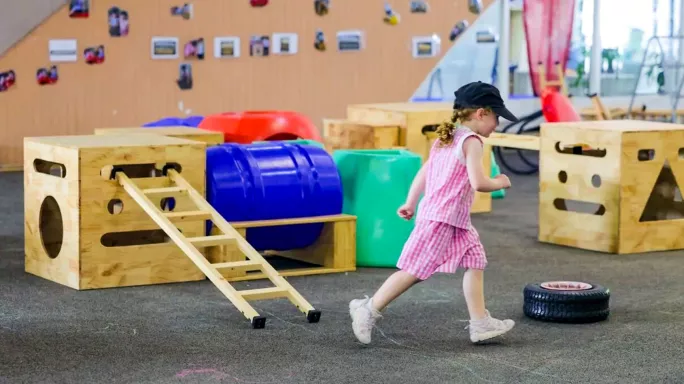
A key message for parents, therefore, has been about the importance of stepping back and allowing children to take ownership of their play.
Gaughan says it is natural for adults to want to offer a helping hand but that, when they do, children “lose the opportunity to feel and adjust to their own sense of balance and risk”.
She continues: “We share with parents that true confidence and coordination develop when children are trusted to try things independently. We highlight the value of giving children time and space to test their ideas, build physical control and learn how to manage risk safely.
“Our role as practitioners was to reassure parents that, while we do hold back to give children the opportunity to make their own decisions and develop self-regulation, we are always nearby and observing carefully.
“Over time, parents could see for themselves that when children are trusted in this way, they become more capable, careful and proud of their achievements.”
Now, Gaughan is looking forward to watching the children grow in confidence and really start to experiment.
Their responses to the new equipment have depended on their dispositions. Some have approached it with confidence and curiosity, climbing and experimenting straightaway, while others have preferred to stand back, observe their friends and join in once they feel ready.
But already, Gaughan says, there has been a marked increase in imaginative and collaborative play.
“Every day the children invent new narratives and purposes for the pieces, showing how open-ended materials spark creativity and deep engagement.”
And the anticipated positive impact on teamwork, problem-solving and communication skills - as well as children’s strength and physical ability - is also becoming apparent.
Over the coming weeks and months, Gaughan and her team will continue to watch the children as they develop and grow.
“Observing the learning that comes from it is really going to be beautiful to see,” she says.