


Recent
Most read


The majority of science teachers say their school lacks the capacity and resources to offer triple science GCSE to all students, a survey shows.
The curriculum and assessment review, published last week, recommends that the government should ensure that any student who wishes to study triple science, rather than combined science, can do so.
The Department for Education accepted this “entitlement”, saying in its response to the review: “We believe that all pupils who can benefit from studying triple science should have the opportunity to do so.”
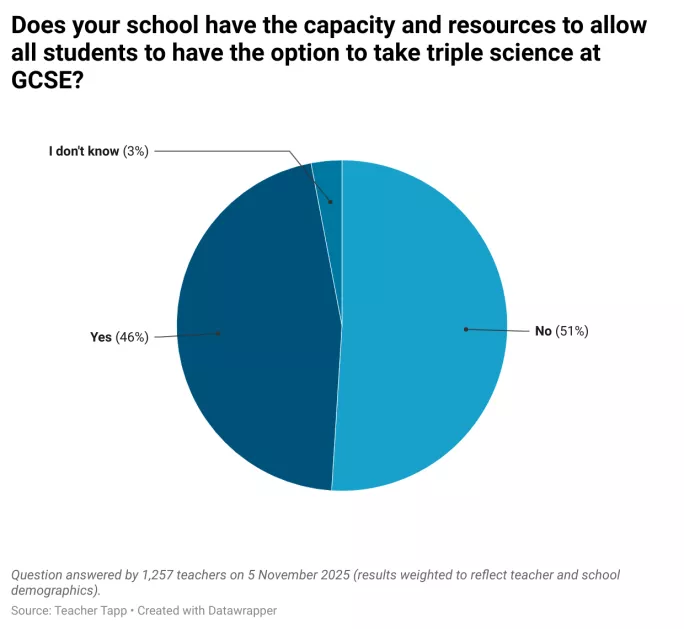
But today’s Teacher Tapp findings, shared with Tes, show that 51 per cent of science teachers said their school has neither the capacity nor resources to allow all students to have the option to take triple science at GCSE.
Some 46 per cent of those surveyed say their school has the capacity to offer the “entitlement”. And 3 per cent of the 1,257 teachers polled said they did not know.
After the government’s response to the curriculum review was published last week, experts and teachers warned that the move will put additional pressure on already stretched schools and teachers.
This pressure has been acknowledged by education secretary Bridgett Phillipson, who conceded last week that “there is more to do” to recruit and retain specialist science teachers.
Speaking to BBC Breakfast last Wednesday, Ms Phillipson said that the policy to offer all students triple science will need to be “implemented carefully”.
The curriculum and assessment review found that around 9 per cent of schools do not currently offer triple science.
The most recent DfE data from the 2024-25 academic year also shows that nearly half of GCSE physics lessons (44.7 per cent) were taught by a teacher lacking a relevant post-A-level qualification in the subject.
The figures were 28.2 per cent and 12.2 per cent for chemistry and biology, respectively. The picture has also worsened across all three subjects compared with four years ago.
Recruitment into physics and chemistry teaching has also remained poor. In the 2024-25 academic year, the government missed its physics initial teacher training recruitment target by 69 per cent.
The chemistry target was also missed by 38 per cent, while recruitment for biology was 19 per cent above the government’s target.
The National Foundation for Educational Research has forecasted that the recruitment of physics teachers for the 2025-26 academic year will only be 64 per cent of the government’s target.
Chemistry and biology recruitment, however, are predicted to be well above target, at 119 per cent and 156 per cent, respectively, according to the NFER.
Jack Worth, education workforce lead at the NFER, told Tes last week that expanding access to triple science was a “welcome ambition”. But added that “without urgent action to boost teacher supply, plans to increase triple science provision risk being unworkable in practice”.
You can now get the UK’s most-trusted source of education news in a mobile app. Get Tes magazine on iOS and on Android