


Recent
Most read


International school teachers moving schools often have the added challenge of getting to grips with a new country - how you can access a doctor, a dentist or set up a bank account - as well as adapting to a new workplace, new students and new colleagues.
For instance, in South Korea, the Alien Registration Card (ARC) is “the ticket to most parts of Korean life”, explains Katie Vis, teaching and learning director at Daegu International School.
And even though staff are supported to secure the ARC from the get-go, it might be a month before it materialises. In the interim they will struggle to do even basic things like booking a taxi or ordering groceries online.
It was to support new international teachers facing bureaucratic quirks like this - which are the kind of challenges that all teachers arriving at a new school in a new country experience - that Daegu International School began running a weekly “new hire ASA” [after-school activity].
The scheme, which is now three years old, means that in the first term of the school year - roughly 12 weeks in total - new staff meet with Vis every Tuesday, for about an hour, to discuss everything from school procedures and protocols to how to access medical care.
Through this extended onboarding programme, the school can drip feed information as opposed to overloading staff when they first arrive. It also gives new hires a regular opportunity to air any problems (including, of course, with securing the ARC).
Vis says: “Those in-service weeks when new hires come in, they’re just inundated with so much information. All the systems and procedures with the new school, and then also the reality of having relocated to an entirely new country. So over the years we have put together a little bit of a curriculum.”
On the day we speak Vis has just hosted the weekly new hire ASA; the topic up for discussion was healthcare.
“Every country has a different medical system and knowing the quirks is really important,” she explains.
“For instance, a lot of people in South Korea don’t have a general practitioner - they go to the hospital for just about everything. So understanding that is important. Or if you have kids where to go if you have a paediatric emergency.
“We also talked about dental care and how to submit claims to our insurance provider. Just very practical things you need to know.”
As well as including sessions about living in South Korea, the programme also covers things like how the school runs its parent-teacher conferences and how to use its online portal for managing student data, including information like attendance and grades.
Vis says this will likely have already been covered when teachers first arrived but at this time there is inevitably an onslaught of information that can leave new teachers “experiencing cognitive overload”.
Returning to this in the 12-week programme is another opportunity “to unpack” practical information at a time when new teachers are starting to explore and engage with these systems.
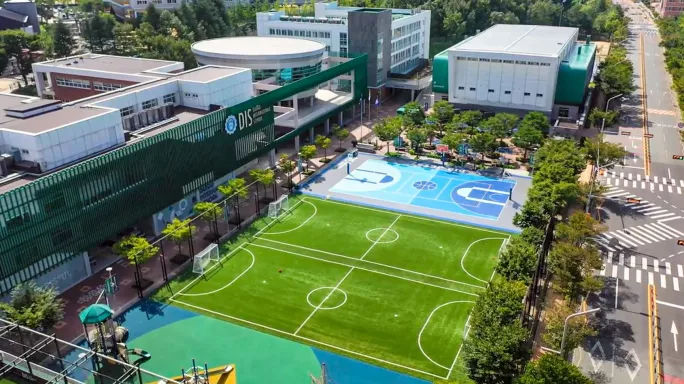
Daegu International School
One ASA session flagged as being among the most valuable, both by Vis and two of this year’s new teachers, focuses on all the major school events that will take place during the course of the year.
Prom, graduation, the school’s Winter Fine Arts Festival - the session covers when these events are held, if attendance is mandatory or not, and what the teacher’s role will be.
Vis says the goal is to prevent key events being sprung on new staff with little or no warning.
“This just allows them to prepare mentally instead of these things being spur of the moment because an email has landed in their inbox saying, ‘It’s the Stem fair next week, please sign up,’” she says.
“If you’re a new teacher you can often just be catching those things on the fly. Instead we give them the long view of what the school year looks like.”
While Vis has topics that she wants to cover in these sessions, there is flexibility in terms of the agenda that the meetings run to. She says that, in many ways, this is their greatest strength, providing new teachers with “a low-stakes way of asking questions”.
“We know questions are going to pop up and instead of having people feel like they have to seek out answers, they have this meeting they can count on where they can bring up whatever is on their mind and we can just unpack that,” Vis says.
Another key benefit of the programme is that participants “become really close” and start to “lean on each other”, she says - which is exactly what Gabriela Marchan, a chemistry teacher who joined the school this year, says she likes about the sessions.
In terms of the sessions the new starters have received to date, Marchan found the overview of the school year among the most useful, but she says it is “the community of support” that the regular meetings create that she has come to value the most.
“I could be honest with Katie and say, ‘I’m overwhelmed,’ and we would try to find a way to make things better,” she says. “It’s been great really. I was able to share some insight with the new-to-Korea staff as well, especially as a woman of colour. That is information that would not otherwise be easily attained.”
Madison Nunes, meanwhile, is also a new arrival at the school. She moved from China to take up her post as an English as an additional language teacher in July.
Nunes is a seasoned traveller, having been working overseas since 2020 in locations including India and West Africa.
However, she still welcomed the “life-focused” sessions on medical care, as well as “school-focused” sessions on things like reporting on pupil progress and grading.
Nunes says other international schools could learn from Daegu International School - which has around 360 pupils from kindergarten to grade 12 and over 40 faculty members - and set aside dedicated time when new teachers can ask questions.
Of course, this is just one part of the school’s system for supporting new staff, with other elements including setting up buddy systems, securing apartments and even picking up new starters from the airport.
For Vis, doing this and then following up with regular touch points and information-sharing sessions is key to ensuring that teachers feel settled so they can “do their best work at school”.
She adds: “We talk about Maslow’s hierarchy of needs when it comes to students - it’s the same with faculty members. We really need to be sure we’re meeting the needs of our faculty members in other ways before we can ask them to be their best selves at work and for our students.”
For essential weekly intelligence on the international schools sector, sign up for the Tes International newsletter