


Recent
Most read


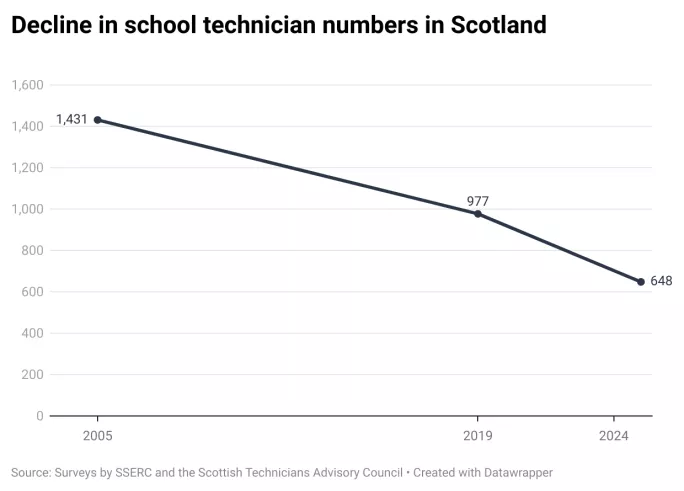
Scotland’s workforce is facing a critical capacity crisis. New national survey data - part of a long-term collaboration between science, technology, engineering and maths (Stem) education body SSERC and the Scottish Technicians’ Advisory Council (STAC) - shows technician numbers in secondary schools have fallen by more than half in two decades, from 1,431 in 2005 to 648 today.
As a result, the technician-to-student ratio has more than halved, drastically reducing support for Stem and ICT education. Despite their essential role, technicians face rising workloads, limited development opportunities and uncertain career pathways.
Without targeted investment, Scotland risks undermining the practical foundations of Stem learning and diminishing the quality and safety of classroom experiences for future generations.
Technicians are the unseen enablers of practical learning in Scotland’s secondary schools. Yet the latest national survey reveals a workforce in steep decline: total numbers have dropped by 55 per cent since 2005.
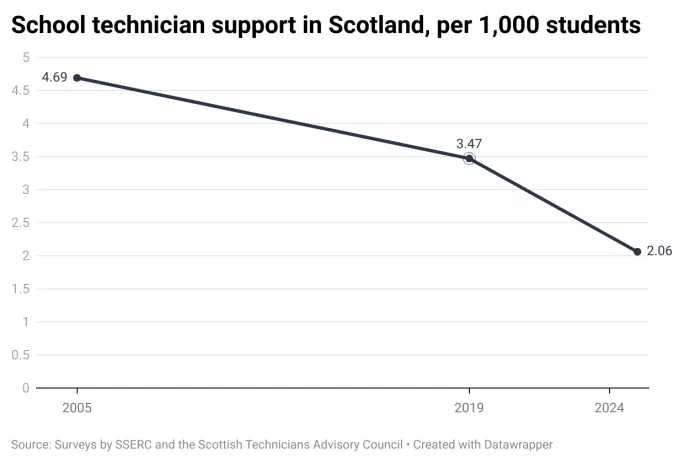
With student numbers stable, the technician-to-student ratio has worsened from one per 213 students to one per 486.
This contraction has profound implications. Many schools now operate with only one or two technicians covering multiple departments. In some smaller or rural schools, provision is part-time or shared.
As one respondent put it: “I’m the sole technician now and there is no cover if I’m off - I’m expected to do everything from science prep to ICT.”
The SSERC-STAC surveys, conducted in 2005, 2019 and 2025, provide the clearest picture yet of the technician workforce. The latest survey, with an 85 per cent response rate, shows continued erosion since 2019, when 977 technicians were recorded.
The number of senior technicians has remained steady at around 160, but the sharp fall in total staff has left schools with significantly reduced technical support.
The total number of school technicians in Scotland’s secondary schools has more than halved over the past 20 years, falling from 1,431 in 2005 to just 648 in 2025. Despite relatively stable student numbers, the technician workforce has steadily contracted - leaving schools with significantly reduced technical support capacity.
Technicians are vital to practical education, ensuring experiments are prepared, equipment is maintained and safety standards are met. As numbers fall, teachers report delays in preparation and rising maintenance backlogs.
Practical lessons are increasingly simplified or reduced to match available support. One technician described current conditions as “firefighting - not developing or innovating”.
Schools value technician training highly, rating it 4.5 out of 5 in importance. However, barriers persist: funding shortfalls, limited time for release and inaccessible training opportunities. Only a small number of schools employ Modern Apprentices, highlighting the fragility of the workforce pipeline. With many technicians nearing retirement, succession planning is now urgent.
The availability of technicians relative to student numbers has declined sharply. In 2005, schools had around 4.7 technicians for every 1,000 students. By 2025, that figure had dropped to just over two per 1,000 - meaning each technician now supports more than twice as many students as they did two decades ago.
The 2025 survey results arrive at a crucial moment. As Scotland seeks to strengthen Stem education and digital skills, the infrastructure needed to deliver those ambitions is eroding. Technicians remain undervalued and often invisible - described by one respondent as “essential but invisible”.
Professional bodies have long advocated for change, including the ring-fencing of funding for technician posts, coordinated national training and structured career pathways. Without intervention, workload pressures will continue to grow, and the quality of practical learning will deteriorate further.
Twenty years of decline cannot be reversed overnight, but the 2025 data provides a vital evidence base for action. The strong survey response reflects a workforce eager to be heard. Their message is clear: technicians are fundamental to delivering Scotland’s educational ambitions.
Sustaining and rebuilding this workforce will require investment, recognition and a shift in how policymakers and school leaders view technical expertise.
As one technician summed it up: “We’re the people who make practical learning possible. Without us, the hands-on side of education simply can’t happen.”
Alastair MacGregor is chief executive of SSERC, a body that supports Stem educators in Scotland
For the latest in Scottish education delivered directly to your inbox, sign up for Tes’ The Week in Scotland newsletter