MYP Maths 4–5 Complete Course Bundle – 10 units with assessmentsQuick View
Lorelei131

MYP Maths 4–5 Complete Course Bundle – 10 units with assessments

10 Resources
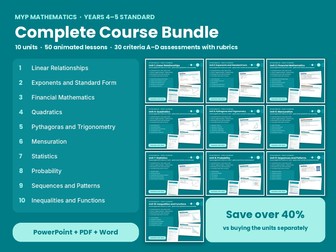
Complete MYP maths course for years 4–5 (standard): 10 units, 50 animated lessons, levelled worksheets and 30 criteria A–D assessments with rubrics. Everything you need to teach two years of MYP mathematics at standard level, from linear relationships to inequalities and functions. Each unit is built around a key concept, a global context and a statement of inquiry, and is assessed against all four MYP criteria. The ten units • Unit 1: Linear Relationships – Equations, gradient, parallel and perpendicular lines, simultaneous equations, linear models • Unit 2: Exponents and Standard Form – Laws of exponents, zero and negative exponents, standard form, estimation and error • Unit 3: Financial Mathematics – Percentages, percentage change, reverse percentages, simple and compound interest, depreciation • Unit 4: Quadratics – Expanding, factorising, solving quadratics, the quadratic formula, quadratic graphs • Unit 5: Pythagoras and Trigonometry – Pythagoras, sine, cosine and tangent, angles of elevation, bearings • Unit 6: Mensuration – Area, arcs and sectors, surface area and volume of prisms, cylinders, pyramids, cones and spheres • Unit 7: Statistics – Sampling, averages and spread, grouped data, box plots, cumulative frequency, scatter graphs • Unit 8: Probability – Theoretical and experimental probability, Venn diagrams, tree diagrams, expected frequency • Unit 9: Sequences and Patterns – Arithmetic and geometric sequences, nth term, sequences in context • Unit 10: Inequalities and Functions – Linear inequalities, regions, function notation, domain and range, transformations In every unit • 5 animated PowerPoint lessons with PDF copies, inquiry questions and criterion-tagged examples • Worksheets in three level bands, with full answers • A Criterion A test with markscheme, an investigation (B, C) and a real-life task (D, C), with 0–8 rubrics and model solutions • A teacher guide with the unit planner, lesson plans and grade boundaries Bought separately the units cost £65.00; the bundle saves over 40%. Last updated: 31 October 2026 (first version). Independent resource, not endorsed by the IBO.
MYP Maths 4–5 Probability – Unit 8: Venn and tree diagrams, expected value, criteria A–D tasksQuick View
Lorelei131

MYP Maths 4–5 Probability – Unit 8: Venn and tree diagrams, expected value, criteria A–D tasks

(0)
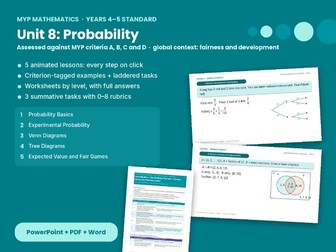
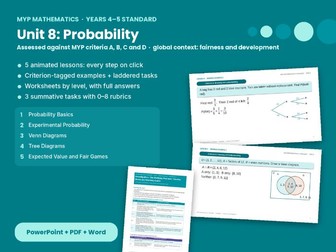
MYP maths unit on probability for years 4–5 (standard): 5 animated lessons, worksheets and 3 criteria A–D assessments with rubrics. Students find theoretical and experimental probabilities, use sample spaces, Venn diagrams and tree diagrams for combined events, and use expected value to judge whether games and decisions are fair. The unit is framed by the global context of fairness and development. What’s included • 5 animated PowerPoint lessons (65 slides, plus PDF copies): Probability Basics; Experimental Probability; Venn Diagrams; Tree Diagrams; Expected Value and Fair Games • Each lesson: inquiry question, starter, key ideas, 4 criterion-tagged worked examples, a practice task from levels 1–2 to 7–8 with a model answer, exit ticket and reflection • 5 worksheets (Word + PDF) in three level bands, with full answers • Task 1: Criterion A test (50 minutes, 34 marks) with markscheme and marks-to-level conversion • Task 2: The Birthday Problem investigation (Criteria B and C), finding why 23 people are enough • Task 3: Is the Game Fair? real-life task (Criteria D and C), designing charity fair games with expected value • Teacher guide: unit planner (key and related concepts, statement of inquiry, inquiry questions), lesson plans, misconceptions and grade boundaries Why teachers use it Each click reveals the next line of working, so students predict before you show them. Tasks come with student rubrics, checklists, model solutions and moderation notes, and everything is editable. Part of a full course This is Unit 8 of 10. Previous unit: MYP Maths 4–5 Statistics – Unit 7 lessons and assessment Next unit: MYP Maths 4–5 Sequences and Patterns – Unit 9 with assessment. Save over 40% with the MYP Maths 4–5 Complete Course Bundle – 10 units with assessments. Last updated: 31 October 2026 (first version). Written for the current MYP mathematics guide (first assessment 2022). Independent resource, not endorsed by the IBO.
MYP Maths 4–5 Sequences and Patterns – Unit 9: arithmetic, geometric, quadratic, criteria A–D tasksQuick View
Lorelei131

MYP Maths 4–5 Sequences and Patterns – Unit 9: arithmetic, geometric, quadratic, criteria A–D tasks

(0)
MYP maths unit on sequences and patterns for years 4–5 (standard): 5 animated lessons, worksheets and 3 criteria A–D assessments with rubrics. Students describe sequences with term-to-term and position-to-term rules, find and use the nth term of arithmetic, geometric and simple quadratic sequences, and use sequences as models of growth. The unit is framed by the global context of scientific and technical innovation. What’s included • 5 animated PowerPoint lessons (65 slides, plus PDF copies): Sequences and Rules; Arithmetic Sequences; Geometric Sequences; Quadratic Sequences; Sequences as Models • Each lesson: inquiry question, starter, key ideas, 4 criterion-tagged worked examples, a practice task from levels 1–2 to 7–8 with a model answer, exit ticket and reflection • 5 worksheets (Word + PDF) in three level bands, with full answers • Task 1: Criterion A test (50 minutes, 34 marks) with markscheme and marks-to-level conversion • Task 2: Leapfrog investigation (Criteria B and C), finding and proving the rule for the frogs puzzle • Task 3: Going Viral real-life task (Criteria D and C), choosing between linear and exponential growth models for an app • Teacher guide: unit planner (key and related concepts, statement of inquiry, inquiry questions), lesson plans, misconceptions and grade boundaries Why teachers use it Each click reveals the next line of working, so students predict before you show them. Tasks come with student rubrics, checklists, model solutions and moderation notes, and everything is editable. Part of a full course This is Unit 9 of 10. Previous unit: MYP Maths 4–5 Probability – Unit 8 lessons and assessment Next unit: MYP Maths 4–5 Inequalities & Functions – Unit 10 with assessment. Save over 40% with the MYP Maths 4–5 Complete Course Bundle – 10 units with assessments. Last updated: 31 October 2026 (first version). Written for the current MYP mathematics guide (first assessment 2022). Independent resource, not endorsed by the IBO.
MYP Maths 4–5 Inequalities & Functions – Unit 10: regions, functions, linear programming, A–D tasksQuick View
Lorelei131

MYP Maths 4–5 Inequalities & Functions – Unit 10: regions, functions, linear programming, A–D tasks

(0)
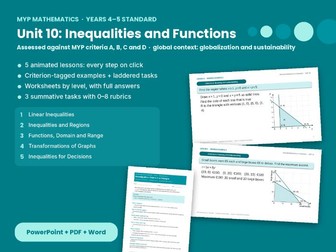
MYP maths unit on inequalities and functions for years 4–5 (standard): 5 animated lessons, worksheets and 3 criteria A–D assessments with rubrics. Students solve linear inequalities, represent inequalities as regions, use function notation with domain and range, transform graphs, and use feasible regions to make decisions with limited resources. The unit is framed by the global context of globalization and sustainability. What’s included • 5 animated PowerPoint lessons (65 slides, plus PDF copies): Linear Inequalities; Inequalities and Regions; Functions, Domain and Range; Transformations of Graphs; Inequalities for Decisions • Each lesson: inquiry question, starter, key ideas, 4 criterion-tagged worked examples, a practice task from levels 1–2 to 7–8 with a model answer, exit ticket and reflection • 5 worksheets (Word + PDF) in three level bands, with full answers • Task 1: Criterion A test (50 minutes, 34 marks) with markscheme and marks-to-level conversion • Task 2: Points in a Triangle investigation (Criteria B and C), counting and proving the number of integer points in a region • Task 3: The School Fundraiser real-life task (Criteria D and C), using linear programming to plan a bake sale • Teacher guide: unit planner (key and related concepts, statement of inquiry, inquiry questions), lesson plans, misconceptions and grade boundaries Why teachers use it Each click reveals the next line of working, so students predict before you show them. Tasks come with student rubrics, checklists, model solutions and moderation notes, and everything is editable. Part of a full course This is Unit 10 of 10. Previous unit: MYP Maths 4–5 Sequences and Patterns – Unit 9 with assessment. Save over 40% with the MYP Maths 4–5 Complete Course Bundle – 10 units with assessments. Last updated: 31 October 2026 (first version). Written for the current MYP mathematics guide (first assessment 2022). Independent resource, not endorsed by the IBO.
MYP Maths 4–5 Exponents & Standard Form – Unit 2: 5 lessons, criteria A–D tasks and rubricsQuick View
Lorelei131

MYP Maths 4–5 Exponents & Standard Form – Unit 2: 5 lessons, criteria A–D tasks and rubrics

(0)
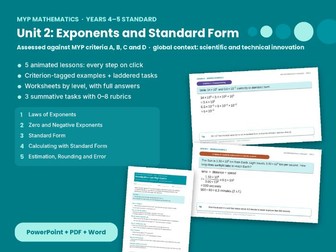
MYP maths unit on exponents and standard form for years 4–5 (standard): 5 animated lessons, worksheets and 3 criteria A–D assessments with rubrics. Students learn the laws of exponents, give meaning to zero and negative exponents, write and calculate with numbers in standard form, and decide how accurate an answer should be using significant figures, estimation, percentage error and bounds. The unit is framed by the global context of scientific and technical innovation. What’s included • 5 animated PowerPoint lessons (65 slides, plus PDF copies): Laws of Exponents; Zero and Negative Exponents; Standard Form; Calculating with Standard Form; Estimation, Rounding and Error • Each lesson: inquiry question, starter, key ideas, 4 criterion-tagged worked examples, a practice task from levels 1–2 to 7–8 with a model answer, exit ticket and reflection • 5 worksheets (Word + PDF) in three level bands, with full answers • Task 1: Criterion A test (50 minutes, 39 marks) with markscheme and marks-to-level conversion • Task 2: Last Digit Cycles investigation (Criteria B and C), finding and justifying rules for the last digits of powers • Task 3: A Model Solar System real-life task (Criteria D and C), designing a scale model with standard form • Teacher guide: unit planner (key and related concepts, statement of inquiry, inquiry questions), lesson plans, misconceptions and grade boundaries Why teachers use it Each click reveals the next line of working, so students predict before you show them. Tasks come with student rubrics, checklists, model solutions and moderation notes, and everything is editable. Part of a full course This is Unit 2 of 10. Previous unit: MYP Maths 4–5 Linear Relationships – Unit 1 with assessment Next unit: MYP Maths 4–5 Financial Mathematics – Unit 3 with assessment. Save over 40% with the MYP Maths 4–5 Complete Course Bundle – 10 units with assessments. Last updated: 31 October 2026 (first version). Written for the current MYP mathematics guide (first assessment 2022). Independent resource, not endorsed by the IBO.
MYP Maths 4–5 Linear Relationships – Unit 1: 5 lessons, criteria A–D tasks and rubricsQuick View
Lorelei131

MYP Maths 4–5 Linear Relationships – Unit 1: 5 lessons, criteria A–D tasks and rubrics

(0)
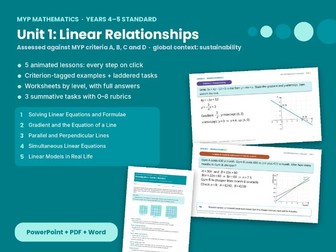
MYP maths unit on linear relationships for years 4–5 (standard): 5 animated lessons, worksheets and 3 criteria A–D assessments with rubrics. Students solve linear equations and rearrange formulae, work with gradients and equations of lines, use parallel and perpendicular lines, solve simultaneous equations, and build and evaluate linear models. The unit is framed by the global context of globalization and sustainability. What’s included • 5 animated PowerPoint lessons (65 slides, plus PDF copies): Solving Linear Equations and Formulae; Gradient and the Equation of a Line; Parallel and Perpendicular Lines; Simultaneous Linear Equations; Linear Models in Real Life • Each lesson: inquiry question, starter, key ideas, 4 criterion-tagged worked examples, a practice task from levels 1–2 to 7–8 with a model answer, exit ticket and reflection • 5 worksheets (Word + PDF) in three level bands, with full answers • Task 1: Criterion A test (50 minutes, 43 marks) with markscheme and marks-to-level conversion • Task 2: Garden Borders investigation (Criteria B and C), finding and justifying a rule for border tiles • Task 3: Going Solar real-life task (Criteria D and C), comparing solar panels with grid electricity • Teacher guide: unit planner (key and related concepts, statement of inquiry, inquiry questions), lesson plans, misconceptions and grade boundaries Why teachers use it Each click reveals the next line of working, so students predict before you show them. Tasks come with student rubrics, checklists, model solutions and moderation notes, and everything is editable. Part of a full course This is Unit 1 of 10. Next unit: MYP Maths 4–5 Exponents & Standard Form – Unit 2 with assessment. Save over 40% with the MYP Maths 4–5 Complete Course Bundle – 10 units with assessments. Last updated: 31 October 2026 (first version). Written for the current MYP mathematics guide (first assessment 2022). Independent resource, not endorsed by the IBO.
MYP Maths 4–5 Financial Mathematics – Unit 3: 5 lessons, criteria A–D tasks and rubricsQuick View
Lorelei131

MYP Maths 4–5 Financial Mathematics – Unit 3: 5 lessons, criteria A–D tasks and rubrics

(0)
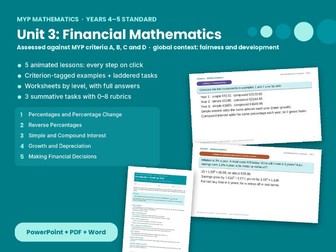
MYP maths unit on financial mathematics for years 4–5 (standard): 5 animated lessons, worksheets and 3 criteria A–D assessments with rubrics. Students use multipliers for percentage change, work backwards with reverse percentages, compare simple and compound interest, model growth and depreciation, and make decisions using unit prices, exchange rates, credit and inflation. The unit is framed by the global context of fairness and development. What’s included • 5 animated PowerPoint lessons (65 slides, plus PDF copies): Percentages and Percentage Change; Reverse Percentages; Simple and Compound Interest; Growth and Depreciation; Making Financial Decisions • Each lesson: inquiry question, starter, key ideas, 4 criterion-tagged worked examples, a practice task from levels 1–2 to 7–8 with a model answer, exit ticket and reflection • 5 worksheets (Word + PDF) in three level bands, with full answers • Task 1: Criterion A test (50 minutes, 37 marks) with markscheme and marks-to-level conversion • Task 2: Doubling Time investigation (Criteria B and C), discovering and testing the rule of 72 • Task 3: Saving for the Future real-life task (Criteria D and C), comparing three savings accounts and inflation • Teacher guide: unit planner (key and related concepts, statement of inquiry, inquiry questions), lesson plans, misconceptions and grade boundaries Why teachers use it Each click reveals the next line of working, so students predict before you show them. Tasks come with student rubrics, checklists, model solutions and moderation notes, and everything is editable. Part of a full course This is Unit 3 of 10. Previous unit: MYP Maths 4–5 Exponents & Standard Form – Unit 2 with assessment Next unit: MYP Maths 4–5 Quadratics – Unit 4 lessons and assessment. Save over 40% with the MYP Maths 4–5 Complete Course Bundle – 10 units with assessments. Last updated: 31 October 2026 (first version). Written for the current MYP mathematics guide (first assessment 2022). Independent resource, not endorsed by the IBO.
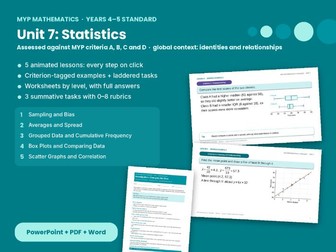
MYP Maths 4–5 Statistics – Unit 7: sampling, averages, box plots, scatter graphs, criteria A–D tasksQuick View
Lorelei131

MYP Maths 4–5 Statistics – Unit 7: sampling, averages, box plots, scatter graphs, criteria A–D tasks

(0)
MYP maths unit on statistics for years 4–5 (standard): 5 animated lessons, worksheets and 3 criteria A–D assessments with rubrics. Students plan fair samples, summarise data with averages and measures of spread, work with grouped data and cumulative frequency, compare distributions with box plots and investigate relationships with scatter graphs. The unit is framed by the global context of identities and relationships. What’s included • 5 animated PowerPoint lessons (65 slides, plus PDF copies): Sampling and Bias; Averages and Spread; Grouped Data and Cumulative Frequency; Box Plots and Comparing Data; Scatter Graphs and Correlation • Each lesson: inquiry question, starter, key ideas, 4 criterion-tagged worked examples, a practice task from levels 1–2 to 7–8 with a model answer, exit ticket and reflection • 5 worksheets (Word + PDF) in three level bands, with full answers • Task 1: Criterion A test (50 minutes, 34 marks) with markscheme and marks-to-level conversion • Task 2: Changing the Data investigation (Criteria B and C), proving how averages and spread change when data are transformed • Task 3: Screen Time and Sleep real-life task (Criteria D and C), using box plots and scatter graphs to investigate a health question • Teacher guide: unit planner (key and related concepts, statement of inquiry, inquiry questions), lesson plans, misconceptions and grade boundaries Why teachers use it Each click reveals the next line of working, so students predict before you show them. Tasks come with student rubrics, checklists, model solutions and moderation notes, and everything is editable. Part of a full course This is Unit 7 of 10. Previous unit: MYP Maths 4–5 Mensuration – Unit 6 lessons and assessment Next unit: MYP Maths 4–5 Probability – Unit 8 lessons and assessment. Save over 40% with the MYP Maths 4–5 Complete Course Bundle – 10 units with assessments. Last updated: 31 October 2026 (first version). Written for the current MYP mathematics guide (first assessment 2022). Independent resource, not endorsed by the IBO.
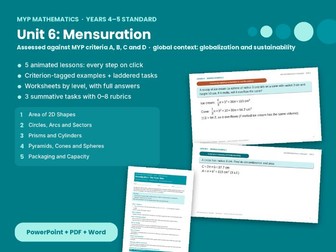
MYP Maths 4–5 Mensuration – Unit 6: area, volume, surface area, criteria A–D tasks and rubricsQuick View
Lorelei131

MYP Maths 4–5 Mensuration – Unit 6: area, volume, surface area, criteria A–D tasks and rubrics

(0)
MYP maths unit on mensuration for years 4–5 (standard): 5 animated lessons, worksheets and 3 criteria A–D assessments with rubrics. Students find areas of 2D shapes, circles, arcs and sectors, the volume and surface area of prisms, cylinders, pyramids, cones and spheres, and use these to compare and design efficient packaging. The unit is framed by the global context of globalization and sustainability. What’s included • 5 animated PowerPoint lessons (65 slides, plus PDF copies): Area of 2D Shapes; Circles, Arcs and Sectors; Prisms and Cylinders; Pyramids, Cones and Spheres; Packaging and Capacity • Each lesson: inquiry question, starter, key ideas, 4 criterion-tagged worked examples, a practice task from levels 1–2 to 7–8 with a model answer, exit ticket and reflection • 5 worksheets (Word + PDF) in three level bands, with full answers • Task 1: Criterion A test (50 minutes, 34 marks) with markscheme and marks-to-level conversion • Task 2: The Open Box investigation (Criteria B and C), finding the cut that gives the largest volume • Task 3: Less Packaging real-life task (Criteria D and C), designing a drinks can that uses less aluminium • Teacher guide: unit planner (key and related concepts, statement of inquiry, inquiry questions), lesson plans, misconceptions and grade boundaries Why teachers use it Each click reveals the next line of working, so students predict before you show them. Tasks come with student rubrics, checklists, model solutions and moderation notes, and everything is editable. Part of a full course This is Unit 6 of 10. Previous unit: MYP Maths 4–5 Pythagoras & Trigonometry – Unit 5 with assessment Next unit: MYP Maths 4–5 Statistics – Unit 7 lessons and assessment. Save over 40% with the MYP Maths 4–5 Complete Course Bundle – 10 units with assessments. Last updated: 31 October 2026 (first version). Written for the current MYP mathematics guide (first assessment 2022). Independent resource, not endorsed by the IBO.
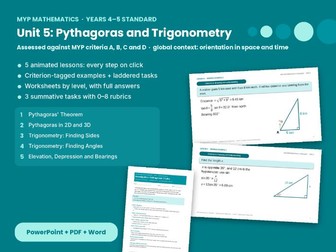
MYP Maths 4–5 Pythagoras & Trigonometry – Unit 5: 5 lessons, criteria A–D tasks and rubricsQuick View
Lorelei131

MYP Maths 4–5 Pythagoras & Trigonometry – Unit 5: 5 lessons, criteria A–D tasks and rubrics

(0)
MYP maths unit on Pythagoras and trigonometry for years 4–5 (standard): 5 animated lessons, worksheets and 3 criteria A–D assessments with rubrics. Students use Pythagoras’ theorem and its converse in two and three dimensions, find sides and angles with sine, cosine and tangent, and solve problems with angles of elevation and depression and bearings. The unit is framed by the global context of orientation in space and time. What’s included • 5 animated PowerPoint lessons (65 slides, plus PDF copies): Pythagoras’ Theorem; Pythagoras in 2D and 3D; Trigonometry: Finding Sides; Trigonometry: Finding Angles; Elevation, Depression and Bearings • Each lesson: inquiry question, starter, key ideas, 4 criterion-tagged worked examples, a practice task from levels 1–2 to 7–8 with a model answer, exit ticket and reflection • 5 worksheets (Word + PDF) in three level bands, with full answers • Task 1: Criterion A test (50 minutes, 37 marks) with markscheme and marks-to-level conversion • Task 2: Pythagorean Triples investigation (Criteria B and C), finding and proving rules that generate triples • Task 3: How Tall Is It? real-life task (Criteria D and C), measuring a building with trigonometry and judging accuracy • Teacher guide: unit planner (key and related concepts, statement of inquiry, inquiry questions), lesson plans, misconceptions and grade boundaries Why teachers use it Each click reveals the next line of working, so students predict before you show them. Tasks come with student rubrics, checklists, model solutions and moderation notes, and everything is editable. Part of a full course This is Unit 5 of 10. Previous unit: MYP Maths 4–5 Quadratics – Unit 4 lessons and assessment Next unit: MYP Maths 4–5 Mensuration – Unit 6 lessons and assessment. Save over 40% with the MYP Maths 4–5 Complete Course Bundle – 10 units with assessments. Last updated: 31 October 2026 (first version). Written for the current MYP mathematics guide (first assessment 2022). Independent resource, not endorsed by the IBO.
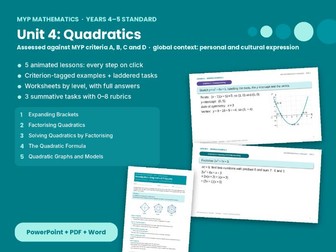
MYP Maths 4–5 Quadratics – Unit 4: expanding, factorising, formula, graphs, criteria A–D tasksQuick View
Lorelei131

MYP Maths 4–5 Quadratics – Unit 4: expanding, factorising, formula, graphs, criteria A–D tasks

(0)
MYP maths unit on quadratics for years 4–5 (standard): 5 animated lessons, worksheets and 3 criteria A–D assessments with rubrics. Students expand and factorise quadratic expressions, solve quadratic equations by factorising and by the quadratic formula, and sketch and use quadratic graphs as models of fountains, arches and projectiles. The unit is framed by the global context of personal and cultural expression. What’s included • 5 animated PowerPoint lessons (65 slides, plus PDF copies): Expanding Brackets; Factorising Quadratics; Solving Quadratics by Factorising; The Quadratic Formula; Quadratic Graphs and Models • Each lesson: inquiry question, starter, key ideas, 4 criterion-tagged worked examples, a practice task from levels 1–2 to 7–8 with a model answer, exit ticket and reflection • 5 worksheets (Word + PDF) in three level bands, with full answers • Task 1: Criterion A test (50 minutes, 37 marks) with markscheme and marks-to-level conversion • Task 2: Diagonals of Polygons investigation (Criteria B and C), finding and proving a quadratic rule • Task 3: The Gateway Arch real-life task (Criteria D and C), testing a parabolic arch design with real vehicles • Teacher guide: unit planner (key and related concepts, statement of inquiry, inquiry questions), lesson plans, misconceptions and grade boundaries Why teachers use it Each click reveals the next line of working, so students predict before you show them. Tasks come with student rubrics, checklists, model solutions and moderation notes, and everything is editable. Part of a full course This is Unit 4 of 10. Previous unit: MYP Maths 4–5 Financial Mathematics – Unit 3 with assessment Next unit: MYP Maths 4–5 Pythagoras & Trigonometry – Unit 5 with assessment. Save over 40% with the MYP Maths 4–5 Complete Course Bundle – 10 units with assessments. Last updated: 31 October 2026 (first version). Written for the current MYP mathematics guide (first assessment 2022). Independent resource, not endorsed by the IBO.
IB Maths AI HL Logs and Infinite Series – HL Unit 1: log laws, sums to infinity, log scales, IB testQuick View
Lorelei131

IB Maths AI HL Logs and Infinite Series – HL Unit 1: log laws, sums to infinity, log scales, IB test

(0)
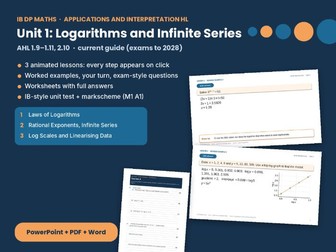
A complete, ready-to-teach unit of additional higher level content for IB DP Mathematics: Applications and Interpretation HL, Topic 1 and 2 (AHL 1.9–1.11, 2.10). Three animated lessons: the unit covers the laws of logarithms and change of base, rational exponents and the sum to infinity of a geometric series, and logarithmic scales with the linearisation of exponential and power data. An IB-style unit test then checks what students have learned. Animated slides that teach step by step Every question appears first. Each click fades in the next line of working or the next answer, so you can ask students to predict the next step before you reveal it. A PDF copy of each deck shows every answer: ideal for cover lessons, revision and absent students. What’s included • 3 lessons (39 slides): Laws of Logarithms; Rational Exponents and Infinite Geometric Series; Logarithmic Scales and Linearising Data • Each lesson: starter, key ideas (formula booklet references), 4 worked examples with GDC steps, ‘your turn’ questions, an exam-style question with an IB-style markscheme, an exit ticket and a summary • Speaker notes on every slide with a short script and all the answers • 3 worksheets (Word + PDF): fluency, problem solving and exam-style questions, with full answers • Unit test (60 minutes, 50 marks): Section A short response (Paper 1 style) and Section B extended response (Paper 2 style), GDC throughout, editable in Word • Full markscheme in IB notation (M1, A1, R1, AG) with indicative grade boundaries • Teacher guide: lesson plans with timings, syllabus map, subject knowledge, common misconceptions, support and stretch ideas, and the full AI HL course plan Exam-ready Questions are labelled Paper 1 style (short response) or Paper 2 style (extended response), with a GDC allowed throughout as in every AI exam. Linearising examples use real data and GDC regression on logged lists, exactly as Paper 2 expects. All questions are original and every answer has been checked. Written to the current AI guide (first assessment 2021, final exams November 2028). This is HL Unit 1 of 11 HL units; the shared SL/HL core is in the AI SL Units 1–12. Independent resource: not produced or endorsed by the International Baccalaureate Organization.
IB Maths AI HL Complex Numbers – HL Unit 2: Cartesian, polar and Euler forms, phasors, IB testQuick View
Lorelei131

IB Maths AI HL Complex Numbers – HL Unit 2: Cartesian, polar and Euler forms, phasors, IB test

(0)
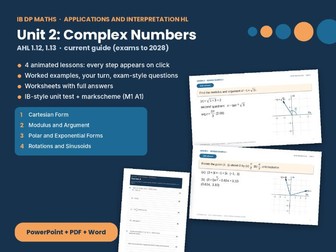
A complete, ready-to-teach unit of additional higher level content for IB DP Mathematics: Applications and Interpretation HL, Topic 1 (AHL 1.12, 1.13). Four animated lessons: the unit covers Cartesian form and complex roots of quadratics, the complex plane with modulus and argument, polar and exponential forms, and applications: rotations and adding sinusoids with phasors. An IB-style unit test then checks what students have learned. Animated slides that teach step by step Every question appears first. Each click fades in the next line of working or the next answer, so you can ask students to predict the next step before you reveal it. A PDF copy of each deck shows every answer: ideal for cover lessons, revision and absent students. What’s included • 4 lessons (52 slides): Complex Numbers in Cartesian Form; The Complex Plane, Modulus and Argument; Polar and Exponential Forms; Rotations and Adding Sinusoids • Each lesson: starter, key ideas (formula booklet references), 4 worked examples with GDC steps, ‘your turn’ questions, an exam-style question with an IB-style markscheme, an exit ticket and a summary • Speaker notes on every slide with a short script and all the answers • 4 worksheets (Word + PDF): fluency, problem solving and exam-style questions, with full answers • Unit test (60 minutes, 50 marks): Section A short response (Paper 1 style) and Section B extended response (Paper 2 style), GDC throughout, editable in Word • Full markscheme in IB notation (M1, A1, R1, AG) with indicative grade boundaries • Teacher guide: lesson plans with timings, syllabus map, subject knowledge, common misconceptions, support and stretch ideas, and the full AI HL course plan Exam-ready Questions are labelled Paper 1 style (short response) or Paper 2 style (extended response), with a GDC allowed throughout as in every AI exam. Argand diagrams accompany the key examples, and the AC-circuit questions show the AI-specific use of complex numbers. All questions are original and every answer has been checked. Written to the current AI guide (first assessment 2021, final exams November 2028). This is HL Unit 2 of 11 HL units; the shared SL/HL core is in the AI SL Units 1–12. Independent resource: not produced or endorsed by the International Baccalaureate Organization.
IB Maths AI HL Matrices and Eigenvalues – HL Unit 3: inverses, systems, eigenvectors, IB testQuick View
Lorelei131

IB Maths AI HL Matrices and Eigenvalues – HL Unit 3: inverses, systems, eigenvectors, IB test

(0)
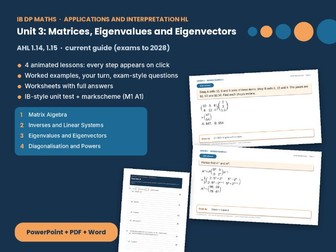
A complete, ready-to-teach unit of additional higher level content for IB DP Mathematics: Applications and Interpretation HL, Topic 1 (AHL 1.14, 1.15). Four animated lessons: the unit covers matrix algebra, determinants and inverses, solving linear systems, eigenvalues and eigenvectors of 2 × 2 matrices, and diagonalisation with powers and long-term behaviour. An IB-style unit test then checks what students have learned. Animated slides that teach step by step Every question appears first. Each click fades in the next line of working or the next answer, so you can ask students to predict the next step before you reveal it. A PDF copy of each deck shows every answer: ideal for cover lessons, revision and absent students. What’s included • 4 lessons (52 slides): Matrix Algebra; Determinants, Inverses and Linear Systems; Eigenvalues and Eigenvectors; Diagonalisation and Powers of Matrices • Each lesson: starter, key ideas (formula booklet references), 4 worked examples with GDC steps, ‘your turn’ questions, an exam-style question with an IB-style markscheme, an exit ticket and a summary • Speaker notes on every slide with a short script and all the answers • 4 worksheets (Word + PDF): fluency, problem solving and exam-style questions, with full answers • Unit test (60 minutes, 50 marks): Section A short response (Paper 1 style) and Section B extended response (Paper 2 style), GDC throughout, editable in Word • Full markscheme in IB notation (M1, A1, R1, AG) with indicative grade boundaries • Teacher guide: lesson plans with timings, syllabus map, subject knowledge, common misconceptions, support and stretch ideas, and the full AI HL course plan Exam-ready Questions are labelled Paper 1 style (short response) or Paper 2 style (extended response), with a GDC allowed throughout as in every AI exam. Diagonalisation is linked to transition matrices and population models, preparing students for Markov chains and coupled differential equations. All questions are original and every answer has been checked. Written to the current AI guide (first assessment 2021, final exams November 2028). This is HL Unit 3 of 11 HL units; the shared SL/HL core is in the AI SL Units 1–12. Independent resource: not produced or endorsed by the International Baccalaureate Organization.
IB Maths AI HL Functions and Modelling – HL Unit 4: transformations, logistic models, IB testQuick View
Lorelei131

IB Maths AI HL Functions and Modelling – HL Unit 4: transformations, logistic models, IB test

(0)
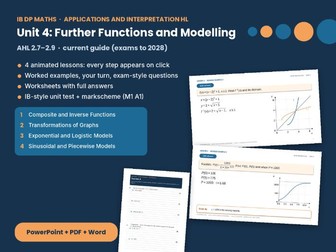
A complete, ready-to-teach unit of additional higher level content for IB DP Mathematics: Applications and Interpretation HL, Topic 2 (AHL 2.7–2.9). Four animated lessons: the unit covers composite and inverse functions, transformations of graphs, and the HL models: exponential with an asymptote, natural logarithmic, logistic, sinusoidal with a phase shift and piecewise. An IB-style unit test then checks what students have learned. Animated slides that teach step by step Every question appears first. Each click fades in the next line of working or the next answer, so you can ask students to predict the next step before you reveal it. A PDF copy of each deck shows every answer: ideal for cover lessons, revision and absent students. What’s included • 4 lessons (52 slides): Composite and Inverse Functions; Transformations of Graphs; Exponential, Logarithmic and Logistic Models; Sinusoidal and Piecewise Models • Each lesson: starter, key ideas (formula booklet references), 4 worked examples with GDC steps, ‘your turn’ questions, an exam-style question with an IB-style markscheme, an exit ticket and a summary • Speaker notes on every slide with a short script and all the answers • 4 worksheets (Word + PDF): fluency, problem solving and exam-style questions, with full answers • Unit test (60 minutes, 50 marks): Section A short response (Paper 1 style) and Section B extended response (Paper 2 style), GDC throughout, editable in Word • Full markscheme in IB notation (M1, A1, R1, AG) with indicative grade boundaries • Teacher guide: lesson plans with timings, syllabus map, subject knowledge, common misconceptions, support and stretch ideas, and the full AI HL course plan Exam-ready Questions are labelled Paper 1 style (short response) or Paper 2 style (extended response), with a GDC allowed throughout as in every AI exam. Each model is fitted to a context and interpreted, including carrying capacity and long-term behaviour. All questions are original and every answer has been checked. Written to the current AI guide (first assessment 2021, final exams November 2028). This is HL Unit 4 of 11 HL units; the shared SL/HL core is in the AI SL Units 1–12. Independent resource: not produced or endorsed by the International Baccalaureate Organization.
IB Maths AI HL Trig and Transformations – HL Unit 5: radians, unit circle, matrix maps, IB testQuick View
Lorelei131

IB Maths AI HL Trig and Transformations – HL Unit 5: radians, unit circle, matrix maps, IB test

(0)
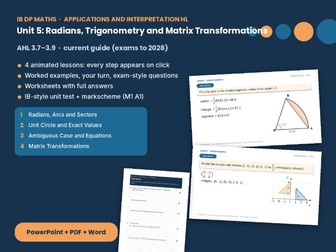
A complete, ready-to-teach unit of additional higher level content for IB DP Mathematics: Applications and Interpretation HL, Topic 3 (AHL 3.7–3.9). Four animated lessons: the unit covers radians with arcs, sectors and segments, the unit circle and exact values, the ambiguous case and graphical solution of trigonometric equations, and matrix transformations with the determinant as area scale factor. An IB-style unit test then checks what students have learned. Animated slides that teach step by step Every question appears first. Each click fades in the next line of working or the next answer, so you can ask students to predict the next step before you reveal it. A PDF copy of each deck shows every answer: ideal for cover lessons, revision and absent students. What’s included • 4 lessons (52 slides): Radians, Arcs and Sectors; The Unit Circle and Exact Values; The Ambiguous Case and Trigonometric Equations; Matrix Transformations • Each lesson: starter, key ideas (formula booklet references), 4 worked examples with GDC steps, ‘your turn’ questions, an exam-style question with an IB-style markscheme, an exit ticket and a summary • Speaker notes on every slide with a short script and all the answers • 4 worksheets (Word + PDF): fluency, problem solving and exam-style questions, with full answers • Unit test (60 minutes, 50 marks): Section A short response (Paper 1 style) and Section B extended response (Paper 2 style), GDC throughout, editable in Word • Full markscheme in IB notation (M1, A1, R1, AG) with indicative grade boundaries • Teacher guide: lesson plans with timings, syllabus map, subject knowledge, common misconceptions, support and stretch ideas, and the full AI HL course plan Exam-ready Questions are labelled Paper 1 style (short response) or Paper 2 style (extended response), with a GDC allowed throughout as in every AI exam. Transformation examples are drawn on grids so students can see each matrix at work. All questions are original and every answer has been checked. Written to the current AI guide (first assessment 2021, final exams November 2028). This is HL Unit 5 of 11 HL units; the shared SL/HL core is in the AI SL Units 1–12. Independent resource: not produced or endorsed by the International Baccalaureate Organization.
IB Maths AI HL Vectors – HL Unit 6: scalar and vector products, lines, kinematics, IB testQuick View
Lorelei131

IB Maths AI HL Vectors – HL Unit 6: scalar and vector products, lines, kinematics, IB test

(0)
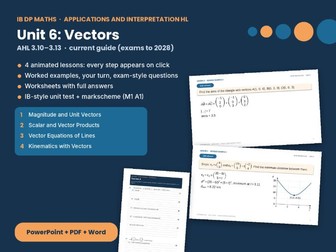
A complete, ready-to-teach unit of additional higher level content for IB DP Mathematics: Applications and Interpretation HL, Topic 3 (AHL 3.10–3.13). Four animated lessons: the unit covers vector algebra and unit vectors, the scalar and vector products with angles and areas, vector equations of lines, and kinematics with constant and variable velocity, including the closest approach of two ships. An IB-style unit test then checks what students have learned. Animated slides that teach step by step Every question appears first. Each click fades in the next line of working or the next answer, so you can ask students to predict the next step before you reveal it. A PDF copy of each deck shows every answer: ideal for cover lessons, revision and absent students. What’s included • 4 lessons (52 slides): Vectors, Magnitude and Unit Vectors; Scalar and Vector Products; Vector Equations of Lines; Kinematics with Vectors • Each lesson: starter, key ideas (formula booklet references), 4 worked examples with GDC steps, ‘your turn’ questions, an exam-style question with an IB-style markscheme, an exit ticket and a summary • Speaker notes on every slide with a short script and all the answers • 4 worksheets (Word + PDF): fluency, problem solving and exam-style questions, with full answers • Unit test (60 minutes, 50 marks): Section A short response (Paper 1 style) and Section B extended response (Paper 2 style), GDC throughout, editable in Word • Full markscheme in IB notation (M1, A1, R1, AG) with indicative grade boundaries • Teacher guide: lesson plans with timings, syllabus map, subject knowledge, common misconceptions, support and stretch ideas, and the full AI HL course plan Exam-ready Questions are labelled Paper 1 style (short response) or Paper 2 style (extended response), with a GDC allowed throughout as in every AI exam. Closest-approach questions show both the GDC graph method and the algebraic method. All questions are original and every answer has been checked. Written to the current AI guide (first assessment 2021, final exams November 2028). This is HL Unit 6 of 11 HL units; the shared SL/HL core is in the AI SL Units 1–12. Independent resource: not produced or endorsed by the International Baccalaureate Organization.
IB Maths AI HL Graph Theory – HL Unit 7: Kruskal, Prim, Chinese postman, salesman, IB testQuick View
Lorelei131

IB Maths AI HL Graph Theory – HL Unit 7: Kruskal, Prim, Chinese postman, salesman, IB test

(0)
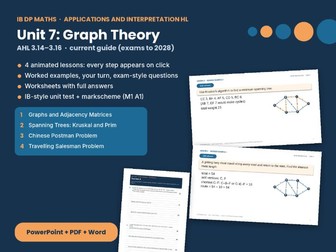
A complete, ready-to-teach unit of additional higher level content for IB DP Mathematics: Applications and Interpretation HL, Topic 3 (AHL 3.14–3.16). Four animated lessons: the unit covers graph vocabulary, adjacency matrices and walks, transition matrices for directed graphs, Eulerian and Hamiltonian paths, minimum spanning trees, the Chinese postman problem and the travelling salesman problem with bounds. An IB-style unit test then checks what students have learned. Animated slides that teach step by step Every question appears first. Each click fades in the next line of working or the next answer, so you can ask students to predict the next step before you reveal it. A PDF copy of each deck shows every answer: ideal for cover lessons, revision and absent students. What’s included • 4 lessons (52 slides): Graphs, Adjacency Matrices and Walks; Eulerian and Hamiltonian Paths and Minimum Spanning Trees; The Chinese Postman Problem; The Travelling Salesman Problem • Each lesson: starter, key ideas (formula booklet references), 4 worked examples with GDC steps, ‘your turn’ questions, an exam-style question with an IB-style markscheme, an exit ticket and a summary • Speaker notes on every slide with a short script and all the answers • 4 worksheets (Word + PDF): fluency, problem solving and exam-style questions, with full answers • Unit test (60 minutes, 50 marks): Section A short response (Paper 1 style) and Section B extended response (Paper 2 style), GDC throughout, editable in Word • Full markscheme in IB notation (M1, A1, R1, AG) with indicative grade boundaries • Teacher guide: lesson plans with timings, syllabus map, subject knowledge, common misconceptions, support and stretch ideas, and the full AI HL course plan Exam-ready Questions are labelled Paper 1 style (short response) or Paper 2 style (extended response), with a GDC allowed throughout as in every AI exam. Every algorithm is shown on a drawn network or distance table, with the edges listed in the order the markscheme expects. All questions are original and every answer has been checked. Written to the current AI guide (first assessment 2021, final exams November 2028). This is HL Unit 7 of 11 HL units; the shared SL/HL core is in the AI SL Units 1–12. Independent resource: not produced or endorsed by the International Baccalaureate Organization.
IB Maths AI HL Further Statistics – HL Unit 8: R², linear combinations, CLT, confidence intervalsQuick View
Lorelei131

IB Maths AI HL Further Statistics – HL Unit 8: R², linear combinations, CLT, confidence intervals

(0)
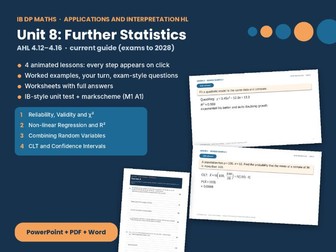
A complete, ready-to-teach unit of additional higher level content for IB DP Mathematics: Applications and Interpretation HL, Topic 4 (AHL 4.12–4.16). Four animated lessons: the unit covers data collection with reliability and validity, χ² refinements, non-linear regression with SS_res and R², linear combinations of random variables, the central limit theorem and confidence intervals. An IB-style unit test then checks what students have learned. Animated slides that teach step by step Every question appears first. Each click fades in the next line of working or the next answer, so you can ask students to predict the next step before you reveal it. A PDF copy of each deck shows every answer: ideal for cover lessons, revision and absent students. What’s included • 4 lessons (52 slides): Data Collection, Reliability and χ² Refinements; Non-linear Regression and R²; Combinations of Random Variables and Unbiased Estimators; The Central Limit Theorem and Confidence Intervals • Each lesson: starter, key ideas (formula booklet references), 4 worked examples with GDC steps, ‘your turn’ questions, an exam-style question with an IB-style markscheme, an exit ticket and a summary • Speaker notes on every slide with a short script and all the answers • 4 worksheets (Word + PDF): fluency, problem solving and exam-style questions, with full answers • Unit test (60 minutes, 50 marks): Section A short response (Paper 1 style) and Section B extended response (Paper 2 style), GDC throughout, editable in Word • Full markscheme in IB notation (M1, A1, R1, AG) with indicative grade boundaries • Teacher guide: lesson plans with timings, syllabus map, subject knowledge, common misconceptions, support and stretch ideas, and the full AI HL course plan Exam-ready Questions are labelled Paper 1 style (short response) or Paper 2 style (extended response), with a GDC allowed throughout as in every AI exam. Confidence-interval questions include the interpretation sentences that examiners look for. All questions are original and every answer has been checked. Written to the current AI guide (first assessment 2021, final exams November 2028). This is HL Unit 8 of 11 HL units; the shared SL/HL core is in the AI SL Units 1–12. Independent resource: not produced or endorsed by the International Baccalaureate Organization.
IB Maths AI HL Poisson and Markov Chains – HL Unit 9: tests, Type I and II errors, IB testQuick View
Lorelei131

IB Maths AI HL Poisson and Markov Chains – HL Unit 9: tests, Type I and II errors, IB test

(0)
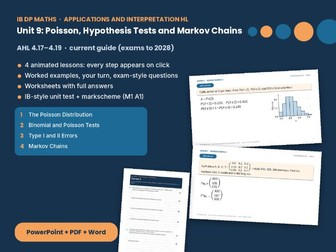
A complete, ready-to-teach unit of additional higher level content for IB DP Mathematics: Applications and Interpretation HL, Topic 4 (AHL 4.17–4.19). Four animated lessons: the unit covers the Poisson distribution, binomial and Poisson hypothesis tests with critical regions, Type I and Type II errors and the test for zero correlation, and Markov chains with steady states. An IB-style unit test then checks what students have learned. Animated slides that teach step by step Every question appears first. Each click fades in the next line of working or the next answer, so you can ask students to predict the next step before you reveal it. A PDF copy of each deck shows every answer: ideal for cover lessons, revision and absent students. What’s included • 4 lessons (52 slides): The Poisson Distribution; Hypothesis Tests for Binomial and Poisson Models; Type I and Type II Errors and Testing Correlation; Markov Chains • Each lesson: starter, key ideas (formula booklet references), 4 worked examples with GDC steps, ‘your turn’ questions, an exam-style question with an IB-style markscheme, an exit ticket and a summary • Speaker notes on every slide with a short script and all the answers • 4 worksheets (Word + PDF): fluency, problem solving and exam-style questions, with full answers • Unit test (60 minutes, 50 marks): Section A short response (Paper 1 style) and Section B extended response (Paper 2 style), GDC throughout, editable in Word • Full markscheme in IB notation (M1, A1, R1, AG) with indicative grade boundaries • Teacher guide: lesson plans with timings, syllabus map, subject knowledge, common misconceptions, support and stretch ideas, and the full AI HL course plan Exam-ready Questions are labelled Paper 1 style (short response) or Paper 2 style (extended response), with a GDC allowed throughout as in every AI exam. Critical regions are found by checking both boundary values, the step most often missed in exams. All questions are original and every answer has been checked. Written to the current AI guide (first assessment 2021, final exams November 2028). This is HL Unit 9 of 11 HL units; the shared SL/HL core is in the AI SL Units 1–12. Independent resource: not produced or endorsed by the International Baccalaureate Organization.
IB Maths AI HL Further Calculus – HL Unit 10: chain rule, inflection, volumes, kinematics, IB testQuick View
Lorelei131

IB Maths AI HL Further Calculus – HL Unit 10: chain rule, inflection, volumes, kinematics, IB test

(0)
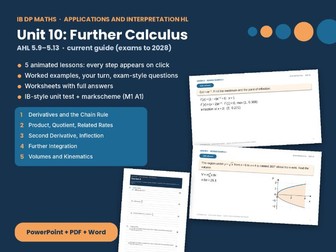
A complete, ready-to-teach unit of additional higher level content for IB DP Mathematics: Applications and Interpretation HL, Topic 5 (AHL 5.9–5.13). Five animated lessons: the unit covers derivatives of trigonometric, exponential and logarithmic functions, the chain, product and quotient rules, related rates, the second derivative, further integration, volumes of revolution and kinematics. An IB-style unit test then checks what students have learned. Animated slides that teach step by step Every question appears first. Each click fades in the next line of working or the next answer, so you can ask students to predict the next step before you reveal it. A PDF copy of each deck shows every answer: ideal for cover lessons, revision and absent students. What’s included • 5 lessons (65 slides): Derivatives and the Chain Rule; Product and Quotient Rules and Related Rates; The Second Derivative and Points of Inflection; Further Integration; Volumes of Revolution and Kinematics • Each lesson: starter, key ideas (formula booklet references), 4 worked examples with GDC steps, ‘your turn’ questions, an exam-style question with an IB-style markscheme, an exit ticket and a summary • Speaker notes on every slide with a short script and all the answers • 5 worksheets (Word + PDF): fluency, problem solving and exam-style questions, with full answers • Unit test (60 minutes, 50 marks): Section A short response (Paper 1 style) and Section B extended response (Paper 2 style), GDC throughout, editable in Word • Full markscheme in IB notation (M1, A1, R1, AG) with indicative grade boundaries • Teacher guide: lesson plans with timings, syllabus map, subject knowledge, common misconceptions, support and stretch ideas, and the full AI HL course plan Exam-ready Questions are labelled Paper 1 style (short response) or Paper 2 style (extended response), with a GDC allowed throughout as in every AI exam. Related-rates and volume questions follow the ‘formula, differentiate, substitute’ structure that earns the method marks. All questions are original and every answer has been checked. Written to the current AI guide (first assessment 2021, final exams November 2028). This is HL Unit 10 of 11 HL units; the shared SL/HL core is in the AI SL Units 1–12. Independent resource: not produced or endorsed by the International Baccalaureate Organization.