AQA A‑Level Biology: Exchange & Transport – 20 MCQ Retrieval Quiz with AnswersQuick View
gareth moores

AQA A‑Level Biology: Exchange & Transport – 20 MCQ Retrieval Quiz with Answers

(0)
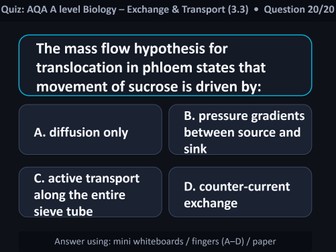
This ready‑to‑teach PowerPoint quiz is designed for whole‑class retrieval practice covering AQA A‑Level Biology Topic 3.3: Exchange & Transport. The resource includes 20 exam‑focused multiple‑choice questions, each followed by a clear answer and explanation slide, making it ideal for checking understanding, tackling common misconceptions and reinforcing key ideas before assessment. What’s included 46 slides in total 20 MCQs (A–D), fully aligned with the AQA specification Immediate answers and explanations after every question Suitable for Year 12 and Year 13 Content covered Surface area to volume ratio, diffusion and exchange surfaces, gas exchange in mammals, fish and insects, breathing and ventilation, digestion and absorption, co‑transport, mass transport in plants, haemoglobin, the Bohr effect, and required calculations (e.g. PVR and cardiac output). How it works in lessons Students commit to an answer first using mini‑whiteboards, fingers or paper. Answers are then revealed and discussed, encouraging justification and deeper understanding. Well suited to a starter, plenary, revision lesson or low‑stakes assessment. Why this resource works Clear, specification‑focused questions with no unnecessary slides. Minimal preparation for teachers and high‑impact retrieval for students.
AQA A‑Level Biology: Cells – 20 MCQ Retrieval Quiz with AnswersQuick View
gareth moores

AQA A‑Level Biology: Cells – 20 MCQ Retrieval Quiz with Answers

(0)
This ready‑to‑teach PowerPoint quiz supports whole‑class retrieval practice for AQA A‑level Biology Topic 3.2: Cells. The resource contains 20 carefully written multiple‑choice questions, each followed by a clear answer and explanation slide, making it ideal for checking understanding, addressing misconceptions and reinforcing key exam knowledge. What’s included 46 slides in total 20 MCQs (A–D), fully aligned with the AQA specification Answer and explanation after every question Suitable for Year 12 and Year 13 Content covered Eukaryotic and prokaryotic cells, viruses, cell organelles, microscopy and calculations, cell fractionation, the cell cycle and mitosis, membranes and transport, and immune cells. How to use Students commit to an answer first using mini‑whiteboards, fingers or paper. Answers are then revealed and discussed, promoting justification and deeper understanding. Well suited to a starter, plenary, revision lesson or low‑stakes assessment. Why teachers use this No prep needed. Clear, specification‑focused questions that quickly reveal gaps in understanding while giving students structured exam practice.
AQA A‑Level Biology Genetics & Diversity – 20‑Question Retrieval QuizQuick View
gareth moores

AQA A‑Level Biology Genetics & Diversity – 20‑Question Retrieval Quiz

(0)
A 20‑question whole‑class retrieval quiz for AQA A‑level Biology Topic 3.4 Genetics & Diversity, designed for Y12/ 13. 20-question whole-class retrieval quiz for AQA A-level Biology Topic 3.4 Genetics & Diversity (Year 13), with answers and explanations. This PowerPoint is a 20-question whole-class multiple-choice quiz for AQA A-level Biology: Genetics & Diversity (Topic 3.4), designed for Year 13 retrieval practice and revision. Students answer each question (A–D) using mini whiteboards, fingers (A–D), or paper, then the answer slide is revealed and the explanation discussed. A short “How to play” slide at the start gives clear instructions and suggested pacing, allowing the quiz to be run with no additional preparation. The quiz covers key specification content including DNA in prokaryotes and eukaryotes, chromosomes and genes, genome vs proteome, transcription and RNA processing (splicing), features of the genetic code and silent substitutions, non-disjunction, independent assortment (2^n), genetic diversity, stabilising and directional selection, natural selection and allele frequency change, the species concept, taxonomic hierarchy, species richness, index of diversity calculations, and the impact of farming on biodiversity. The resource includes 20 question slides and 20 answer/explanation slides and is suitable for lesson starters, plenaries, revision lessons, or end-of-topic consolidation.
AQA A Level Biology Biological Molecules Revision QuizQuick View
gareth moores

AQA A Level Biology Biological Molecules Revision Quiz

(0)
This fully prepared PowerPoint quiz supports whole‑class retrieval practice for AQA A‑level Biology Topic 1: Biological Molecules. The resource includes 20 multiple‑choice questions, each followed by a clear answer and explanation slide, making it ideal for checking understanding, correcting misconceptions and reinforcing exam‑ready knowledge. What’s included 46 slides in total 20 MCQs (A–D), fully aligned with the AQA specification Immediate answer and explanation after every question Designed for Year 12 and Year 13 Topics covered Condensation and hydrolysis, carbohydrates, food tests, lipids, proteins, enzymes, nucleic acids, ATP and pH calculations. Classroom use Students commit to an answer first (mini‑whiteboards, fingers or paper), then answers are revealed and discussed. Works well as a starter, plenary, revision lesson or low‑stakes assessment. Why it works Clear, efficient and no prep required. Helps students practise exam‑style thinking while giving teachers quick insight into gaps in understanding.
AQA A‑Level Biology Retrieval Practice Quiz Bundle (Biological Molecules to Genetics)Quick View
gareth moores

AQA A‑Level Biology Retrieval Practice Quiz Bundle (Biological Molecules to Genetics)

4 Resources
4 x 20‑question whole‑class retrieval quizzes for AQA A‑level Biology, covering core topics from Biological Molecules to Genetics and Diversity. This bundle contains a series of consistent, classroom‑ready PowerPoint quiz decks designed for whole‑class retrieval practice in AQA A‑level Biology. Each PowerPoint contains 20 multiple‑choice questions (A–D), followed by answer slides with clear explanations. The quizzes are designed to be run using a commit‑reveal‑explain approach with mini whiteboards, fingers (A–D) or paper responses, making them ideal for low‑stakes assessment, revision and consolidation. The bundle includes quiz decks covering: Biological Molecules Cells Exchange and Transport Genetics and Diversity All quizzes are suitable for Year 12/13 and closely aligned to the AQA A‑level Biology specification. The consistent format means students quickly understand routines, allowing focus on thinking and recall rather than instructions. Ideal for lesson starters, plenaries, revision lessons, recap sessions or exam preparation, this bundle provides multiple hours of ready‑to‑use retrieval practice with no additional preparation required.
2026 AQA Combined GCSE Science Exam Preparation Papers and DecksQuick View
gareth moores

2026 AQA Combined GCSE Science Exam Preparation Papers and Decks

(0)
Predicted Exam Papers & Revision Resources for AQA Combined Science (Trilogy) Higher – 2026 These resources include predicted exam papers and mark schemes for the 2026 AQA Combined Science Higher Tier. They cover all three Paper 1 exams and the Biology and Chemistry sections of Paper 2. (Please note: there is no Physics Paper 2 included.) In addition to the papers, you’ll also find three PowerPoint slide decks — one each for Biology, Chemistry, and Physics. These focus on exam technique, common mistakes, and revision priorities informed by examiner feedback from recent exam years. They’re designed to help students understand both what to revise and how to approach the questions effectively. All materials are teacher‑made for use with my own classes. They’re based on detailed analysis of past papers, question trends, and examiner reports, with the aim of giving students structured, high‑quality practice and clearer revision focus. Although these papers include predictions, there is no guarantee that these topics will appear in the real exams. Students should always revise the full AQA specification. I’m an experienced science teacher, and these are homemade classroom resources, not official publications. They’re free to download — if they help your students, a kind review would make my day.