Percy Jackson & the Lightning Thief – Book Cover Inference WorksheetQuick View
elasticbandy

Percy Jackson & the Lightning Thief – Book Cover Inference Worksheet

(0)
See, Think, Question | Years 5–8 | English This engaging See, Think, Question worksheet uses the book cover of Percy Jackson & the Lightning Thief to develop pupils’ inference, reasoning, and questioning skills. Designed for classes between Years 5, 6, 7 and 8, this resource is ideal for UKS2–KS3 transition work as well as mixed-ability classes. Pupils do not need prior knowledge of the story to access the task. Pupils are guided to: Identify clear visual details and important words from the book cover Explain what these details make them think about the story or character Link ideas back to the image using visual evidence Ask thoughtful questions inspired by what they can see The structured layout supports younger learners while still allowing challenge and depth for older pupils. What’s included: 1 printable A4 worksheet Clear See / Think / Question structure Child-friendly WALT and success criteria Optional challenge question to stretch confident writers Skills focus: Visual inference Evidence-based reasoning Speaking and listening Questioning and curiosity Suitable for: Year 5 Year 6 Year 7 Year 8 UKS2 and KS3 English This resource works well as: A lesson starter or hook A pre-reading or prediction task A transition activity between KS2 and KS3 A low-stakes assessment or cover lesson No preparation required – simply print and use.
KS3 Reading & Inference – Short Extracts & Skills: Tension & SuspenseQuick View
elasticbandy

KS3 Reading & Inference – Short Extracts & Skills: Tension & Suspense

(0)
A low-prep, skills-focused reading and inference resource designed to support KS3 pupils in exploring tension and suspense through a short, text-agnostic fiction extract. This resource helps pupils understand how writers create suspense through pace, sound, setting and character reaction, encouraging pupils to infer tension rather than being told directly. Pupils practise retrieval, inference, language analysis and vocabulary in context while developing confidence in explaining how tension is built. Suitable for use as a standalone lesson, starter activity, cover work or intervention task. Skills Covered Retrieval Word-level inference Inference with evidence Language analysis Tension and suspense Vocabulary in context Writer’s intent What’s Included One short fiction extract Ten scaffolded comprehension and inference questions (15 marks total) Vocabulary development task (synonyms in context) Answer sheet with flexible marking guidance Teacher reference table showing the skill focus for each question Why Teachers Use This Resource No prior knowledge of a set text required Suitable for Years 7–9 Easy to differentiate for mixed-ability classes Minimal preparation and marking Supports progression towards GCSE-style reading analysis Series Information This resource is part of the series: KS3 Reading & Inference – Short Extracts & Skills Each resource in the series focuses on a different core reading skill and can be used independently or bundled for wider curriculum coverage. Suggested Uses KS3 English lessons Cover work Reading interventions Homework or revision Assessment practice Skills-based starters or plenaries
KS3 Reading & Inference – Short Extracts & Skills: Setting & AtmosphereQuick View
elasticbandy

KS3 Reading & Inference – Short Extracts & Skills: Setting & Atmosphere

(0)
A low-prep, skills-focused reading and inference resource designed to support KS3 pupils in analysing setting and atmosphere using a short, text-agnostic fiction extract. This resource helps pupils explore how writers create mood through setting, description and word choice, encouraging pupils to infer atmosphere rather than relying on explicit explanation. Pupils practise retrieval, inference, language analysis and vocabulary in context while developing confidence in explaining how setting influences meaning. Suitable for use as a standalone lesson, starter activity, cover work or intervention task. Skills Covered Retrieval Word-level inference Inference with evidence Language analysis Setting and atmosphere Vocabulary in context Writer’s intent What’s Included One short fiction extract Ten scaffolded comprehension and inference questions (15 marks total) Vocabulary development task (synonyms in context) Answer sheet with flexible marking guidance Teacher reference table showing the skill focus for each question Why Teachers Use This Resource No prior knowledge of a set text required Suitable for Years 7–9 Easy to differentiate for mixed-ability classes Minimal preparation and marking Supports progression towards GCSE-style reading analysis Series Information This resource is Resource 3 in the series: KS3 Reading & Inference – Short Extracts & Skills Each resource in the series focuses on a different core reading skill and can be used independently or bundled for wider curriculum coverage. Suggested Uses KS3 English lessons Cover work Reading interventions Homework or revision Assessment practice Skills-based starters or plenaries
People & Emotion – See Think Question Visual Inference Photographs (KS2–KS4)Quick View
elasticbandy

People & Emotion – See Think Question Visual Inference Photographs (KS2–KS4)

(0)
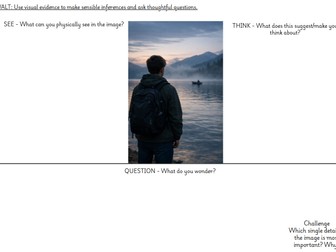
People & Emotion – See Think Question Visual Inference Photographs (KS2–KS4) This resource contains a set of carefully selected photographs designed to develop pupils’ inference, discussion and questioning skills using the See, Think, Question framework. Each worksheet features a single photograph with structured prompts to support pupils in: observing visual detail making sensible inferences asking thoughtful, open-ended questions The images include a range of positive, neutral and ambiguous emotions, making this resource suitable for repeated use across different lessons, topics and age groups. What’s included: 12 visual inference worksheets One photograph per page Consistent See / Think / Question structure Optional challenge question on every page Suitable for: Upper KS2 KS3 KS4 SEND EAL Works well for: Reading and inference lessons Oracy and discussion tasks Writing starters Cover or supply lessons PSHE and character exploration Skills developed: Making inferences from visual evidence Exploring feelings, motivation and perspective Justifying ideas using detail Asking meaningful questions No prior knowledge required. Photographs only. Fully printable.
KS3 Reading & Inference – Short Extracts & Skills: Character ReactionsQuick View
elasticbandy

KS3 Reading & Inference – Short Extracts & Skills: Character Reactions

(0)
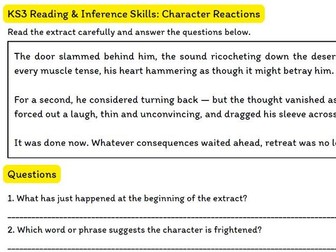
A low-prep, skills-focused reading and inference resource designed to support KS3 pupils in analysing character reactions and emotions using a short, text-agnostic extract. Pupils practise retrieval, inference, language analysis and vocabulary in context, while developing confidence in explaining how writers show emotion through actions and word choices rather than direct explanation. Skills Covered Retrieval Word-level inference Inference with evidence Language analysis Character reactions and emotions Vocabulary in context Writer’s intent What’s Included One short fiction extract Ten scaffolded comprehension and inference questions (15 marks total) Vocabulary development task Answer sheet with flexible marking guidance Teacher reference table showing the skill focus for each question Why Teachers Use This Resource No prior knowledge of a set text required Suitable for Years 7–9 Easy to differentiate Minimal preparation and marking Supports progression towards GCSE-style analysis Series Information This resource is Resource 1 in the series: KS3 Reading & Inference – Short Extracts & Skills Each resource focuses on a different core reading skill and can be used independently or bundled for wider curriculum coverage. Suggested Uses KS3 English lessons Cover work Reading interventions Homework or revision Assessment practice Tags KS3 English Reading Inference Comprehension Character Vocabulary Cover Work English Skills
KS3 Reading & Inference – Short Extracts & Skills: Character Motivation & DecisionsQuick View
elasticbandy

KS3 Reading & Inference – Short Extracts & Skills: Character Motivation & Decisions

(0)
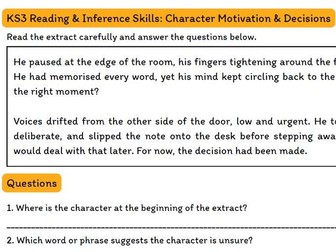
Choices, Pressure and Consequence | No Prior Text Knowledge Required A low-prep, skills-focused reading and inference resource designed to support KS3 pupils in analysing character motivation and decision-making using a short, text-agnostic fiction extract. This resource encourages pupils to explore why characters act the way they do, focusing on internal conflict, pressure, and consequence. Pupils practise retrieval, inference, language analysis and vocabulary in context, while developing confidence in explaining decisions using evidence from the text. Suitable for use as a standalone lesson, starter activity, cover work or intervention task. Skills Covered Retrieval Word-level inference Inference with evidence Language analysis Character motivation and decision-making Vocabulary in context Writer’s intent What’s Included One short fiction extract Ten scaffolded comprehension and inference questions (15 marks total) Optional challenge question Vocabulary development task (synonyms in context) Answer sheet with flexible marking guidance Teacher reference table showing the skill focus for each question Why Teachers Use This Resource No prior knowledge of a set text required Suitable for Years 7–9 Easy to differentiate for mixed-ability classes Minimal preparation and marking Supports progression towards GCSE-style reading analysis Series Information This resource is Resource 2 in the series: KS3 Reading & Inference – Short Extracts & Skills Each resource in the series focuses on a different core reading skill and can be used independently or bundled for wider curriculum coverage. Suggested Uses KS3 English lessons Cover work Reading interventions Homework or revision Assessment practice Skills-based starters or plenaries Tags KS3 English Reading Inference Comprehension Character Decision Making Vocabulary Cover Work English Skills
Quick Reading and Inference Bundle – Year 8 (Character, Setting and Decisions)Quick View
elasticbandy

Quick Reading and Inference Bundle – Year 8 (Character, Setting and Decisions)

(0)
Title Quick Reading and Inference Bundle – Year 8 (Character, Setting and Decisions) Description A carefully pitched bundle of three reading and inference resources designed for Year 8 pupils, bridging the gap between lower KS3 comprehension work and the increased analytical demands of Year 9. Each resource uses an original, age-appropriate text and focuses on a different inference strand, requiring pupils to interpret meaning through character reactions, setting and mood, and actions and decisions. Together, the three resources develop confident inference, evidence selection and explanation skills in preparation for more demanding KS3 reading. Ideal for use throughout Year 8 as pupils transition towards pre-GCSE expectations. Suitable for homework, independent practice, cover lessons, starters or intervention work. The texts include challenging but accessible vocabulary and statutory spellings, alongside short vocabulary tasks to support language development. What’s included Year 8 Quick Reading and Inference – Character Reactions Focus on inferring thoughts and feelings from behaviour Year 8 Quick Reading and Inference – Setting and Mood Focus on atmosphere and how language shapes mood Year 8 Quick Reading and Inference – Actions and Decisions Focus on motivation, choices and decision-making Each resource includes: One original reading extract (Year 8 appropriate) A 10-question reading and inference task A vocabulary synonyms task linked to the text A full answer sheet with marking guidance
Year 8 Quick Reading and Inference – Actions and DecisionsQuick View
elasticbandy

Year 8 Quick Reading and Inference – Actions and Decisions

(0)
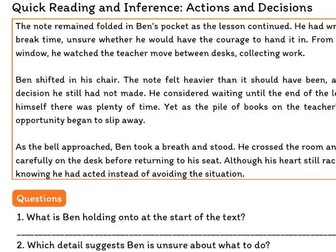
A focused reading and inference resource designed for Year 8 pupils, developing confidence with interpreting actions and decisions while bridging the gap between lower KS3 reading skills and the increased analytical demands of Year 9. This resource uses an original, age-appropriate text that requires pupils to infer meaning from a character’s behaviour and choices rather than explicit explanation. Questions guide pupils from retrieval to inference and explanation, helping them recognise how actions can reveal thoughts, feelings and decision-making. The task includes 10 questions in total, with an optional challenge question to stretch pupils’ thinking without increasing marking workload. Ideal for use as homework, independent practice, cover lessons, starters or intervention work. The text includes challenging but accessible vocabulary and statutory spellings, alongside a short vocabulary synonyms task to support language development. What’s included One original reading extract (Year 8 appropriate) A 10-question reading and inference task Questions focused on actions and decisions Vocabulary synonyms task linked to the text Full answer sheet with marking guidance
Year 8 Quick Reading and Inference – Character ReactionsQuick View
elasticbandy

Year 8 Quick Reading and Inference – Character Reactions

(0)
A focused reading and inference resource designed for Year 8 pupils, bridging the gap between lower KS3 comprehension work and the increased analytical demands of Year 9. This resource uses an original, age-appropriate text that requires pupils to infer a character’s reactions and changing feelings through behaviour and subtle language choices, rather than explicit emotion. Questions are carefully structured to move from retrieval to inference and explanation, supporting pupils as they develop confidence with more challenging reading tasks. The resource includes 10 questions in total, with an optional challenge question to stretch pupils’ thinking without increasing workload or marking demands. Ideal for use as homework, independent practice, cover lessons, starters or intervention work. The text includes challenging but accessible vocabulary and statutory spellings, alongside a short vocabulary synonyms task to support language development. What’s included One original reading extract (Year 8 appropriate) A 10-question reading and inference task Questions focused on character reactions and change Vocabulary synonyms task linked to the text Full answer sheet with marking guidance
Year 8 Quick Reading and Inference – Setting and MoodQuick View
elasticbandy

Year 8 Quick Reading and Inference – Setting and Mood

(0)
A focused reading and inference resource designed for Year 8 pupils, developing confidence with setting and mood while bridging the gap between lower KS3 comprehension and the increased analytical demands of Year 9. This resource uses an original, age-appropriate text set in a familiar school environment. Pupils are required to infer mood and atmosphere through language choices and detail, rather than relying on explicit description. Questions are carefully structured to move from retrieval to inference and explanation, supporting pupils as they develop more subtle reading skills. The task includes 10 questions in total, with an optional challenge question to stretch pupils’ thinking without increasing marking workload. Ideal for use as homework, independent practice, cover lessons, starters or intervention work. The text includes challenging but accessible vocabulary and statutory spellings, alongside a short vocabulary synonyms task to support language development. What’s included One original reading extract (Year 8 appropriate) A 10-question reading and inference task Questions focused on setting and mood Vocabulary synonyms task linked to the text Full answer sheet with marking guidance
Quick Reading and Inference Comprehension – Setting and AtmosphereQuick View
elasticbandy

Quick Reading and Inference Comprehension – Setting and Atmosphere

(0)
A short, focused reading and inference resource designed to help pupils explore how writers create setting and atmosphere using language and detail. This resource includes an original, age-appropriate reading extract set in a park and a series of questions that move from retrieval to inference and explanation. Pupils are encouraged to infer mood and atmosphere and support their ideas with evidence from the text. Suitable for Year 7 and upper KS2 pupils, and ideal for use as homework, cover work, starters or independent reading practice. The reading text uses age-appropriate vocabulary and includes statutory spellings to support spelling consolidation alongside reading comprehension and inference skills. What’s included: One original reading extract Comprehension and inference questions Vocabulary synonyms task linked to words from the text Full answer sheet with marking guidance This resource is low-prep, easy to mark, and supports the development of inference skills without relying on any prior text knowledge.
Quick Reading and Inference Comprehension – Actions and MotivationQuick View
elasticbandy

Quick Reading and Inference Comprehension – Actions and Motivation

(0)
A short, focused reading and inference resource designed to help pupils explore how a character’s actions reveal motivation and decision-making. This resource includes an original, age-appropriate reading extract and a range of questions that guide pupils from retrieval to inference and explanation. Pupils are encouraged to consider why a character behaves in a certain way and how actions can show changes in attitude or confidence. Suitable for Year 7 and upper KS2 pupils, and ideal for use as homework, cover work, starters or independent reading practice. The reading text uses age-appropriate vocabulary and includes statutory spellings to support spelling consolidation alongside reading comprehension and inference skills. What’s included: One original reading extract Comprehension and inference questions Vocabulary synonyms task linked to words from the text Full answer sheet with marking guidance This resource is low-prep, easy to mark, and supports the development of inference skills without relying on any prior text knowledge.
Quick Reading and Inference Bundle – Character, Setting and MotivationQuick View
elasticbandy

Quick Reading and Inference Bundle – Character, Setting and Motivation

(0)
A complete bundle of three short, focused reading and inference resources designed to develop pupils’ inference skills across different reading focuses. Each resource includes an original, age-appropriate reading extract and a structured set of questions that move from retrieval to inference and explanation. Together, the three resources allow pupils to practise inferring meaning from character feelings, setting and atmosphere, and actions and motivation. Suitable for Year 7 and upper KS2 pupils, and ideal for use as homework, cover work, starters or independent reading practice. The texts use age-appropriate vocabulary and include a range of statutory spellings to support spelling consolidation alongside reading comprehension and inference skills. What’s included Quick Reading and Inference: Character Feelings Quick Reading and Inference: Setting and Atmosphere Quick Reading and Inference: Actions and Motivation Each resource includes: One original reading extract Comprehension and inference questions A vocabulary synonyms task linked to words from the text A full answer sheet with marking guidance
Year 9 Reading and Inference – Character Perspective (Pre-GCSE Skills)Quick View
elasticbandy

Year 9 Reading and Inference – Character Perspective (Pre-GCSE Skills)

(0)
A short, high-challenge reading and inference resource designed specifically for Year 9 pupils, bridging KS3 reading skills and pre-GCSE analytical thinking. This resource uses an original, age-appropriate text that requires pupils to infer a character’s perspective, attitudes and internal conflict through subtle language choices rather than explicit emotion. Questions move from retrieval to inference and explanation, encouraging pupils to select evidence and consider writer intention. Ideal for developing confident inference skills before GCSE English Language. Suitable for use as homework, independent practice, cover work or reading starters. The reading text includes challenging vocabulary and statutory spellings, alongside a focused vocabulary task to support academic language development. What’s included One original reading extract (Year 9 appropriate) Inference questions focused on character perspective Pre-GCSE style explanation questions Vocabulary synonyms task using higher-level vocabulary Full answer sheet with marking guidance
Year 9 Reading and Inference – Actions, Decisions and Consequences (Pre-GCSE Skills)Quick View
elasticbandy

Year 9 Reading and Inference – Actions, Decisions and Consequences (Pre-GCSE Skills)

(0)
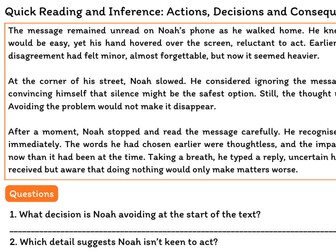
A challenging reading and inference resource designed for Year 9 pupils, focusing on how a character’s actions and decisions reveal consequences and responsibility. This resource uses an original, age-appropriate text that requires pupils to infer meaning from behaviour rather than explicit explanation. Questions encourage pupils to track changes in attitude, consider motivation, and explain the impact of choices, supporting the transition from KS3 reading skills to GCSE-style thinking. Ideal for developing thoughtful, analytical responses before GCSE English Language. Suitable for homework, independent practice, cover lessons or reading starters. The text includes challenging vocabulary and statutory spellings, alongside a targeted vocabulary task to support academic language development. What’s included One original reading extract (Year 9 appropriate) Inference questions focused on actions and consequences Questions requiring explanation and evaluation Vocabulary synonyms task using higher-level vocabulary Full answer sheet with marking guidance
Year 9 Reading and Inference Bundle – Pre-GCSE Skills (Character, Setting & Decisions)Quick View
elasticbandy

Year 9 Reading and Inference Bundle – Pre-GCSE Skills (Character, Setting & Decisions)

(0)
A high-challenge bundle of three reading and inference resources designed specifically for Year 9 pupils, bridging KS3 reading skills and pre-GCSE analytical thinking. Each resource uses an original, age-appropriate text and focuses on a different inference strand, requiring pupils to interpret meaning through language choices, behaviour, setting and symbolism, rather than relying on explicit explanation. Together, the resources develop confident inference, evidence selection and explanation skills in preparation for GCSE English Language. Ideal for use throughout Year 9 as pupils transition from KS3 to GCSE-style reading. Suitable for homework, independent practice, cover lessons, reading starters or intervention work. The texts include challenging vocabulary and statutory spellings, alongside focused vocabulary tasks to support academic language development. What’s included Quick Reading and Inference: Character Perspective (Year 9) Focus on internal conflict, reflection and viewpoint Quick Reading and Inference: Setting, Mood and Symbolism (Year 9) Focus on atmosphere, symbolism and writer’s intention Quick Reading and Inference: Actions, Decisions and Consequences (Year 9) Focus on motivation, responsibility and the impact of choices Each resource includes: One original reading extract (Year 9 appropriate) Structured inference questions moving from retrieval to explanation Vocabulary synonyms task using higher-level vocabulary Full answer sheet with marking guidance
English SPaG Homework – Capital Letters & Full StopsQuick View
elasticbandy

English SPaG Homework – Capital Letters & Full Stops

(0)
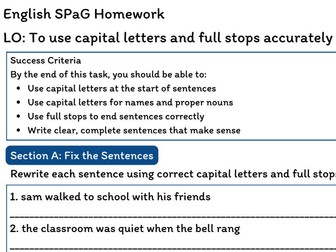
A clear, printable English SPaG homework worksheet focusing on the accurate use of capital letters and full stops. This resource is designed to help pupils apply punctuation rules correctly, including identifying missing capital letters, removing incorrect capital letters, and writing clear, complete sentences. Suitable for upper primary (Year 6), KS3 / Year 7, and for use as homework, cover work or independent practice. What’s included: 15-question SPaG homework task 10 fix-the-sentence questions 4 write-your-own sentence tasks Clear learning objective and skills-based success criteria Full answer sheet with marking guidance This resource is low-prep, easy to mark, and ideal for reinforcing key sentence punctuation skills.
English SPaG Homework – Commas in ListsQuick View
elasticbandy

English SPaG Homework – Commas in Lists

(0)
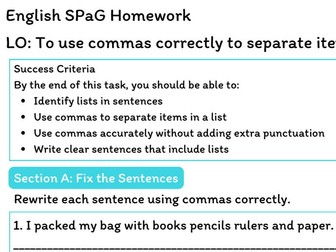
A clear, printable English SPaG homework worksheet focusing on the correct use of commas in lists. This resource helps pupils identify lists in sentences and apply commas accurately to separate items. Pupils practise correcting sentences with missing commas and writing their own sentences that include lists. Suitable for upper primary (Year 6), KS3 / Year 7, and for use as homework, cover work or independent practice. What’s included: 15-question SPaG homework task 10 fix-the-sentence questions 4 write-your-own sentence tasks Clear learning objective and skills-based success criteria Full answer sheet with marking guidance This resource is low-prep, easy to mark, and ideal for reinforcing accurate punctuation in sentence writing.
English SPaG Homework Bundle – Capital Letters, Commas in Lists & Sentence TypesQuick View
elasticbandy

English SPaG Homework Bundle – Capital Letters, Commas in Lists & Sentence Types

(0)
A complete bundle of three clear, printable English SPaG homework worksheets focusing on core sentence and punctuation skills. This bundle is designed to support pupils in applying key grammar and punctuation rules accurately through practice and consolidation tasks. Each worksheet follows the same consistent structure and is intended for independent work, assuming prior teaching of the skills. Suitable for upper primary (Year 6), KS3 / Year 7, and for use as homework, cover work or independent practice. What’s included: English SPaG Homework – Capital Letters & Full Stops English SPaG Homework – Commas in Lists English SPaG Homework – Sentence Types (Simple, Compound and Complex) Each worksheet includes: 12 - 15 question SPaG homework task A mix of fix-the-sentence and write-your-own sentence questions Clear learning objective and skills-based success criteria Full answer sheet with marking guidance This bundle is low-prep, easy to mark, and ideal for reinforcing essential sentence punctuation and grammar skills across upper primary and KS3.
English SPaG Homework – Sentence Types (Simple, Compound and Complex)Quick View
elasticbandy

English SPaG Homework – Sentence Types (Simple, Compound and Complex)

(0)
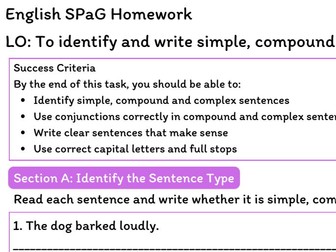
A clear, printable English SPaG homework worksheet focusing on identifying and writing simple, compound and complex sentences. This resource is designed to help pupils recognise different sentence types and apply their understanding by rewriting and creating sentences using appropriate conjunctions. It is intended as a practice and consolidation task, assuming prior teaching of sentence types. Suitable for upper primary (Year 6), KS3 / Year 7, and for use as homework, cover work or independent practice. What’s included: 12-question SPaG homework task Identification of simple, compound and complex sentences Sentence rewriting tasks Write-your-own sentence tasks Clear learning objective and skills-based success criteria Full answer sheet with marking guidance This resource is low-prep, easy to mark, and ideal for reinforcing sentence structure and punctuation skills.
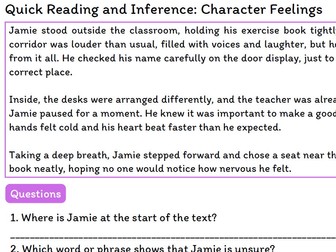
Quick Reading and Inference Comprehension – Character FeelingsQuick View
elasticbandy

Quick Reading and Inference Comprehension – Character Feelings

(0)
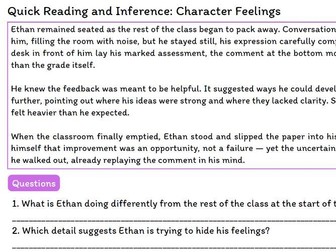
A short, focused reading and inference resource designed to help pupils practise inferring a character’s feelings using evidence from the text. This resource includes an original, age-appropriate reading extract and a range of questions that move from retrieval to inference and explanation. It is designed as a quick task that can be completed independently. Suitable for Year 7 and upper KS2 pupils, and ideal for use as homework, cover work, starters or independent reading practice. The reading text uses age-appropriate vocabulary and includes statutory spellings to support spelling consolidation alongside reading comprehension skills. What’s included: One original reading extract Comprehension and inference questions Vocabulary synonyms task linked to words from the text Full answer sheet with guidance This resource is low-prep, easy to mark, and supports the development of inference skills without relying on any prior text knowledge.