GCSE Science Math Skills Bundle | Complete Lesson SeriesQuick View
s_jackson11

GCSE Science Math Skills Bundle | Complete Lesson Series

(0)
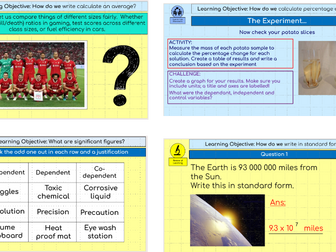
Stop losing marks on science calculations! Maths makes up 20%+ of GCSE Science papers. Help your students master every single calculation with this ready-to-teach, 4-lesson PowerPoint bundle. Fully aligned with AQA, Edexcel, and OCR (Combined & Separate Sciences). What’s Included? 4 fully editable, structured lesson presentations: Means & Anomalies – Step-by-step arithmetic mean, spotting anomalies, and avoiding calculator BIDMAS errors. Percentage Change & Osmosis. Applied directly to osmosis required practicals. Significant Figures - Real-world hook detailing the importance of precision in science and engineering. Standard Form (Scientific Notation) - Working with very large (astronomical) and very small (atomic/cellular) numbers. Why Teachers Love This Bundle: Explicit Instruction Pedagogy: Built on I Do, We Do, You Do and dual-coding principles. Exam Ready: Loaded with authentic past-paper questions and mark scheme breakdowns. Zero Prep: Download, edit if needed, and teach immediately. Versatile: Perfect for main lessons, intervention groups, or revision. Save hours of planning time. Download now and lock in those quantitative marks!
GCSE Physics: Density, Particle Theory & Required PracticalQuick View
s_jackson11

GCSE Physics: Density, Particle Theory & Required Practical

(0)
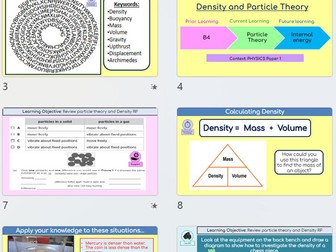
Equip your GCSE Physics students with a fully planned, interactive lesson pack on Density, Particle Theory, and AQA Required Practical 5 (Investigating Density of Regular/Irregular Solids and Liquids). Designed in line with evidence-based pedagogy, this pack seamlessly bridges particle model theory with practical displacement methods and mathematical calculations. What’s Included?23-Slide Presentation Deck (PPTX): Includes prior learning retrieval, structured worked examples using formula triangles, AQA Required Practical setup diagrams (Eureka cans & measuring cylinders), and real-world application tasks. Interactive Starter & Retrieval Activities: Features a keyword spiral word-search challenge, particle model comparison questions (solids vs. gases), and low-stakes diagnostic check-ins. Differentiated Practical & Analytical Tasks: Includes a 9-box “Thoughts and Crosses” revision game, step-by-step displacement setup guides, and Archimedes’ Principle extension questions (explaining why coins float in mercury and humans float in the Dead Sea). Mathematical Scaffolding: Uses the DESCU framework and formula triangles to guide students through calculating density, rearranging for mass or volume, and applying correct SI units. Conceptual & Physical Physics: Connects microscopic particle arrangements in solids, liquids, and gases to macroscopic properties, buoyancy, upthrust, and displacement forces.Plug-and-Play Lesson: Fully projectable, dual-coded, and ready to teach immediately for GCSE Physics Paper 1 preparation.
GCSE Triple Physics: Background Radiation & DoseQuick View
s_jackson11

GCSE Triple Physics: Background Radiation & Dose

(0)
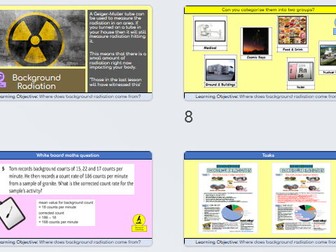
Complete GCSE Physics lesson deck on background radiation sources, dosage units (Sv/mSv), geographical variation, and corrected count rate math. Key Features:Structured Slide Deck (18 Slides): Follows pedagogical routines (Activate Prior Knowledge, Turn & Talk, New Knowledge, Worked Calculations, and Review of Learning). Natural vs. Artificial Source Classification: Breaks down natural sources (Radon gas from granite, cosmic rays, food/drink, rocks/buildings) versus man-made sources (medical X-rays, nuclear power, fallout from weapons testing/accidents). Geographical & Environmental Context: Explores radiation maps of the UK (high-radon areas such as Cornwall, Devon, and Aberdeen) and explains basement ventilation necessity. Radiation Dose & Units: Introduces sieverts (Sv) and millisieverts (mSv), discussing average UK annual exposure (~2200 µSv) and factors influencing dosage (location, altitude, occupation). Practical Math Skills (Corrected Count Rate): Includes step-by-step worked calculations for subtracting mean background count rates from measured sample activity. Worksheet & Review Tasks: Features a double-sided “Science Geeks” background radiation activity sheet with full answer keys. Included Resources:P4.9 Background radiation.pptx (18-slide complete presentation with integrated tasks and answers)
GCSE Triple Physics Nuclear Fission & FusionQuick View
s_jackson11

GCSE Triple Physics Nuclear Fission & Fusion

(0)
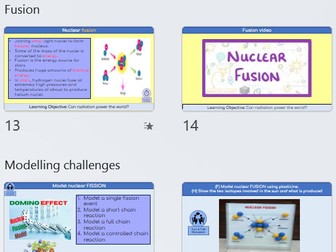
Complete AQA GCSE Physics Triple Science lesson on Nuclear Fission & Fusion with dual-coded slides, exam questions, mark schemes, and hands-on modeling. Save planning time with this fully resourced, ready-to-teach 27-slide PowerPoint presentation tailored for AQA GCSE Physics (Triple Science / Separate Physics - Unit 4 Paper 1). Built around explicit instruction, retrieval practice, and interactive modeling, this lesson ensures high student engagement while embedding key spec content. Pedagogy & Dual-Coding: Uses structured visual icons throughout to guide learning routines (Prior Knowledge, New Knowledge, Turn & Talk, Deliberate Practice, You DO). Core Curriculum Topics: Covers nuclear fission (unstable nuclei splitting, chain reactions, power stations vs. weapons) and nuclear fusion (joining light nuclei, energy conversion in stars). Embedded Exam Practice: Includes genuine AQA-style exam questions with step-by-step mark schemes for instant feedback and self-assessment. Interactive Modeling Activities: Includes practical group tasks using everyday items (dominoes/marbles for fission chain reactions and modeling fusion). Retrieval & Differentiated Tasks: Includes “Odd One Out” retrieval grids, half-life calculation review, and comparative analysis tasks between fission and fusion. Embedded Video Links: Curated visual aids to consolidate student understanding of complex processes. What’s Included:1 x 27-Slide Fully Editable PowerPoint Presentation
KS3/GCSE Renewable & Non-Renewable EnergyQuick View
s_jackson11

KS3/GCSE Renewable & Non-Renewable Energy

(0)
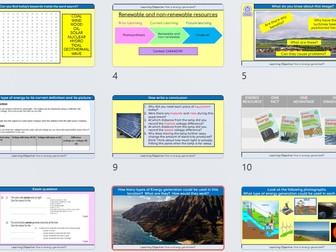
Complete KS3/GCSE Science lesson & practical on Renewable & Non-Renewable Energy with dual-coded slides, solar panel lab, word search, and exam tasks. Full Description BodySave hours of lesson preparation with this comprehensive, engaging, and ready-to-teach 20-slide PowerPoint presentation focusing on Renewable and Non-Renewable Energy Resources (KS3 / GCSE Science & Chemistry). Structured around cognitive load theory and explicit instruction routines, this resource incorporates visual dual-coding icons to seamlessly guide students through retrieval practice, practical investigation, and exam application. Key Features & Included Content:Structured Pedagogy & Dual-Coding: Features clear icon indicators throughout (Prior Knowledge, New Knowledge, Turn & Talk, Deliberate Practice, You DO, Review of Learning). Interactive Starter & Retrieval: Includes a customized “Types of Energy” word search starter activity to introduce key vocabulary early. Core Curriculum Concepts: Clear definitions and categorizations of renewable vs. non-renewable energy sources (Coal, Oil, Gas, Nuclear, Solar, Wind, Hydro, Tidal, Geothermal, Wave, Biomass). Hands-on Solar Cell Practical: Complete lab investigation investigating how light intensity and distance affect solar panel output (includes aims, predictions, data tables, risk assessment, and conclusion prompts). Real-World & Visual Scenarios: Photo analysis tasks evaluating real-world geography and locations suitable for specific renewable installations (e.g., coastal cliffs, windy valleys, geothermal ground sources). Differentiated Summary Tasks: Includes matching tables, copy-and-complete cloze passages, and advantage/disadvantage sorting matrices. Exam-Style Practice & Answers: Features real exam questions on solar cell and wind turbine limitations paired with full mark schemes for instant feedback. What’s Included:1 x 20-Slide Fully Editable PowerPoint Presentation
Year 8 Science: Crude Oil & Fractional DistillationQuick View
s_jackson11

Year 8 Science: Crude Oil & Fractional Distillation

(0)
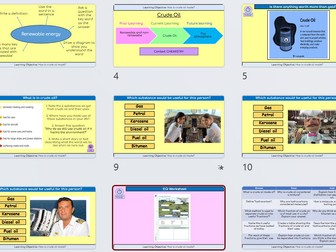
Power Up Your GCSE Chemistry Lessons with a Complete, Ready-to-Teach Package! Looking for a fully planned, low-prep chemistry lesson on Crude Oil, Hydrocarbons, and Fractional Distillation? This comprehensive resource pack aligns with evidence-based pedagogy—featuring explicit instruction, dual coding, turn-and-talk activities, and tiered differentiation. What’s Included? 17-Slide Presentation (PPTX): Clean, engaging slide deck incorporating prior learning retrieval, clear diagrams of oil formation and fractional distillation, structured I Do / We Do / You Do modelling, and thought-provoking discussion prompts. Bronze / Silver / Gold Tiered Worksheets (PDF): Scaffolds learning for all abilities—ranging from foundational definitions (Bronze) to multi-step explanations of boiling points and environmental impacts (Gold). Complete Support & Main Worksheets with Full Answer Keys (PDFs): Includes dedicated support worksheets and detailed mark schemes for instant self-assessment or fast teacher marking. Key Features & Learning Objectives: Pedagogy-First Structure: Built around clear learning goals, prior knowledge retrieval, dual-coded visual icons, and deliberate practice. Comprehensive Coverage: Covers crude oil formation, hydrocarbon properties, the 6 key fractions (Gas, Petrol, Kerosene, Diesel, Fuel Oil, Bitumen), and fractional distillation. Built-in Differentiation: Includes Bronze/Silver/Gold challenge tasks, support sheets for lower-attaining students, and synoptic extension questions exploring alternative energy and environmental impacts. Instant Classroom Readiness: Download, project, print, and teach immediately—saving hours of lesson planning time!
KS3 Science: The Carbon Cycle & Global WarmingQuick View
s_jackson11

KS3 Science: The Carbon Cycle & Global Warming

(0)
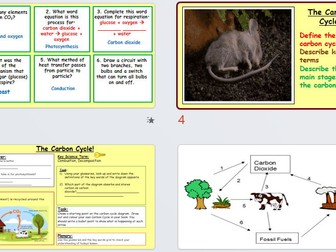
Power up your Key Stage 3 Science curriculum with a complete, low-prep Year 8 lesson pack on the Carbon Cycle, Atmospheric Changes, and Global Warming. Fully aligned with evidence-based pedagogy—featuring retrieval practice, visual modeling, practical diagram-building tasks, and targeted support for SEN students. What’s Included? Comprehensive Lesson Deck (PPTX): Includes structured retrieval starters, clear visual diagrams, embedded video links, step-by-step modeling, and consolidation tasks tailored for KS3/Year 8 learners. Student Worksheet Package (DOCX/PDF): Diagram labeling tasks, process identification (photosynthesis, respiration, combustion, decomposition, feeding), and analytical short-answer questions. Dedicated SEN Support Resources (PPTX): Accessible, scaffolded presentation with visual cues, key term glossaries, simplified diagram tasks, and structured starters/plenaries. Key Features & Learning Objectives: Core Biological & Chemical Processes: Master key terms including photosynthesis, respiration, combustion, decomposition, and feeding/digestion. Atmospheric & Climate Connections: Explores historical shifts in the Earth’s atmosphere, greenhouse gas emissions, and global warming impacts. Hands-On & Interactive Learning: Features an interactive model-building poster task (sky/ground/underground layers) to solidify understanding. Instant Classroom Readiness: Download, project, print, and teach immediately—saving hours of lesson planning time!
KS3 Science: Global Warming & Forest FiresQuick View
s_jackson11

KS3 Science: Global Warming & Forest Fires

(0)
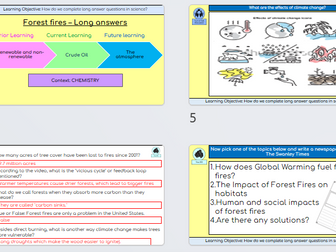
Enhance your Key Stage 3 Chemistry and Science curriculum with a high-impact Year 8 lesson on Global Warming, Climate Change Effects, and Forest Fires. This lesson focuses on developing extended scientific writing and critical evaluation skills, structured using evidence-based pedagogy with dual-coded icons and clear scaffolding. What’s Included? 15-Slide Presentation Deck (PPTX): Built around structured lesson phases—Activate Prior Knowledge, New Knowledge, Turn & Talk, Modeling, and Extended Writing. Embedded Video Analysis & Questions: Guided retrieval activities exploring wildfire statistics, carbon sinks, and climate feedback loops. Positive vs. Negative Impact Sorting Task: Interactive statements card-sort evaluating the social, environmental, and economic impacts of climate change. Differentiated Writing Tasks: Includes a newspaper report template (“The Swanley Times”) and a 4-minute continuous writing prompt with structured model answers on key topics (feedback loops, habitat destruction, social impacts, and solutions). Key Features & Learning Objectives: Extended Writing Focus: Explicitly guides Year 8 pupils on how to construct long-answer, extended scientific responses in Chemistry/Environmental Science. Scientific Concepts: Teaches carbon sinks, greenhouse gases, feedback loops, ecosystem destruction, and human/economic impacts. Pedagogy-Focused Design: Incorporates dual-coded slide icons for easy classroom navigation, prior knowledge retrieval, and structured discussion prompts. Zero Prep Needed: Fully planned, projectable, and ready to teach immediately.
KS3 Science: Speed, Distance & Time CalculationsQuick View
s_jackson11

KS3 Science: Speed, Distance & Time Calculations

(0)
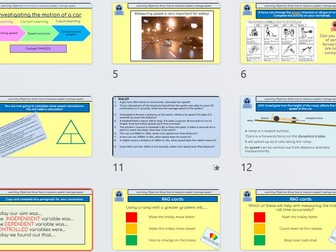
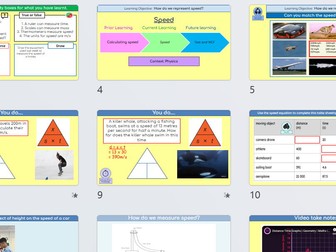
Power up your Key Stage 3 Physics curriculum with a complete, low-prep Year 8 lesson pack on Speed Calculations, Motion, and Investigating Variables. Fully aligned with evidence-based pedagogy—featuring structured retrieval starters, worked formula triangle modeling (I Do / We Do / You Do), a hands-on practical investigation (trolley down a ramp), and differentiated student worksheets. What’s Included? 25-Slide Presentation Deck (PPTX): Clean visual layout incorporating dual-coded icons, prior learning retrieval, worked speed calculation examples ( Speed=Distance/Time), step-by-step practical setup, and team quiz plenary. Trolley & Ramp Practical Investigation Worksheet (DOCX): Structured planning and evaluation template covering independent, dependent, and control variables, equipment tables, prediction prompts, and data collection grid with mean speed calculations. Differentiated Speed Calculation Worksheets (DOCX): Scaffolds speed, distance, and time problems—from real-world speed comparisons (Usain Bolt, animals, vehicles) to unit conversions (m/s, mph, km/h) and short-answer reasoning questions. Key Features & Learning Objectives: Physics Formula Mastery: Teaches pupils how to rearrange and calculate speed, distance, and time using the standard formula triangle. Hands-On Practical & Scientific Enquiry: Guides pupils through measuring the effect of ramp height on mean trolley speed while identifying and controlling variables for valid results. Built-in Scaffolding & Pedagogy: Features dual-coded slide indicators for clear classroom management, low-stakes retrieval quizzes, RAG card check-ins, and structured support/extension tasks. Instant Classroom Readiness: Download, print, project, and teach immediately—saving hours of planning time! 4. Investigating the motion of a car.pptx
KS3 Science: Distance-Time Graphs & MotionQuick View
s_jackson11

KS3 Science: Distance-Time Graphs & Motion

(0)
Complete your KS3 Physics unit on Motion with a comprehensive Year 8 lesson pack on Distance-Time Graphs, Gradient Analysis, and Speed Calculations. Built in line with structured T&L frameworks (The Orchards Way), this low-prep resource guides students from basic graph interpretation to calculating gradients and writing motion narratives. What’s Included? 21-Slide Presentation Deck (PPTX): Includes prior learning retrieval (forces and speed equations), visual video link integration, step-by-step graph section breakdowns (stationary, constant speed, acceleration, returning to start), and an end-of-unit 30-mark speed test slide. SEN & Differentiated Graph Worksheets (PPTX): Scaffolding prompts featuring fill-in-the-blank starter tasks, key term glossaries, structured graph labeling activities, and pre-grid paper templates. Creative Motion Graph Story Activity (PPTX): Multi-modal task prompting students to plot journeys involving walking, trains, buses, and waiting times using custom distance/time axes. Key Features & Learning Objectives: Graph Interpretation & Gradient Analysis: Teaches pupils how to read horizontal lines (stationary), diagonal lines (steady speed), and steep slopes (accelerating/speeding up) on distance-time graphs. Mathematical & Problem-Solving Skills: Scaffolds calculating speed directly from graph gradients alongside speed-distance-time formula triangles. Inclusive & Differentiated: Includes tailored SEN options, visual key term supports, and extended “Convince Me!” reasoning challenges for higher-ability learners. Instant Classroom Readiness: Fully planned, editable slides and projectable activity sheets ready for immediate teaching.
KS3 Biology: Complete lesson on Photosynthesis Limiting FactorsQuick View
s_jackson11

KS3 Biology: Complete lesson on Photosynthesis Limiting Factors

(0)
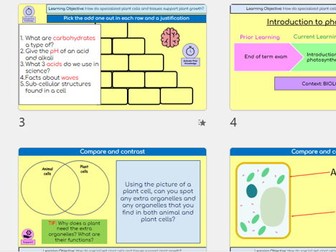
Complete KS3 Biology lesson covering limiting factors of photosynthesis (light, CO2, temp). Includes scientific variables practice & exam questions. Key Features:Comprehensive 21-Slide Presentation: Structured PowerPoint deck exploring how light intensity, carbon dioxide concentration, and temperature dictate rates of photosynthesis. Real-World & Commercial Applications: Features commercial greenhouse case studies showing how artificial lighting and heating maximize plant growth and crop yield. Working Scientifically Skills: Dedicated activities sorting Independent, Dependent, and Control variables, reinforcing experimental design across science topics. Structured Pedagogy: Built-in “Turn & Talk” discussions, video comprehension prompts, interactive Bitesize simulation links, and RAG-card quick checks. Exam & Deliberate Practice: Includes exam-style application questions with model answers for self or peer assessment. Included Resources:4. Limiting factors.pptx (21-slide PowerPoint presentation) Bonus: Compatible with standard science investigation planning worksheets.
GCSE Physics: Alpha, Beta & Gamma RadiationQuick View
s_jackson11

GCSE Physics: Alpha, Beta & Gamma Radiation

(0)
Complete GCSE Physics lesson deck covering alpha, beta, and gamma properties, penetration power, ionisation, standard form practice, and industrial uses. Key Features:Structured Slide Deck (23 Slides): Built following explicit instruction routines (Activate Prior Knowledge, New Knowledge, Partner Discussion, You DO activities, and Plenary). Core Physics Concepts: Explains radioactive decay, activity (Bq), count-rate, and the properties of Alpha (alpha), Beta (beta), and Gamma (gamma) radiation. Penetration & Ionisation Analysis: Covers range in air, absorbing materials (paper, aluminium, lead), and relative ionising power dislodging electrons. Real-World Applications & Context: Features real-world case studies like the Chernobyl disaster, Geiger-Müller counter demonstrations, and background radiation in natural rocks. Industrial & Medical Uses Worksheets: Includes structured job-matching tasks for thickness control, sterilisation, smoke detectors, pipe leak tracers, and radiotherapy cancer treatment. Interactive Activities & Math Practice: Contains standard form matching drills, “Around the Room” diagnostic cards, paired “Heads Up” revision games, and homework mark schemes. Included Resources:P4.4 Types of radiation.pptx (23-slide complete lesson presentation)
GCSE Physics: Predicting Types of RadiationQuick View
s_jackson11

GCSE Physics: Predicting Types of Radiation

(0)
Complete GCSE Physics lesson deck covering radioactive decay, experimental design for count-rate/penetration, graph skills (SLURP), and exam practice. Key Features: Structured Slide Deck (16 Slides): Built following Orchards Way explicit instruction routines (Activate Prior Knowledge, Turn & Talk, Deliberate Practice, and Review of Learning). Experimental Design & Practical Skills: Scaffolds student tasks for designing experiments using a Geiger-Müller counter, clamps, rulers, absorbers, and radioactive sources to measure count rates and penetration power. Graphing Skills Integration: Features “SLURP” graphing rules (Scale, Line of best fit, Units, Axis, Plotting) to embed practical data skills. Hands-on Analogies & Engagement: Uses table tennis ball stack activities to demonstrate nuclear instability and paired “Heads Up” key term games. Exam Questions & Official Mark Schemes: Includes exam-style practical questions analyzing lead sheet absorber data alongside official mark schemes. Included Resources:P4.5 Predicting types of radiation.pptx (16-slide complete lesson presentation) EQ Practical question.docx
GCSE Physics: Nuclear Equations & DecayQuick View
s_jackson11

GCSE Physics: Nuclear Equations & Decay

(0)
Complete GCSE Physics lesson deck and practice sheet covering alpha, beta, and gamma nuclear decay equations, decay series, and exam mark schemes. Key Features:Structured Slide Deck (26 Slides): Formatted using pedagogical routines (Activate Prior Knowledge, Turn & Talk, I Do/We Do/You Do, and Deliberate Practice). Comprehensive Decay Coverage: Step-by-step guidance on writing and balancing nuclear equations for Alpha (alpha), Beta (beta), and Gamma (gamma) decay, including decay series tracing (Uranium to Lead). Real-World Contexts & Misconception Hooks: Includes real-world prompts (e.g., Chernobyl disaster, distant galaxy red-shift retrieval) to engage students before nuclear mechanics. Tiered Practice & Differentiation: Contains scaffolded tasks for balancing atomic/mass numbers alongside extended challenges (determining neutron counts and identifying daughter nuclides using the periodic table). Exam Questions & Official Mark Schemes: Features authentic AQA/GCSE-style exam questions on decay equations and multi-step decay pathways with official mark schemes. Included Resources:P4.6 Nuclear equations.pptx (26-slide complete lesson presentation) Nuclear chemistry equations practice sheet
GCSE Physics: Contamination vs IrradiationQuick View
s_jackson11

GCSE Physics: Contamination vs Irradiation

(0)
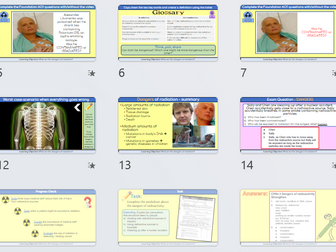
Complete GCSE Physics lesson deck on radioactive contamination vs. irradiation, health risks, medical applications, and lab safety precautions. Key Features:Structured Slide Deck (26 Slides): Formatted following routines (Activate Prior Knowledge, Turn & Talk, I Do/We Do/You Do, and Deliberate Practice). Contamination vs. Irradiation Comparison: Clearly distinguishes between external exposure (irradiation) and internal/surface radioactive presence (contamination) using comparison tables and scenario checks. Real-World & Case Study Hooks: Integrates engaging contexts such as the Alexander Litvinenko Polonium-210 poisoning case, food gamma irradiation (strawberries), and Cheronbyl fallout. Biological Dangers & Medical Applications: Examines radiation dosage effects (DNA mutations, cancer risk, tissue burns) alongside industrial and medical uses (cancer therapy, radioactive tracing, food preservation). Lab & Hospital Safety Precautions: Details protocols for handling sources (tongs, lead-lined storage boxes, dosimeter badges, distance/time limiting). Embedded Worksheets & Mark Schemes: Features Edexcel/GCSE-aligned practice questions, scenario worksheets, and mark schemes for instant feedback. Included Resources:P4.8 Contamination vs Irradiation.pptx (26-slide complete presentation with integrated tasks and answers)
GCSE Physics: Half-Life & Decay CalculationsQuick View
s_jackson11

GCSE Physics: Half-Life & Decay Calculations

(0)
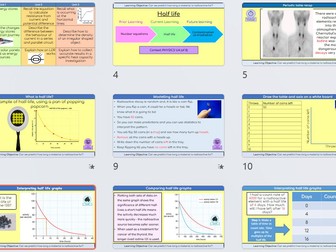
Complete GCSE Physics lesson deck on radioactive half-life, decay calculations, graph analysis, coin/popcorn modeling activities, and exam questions. Key Features:Structured Slide Deck (30 Slides): Designed around teaching routines (Activate Prior Knowledge retrieval grids, New Knowledge, Turn & Talk, I Do/We Do/You Do modeling, and Deliberate Practice). Conceptual & Hands-on Modeling: Features relatable analogies (popcorn popping rates and 50-coin flip simulations) to demonstrate the random nature of decay and half-life statistics. Graph Analysis & Calculations: Teaches students how to extract half-life values from activity-time curves (e.g., Caesium-137, Iodine isotopes, Potassium-40) and perform step-by-step table/ratio decay calculations. Real-World Medical & Environmental Contexts: Connects decay rates to real-world scenarios including the 1986 Chernobyl nuclear disaster fallout and medical thyroid cancer treatments using Iodine isotopes. Exam Questions & Mark Scheme: Includes exam practice covering decay randomness, isotope decay equations, half-life determination from graphs, and penetration detection with full mark scheme answers included. Included Resources:P4.7 Half life.pptx (30-slide complete lesson presentation with embedded tasks and answer keys)
GCSE Physics: Atomic Mass, Numbers & IsotopesQuick View
s_jackson11

GCSE Physics: Atomic Mass, Numbers & Isotopes

(0)
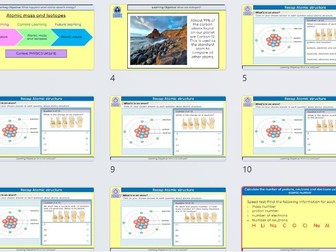
Complete GCSE Physics lesson deck exploring atomic numbers, mass numbers, isotopes, RAM calculations, homework tasks, and 6-mark exam questions. Key Features: Structured Presentation (21 Slides): Follows standard pedagogy (Activate Prior Knowledge, Turn & Talk, You DO tasks, and Exam Practice). Interactive Prior Knowledge Checks: Built-in 10-question multiple-choice recap covering atomic structure, charges, relative particle masses, and atomic/mass numbers. Core Physics & Chemistry Concepts: Defines atomic number, mass number, isotopes (e.g., Carbon-12, Carbon-13, Carbon-14, Lithium, and Hydrogen isotopes), and Relative Atomic Mass (RAM). Differentiated Practical Tasks & Homework: Includes complete printable homework activity sheets with full mark schemes explaining isotopic proportions (e.g., Chlorine-35 vs. Chlorine-37). GCSE Exam Practice & Scaffolding: Features short exam-style questions as well as a full 6-mark extended-writing question detailing the three isotopes of hydrogen (Protium, Deuterium, Tritium) with clear model answers. Included Resources:P4.2 Atomic Mass and Isotopes NEW.pptx
KS3 Science: Complete PowerPoint lesson on Plant Cells & Leaf StructureQuick View
s_jackson11

KS3 Science: Complete PowerPoint lesson on Plant Cells & Leaf Structure

(0)
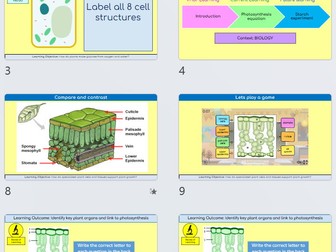
Complete KS3 Biology lesson on specialized plant cells, tissue structure, and leaf adaptations. Includes retrieval practice, diagrams, and quizzes. Key Features: Fully Resourced Presentation: 35 structured PowerPoint slides designed around explicit instruction and dual-coding principles. Clear Learning Journey: Covers Year 7 retrieval (plant cell organelles) through to Year 8 core concepts (leaf cross-sections, palisade/spongy mesophyll, stomata, and plant organs). Embedded Pedagogy: Built-in “Activate Prior Knowledge”, “Turn & Talk”, modeling (“I Do / We Do / You Do”), and differentiation prompts. Assessment & Retrieval: Features interactive checking activities, leaf cross-section labeling games, and quick end-of-lesson review questions. Adaptable Format: Easily editable PowerPoint format suitable for KS3 Science curriculum units on Bioenergetics and Plant Structure. Included Resources: 1 x 35-slide PowerPoint presentation (.pptx)
KS3 Science: Complete lesson Photosynthesis Word EquationQuick View
s_jackson11

KS3 Science: Complete lesson Photosynthesis Word Equation

(0)
Complete KS3 Biology lesson exploring reactants, products, and word equations for photosynthesis. Features retrieval tasks, video prompts, and quizzes. Key Features:Fully Resourced Presentation: 21 structured PowerPoint slides focusing explicitly on building and understanding the photosynthesis word equation. Core Curriculum Content: Guides students through identifying raw materials (carbon dioxide + water), products (glucose + oxygen), and necessary conditions (light energy & chlorophyll). Integrated Retrieval Practice: Includes prior knowledge activation on plant cell structures, leaf cross-sections, and plant organ functions to solidify past learning. Structured Pedagogy: Built-in “Turn & Talk” discussion breaks, explicit instruction slides, and targeted quick-check questioning. Versatile & Editable: Easily customizable PowerPoint deck aligned with KS3 National Curriculum Science requirements for Bioenergetics. Included Resources:1 x 21-slide PowerPoint presentation (.pptx)
KS3 Biology: Complete lesson on Testing Leaves for Starch PracticalQuick View
s_jackson11

KS3 Biology: Complete lesson on Testing Leaves for Starch Practical

(0)
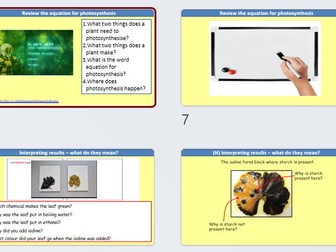
Complete KS3 Biology practical lesson testing leaves for starch. Includes PowerPoint presentation, student worksheets, step-by-step method, and risk assessments. Key Features: Complete Practical Pack: Includes a 12-slide presentation alongside structured student worksheets and a tick-list practical guide. Step-by-Step Practical Methodology: Breaks down the testing procedure clearly Safety & Risk Assessment Focus: Features explicit guidance on handling flammable ethanol using a water bath rather than a naked flame, with risk assessment tables for students. Data Interpretation & Analysis: Structured post-lab activities evaluating light vs. dark leaves and variegated leaves to link starch production back to photosynthesis and chlorophyll. Retrieval Practice: Begins with retrieval questions covering previous biology and physics concepts to reinforce past learning. Included Resources:3. Starch experiment.pptx (12-slide PowerPoint presentation) Starch test for two leaves.docx (Structured lab write-up and worksheet) Student tick list starch experiment.docx (Step-by-step practical checklist)
KS3/GCSE Biology: Complete lesson on Pondweed Photosynthesis PracticalQuick View
s_jackson11

KS3/GCSE Biology: Complete lesson on Pondweed Photosynthesis Practical

(0)
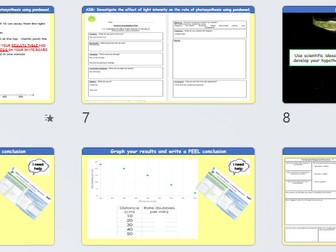
Complete KS3/GCSE Biology required practical investigating light intensity on pondweed. Includes 14 slides, investigation sheets, graphing, and exam practice. Key Features: Full Practical Presentation (14 Slides): Walks students through setting up the pondweed experiment, collecting oxygen bubble data, and evaluating experimental variables. Cross-Curricular Graphing Skills: Integrates mathematical graph-plotting rules (SLURP: Scale, Label, Units, Ruler, Plot) alongside PEEL paragraph conclusions. Student Planning & Investigation Worksheets: Accompanied by printable two-page science investigation planning sheets (.doc) covering variables, predictions, and methods. Exam & Summary Practice: Features authentic GCSE-style practical exam questions (e.g., explaining LED lamp benefits, heat shields, and enzyme temperature effects) with complete mark schemes. Flexible Video/Virtual Lab Support: Includes video links and interactive simulation prompts for students conducting virtual trials or absent during lab days. Included Resources:Limiting factors practical.pptx (14-slide PowerPoint presentation) Practical video lesson.pptx (7-slide video-led presentation deck) Copy of science_investigation_sheets_2.doc (2-page printable practical planning sheet)