 Quick View
Lady Wonder: The Psychic Crime-Solving Horse Readers' Theatre Script
Included in the Lady Wonder: The Psychic Crime-Solving Horse Readers’ Theatre Unit:
6 page script
8 characters
1-3 narrators
Student Success Criteria
Student Friendly Goals
Teacher’s Reader’s Theatre Checklist
Drawing Conclusions about Characters Activity
Lady Wonder: The Psychic Crime-Solving Horse synopsis:
In 1955, little Ronnie Weitcamp goes missing during a game of hide and seek with his friends. He goes deep into the forest asking his friend to chase him but is warned not to do so. Shortly thereafter, the police and Ronnie’s mother are searching for Ronnie, but they do not find him. The police have exhausted all leads in the case, so Officer Randolph suggests asking Lady Wonder, the psychic horse. She successfully solved a child disappearence years ago. Fearing nothing to lose, Detective Gary reluctantly travels to Lady Wonder’s stable for some answers. Stable keeper Martha warns Detective Gary that Lady Wonder is older now and may not answer any or all of his questions. Detective Gary takes out his notepad and proceeds to question Lady Wonder. Will it lead him to little Ronnie? Can Lady Wonder be trusted? Would you trust a horse to answer life or death questions? Find out in the Lady Wonder: The Psychic Crime-Solving Horse readers’ theatre unit!
Mr. Marvel’s Musings:
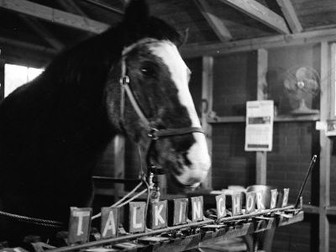
Lady Wonder (1924-1957) was a real horse that predicted events, elections, supposedly had psychic powers, and solved crimes. Your students can research the real Lady Wonder and see if she was legitmate in her findings and predictions or if they were suspicious.
Do not fear the reader’s theater format. Students love these adapted stories because they are listening to the story and they are a part of the story by playing a character within the story.
Reader’s theatre inspires reluctant readers to join in the fun. The strongest and most advanced readers in your class will encourage other students to raise their hand and participate in the story. I also use reader’s theatre to add to my drama marks.
If the reader’s theatre format did not work for my students and I, then I would have stopped creating and adapting them years ago.
Reluctant readers sometimes feel anxious looking at pages of text, whereas a reader’s theater script is broken up into narration and different characters speaking, thus making the story more accessible to those students who have not discovered the incredibly fun activity of reading for entertainment.
I use shorter stories with minimal characters in literature circles. When can one make time for a reader’s theatre story in class?
I hope you, and your students enjoy reading Lady Wonder: The Psychic Crime-Solving Horse Theatre script.
Excelsior!
Mr. Marvel: The King of Reader’s Theatre