session 1 - ages 15-17 - Exploring advanced 3D printing WSQuick View
j_k_arthur69

session 1 - ages 15-17 - Exploring advanced 3D printing WS

(0)
a simple worksheet made up of 6 parts asking pupils to complete tasks in each section, and a bonus section. sections included; 1 - advanced concepts in 3D printing 2 - emerging technologies in 3D printing 3 - industry applications 4 - 3D printing design and software 5 - career exploration in 3D printing 6 - critical analysis and future trends bonus - industry partnership projects This can be used as a standalone research task or can be broken down into individual tasks to be used as necessary
session 2 ages 15-17 - advanced types of 3D printing technologiesQuick View
j_k_arthur69

session 2 ages 15-17 - advanced types of 3D printing technologies

(0)
a simple worksheet made up of 4 parts asking pupils to complete tasks in each section, and a bonus section. sections included; 1 - advanced types of 3D printing technologies 2 - advantages and disadvantages 3 - application exploration of each type 4 - comparison table This can be used as a standalone research task or can be broken down into individual tasks to be used as necessary
session 3 age 11-14 - components of a 3D printerQuick View
j_k_arthur69

session 3 age 11-14 - components of a 3D printer

(0)
a simple worksheet made up of 4 parts asking pupils to complete tasks in each section. Sections included; 1 - components identification 2 - troubleshooting basics 3 - maintenance and calibration 4 - real world application Page 3 includes pictures of a 3D printer to be labelled and used with section 1. This can be used as a standalone research task or can be broken down into individual tasks to be used as necessary
session 1  - ages 11-14 - Exploring 3D printing WSQuick View
j_k_arthur69

session 1 - ages 11-14 - Exploring 3D printing WS

(0)
a simple worksheet made up of 6 parts asking pupils to complete tasks in each section, and a bonus section. sections included; 1 - introduction to 3D printing 2 - types of 3D printing 3 - applications of 3D printing 4 - 3D printing in action 5 - design your 3D object 6 - reflection bonus: design a 3D printing poster This can be used as a standalone research task or can be broken down into individual tasks to be used as necessary
session 5 - ages 11-14 - introduction to 3D modelling softwareQuick View
j_k_arthur69

session 5 - ages 11-14 - introduction to 3D modelling software

(0)
a simple worksheet made up of 4 parts asking pupils to complete tasks in each section. Sections included; 1 - understanding 3D modelling 2 - basics of 3D modelling software 3 - creating basic shapes 4 - designing a simple object This can be used as a standalone research task or can be broken down into individual tasks to be used as necessary. note: TinkerCAD is my software of choice when first starting to teach about 3D modelling. It is an excellent online based software tool very accessible to students with a good user interface and tutorial to allow students to develop at their own pace, as well as having a number of other useful features like being able to set up classes where students can save work and you have access to their gallery of designs
session 6 ages 11-14 - advanced 3D designQuick View
j_k_arthur69

session 6 ages 11-14 - advanced 3D design

(0)
Tasks on worksheet: 1 - Advanced 3D Design Basics 2 - Designing Complex Objects 3 - Design Principles for 3D Printing 4 - Design Thinking for Projects Conclusion This can be used as a standalone research task or can be broken down into individual tasks to be used as necessary. note: TinkerCAD is my software of choice when first starting to teach about 3D modelling. It is an excellent online based software tool very accessible to students with a good user interface and tutorial to allow students to develop at their own pace, as well as having a number of other useful features like being able to set up classes where students can save work and you have access to their gallery of designs
session 3 ages 15-17 - components of a 3D printerQuick View
j_k_arthur69

session 3 ages 15-17 - components of a 3D printer

(0)
a simple worksheet made up of 4 parts asking pupils to complete tasks in each section. Sections included; 1 - components identification 2 - troubleshooting basics 3 - maintenance and calibration 4 - real world application Page 3 includes pictures of a 3D printer to be labelled and used with section 1. This can be used as a standalone research task or can be broken down into individual tasks to be used as necessary
session 7 - ages 15-17Quick View
j_k_arthur69

session 7 - ages 15-17

(0)
a simple worksheet made up of 4 parts asking pupils to complete tasks in each section. Sections included; 1 - Introduction to Bioprinting 2 - Applications of Bioprinting 3 - Introduction to Metal Printing 4 - Applications of Metal Printing 5 - conclusion: Reflect on the potential impact of bioprinting and metal 3D printing in various fields. How might these technologies revolutionize industries? This can be used as a standalone research task or can be broken down into individual tasks to be used as necessary
session 7 - ages 11-14Quick View
j_k_arthur69

session 7 - ages 11-14

(0)
a simple worksheet made up of 4 parts asking pupils to complete tasks in each section. Sections included; 1 - Exploring Advanced Technologies 2 - Applications of Advanced Technologies 3 - Bioprinting and Metal Printing 4 - Future Trends in Printing Technologies 5 - conclusion to reflect on the exciting possibilities of 3D printing and its potential impact This can be used as a standalone research task or can be broken down into individual tasks to be used as necessary
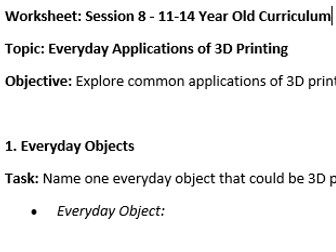
session 8 - ages 11-14 - Everyday Applications of 3D PrintingQuick View
j_k_arthur69

session 8 - ages 11-14 - Everyday Applications of 3D Printing

(0)
a simple worksheet made up of 5 parts asking pupils to complete tasks in each section. Sections included; 1 - Everyday Objects 2 - 3D Printing in Daily Life 3 - Customization with 3D Printing 4 - Personal 3D Printing Project 5 - conclusion This can be used as a standalone research task or can be broken down into individual tasks to be used as necessary
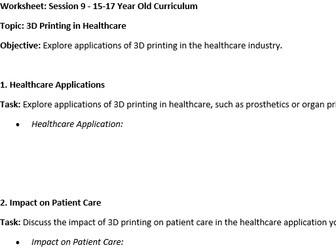
session 9 - ages 15-17 - 3D Printing in HealthcareQuick View
j_k_arthur69

session 9 - ages 15-17 - 3D Printing in Healthcare

(0)
a simple worksheet made up of 5 parts asking pupils to complete tasks in each section. Sections included; 1 - Healthcare Applications 2 - Impact on Patient Care 3 - Advances in Medical Technology 4 - Future Developments 5 - Conclusion This can be used as a standalone research task or can be broken down into individual tasks to be used as necessary
session 10 - ages 11-14 - designing a miniature townQuick View
j_k_arthur69

session 10 - ages 11-14 - designing a miniature town

(0)
a simple worksheet made up of 4 parts asking pupils to complete tasks in each section. this is a very basic scaffolding worksheet to help guide students. It will be best used as guidance for the teacher when introducing the project. Sections included; 1 - Introduction to the Project 2 - Town Planning 3 - Assigning Roles 4 - Collaborative Design 5 - Conclusion
session 9 - ages 11-14 - 3D Printing art and creativityQuick View
j_k_arthur69

session 9 - ages 11-14 - 3D Printing art and creativity

(0)
a simple worksheet made up of 4 parts asking pupils to complete tasks in each section. Sections included; 1 - Artistic Applications 2 - Hands-on Art Project 3 - Personal Reflection 4 - Artistic Possibilities 5 - Conclusion This can be used as a standalone research task or can be broken down into individual tasks to be used as necessary
session 11 - ages 15-17 - Ethical Implications of 3D PrintingQuick View
j_k_arthur69

session 11 - ages 15-17 - Ethical Implications of 3D Printing

(0)
a simple worksheet made up of 8 parts asking pupils to complete tasks in each section. section 2 and 3 case studies can be personalised and changed if required, it will not impact the outcome as long as it relates to the case study topics. Sections included; 1 - Introduction to Ethical Considerations 2 - Case Study: Intellectual Property 3 - Case Study: Weapons Production 4 - Privacy and Surveillance 5 - Environmental Impact 6 - Accessibility and Equity 7 - Personal Reflection 8 - Mitigating Ethical Concerns 9 - Conclusion This can be used as a standalone research task or can be broken down into individual tasks to be used as necessary.
session 11 - ages 11-14 - Future of 3D PrintingQuick View
j_k_arthur69

session 11 - ages 11-14 - Future of 3D Printing

(0)
a simple worksheet made up of 8 parts asking pupils to complete tasks in each section. Sections included; 1 - Current State of 3D Printing 2 - Emerging Materials 3 - Sustainable 3D Printing 4 - Bioprinting Exploration 5 - Integration with Other Technologies 6 - Personal Predictions 7 - Impact on Industries 8 - Ethical Considerations 9 - Conclusion This can be used as a standalone research task or can be broken down into individual tasks to be used as necessary
session 12 - ages 11-14 - 3D Print ShowcaseQuick View
j_k_arthur69

session 12 - ages 11-14 - 3D Print Showcase

(0)
a simple worksheet made up of 8 parts designed for the teacher to lead the lesson. suggested timings and activities are included. Sections included; 1 - Introduction and Overview (5 minutes) 2 - Showcase Preparation (5 minutes) 3 - Project Presentation (15-20 minutes) 4 - Collaborative Showcase (10 minutes) 5 - Reflection and Discussion (5-10 minutes) 6 - Future Projects Brainstorming (5-10 minutes) 7 - Conclusion and Next Steps (5-10 minutes) 8 - Homework Assignment This can be done in 1 hour if class behaviour is no issue and some teacher preparations are made in setting up presentation areas. Timings will otherwise be tight. I would suggest this be done over a 1.5 hour lesson or two 1 hour lessons.
15-17 year olds - 12 lesson exit questionsQuick View
j_k_arthur69

15-17 year olds - 12 lesson exit questions

(0)
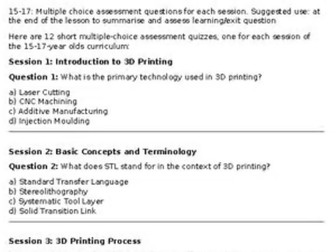
The file contains a set of 12 multiple-choice questions designed to assess students’ understanding of topics covered in a 3D printing curriculum for 15-17-year-olds. Each question corresponds to a session in the curriculum, addressing concepts such as basic and advanced 3D printing technologies, materials, design considerations, troubleshooting, practical skills, and future trends. The assessments emphasize key learning points, including post-processing, industry applications, and innovations in 3D printing. Correct answers for each question are also provided for reference. These questions are ideal for summarizing and evaluating student learning at the end of each lesson.
11-14 year olds - 12 lesson exit questionsQuick View
j_k_arthur69

11-14 year olds - 12 lesson exit questions

(0)
The file contains a set of 12 multiple-choice questions designed to assess students’ understanding of key topics covered in a 3D printing curriculum for 11-14-year-olds. Each question aligns with one of the sessions in the curriculum, covering topics such as the basics of 3D printing, technologies, design considerations, materials, practical skills, troubleshooting, applications, and future trends. The questions are intended for use as lesson-ending assessments to summarize and evaluate students’ learning.
bonus worksheet - 11-14 year olds - post processing and finishing touchesQuick View
j_k_arthur69

bonus worksheet - 11-14 year olds - post processing and finishing touches

(0)
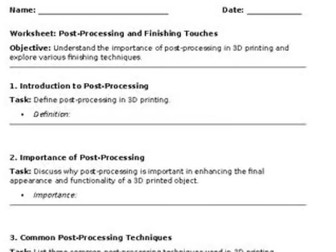
The file is a worksheet designed for 11-14-year-old students focusing on post-processing and finishing touches in 3D printing. It includes tasks and questions aimed at helping students understand the importance of post-processing, explore various techniques, and engage in hands-on activities. Sections include defining post-processing, discussing its importance, listing techniques, performing a hands-on activity, exploring finishing touches, and reflecting on before-and-after comparisons of 3D printed objects. The worksheet concludes with a reflection on the impact of post-processing on the quality and user experience of 3D printed items.
11-14 year olds - 3D printing summary worksheetQuick View
j_k_arthur69

11-14 year olds - 3D printing summary worksheet

(0)
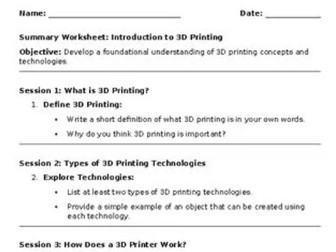
The file is a summary worksheet of the 12 lessons designed for 11-14-year-old students to build a foundational understanding of 3D printing concepts and applications. It is structured into multiple sessions, each focusing on different aspects of 3D printing, including: Basic definitions, importance, and types of 3D printing technologies. The working process and components of a 3D printer. Introduction to 3D modeling and a hands-on activity involving designing and printing an object. Exploration of common materials and their significance in 3D printing. Practical applications in everyday life and artistic uses of 3D printing. A group project to design and print a miniature town, emphasizing teamwork and reflection. Discussion on future trends and their potential impact on industries and daily life. A showcase session for presenting 3D printed projects. The worksheet concludes with reflective questions encouraging students to share what they learned and how they might use 3D printing in the future.
advanced 3D printing summary worksheet - 15-17 year oldsQuick View
j_k_arthur69

advanced 3D printing summary worksheet - 15-17 year olds

(0)
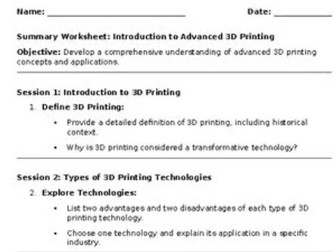
The file is a comprehensive summary worksheet for 15-17-year-old students on advanced 3D printing concepts and applications. It spans multiple sessions, each focusing on a key aspect of 3D printing, including its definition, technologies, components, materials, and advanced techniques. Topics include: Exploration of different 3D printing technologies, their pros and cons, and applications in industries. Identification and roles of 3D printer components. Research on advanced materials and 3D modeling software. Advanced techniques like bioprinting and metal printing, alongside industry case studies. Applications in fields like healthcare, aerospace, and engineering, with emphasis on design optimization. Ethical considerations and societal impacts of 3D printing. Future trends and final reflections on the course. The worksheet concludes with reflective questions encouraging students to connect their learning to potential future applications in studies or careers.