GCSE Chemistry Bundle: Atomic Structure and The Periodic TableQuick View
WorldofTeaching

GCSE Chemistry Bundle: Atomic Structure and The Periodic Table

2 Resources
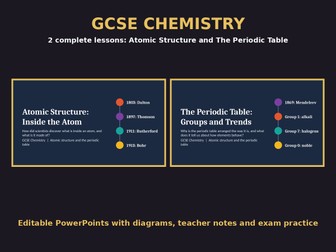
Two complete, ready to teach GCSE Chemistry lessons covering atomic structure and the periodic table. Buying them together saves £1 on buying them separately. Every lesson has teacher notes on every slide, so you can pick it up and teach it straight away. The bundle includes: Atomic Structure: Inside the Atom The Periodic Table: Groups and Trends Atomic Structure covers the development of the model of the atom from Dalton to Chadwick, the gold foil experiment, protons, neutrons and electrons, atomic and mass numbers, isotopes and electron shells. The Periodic Table covers Mendeleev and how the table developed, groups and periods, metals and non metals, and the trends in Group 1, Group 7 and Group 0. Each lesson includes: Learning objectives at three levels: must, should and could A warm up quiz with answers and key words Clear diagrams drawn as editable PowerPoint shapes Portraits of the scientists behind each discovery Practice questions with full answer slides An AQA style exam question with a mark scheme and a model answer Common mistakes, an exit ticket with answers and a key points summary All slides are fully editable. Suitable for Year 9, Year 10 and Year 11, and matches AQA, Edexcel, OCR and WJEC specifications for Chemistry and Combined Science. If you find the bundle useful, a quick review would be really appreciated.
GCSE History Bundle: 20th Century, WW1, Hitler and the Cold WarQuick View
WorldofTeaching

GCSE History Bundle: 20th Century, WW1, Hitler and the Cold War

4 Resources
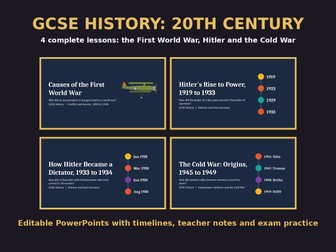
Four complete, ready to teach GCSE History lessons covering the causes of the First World War, Hitler’s rise to power and dictatorship, and the origins of the Cold War. Buying them together saves £3 on buying them separately. Every lesson has teacher notes on every slide, so you can pick it up and teach it straight away. The bundle includes: Causes of the First World War (Conflict and tension, 1894 to 1918) Hitler’s Rise to Power, 1919 to 1933 (Weimar and Nazi Germany) How Hitler Became a Dictator, 1933 to 1934 (Weimar and Nazi Germany) The Cold War: Origins, 1945 to 1949 (Superpower relations and the Cold War) Each lesson includes: Learning objectives at three levels: must, should and could A warm up quiz with answers and key words Clear timelines and diagrams drawn as editable PowerPoint shapes Source and interpretation work linked to the period Knowledge checks with full answer slides An exam style question with a mark scheme and a model answer Common mistakes, an exit ticket with answers and a key points summary All slides are fully editable. Suitable for Year 9, Year 10 and Year 11, and works for AQA, Edexcel, OCR and Eduqas GCSE History. If you find the bundle useful, a quick review would be really appreciated.
Simultaneous Equations: Full GCSE Maths LessonQuick View
WorldofTeaching

Simultaneous Equations: Full GCSE Maths Lesson

(0)
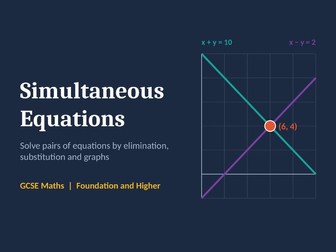
A complete, ready to teach GCSE maths lesson on simultaneous equations: elimination, substitution and graphs, with worked answers on every slide. 29 slides, with teacher notes on every slide. The lesson builds step by step from the idea that one pair of values makes both equations true, shown on a graph where two lines cross, through to solving harder pairs and real life problems. It covers: Learning objectives at three levels: must, should and could A warm up on the skills students need, with answers Key words: simultaneous, coefficient and eliminate The elimination method in five clear steps, with the rule “same signs subtract, different signs add” Worked examples: subtracting, adding and multiplying one equation to match coefficients Your turn questions with a full answer slide Harder pairs: multiplying both equations, solving by substitution, and a line and curve pair such as y = x² and y = x + 6 (Higher tier) A practice set of six pairs with answers Problem solving: cinema ticket prices and a café order An exam style question (5 marks) with an M1, A1, C1 mark scheme Common mistakes, an exit ticket with answers and a key points summary Every worked example is set out one step at a time, and a consistent colour code highlights the coefficients being matched and the letter being eliminated, so students can follow the method easily. All diagrams are editable PowerPoint shapes. Suitable for Year 10 and Year 11, GCSE Foundation and Higher tier, and matches AQA, Edexcel and OCR specifications. If you find this lesson useful, please leave a review. It is part of a growing series of premium GCSE maths lessons, including Solving Linear Equations, Expanding and Factorising Quadratics, Pythagoras’ Theorem, Trigonometry (SOHCAHTOA) and Area and Circumference of Circles.
Atomic Structure: Inside the Atom, GCSE Chemistry LessonQuick View
WorldofTeaching

Atomic Structure: Inside the Atom, GCSE Chemistry Lesson

(0)
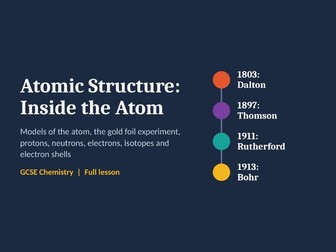
A complete, ready to teach GCSE Chemistry lesson on atomic structure. Students follow how the model of the atom developed from Dalton’s solid spheres to Bohr’s shells, see how the gold foil experiment revealed the nucleus, and learn to work out the protons, neutrons and electrons in any atom. 31 slides with clear, editable diagrams and teacher notes on every slide. What’s included: Learning objectives at three levels: must, should and could A warm up quiz with answers, and key words including nucleus, atomic number, mass number and isotope A timeline from Dalton (1803) to Chadwick’s discovery of the neutron (1932) The scientists: Dalton, Thomson, Rutherford, Bohr and Chadwick, with public domain portraits Four models of the atom drawn side by side: solid sphere, plum pudding, nuclear and shell models The gold foil experiment: a diagram of alpha particle scattering, with each observation linked to its conclusion A labelled atom, the charge and mass of subatomic particles, and the size of an atom Atomic number and mass number, with a practice quiz and answers Isotopes (carbon 12 and carbon 14 drawn side by side) and electron shell diagrams with a practice quiz An AQA style 6 mark question with a mark scheme and a model answer Common mistakes, an exit ticket with answers and a key points summary All slides are fully editable. Suitable for Year 9, 10 and 11, GCSE Chemistry and Combined Science, and works for AQA, Edexcel, OCR and WJEC. If you find this lesson useful, a quick review would be really appreciated.
The Periodic Table: Groups and Trends, GCSE Chemistry LessonQuick View
WorldofTeaching

The Periodic Table: Groups and Trends, GCSE Chemistry Lesson

(0)
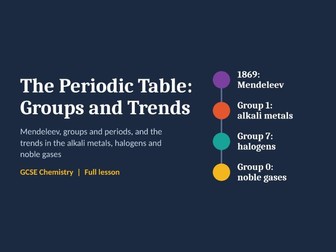
A complete, ready to teach GCSE Chemistry lesson on the periodic table. Students find out how Mendeleev arranged the elements and why he left gaps, learn to read groups and periods from electron arrangements, and explain the trends in the alkali metals, the halogens and the noble gases. 31 slides with clear, editable diagrams and teacher notes on every slide. What’s included: Learning objectives at three levels: must, should and could A warm up recap quiz on atomic structure, and key words including group, period, alkali metal, halogen and noble gas A timeline from early lists of elements to the modern table Dmitri Mendeleev: ordering by atomic weight, leaving gaps and making predictions, with a public domain portrait Mendeleev’s table compared with the modern periodic table A colour coded periodic table of the first four periods: metals, non metals and noble gases Sodium and chlorine shell diagrams showing how group and period come from electron arrangement Group 1, Group 7 and Group 0: properties, reactions, uses and trends in reactivity, explained using electrons Three practice quizzes with answers An AQA style 6 mark question on Group 1 reactivity with a mark scheme and a model answer Common mistakes, an exit ticket with answers and a key points summary All slides are fully editable. Suitable for Year 9, 10 and 11, GCSE Chemistry and Combined Science, and works for AQA, Edexcel, OCR and WJEC. Follows on from our Atomic Structure lesson. If you find this lesson useful, a quick review would be really appreciated.
The Cold War: Origins, 1945 to 1949, GCSE History LessonQuick View
WorldofTeaching

The Cold War: Origins, 1945 to 1949, GCSE History Lesson

(0)
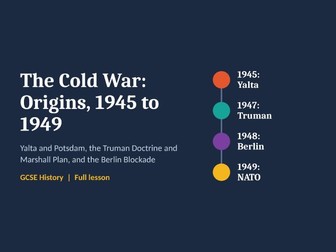
A complete, ready to teach GCSE History lesson on the origins of the Cold War. Students follow how the wartime allies became enemies in just four years, from the Yalta and Potsdam conferences to the Truman Doctrine, the Marshall Plan and the Berlin Blockade. 26 slides with teacher notes on every slide, a drawn map of divided Germany and Berlin, and public domain photographs of Yalta, Potsdam and the Berlin Airlift. What’s included: Learning objectives at three levels: must, should and could A warm up quiz with answers, and key words including containment, satellite state and Iron Curtain A timeline from Yalta (1945) to NATO (1949) The USA and the USSR compared, with a portrait of Harry Truman The Yalta and Potsdam conferences, the atomic bomb and Soviet control of Eastern Europe The Iron Curtain speech, the Truman Doctrine, the Marshall Plan and the Soviet response The Berlin Blockade: a map of divided Germany and Berlin and the new Deutschmark currency The Berlin Airlift and its consequences: NATO, two Germanys and the Soviet atomic bomb Two quizzes with answers An Edexcel style 12 mark “explain why” question with a mark scheme and a model paragraph Common mistakes, an exit ticket with answers and a key points summary All slides are fully editable. Suitable for Year 10 and Year 11, and works for Edexcel Superpower relations and the Cold War and AQA Conflict and tension between East and West. If you find this lesson useful, a quick review would be really appreciated.
An Inspector Calls: Responsibility and Change, GCSE English Literature LessonQuick View
WorldofTeaching

An Inspector Calls: Responsibility and Change, GCSE English Literature Lesson

(0)
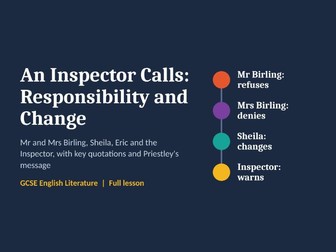
A complete, ready to teach GCSE English Literature lesson on responsibility and change in J. B. Priestley’s An Inspector Calls. 30 slides with teacher notes on every slide, so you can pick it up and teach it straight away. The lesson builds step by step through the play: Learning objectives at three levels: must, should and could A warm up plot quiz with answers, and key words including dramatic irony, mouthpiece and morality play A timeline of the five confessions across one evening Context: the 1912 setting, the 1945 audience and Priestley’s socialist beliefs Mr and Mrs Birling: key quotations and analysis, including the dramatic irony of the “unsinkable” Titanic and “the father of the child” Sheila and Eric: how the younger generation changes, with a then and now comparison The Inspector: stage directions, the “one body” speech and his role as Priestley’s mouthpiece Two quotation quizzes with answers An AQA style modern text essay question (30 marks plus 4 for AO4), a mark scheme and a model paragraph Common mistakes, an exit ticket with answers and a key points summary Every quotation is analysed for language and method, and each character has its own colour throughout, so students can see how the Birlings respond differently to the Inspector. All slides are fully editable. Suitable for Year 10 and Year 11, and works for AQA, Edexcel, OCR and Eduqas. If you find it useful, a quick review would be really appreciated. Other lessons in the series from WorldofTeaching include A Christmas Carol: Scrooge’s Transformation, Macbeth: Ambition and Character, Lady Macbeth, and Macbeth: The Witches and the Supernatural.
Jekyll and Hyde: Duality and Respectability, GCSE English Literature LessonQuick View
WorldofTeaching

Jekyll and Hyde: Duality and Respectability, GCSE English Literature Lesson

(0)
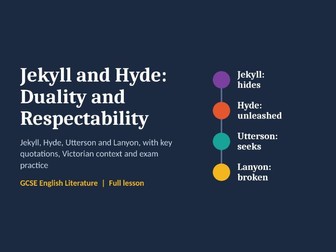
A complete, ready to teach GCSE English Literature lesson on Robert Louis Stevenson’s Strange Case of Dr Jekyll and Mr Hyde. Students explore how Stevenson presents Hyde as primitive and frightening, why the respectable Dr Jekyll “concealed” his pleasures, and how Utterson, Lanyon and a Gothic London build the mystery. 28 slides with teacher notes on every slide. What’s included: Learning objectives at three levels: must, should and could A warm up plot quiz with answers, and key words including duality, repression, Gothic and atavism A chapter timeline showing how the mystery is held back until the final letters Context: Victorian respectability, Darwin and evolution, science and religion, and double lives Mr Hyde: key quotations and analysis, including “trampled calmly”, “troglodytic” and “Satan’s signature upon a face” Dr Jekyll: his full statement, the “primitive duality of man” and a Jekyll and Hyde comparison table Utterson, Lanyon and setting: the bargain of silence, Lanyon’s shock, the fog and the “blistered and distained” door Two quotation quizzes with answers An AQA style 19th century novel extract question (30 marks) with a mark scheme and a model paragraph Common mistakes, an exit ticket with answers and a key points summary All slides are fully editable. Suitable for Year 10 and Year 11, and works for AQA, Edexcel, OCR and Eduqas. If you find this lesson useful, a quick review would be really appreciated.
GCSE English Literature Bundle: 6 Complete LessonsQuick View
WorldofTeaching

GCSE English Literature Bundle: 6 Complete Lessons

6 Resources
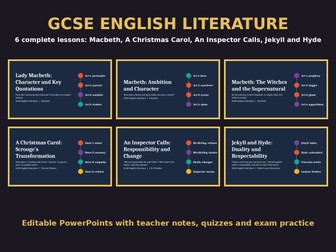
Six complete, ready to teach GCSE English Literature lessons covering Macbeth, A Christmas Carol, An Inspector Calls and Jekyll and Hyde. Buying them together saves £6 on buying them separately. Every lesson has teacher notes on every slide, so you can pick it up and teach it straight away. The bundle includes: Macbeth: Ambition and Character Lady Macbeth: Character and Key Quotations Macbeth: The Witches and the Supernatural A Christmas Carol: Scrooge’s Transformation An Inspector Calls: Responsibility and Change Jekyll and Hyde: Duality and Respectability Each lesson includes: Learning objectives at three levels: must, should and could A warm up quiz and key words Key quotations with analysis of language, structure and method Historical and social context linked to the text Quotation quizzes with answers An AQA style exam question with a mark scheme and a model paragraph Common mistakes, an exit ticket with answers and a key points summary All slides are fully editable. Suitable for Year 10 and Year 11, and works for AQA, Edexcel, OCR and Eduqas. If you find the bundle useful, a quick review would be really appreciated.
Causes of the First World War: GCSE History Lesson PowerPointQuick View
WorldofTeaching

Causes of the First World War: GCSE History Lesson PowerPoint

(0)
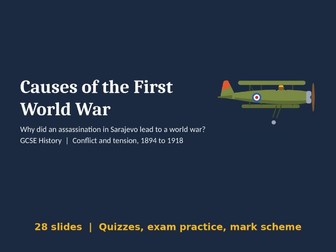
A complete, ready to teach GCSE History lesson on why the First World War began. 28 fully editable slides with teacher notes on every slide, illustrated throughout with simple pictures. What it covers: Starter: a warm up quiz, learning objectives and 8 key words Long term causes (MAIN): the naval race and the Schlieffen Plan, the Triple Alliance and Triple Entente, the race for empire and the Moroccan Crises, and nationalism in the Balkans The spark: the assassination of Franz Ferdinand in Sarajevo, told step by step The July Crisis: a timeline from 28 June to 4 August 1914, and why Britain joined the war Tasks: a “which cause is it?” sort and an ordering task, both with answers Exam practice: a 16 mark “how far do you agree” question, a levelled mark scheme, a model paragraph and common mistakes Plenary: an exit ticket with answers and a key points summary, with a link to Remembrance Day The exam question is written in the style of AQA GCSE History (Conflict and tension, 1894 to 1918), and the lesson works just as well for KS3 and other GCSE courses. If you find it useful, please leave a review.
A Christmas Carol: Scrooge's Transformation, GCSE English Literature LessonQuick View
WorldofTeaching

A Christmas Carol: Scrooge's Transformation, GCSE English Literature Lesson

(0)
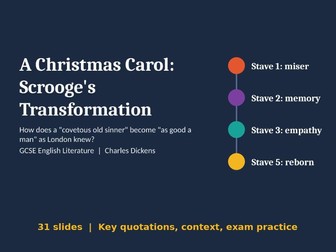
A complete, ready to teach GCSE English Literature lesson on how Dickens presents Scrooge’s change from miser to reformed man in A Christmas Carol. 31 fully editable slides with teacher notes on every slide. What it covers: Starter: a recap quiz with answers, key words and the big picture of the five staves Context: Victorian London in 1843, poverty, the Poor Law and Dickens’s message Stave 1, the miser: how Dickens presents Scrooge through language and imagery, and Marley’s warning Staves 2 to 4, the three spirits: what each spirit shows Scrooge and the signs of change Ignorance and Want: the children under the Ghost’s robe and what they represent Stave 5, reborn: the new Scrooge and a then and now comparison Tasks: quotation quizzes, a “which stave?” activity and an exit ticket, all with answers Exam practice: an AQA style extract question, a six level mark scheme, a model paragraph and common mistakes Written in the style of AQA Paper 1, and just as useful for Edexcel, OCR and Eduqas. If you find it useful, please leave a review.
Lady Macbeth: Character and Key Quotations, GCSE English Literature LessonQuick View
WorldofTeaching

Lady Macbeth: Character and Key Quotations, GCSE English Literature Lesson

(0)
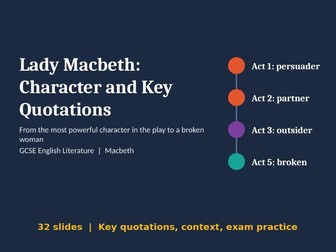
A complete, ready to teach GCSE English Literature lesson on Lady Macbeth, following her from the most powerful character in the play in Act 1 to a woman broken by guilt in Act 5. 32 fully editable slides with teacher notes on every slide. What it covers: Starter: a plot recap quiz, 8 key words and a timeline of Lady Macbeth’s journey Context: the expectations placed on Jacobean women, the divine right of kings, the Gunpowder Plot, witchcraft and the Great Chain of Being Act 1, the persuader: the letter scene, a close look at “unsex me here” and her four persuasion tactics in Act 1 Scene 7 Acts 2 and 3, the first cracks: the murder of Duncan, “A little water clears us of this deed” and the shift in power Act 5, the collapse: the sleepwalking scene, an Act 1 and Act 5 comparison, and a villain or victim debate Exam practice: an AQA style extract question, a six level mark scheme, a model paragraph and common mistakes Plenary: an exit ticket with answers and a key points summary Quotation quizzes are followed by answer slides. Written in the style of AQA Paper 1, and just as useful for Edexcel, OCR and Eduqas. Part of a Macbeth series: Lady Macbeth, Macbeth’s ambition, and the witches and the supernatural. If you find it useful, please leave a review.
Macbeth: The Witches and the Supernatural, GCSE English Literature LessonQuick View
WorldofTeaching

Macbeth: The Witches and the Supernatural, GCSE English Literature Lesson

(0)
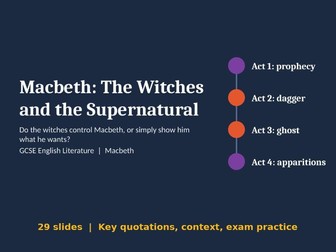
A complete, ready to teach GCSE English Literature lesson on the witches and the supernatural in Macbeth, ending with the big debate: fate or free will? 29 fully editable slides with teacher notes on every slide. What it covers: Starter: a recap quiz, 8 key words including equivocation and paradox, and a timeline of every supernatural moment Context: King James and Daemonologie, the North Berwick witch trials and the 1604 Witchcraft Act Act 1, the prophecies: “Fair is foul”, Macbeth’s first words, Banquo’s “instruments of darkness” warning and a close look at the witches’ chanting language Banquo and Macbeth: how each reacts to the same prophecies Visions and ghosts: the dagger and Banquo’s ghost, real or imagined? Act 4, the apparitions: the three prophecies, what Macbeth thinks they mean and how they really come true Tasks: quotation quizzes with answers and a fate or free will debate Exam practice: an AQA style extract question, a six level mark scheme, a model paragraph and common mistakes Written in the style of AQA Paper 1, and just as useful for Edexcel, OCR and Eduqas. Part of a Macbeth series: Lady Macbeth, Macbeth’s ambition, and the witches and the supernatural. If you find it useful, please leave a review.
Macbeth: Ambition and Character, GCSE English Literature LessonQuick View
WorldofTeaching

Macbeth: Ambition and Character, GCSE English Literature Lesson

(0)
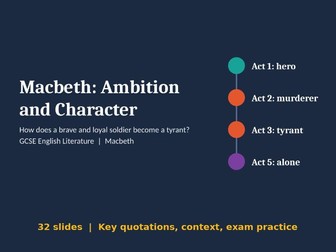
A complete, ready to teach GCSE English Literature lesson on Macbeth’s ambition and character, following him from “brave Macbeth” in Act 1 to “this dead butcher” at the end of the play. 32 fully editable slides with teacher notes on every slide. What it covers: Starter: a plot recap quiz, 8 key words including hamartia and equivocation, and a timeline of Macbeth’s journey Context: the divine right of kings, King James and Banquo, witchcraft, the Gunpowder Plot and Macbeth as a tragic hero Act 1, the hero tempted: “brave Macbeth”, “Stars, hide your fires” and a close look at “vaulting ambition” Act 2, the murderer: the dagger soliloquy, “Macbeth does murder sleep” and “Neptune’s ocean” Acts 3 and 4, the tyrant: “full of scorpions is my mind”, “I am in blood / Stepped in so far” and the murder of Macduff’s family Act 5, alone: “a walking shadow”, “I will not yield” and Malcolm’s final judgement Tasks: quotation quizzes with answers, an Act 1 and Act 5 comparison, and a “who is to blame?” debate Exam practice: an AQA style extract question, a six level mark scheme, a model paragraph and common mistakes Written in the style of AQA Paper 1, and just as useful for Edexcel, OCR and Eduqas. Part of a Macbeth series: Lady Macbeth, Macbeth’s ambition, and the witches and the supernatural. If you find it useful, please leave a review.
Hitler's Rise to Power 1919 to 1933: GCSE History Lesson PowerPointQuick View
WorldofTeaching

Hitler's Rise to Power 1919 to 1933: GCSE History Lesson PowerPoint

(0)
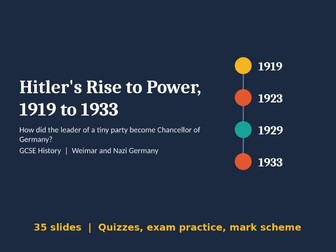
A complete, ready to teach GCSE History lesson on how Hitler went from leading a tiny Munich party to becoming Chancellor of Germany in January 1933. 35 fully editable slides with teacher notes on every slide. What it covers: Starter: a warm up quiz on the Weimar Republic, 8 key words and a big picture timeline from 1919 to 1933 The early Nazi Party, 1919 to 1923: the DAP, the 25 Point Programme, the SA and the Munich Putsch, and why its failure helped Hitler The lean years, 1924 to 1928: recovery under Stresemann, and how Hitler rebuilt the party The Depression, 1929 to 1932: the Wall Street Crash, rule by decree, a chart of Reichstag seats, why people voted Nazi and what the party promised each group How Hitler became Chancellor: the elections of 1932 and the deal between Papen, Hindenburg and Hitler in January 1933 Exam practice: a 12 mark “explain why” question, a levelled mark scheme, a model PEEL paragraph and common mistakes Plenary: an exit ticket with answers and a key points summary Quizzes and tasks are followed by answer slides, so the lesson works for whole class teaching, cover lessons or revision. The exam question is written in the style of Edexcel GCSE History (Weimar and Nazi Germany, 1918 to 1939), and the lesson works just as well for AQA, OCR and Eduqas courses. If you find it useful, please leave a review.
How Hitler Became a Dictator 1933 to 1934: GCSE History Lesson PowerPointQuick View
WorldofTeaching

How Hitler Became a Dictator 1933 to 1934: GCSE History Lesson PowerPoint

(0)
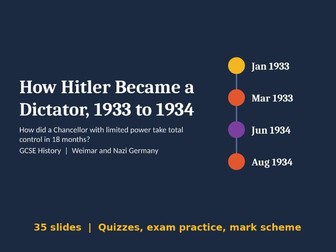
A complete, ready to teach GCSE History lesson on how Hitler turned the chancellorship into a dictatorship in just 18 months. 35 fully editable slides with teacher notes on every slide. What it covers: Starter: a recap quiz on how Hitler became Chancellor, 8 key words and the four limits on his power in January 1933 The Reichstag Fire: what happened, the Reichstag Fire Decree, the debate over who started the fire and a chart of the March 1933 election The Enabling Act: how it was passed by 444 votes to 94, and what it allowed Hitler to do Removing opposition: Gleichschaltung, the banning of trade unions and parties, and the one party state by July 1933 The Night of the Long Knives: the threat from Röhm and the SA, the purge of June 1934 and its results Hitler becomes Führer: the death of Hindenburg, the army’s oath and the August 1934 plebiscite Tasks: quizzes with answers, an ordering task and a legal methods versus terror comparison Exam practice: a 12 mark “explain why” question, a levelled mark scheme, a model PEEL paragraph and common mistakes Plenary: an exit ticket with answers and a key points summary The exam question is written in the style of Edexcel GCSE History (Weimar and Nazi Germany, 1918 to 1939), and the lesson works just as well for AQA, OCR and Eduqas courses. This lesson follows on from “Hitler’s Rise to Power 1919 to 1933”, also available in my shop. If you find it useful, please leave a review.
Expanding and Factorising Quadratics: Full GCSE Maths LessonQuick View
WorldofTeaching

Expanding and Factorising Quadratics: Full GCSE Maths Lesson

(0)
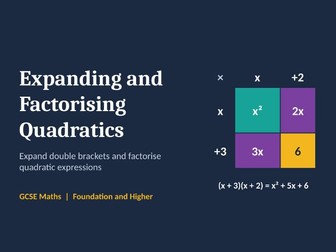
A complete, ready to teach GCSE maths lesson on expanding double brackets and factorising quadratics. 31 fully editable slides with teacher notes on every slide. The lesson builds step by step from single brackets to factorising quadratics: Learning objectives at three levels: must, should and could Warm up on single brackets, multiplying negatives and number pairs, with answers Key words: expand, factorise, quadratic and coefficient The grid method for expanding double brackets, with FOIL shown as an alternative Three worked examples on expanding, including negatives and (2x + 1)(x − 3), then six “your turn” questions Factorising x² + bx + c using the two number rule, plus the difference of two squares A practice set on factorising fully, with answers Problem solving: the area of a garden and a photo frame An exam style question (6 marks) with a mark scheme Common mistakes, an exit ticket with answers and a key points summary Every question has a worked answer slide, and the x² term, x terms and number term are colour coded on every grid so students can see where each part of the answer comes from. All diagrams are drawn as editable PowerPoint shapes. Suitable for Year 9 to Year 11, Foundation and Higher tier, for AQA, Edexcel and OCR GCSE Maths. If you find it useful, please leave a review. Also in the series: Pythagoras’ Theorem, Trigonometry (SOHCAHTOA) and Area and Circumference of Circles.
Hitler and Nazi Germany GCSE History Bundle: 2 Complete LessonsQuick View
WorldofTeaching

Hitler and Nazi Germany GCSE History Bundle: 2 Complete Lessons

2 Resources
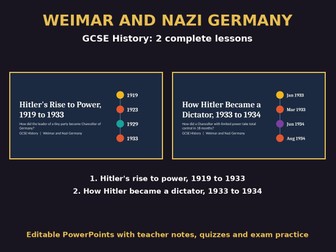
Two complete, ready to teach GCSE History lessons on Weimar and Nazi Germany, saving you £1 on buying them separately. Every slide is fully editable and has teacher notes. Hitler’s Rise to Power, 1919 to 1933: from a tiny party to Chancellor, covering the Munich Putsch, the Depression, Nazi propaganda and the backroom deal of January 1933. How Hitler Became a Dictator, 1933 to 1934: the Reichstag Fire, the Enabling Act, the Night of the Long Knives and the death of Hindenburg. Each lesson includes a recap starter, context, quizzes with answers, an exam style question with a mark scheme, a model answer and an exit ticket. Suitable for AQA, Edexcel, OCR and Eduqas GCSE History. If you find it useful, please leave a review.
Macbeth GCSE English Literature Bundle: 3 Complete LessonsQuick View
WorldofTeaching

Macbeth GCSE English Literature Bundle: 3 Complete Lessons

3 Resources
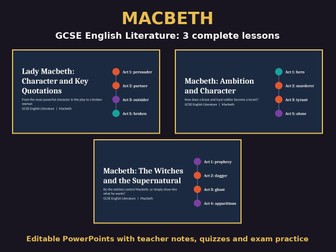
Three complete, ready to teach GCSE English Literature lessons on Macbeth, saving you £3 on buying them separately. Every slide is fully editable and has teacher notes. Lady Macbeth: Character and Key Quotations: from the most powerful character in the play to a broken woman, act by act. Macbeth: Ambition and Character: how a brave and loyal soldier becomes a tyrant, from hero to murderer to a man alone. Macbeth: The Witches and the Supernatural: the prophecies, the dagger, Banquo’s ghost and the apparitions, ending with the big debate: fate or free will? Each lesson includes a recap starter, context, key quotations, quizzes with answers, an AQA style extract question with a mark scheme, a model paragraph and common mistakes. Written in the style of AQA Paper 1, and just as useful for Edexcel, OCR and Eduqas. If you find it useful, please leave a review.
Microscopy: AQA GCSE Biology Revision PowerPointQuick View
WorldofTeaching

Microscopy: AQA GCSE Biology Revision PowerPoint

(0)
A one topic revision PowerPoint for AQA GCSE Biology Paper 1, Cell Biology. Dense, visual summary slides that are ready to use for a recap starter, homework or a revision lesson. What it covers: Light vs electron microscopes: magnification, resolution, cost and what each can show Magnification calculations: the I = M x A triangle, worked examples and converting between mm, micrometres and nanometres Electron microscopy: how TEM and SEM work and what they reveal Preparing and viewing slides: making a temporary mount of onion or cheek cells, step by step Key vocabulary and exam tips Fully editable. Suitable for GCSE Biology and Combined Science (Foundation and Higher). Part of a six part Cell Biology revision set: Cell Structure, Microscopy, Diffusion, Osmosis, Active Transport, and Cell Division and Stem Cells. If you find it useful, please leave a review.
Active Transport: AQA GCSE Biology Revision PowerPointQuick View
WorldofTeaching

Active Transport: AQA GCSE Biology Revision PowerPoint

(0)
A one topic revision PowerPoint for AQA GCSE Biology Paper 1, Cell Biology. Dense, visual summary slides that are ready to use for a recap starter, homework or a revision lesson. What it covers: What active transport is: movement against a concentration gradient using carrier proteins and energy from respiration Diffusion, osmosis and active transport compared in one table Real examples: mineral ions into root hair cells, glucose absorption in the gut and more Evidence that active transport needs energy: metabolic poisons, lack of oxygen and temperature Key vocabulary and exam tips Fully editable. Suitable for GCSE Biology and Combined Science (Foundation and Higher). Part of a six part Cell Biology revision set: Cell Structure, Microscopy, Diffusion, Osmosis, Active Transport, and Cell Division and Stem Cells. If you find it useful, please leave a review.