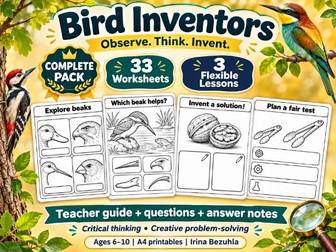
Bird Inventors — Observe. Think. Invent. 33 printable worksheets and three flexible lessonsQuick View
sunnyventa

Bird Inventors — Observe. Think. Invent. 33 printable worksheets and three flexible lessons

(0)
Bird Inventors — Observe. Think. Invent. 33 printable worksheets and three flexible lessons for ages 6–10 Why do birds have different beaks? Which features help them find and handle food? What could they do when conditions change? Bird Inventors combines nature exploration with critical thinking and creative problem-solving. Children study pictures, compare beak shapes, explain their choices and invent solutions to feeding challenges. The activities move beyond matching a bird to its beak. Children distinguish observations from assumptions, ask useful questions, consider alternative explanations and plan ways to test their ideas. What’s included: 33 illustrated, numbered worksheets. Three flexible lesson outlines with no fixed timings. Beak comparison and feeding challenges. Open-ended invention and design tasks inspired by selected TRIZ principles. Critical-thinking activities exploring evidence, assumptions and alternative explanations. Model-testing tasks that encourage children to predict, observe and improve. Teacher guidance with discussion prompts, example answers and common teaching pitfalls. Flexible classroom use: Choose the activities and amount of work that suit your group. Children can speak, draw, write or dictate their responses. Suitable for science lessons, learning centres, projects, partner work and small groups. Open-ended tasks welcome different solutions when children can explain how their ideas might work. Teacher notes provide possible answers and questions to deepen the discussion. Format: One 59-page English-language PDF with contents at the beginning, all worksheets and teacher guidance included, and author information at the end. A4 portrait, with black-and-white student pages suitable for printing and colouring. Teacher answers are grouped separately from student activities. Created by Irina Bezuhla.
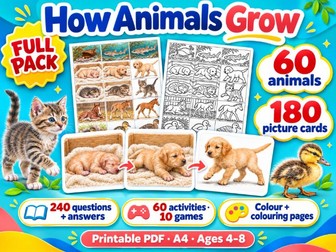
How Animals Grow – 180 Picture Cards, Activities and Colouring PagesQuick View
sunnyventa

How Animals Grow – 180 Picture Cards, Activities and Colouring Pages

(0)
How Animals Grow – 180 Picture Cards, Activities and Colouring Pages What does a newborn squirrel look like? How does a chick change as it grows? Why do some animal sequences show eggs, larvae or pupae? This printable pack invites children aged 4–8 to explore animal development through pictures, questions and hands-on play. Children arrange sequences, spot changes, compare animals and explain their ideas. What’s included: 60 animal examples with three developmental pictures each: 180 picture cards. Ten A4 sheets of colour cards and ten matching black-and-white colouring sheets. An illustrated teaching guide covering birth, food, care and development. 240 questions with answers. 60 activities with suggested answers. Ten game ideas and 20 additional discussion questions. The picture cards have no written labels, making them useful for sequencing, storytelling and discussion. The guide explains the stages shown: not every sequence represents a complete life cycle or ends with an adult animal. Suitable for early years settings, primary classrooms, home education and family learning. Activities encourage careful observation, vocabulary, reasoning and curiosity about nature. English-language digital download. Printable A4 PDFs. Print, colour, cut out and explore!
Understanding Cats – 148 Picture Cards, Games & WorksheetsQuick View
sunnyventa

Understanding Cats – 148 Picture Cards, Games & Worksheets

(0)
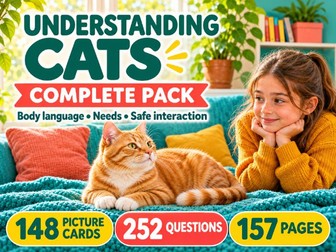
Understanding Cats – 148 Picture Cards, Games & Worksheets Why does a cat hiss? Is showing its belly an invitation to stroke it? And why does a full food bowl not guarantee a comfortable life? Help children explore cat body language, everyday needs and safe interaction through pictures, stories and play. A cat narrates its own experiences, inviting children to notice details, consider different explanations and choose helpful actions. The complete 157-page PDF includes: 148 black-and-white picture cards on 37 A4 sheets, with many before-and-after sequences. A 73-page guide with 28 story chapters, 12 exercises, 5 card games, 3 activity plans and discussion notes for every card. 9 worksheet pages, including a home plan, cut-out symbols, observation diary, checklist, rules poster and certificate. 252 questions across 7 dice grids, with answer prompts for adults. A cat food overview covering everyday food, occasional extras and unsuitable foods. The 60-space “Cat Trail” board game, with rules and a cooperative version. Bonus 1: 24 cat myths with explanations and discussion questions. Bonus 2: 24 critical-thinking tasks, a comparison of house cats, cheetahs and lions, and short activity plans. Children practise describing what they can see, separating observations from guesses and explaining their choices. Body posture, surroundings and context are considered together: one signal cannot tell the whole story. Choose materials for a short conversation, learning stations, language support, a pet-care project or activities at home. No real cat is needed — pictures and a toy figure are enough. Developed by a veterinarian and animal behaviour specialist with more than 15 years of experience working with animals and families. Format: downloadable A4 PDF. Picture cards and the board game are black-and-white. Cards can also be coloured in. A separate free sample is available.
Critical Thinking – Part 1: Observe, Explain and CheckQuick View
sunnyventa

Critical Thinking – Part 1: Observe, Explain and Check

(0)
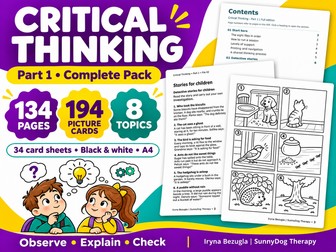
Critical Thinking – Part 1: Observe, Explain and Check Did the dog really eat the missing biscuits? Does an unanswered message mean a friend is ignoring you? What else could explain what happened? Turn everyday situations into thoughtful conversations. Children explore different explanations, separate observations from assumptions and reconsider their ideas when new information appears. The complete pack includes: 134 pages of activities, examples and guidance. 194 numbered black-and-white picture cards on 34 A4 sheets. 8 topics, covering detective stories, alternative explanations, cause and coincidence, checking sources, perspectives and responsible decisions. Possible answers and discussion prompts for adults. A clickable contents section and PDF bookmarks. Choose one situation, invite children’s ideas and explore how to check them. Suitable for primary classrooms, small groups and learning at home, with adult support adapted to each child. Digital download · English PDF · A4 portrait Created by Iryna Bezugla | SunnyDog Therapy
The Third Year of Life — 126 Games and Activities for Ages 2–3Quick View
sunnyventa

The Third Year of Life — 126 Games and Activities for Ages 2–3

(0)
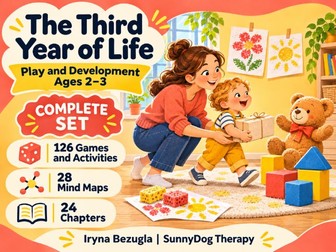
The Third Year of Life — 126 Games and Activities for Ages 2–3 Looking for a simple game your toddler can enjoy today? This practical resource gives you clear instructions for supporting movement, hand skills, communication, play and everyday independence. Choose an activity → prepare the materials → show one action → let your child try. Each game includes a child-friendly prompt, play instructions, adult support and three optional extensions, so you can adjust the challenge without having to invent the next step. The complete set includes: 126 games and activities: 48 core activities and 78 additional games. A 61-page book with 24 chapters, available as a printable PDF and editable Word document. 28 A4 mind maps to print and keep beside you during play. One combined 89-page PDF containing the book and all mind maps. Two age quick guides: 2–2½ years and 2½–3 years. A quick game selector for moments when your child is tired, wants to move, needs quiet play or has just five minutes. A flexible four-week plan and practical observation guidance. What can you explore together? Gross and fine motor skills, sensory experiences, attention, memory, language, pretend play, emotions and daily routines. Carry a parcel to a toy bear, make sponge prints, build, search, take turns and practise small steps towards independence. The mind maps summarise the main points of each section, including practical motor activities and clear steps for responding to intense crying and maintaining boundaries. Easy to use and print English language · A4 portrait · Black-and-white pages · Everyday materials · Clear instructions with arrows and numbered steps. Age ranges offer starting points, not deadlines. Choose activities according to your child’s interest, comfort and current abilities. The extensions are possibilities, not a compulsory programme. For parents, caregivers and early childhood professionals. Iryna Bezugla | SunnyDog Therapy
Choose Your Response — Boundaries, Peer Pressure and Bullying | 104-Page Activity Pack | Ages 8–12Quick View
sunnyventa

Choose Your Response — Boundaries, Peer Pressure and Bullying | 104-Page Activity Pack | Ages 8–12

(0)
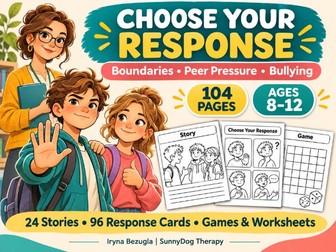
Choose Your Response — Boundaries, Peer Pressure and Bullying | 104-Page Activity Pack | Ages 8–12 What can a child do when someone keeps using an unwanted nickname, shares a private photo or says, “Do this, or we won’t be friends”? This printable resource helps children explore difficult social situations, choose words that feel natural, recognise pressure and find support. Through illustrated stories, response cards and creative activities, they consider several possible actions and discover how new information can change a plan. Children do not have to find the perfect comeback. They can speak, write, point, leave a conversation or seek help. The accompanying guidance helps adults connect practice with practical support. What’s included 24 fictional school situations, covering belongings, exclusion, friendship pressure, privacy, rumours, unwanted touching and online behaviour. 96 response cards offering calm words, optional humour, firm boundaries and practical actions. Four 6×6 activity tables with 144 prompts, plus 144 sample responses and guidance for adults. 24 numbered activity sheets, including blank response cards, a comic strip, a joke workshop, question cards, sorting activities, class rules and a Plan B chain. An adult handbook with explanations, 20 guided games, sample conversations, adaptations and photocopiable templates. A personal help sheet for identifying a contact person, a backup and a way to communicate. A detailed card guide, including optional dice games and the sorting key. An example lesson with nine extension activities and printable worksheets, exploring rumours, evidence and creative problem solving. What children practise Children distinguish observations from assumptions, identify missing information, express boundaries and compare possible consequences. They explore the difference between free choice and pressure, consider safe ways to support others and develop alternatives when a first approach does not help. Activities also ask what the group and adults can change, so responsibility does not rest entirely on the child being targeted. Flexible ways to use the pack Suitable for classroom discussion, small groups, individual support and guided use at home. Choose one story and a few cards for a short activity, or combine tasks into a longer session. Optional dice rules add variety without making the child’s response compulsory. Younger children may benefit from reading aloud and two choices at a time. Older children can compare ambiguous situations, investigate missing facts and develop solutions at the individual, group and school levels.
Understanding Horses: 208 Picture Cards, Games & Safe HandlingQuick View
sunnyventa

Understanding Horses: 208 Picture Cards, Games & Safe Handling

(0)
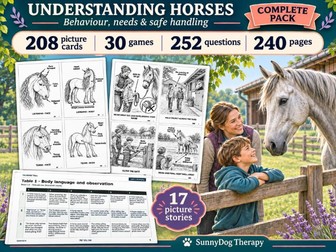
What does a horse’s posture tell us? Why might it turn away? And how can children respond safely without guessing what the horse “must be feeling”? This complete printable pack helps children observe carefully, consider different explanations and make thoughtful decisions around horses. It explores behaviour, body language, everyday needs, care and safety through pictures, games and discussion. No horse or stable is needed. All activities take place at the table, making the pack suitable for classrooms, riding schools, pony clubs, home education and family learning. What’s included — 240 pages in one PDF: 208 picture cards on 52 A4 sheets, with card codes and three difficulty levels An extensive teacher guide with background information, stable rules, discussion examples and a quick-start session 30 games with variations 36 thinking tasks and five ready-to-use lesson plans Horse Detectives: seven activities with puzzles, matching tasks, traffic-light paddles, detective ID cards and a certificate The Horse Trail: three game boards, 252 questions across seven tables, answers and discussion prompts 17 picture stories with 32 additional story cards Observation sheets, printable templates, a glossary and guidance for supporting children who feel worried around horses More than naming emotions Children follow four simple steps: “I can see…” — describe a visible detail. “Perhaps… or…” — consider two possible explanations. “What don’t we know?” — identify missing information. “What would I do?” — suggest a safe next step. Topics range from ears, eyes and posture to herd life, learning, equipment, senses and welfare. More advanced material introduces collection, piaffe, passage and jumping. Three difficulty levels support children from approximately age five upwards, including older learners. Choose activities to suit the group’s experience and interests. Format: One PDF with a clickable contents section and bookmarks. Black-and-white picture cards, four per A4 sheet. Question tables use landscape pages. Try the separate free selection before choosing the complete pack. Real-life encounters with horses require knowledgeable adult supervision. These materials do not replace practical instruction or veterinary advice.
Who Left This Behind? – 65 Animal Pairs cardsQuick View
sunnyventa

Who Left This Behind? – 65 Animal Pairs cards

(0)
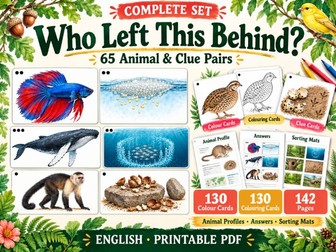
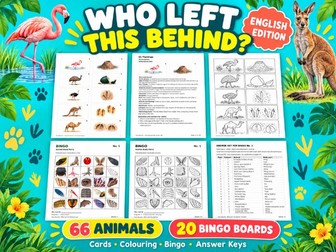
Who Left This Behind? – 65 Animal Pairs A bubble nest on the water, nutshells beside a stone or a shelter made of twigs… Which animal left it behind? Turn children into nature detectives with this animal-and-clue matching set. Children examine pictures, find connections and explain the details that helped them decide. The complete set includes: 65 matching pairs: 130 colour picture cards 130 matching black-and-white colouring cards A detailed guide with 65 illustrated animal profiles A shorter guide explaining each animal-and-clue connection Discussion questions, suggested answers and creative activities An answer table covering all 65 pairs 22 sorting mats on 11 pages A contents page, PDF bookmarks and information about the author Discover the story behind each clue The animal profiles explain what each picture shows, how the clue forms and why it is connected to the animal. They also explore habitat, diet, activity, movement, social life and approximate lifespan. Sorting activities invite children to explore further: Which animals fly? Which eat plants? Who builds a nest or leaves food remains? More than one well-reasoned answer may be possible. Use the cards for matching, describing, comparing, sorting and colouring at home, in early years settings, in the classroom or during language activities. Start with a few clearly different pairs and gradually increase the challenge. Length: 142 pages in one PDF Language: English Printing: A4, single-sided, actual size / 100% The illustrations are simplified learning pictures, not a field identification guide. Digital download only. No physical product will be shipped.
Who Eats What? – 66 Animal–Food Pairs to Match, Explore and ColourQuick View
sunnyventa

Who Eats What? – 66 Animal–Food Pairs to Match, Explore and Colour

(0)
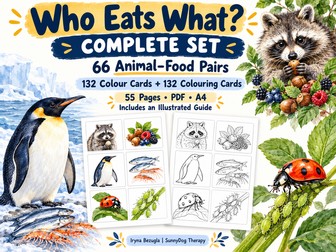
Who Eats What? – 66 Animal–Food Pairs to Match, Explore and Colour What does a flamingo eat? What food does a hedgehog find? And what do moth caterpillars feed on? This illustrated resource invites children to explore animal diets through matching, comparing and talking about their discoveries. The complete set includes: 66 animal–food pairs. 132 colour picture cards across 22 A4 pages. 132 black-and-white colouring cards across 22 A4 pages. An 11-page illustrated guide to the animals and their food. 55 A4 pages in one printable PDF. The picture cards have no written labels. Food cards show examples of typical foods, sometimes including several plants or prey animals. The accompanying guide supports discussion and helps adults check the matches. Use the cards for science lessons, learning stations, vocabulary activities or discoveries at home. Print, cut out and mix the cards, then invite children to find the pairs and explain their choices. The outline cards provide an additional colouring activity. Created by Iryna Bezugla | SunnyDog Therapy Digital download for printing at home or school. No physical product is included.
The Tasmanian Devil — A Night Expedition with Discoveries, Games and ExperimentsQuick View
sunnyventa

The Tasmanian Devil — A Night Expedition with Discoveries, Games and Experiments

(0)
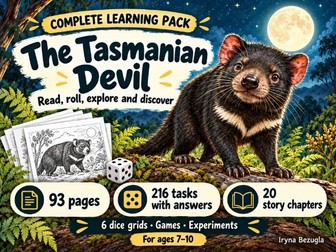
The Tasmanian Devil — A Night Expedition with Discoveries, Games and Experiments Why isn’t an animal with such a fearsome name necessarily about to attack? Why does it have a thick tail? What would change if its tail were shorter? And can you blame an animal just because someone spotted it near another creature’s dinner? This educational activity pack invites children aged approximately 7–10 to explore the Tasmanian devil’s life: its body, senses, nighttime journeys, communication and development. A fictional guide—the devil itself—leads the adventure. It tells jokes, asks tricky questions and helps children notice where observation ends and guesswork begins. What’s included A complete 100-page PDF in Ukrainian. Ten 6×6 dice grids featuring 360 tasks, selected by rolling a die twice. A larger-print version of each grid across two sheets. An answer guide for all 360 tasks: explanations, possible answers and examples of creative solutions. A 24-space board game, “Along Tasmania’s Night Trails.” Twelve black-and-white playing pieces to colour and cut out. Three teaching guides: detailed background notes, an immersive lesson and a follow-up expedition. Four main experiments, paper models, ten invention challenges and ten myths to investigate. Three worksheets: a researcher’s journal, an inventor’s card and a news-checking sheet. Game rules, a materials list and printing recommendations. How to play Choose a grid and roll a die twice: the first roll selects the row, and the second selects the column. Where they meet, you’ll find a question or challenge: explain, compare, draw, imagine an alternative or test an idea using a model. Play with the board game, explore one topic or work through the whole story gradually. There is no time limit. What children will do Children will explore connections between body features and ways of life, compare routes, test ideas and suggest several solutions to the same problem. For example, they will investigate why the nearest food is not always the best choice—and why a camera recording with no animal in it does not prove the animal was absent. Creative challenges allow for different well-reasoned answers. Adults receive explanations to help them keep the conversation going. The pack is suitable for family learning, primary classrooms, nature clubs and children’s discovery sessions. Experiments use everyday objects, paper, cardboard and counters. A digital resource to download and print. The archive contains the complete PDF, separate PDF sections, PNG grids and three teaching guides in Word format. The black-and-white design is suitable for printing and colouring.
Discover the Octopus — Stories, Science Questions and Imagination for KidsQuick View
sunnyventa

Discover the Octopus — Stories, Science Questions and Imagination for Kids

(0)
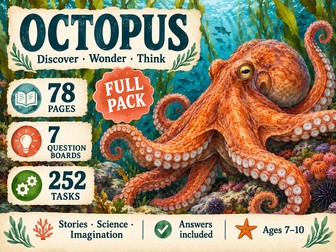
Discover the Octopus — Stories, Science Questions and Imagination for Kids 78 pages of underwater adventures · 7 question boards · 252 tasks with answers A rock that suddenly crawls away. Arms that gather information through touch. Three hearts inside one body. The octopus is full of surprises—and invites children to wonder, ask questions and think further. In this comprehensive printable pack, a female octopus guides children through her underwater world. She tells them about hiding places, hunting and encounters with predators. Along the way, children suggest decisions, compare clues and develop their own explanations. The conversations go beyond remembering facts: Why is matching the background’s colour not always enough for camouflage? Do empty shells outside a den prove that an octopus ate there? And what might happen if an octopus grew a hook-shaped tail? What’s inside the complete pack? 6 factual boards with 216 questions: body structure, sensitive arms, camouflage, movement, food and development. A first-person story: eight short chapters with humour, discussion pauses, myths and research examples. “A Day with Me”: eight adventure scenes that invite children to consider choices and explain their decisions. A research lab: six tasks about observing, comparing and testing explanations. Myths and relatives: twelve statements to investigate, plus comparisons with squid, cuttlefish and nautiluses. Six marine mysteries: new clues encourage children to reconsider their first ideas. A fantasy workshop with 36 tasks: invent tails, wings and unusual suckers—then explain their benefits, discover drawbacks and improve the design. Answers and guidance for adults: keys for every board question, examples for open-ended tasks and six new funny dialogues. Simply read aloud and start a conversation All activities are completed orally. No game pieces, craft supplies or experiment equipment are needed. Choose a story, a board or a few questions to suit your group. Just a handful of tasks can provide material for a short discovery session. The activities give children opportunities to explain connections, consider different possibilities and put their ideas into words. Facts, possible explanations and fantasy are clearly distinguished. Creative questions welcome different well-reasoned answers.
Animals and Their Young — Cards, Coloring Cards and BingoQuick View
sunnyventa

Animals and Their Young — Cards, Coloring Cards and Bingo

(0)
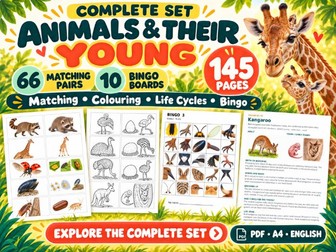
Animals and Their Young — Complete Printable Set with Picture Cards, Coloring Cards and Bingo What does a newborn kangaroo look like? Which chick belongs to which bird? And how does a tiny larva become an adult insect? Discover the fascinating world of animal development with this 145-page printable resource. Children match adults with their young, explore life cycles, compare animal features and learn how different animals care for their offspring. Combining illustrated information pages with hands-on activities, Animals and Their Young offers plenty of opportunities to look closely, ask questions, play and learn. What’s included 66 illustrated animal profiles covering birth or hatching, early development, parental care and lifespan. 66 full-color matching pairs: 132 cards showing adult animals and their young or early developmental stages. The same 66 pairs as black-and-white coloring cards: another 132 cards to color and use for matching activities. 10 different 5 × 5 bingo boards, each available in color and black and white. Bingo calling cards, instructions and answer keys. Guidance for using the animal profiles and references for further reading. More than big animals and little animals The cards introduce children to different ways of growing up. Bird partner cards show eggs and chicks. Insects introduce stages such as eggs, larvae and pupae where these apply. The kangaroo illustrations show both the tiny newborn and the older pouch young. The animal profiles help adults explain these differences and extend the conversation beyond matching pictures. Meet a remarkable variety of animals Explore flamingos, emus, ostriches, kangaroos, dromedary camels, crocodiles, pikas, bumblebees, cranes, hummingbirds and many more. Familiar animals appear alongside less familiar species, including the rufous hornero and hamerkop. Ways to play and learn Start with three to five matching pairs and invite children to describe what they notice. Which features look similar? Which young animals look very different from the adults? Let children explain their choices, then explore the relevant animal profile together. Use the coloring cards for a creative follow-up, choose new pairs for another matching game, or play bingo to practise observing and identifying animal body parts. The 10 different bingo boards offer variety for repeated play and group activities. Each board’s color and black-and-white versions use the same layout. Search keywords: animals and their young, baby animal matching cards, animal life cycles, printable animal bingo, animal coloring cards, preschool animal activities, kindergarten science, elementary science, homeschool printables, animal families.
Who Left This Behind? ## Printable Animal Matching Games, Nature Activities and Body Parts BingoQuick View
sunnyventa

Who Left This Behind? ## Printable Animal Matching Games, Nature Activities and Body Parts Bingo

(0)
Discover the Giraffe – Free Printable Sample Roll, wonder and create! Explore giraffe life with this free activity sample for curious children aged approximately 6–10. What’s included on 13 pages: 42 questions and activities with suggested answers – one row from each of the seven illustrated dice tables. That’s 1/6 of the 252 table activities in the full pack. Three marked levels: A – Getting Started, B – Thinking Further, C – Investigating. A story excerpt narrated by Leaflover about his first day of life. Six additional discussion questions with possible answers and a practical activity. Information about the author and contact details. How does a giraffe reach leaves high in a tree? What does a newborn calf need? And what would a bus for giraffes look like? The activities invite children to observe, compare, explain their ideas and use their imagination. Adults receive answer suggestions to help guide a relaxed conversation. How to play: The table row is already chosen. Roll one die to select a column, or choose a question together. Children can answer by speaking, drawing or showing an idea. There is no time limit or penalty for mistakes. Format: free English-language PDF, 13 pages, designed for A4 printing. The black-and-white illustrations can be coloured. Author: Iryna Bezuhla, psychologist, speech and language therapist, author and creator of educational games for children. Try the activities together and discover the approach behind the full pack, which includes more stories, dice tables, investigation worksheets and a savanna board game.
Dog Fitness: A Practical Guide to Movement, Strength and Everyday WellbeingQuick View
sunnyventa

Dog Fitness: A Practical Guide to Movement, Strength and Everyday Wellbeing

(0)
Dog Fitness: A Practical Guide to Movement, Strength and Everyday Wellbeing How can you help your dog move with confidence, build strength and enjoy an active life? It starts with understanding your dog’s body—and choosing activities that suit their age, abilities and needs. In this illustrated guide, I explain how I approach dog fitness, from daily walks and warm-ups to exercises for balance, coordination and body awareness. I share what to observe, how to introduce exercises gradually and when to make a task easier. Inside, you’ll explore: Everyday movement: walking, varied surfaces and practical ways to add purposeful activity to your routine. Preparation and recovery: warm-ups, drinking water, rest and signs that your dog needs a break. Body awareness and coordination: paw placement, controlled movement, balance and cavaletti exercises. Strength and posture: foundations for standing, moving and performing exercises with control. Individual needs: considerations for puppies, senior dogs and dogs with different builds and abilities. Equipment and handling: choosing supports, understanding harnesses and creating suitable training conditions. Joint health and supplements: an introduction to the evidence, with distinctions between research findings and individual treatment decisions. Illustrations, tables and practical checklists support the explanations and help you connect the ideas to your own dog. My approach begins with observation: how does the dog stand, step, turn and recover? From there, we can choose a suitable challenge and progress at the dog’s pace. For dog owners, trainers and canine professionals who want a clearer understanding of purposeful movement and thoughtful exercise. This book is an educational guide. Dogs with pain, injury or health conditions need an individual veterinary assessment before starting or changing an exercise programme.
Dogs in Hot Weather An Illustrated Guide to Summer Health, Heat Safety and Everyday CareQuick View
sunnyventa

Dogs in Hot Weather An Illustrated Guide to Summer Health, Heat Safety and Everyday Care

(0)
Dogs in Hot Weather An Illustrated Guide to Summer Health, Heat Safety and Everyday Care Summer brings longer walks, swimming and outdoor adventures—but it also changes what your dog needs. Hot pavements, humid rooms, restless nights and energetic games can create risks that are easy to overlook. This practical, illustrated guide helps you understand how heat affects your dog’s body, behaviour and recovery, and what to watch for at home, on walks and around water. Inside, you’ll explore: Overheating and heatstroke: warning signs, immediate cooling and when to seek urgent veterinary help. Water and food: drinking habits, changes in appetite and summer feeding considerations. Walks and exercise: gradual heat adaptation, activity levels, rest and recovery. Sleep and behaviour: why hot nights can leave dogs tired, restless or more reactive. Swimming and water hazards: blue-green algae, salt water and risks around lakes and beaches. Cooling products and coat care: considerations when using mats and vests, and how fur affects cooling. Other summer hazards: barbecue leftovers, sunburn, grass awns, insects and ticks. Clear explanations, everyday examples and visual reminders make the book accessible to dog owners, trainers and anyone caring for dogs during warmer weather. Particular attention is given to dogs that may struggle more in the heat, including puppies, older dogs and short-nosed breeds. Understand the risks, notice changes sooner and make more informed choices throughout the summer. An educational guide to support everyday care. It does not replace veterinary diagnosis or treatment.
Canine Health and First AidQuick View
sunnyventa

Canine Health and First Aid

(0)
Canine Health and First Aid Understand Your Dog’s Health, Recognise Warning Signs and Prepare for the Unexpected Your dog cannot tell you where it hurts. A change in appetite, unusual tiredness, a different way of walking or a sudden reluctance to be touched may be your first clue that something is wrong. Canine Health and First Aid helps you become a more observant, better-prepared dog owner. It brings everyday health topics and emergency situations together in one accessible reference, with clear explanations and practical examples. Inside, you’ll explore: Recognising changes in health: behaviour, breathing, temperature, gum colour, appetite and drinking habits. Preparing for emergencies: organising a first aid kit, keeping medical records and transporting an injured dog. Common injuries: wounds, bleeding, damaged paw pads, limping, fractures and dental trauma. Digestive concerns: vomiting, diarrhea, abdominal swelling and potential poisoning. Eyes, ears and teeth: changes worth noticing and problems that need veterinary attention. Seasonal and outdoor hazards: overheating, cold exposure, ticks, bites and water-related emergencies. Prevention and ongoing care: parasites, vaccination topics and supporting your dog before and after veterinary procedures. Whether you are welcoming your first puppy or have lived with dogs for years, this book offers a broad introduction to the health concerns owners may encounter. Its organised sections make it easy to explore a topic, revisit an explanation and prepare questions for your veterinarian. Know your dog’s normal. Notice changes. Be ready to seek help. An educational resource for dog owners and caregivers. It does not replace veterinary assessment, professional first aid training or an individual treatment plan.
Animals on Halloween Night — Match, Discover and SortQuick View
sunnyventa

Animals on Halloween Night — Match, Discover and Sort

(0)
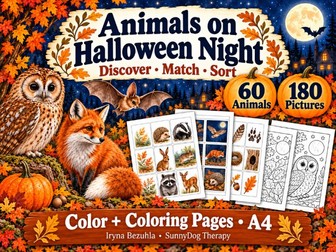
Animals on Halloween Night — Match, Discover and Sort Who is sleeping? Who is hunting? And who left those mysterious tracks? Turn your classroom into an animal detective adventure! Children match animal portraits with night-time scenes and visual clues, then explore what animals eat, where they live and how they move. With 60 animals and 180 unique picture motifs, this printable pack offers activities for matching, sorting, storytelling and nature discovery. What’s included 20 colour-card sheets with nine pictures per page. 20 colouring-card sheets featuring the same motifs. Three illustrated sorting mats: diet, animal groups and living together. 60 small animal cards on two easy-to-print pages. A 63-page teacher guide with 60 illustrated animal profiles covering habitat, lifespan, diet, movement, activity and special abilities. Discussion questions, detective-clue explanations and factual notes. A compact answer key, game ideas and printing instructions. An editable Word version of the teacher guide. 118 printable A4 pages, including both alternative card versions. The pack includes separate PDFs and a combined PDF with navigation bookmarks, plus the editable guide. Start small and build the challenge Begin with three animals and match their portraits to the night pictures. Add detective clues, compare similar species or sort the small cards by diet and animal group. Invite children to explain their choices and create a short story from an animal’s perspective. Use the materials for small groups, learning stations, whole-class discussions or learning at home. The illustrated profiles provide background information and conversation prompts to help adults prepare. Age and language Written in English. Suitable from approximately age 5 with adult guidance, and for primary school. Children do not need to read to play the picture-matching game. Thoughtful nature learning Halloween provides the storytelling theme. The animals live in different regions, and seasonal notes explain when a pictured behaviour may occur. Some clues are stylised rather than exact identification evidence. Social sorting allows more than one well-explained answer. The set contains no fish card; the Fish field is available for an addition of your own. Easy printing Print on A4 paper at 100% or actual size, single-sided. Choose the colour cards or the colouring version and print only the guide pages you need. Created by Iryna Bezuhla · SunnyDog Therapy A ready-to-use resource for children who love animals, mysteries and discovering how nature works. Digital download. No physical product will be shipped. Illustrations created with AI assistance. For the purchaser’s own classroom, supervised-group and family use. Resale and public redistribution of the files are not permitted.
Roll and Choose – Friendship, Feelings & Personal BoundariesQuick View
sunnyventa

Roll and Choose – Friendship, Feelings & Personal Boundaries

(0)
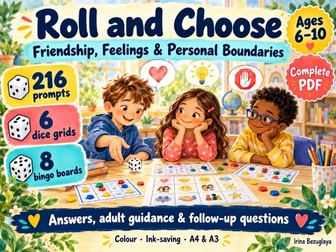
Roll and Choose – Friendship, Feelings & Personal Boundaries Printable conversation games for ages 6–10 How can you say no to a hug? What could you do when a joke hurts someone? Can friends disagree and still enjoy spending time together? Roll and Choose invites children to explore everyday situations, explain their ideas and discover different ways to respond. Dice grids and bingo boards create opportunities to talk about feelings, friendship, personal boundaries, helping others and making things right. What’s included 6 dice grids with 216 different prompts covering personal boundaries, words and feelings, supporting others, asking for help, friendship and conversations, and repairing harm. 216 example answers, each with an adult note and a follow-up question. 8 bingo boards with 128 spaces exploring interests, shared activities, curiosity, support, boundaries and kind words. A complete adult guide with rules, discussion ideas, thinking activities and a sample session. 40 optional humorous phrases for suitable situations. A quick-start sheet and player reminder. Colour and ink-saving A4 game sheets. All six grids in larger A3 versions. Roll, think and talk Roll one die twice, or use two different-coloured dice, to choose a row and column. Read the prompt, explore a possible response and discuss a follow-up question. The bingo activities offer another way to begin: children can discover shared interests, notice differences and practise expressing their preferences. There is room for more than one answer. Children are encouraged to suggest alternatives, explain their reasoning and consider another person’s viewpoint. Gentle humour adds variety while keeping everyone’s feelings and boundaries in mind. Flexible ways to participate Suitable for one child with an adult or 2–6 players, at home, in classrooms and in small groups. Many activities take 10–15 minutes. Children may speak, point, draw, dictate or pass. They do not need to share personal experiences or take part in physical contact. Adults can use fictional characters and adapt the discussion to the group. Format and printing One complete 97-page PDF in English, containing the adult guide, colour sheets, ink-saving alternatives and A3 grids. Alternative print versions repeat the same activities. Printing instructions and navigation bookmarks help you choose the pages you need. Print A4 materials on A4 and large-print grids on A3, at actual size or 100%. Dice and counters are needed and are not included. This is a digital download; no physical product will be shipped. Terms of use Print copies for your own family, class or activities you personally lead. Do not resell, redistribute or publicly upload the files or printouts. Author: Irina Bezuglaya
Wolves: Explore, Play and Discover — Printable Learning PackQuick View
sunnyventa

Wolves: Explore, Play and Discover — Printable Learning Pack

(0)
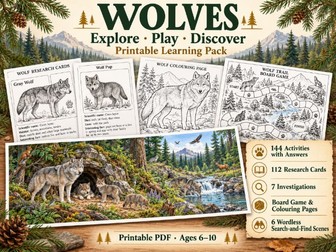
Wolves: Explore, Play and Discover — Printable Learning Pack How does a wolf family live? What can tracks in the snow tell us? And how can we separate what we see from what we only guess? This English-language learning pack invites children aged 6–10 to explore wolves through observation, discussion, games and investigations. Children compare pictures, ask questions, suggest explanations and support their ideas with evidence. What’s included: 144 activities with a detailed teacher answer key, organised into four dice grids. 112 research picture cards for observation, comparison and storytelling. 7 investigations with step-by-step guidance and 22 pages of printable handouts. A board game with an updated two-part board, rules and playing pieces. A teacher resource exploring life in a wolf family. 10 colouring scenes, plus a selection of three easy and three advanced sheets. Some pictures appear in both sets. 6 wordless, full-colour search-and-find scenes: three standard and three more detailed pictures. Teacher guidance and editable Word documents. Build curiosity and thoughtful discussion The activities encourage children to look closely, describe details, compare possibilities and explain their thinking. The answer key helps adults extend conversations while allowing children to respond in their own words. Use the materials for science lessons, wildlife projects, learning stations, small-group activities or home education. Choose a few pages for a short session or explore the pack over several lessons. Format: Digital download in English. Includes a combined PDF, individual printable PDFs, editable Word resources and separate PNG search-and-find pictures. Most worksheets are black and white; the search-and-find scenes are in colour. You will need: A die, playing pieces and basic materials for selected investigations. Adult guidance is recommended.
Discover the Giraffe: Animal Science, Dice Games & Storytelling PackQuick View
sunnyventa

Discover the Giraffe: Animal Science, Dice Games & Storytelling Pack

(0)
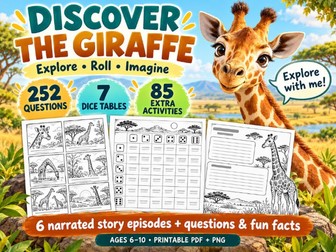
Discover the Giraffe: Animal Science, Dice Games & Storytelling Pack 252 questions, creative challenges and a giraffe with plenty to say! Why do giraffes have such long necks? How do they reach water on the ground? And why might a giraffe keep chewing when there isn’t a branch in sight? Join Leaflover the giraffe for a playful journey through the savanna. Children aged 6–10 explore animal adaptations, compare ideas, build simple models and tell their own stories. Meet your giraffe storyteller Leaflover tells his day in his own voice across six connected episodes—from breakfast among thorny branches to a mysterious night-time hum. Each episode includes: Interesting animal facts woven into the story Questions to discuss Possible answers for adults A short practical or imaginative activity Gentle humour that keeps the conversation lively What’s included? 7 illustrated dice tables with 252 questions 252 matching answer ideas 85 additional play, discussion and creativity prompts 6 first-person story episodes A six-panel picture story to colour and complete A true-or-false knowledge warm-up with explanations 4 research worksheets exploring reach, height, neck bones and the heart A two-sheet savanna board game, numbered 1–76 A 34-page teacher and parent guide A one-page Quick Start All 15 children’s activity pages together in one convenient PDF Seven question tables supplied separately as 300-dpi PNG files Roll, wonder and explain Two dice choose a row and column. Children answer the question, explain their reasoning or try an activity. Some questions explore facts. Others invite inventions, role play and funny possibilities: What would an acacia say to a giraffe? How would you design a giraffe bus? Can you invent a giraffe riddle without using the word “neck”? There is no time limit and no penalty for wrong or skipped answers. Open tasks welcome different well-explained solutions. Flexible classroom and home use Use the pack for animal projects, science lessons, learning stations, small groups or home education. Read questions aloud for younger children, or invite older learners to compare explanations and plan their own investigations. Age: approximately 6–10 Language: English Format: printable A4 PDFs and PNG files Printing: black-and-white, with illustrations to colour Materials: two dice, counters, pencils and paper; simple modelling materials for selected activities The separate table and board PDFs repeat pages included in the children’s PDF, allowing you to print only what you need. Digital download. No physical product will be shipped.
Bat Story & Dice Game with 216 Thinking QuestionsQuick View
sunnyventa

Bat Story & Dice Game with 216 Thinking Questions

(0)
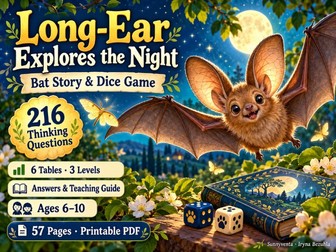
Long-Ear Explores the Night – Bat Story & Dice Game with 216 Thinking Questions How does a bat find its way in the dark? Why does good hearing not always guarantee dinner? And what happens when a new lamp lights up a familiar flight path? Join Long-Ear, a brown long-eared bat, for a nighttime adventure that introduces children to his world. A five-chapter story and six question tables invite children to compare, explain, make choices and think about consequences. The questions explore real situations: a blocked exit, an occupied resting place, a moving insect or a sound with an unexpected source. Children use the information provided to explain their ideas and consider different solutions. What’s included? 57 pages in one clearly organised PDF A five-chapter story told from Long-Ear’s perspective 216 questions across six dice tables Three levels: getting started, making connections and thinking more deeply All six tables in both standard and larger-print formats Answers and explanations for every question Teaching suggestions, follow-up prompts and gentle humour A contents page, printing guide and factual sources Please note: The standard and larger-print tables contain the same 216 questions. Choose the format that suits your children; there is no need to print both. What will children explore? Bat anatomy, wings and flight, echolocation, hunting, roosts, growing up and hibernation. Children also consider how plants, insects, darkness and connected habitats support a bat’s life. The deeper questions encourage children to distinguish observations from guesses, consider alternative explanations and recognise when more information is needed. How to play Roll two dice: the first selects a row, the second a column. Read the question where they meet and invite the child to answer aloud and explain their reasoning. You can also roll one die twice or choose questions directly. No extra models, picture cards, recordings or practical experiments are required. The tables work independently of the story. The answer key supports adults throughout. Open questions may have several valid answers when children explain how their ideas fit the conditions. Who is it for? Designed for children aged approximately 6–10 with adult guidance. Suitable for primary science, speaking and listening activities, small-group learning, learning stations and use at home. Start with a few questions and adjust the level to the child. The aim is to build understanding through conversation, rather than memorise a particular wording. Format: Digital download. One complete PDF, A4, black-and-white. Question tables are landscape; story and answer pages are portrait. A print guide identifies the pages needed for each section. Author: Iryna Bezuhla · Sunnyventa