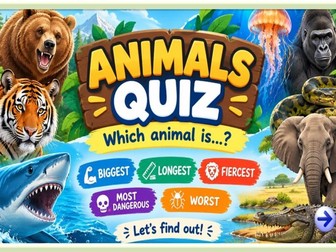
animals quiz presentation, KS1 KS2 science trivia, animal adaptations game, classroom brain break ppQuick View
CoconutBayResources

animals quiz presentation, KS1 KS2 science trivia, animal adaptations game, classroom brain break pp

(0)
Engage your students with this interactive Animals Quiz presentation, perfect for science lessons, trivia days, or brain breaks! This comprehensive 14-slide digital resource challenges learners to compare different creatures and find out who reigns supreme. Packed with vibrant illustrations, students will explore fascinating biology facts across multiple categories, including the biggest, longest, fiercest, and most dangerous animals on Earth. From comparing the standing height of a grizzly bear and a gorilla to discovering the surprising number of legs on a millipede, this quiz sparks curiosity and critical thinking. Each slide presents a fun question followed by an immediate answer key detailing scientific metrics like lengths, heights, and global statistics. Ideal for whole-class engagement on an interactive whiteboard or independent study, this presentation wraps up with a celebratory screen to reward your students’ hard work.

ESL Game. English Game great for ESL classes of all ages.Quick View
CoconutBayResources

ESL Game. English Game great for ESL classes of all ages.

(0)
Kick off the first day back at school with a high-energy, low-stress speaking game that gets students talking from the very first minute! Candy Quest is an interactive, gamified icebreaker designed to build classroom community, practice oral communication, and lower affective filters through a tangible reward system. This resource has been intentionally designed with a sleek, minimalist aesthetic. There are no heavy graphics, distracting animations, or neon color palettes. This ensures that young learners stay focused entirely on the language prompts, eye contact, and social connection, not screen distractions. What’s Included in the Download: 14 Slide Presentation: Structured “Meet & Greet” and “Would You Rather” prompts color-coded into 4 clear categories (Red, Blue, Green, Yellow). • Step-by-Step Instruction Slide: Clear, student-facing rules on how to speak fully to win the premium candy prize. • Comprehensive Teacher’s Notes: Complete pedagogical guide featuring time-management breakdowns, classroom management strategies, and scaffolding frameworks. Perfect For: • First Day of School / Back-to-School Icebreakers • ESL / EFL / ELD Oral Communication Classes • Morning Meetings & Advisory Periods • Structuring Oral Answers (Using “because…” and conditionals) Note: This resource is designed to be paired with a tangible reward. For best results, teachers are encouraged to use a premium, tooth friendly high-quality candy incentive to maximize student output and motivation!
Bargain Bundle of ESL ppts.Quick View
CoconutBayResources

Bargain Bundle of ESL ppts.

15 Resources
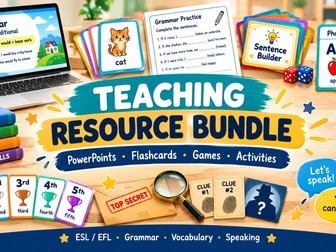
I have created a Bundle of ESL complete lesson’s , cards and games. Thus will only be available until the end of October. The normal price if you bought each one would have been 25.97 but you can grab the whole set for just 12.00. A saving of 54%
CEFR A2–B1 learners, Going to.Quick View
CoconutBayResources

CEFR A2–B1 learners, Going to.

(0)
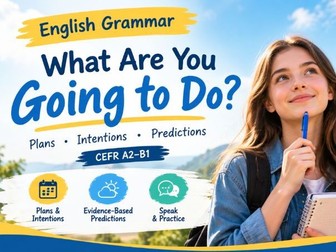
Teach students how to talk about the future with be going to in this engaging, ready-to-use grammar lesson for CEFR A2–B1 learners. Students learn how to form and use am/is/are + going to + base verb to talk about future plans and intentions, as well as predictions based on present evidence. The lesson includes guided elicitation, clear grammar explanations, examples, common mistakes, controlled practice, a reading comprehension activity, pair speaking practice, and the fun “Going to Guess!” classroom game. Students finish with an exit ticket to demonstrate their understanding. Grammar focus: be going to + base verb for future plans, intentions, and evidence-based predictions. A practical, communicative lesson designed to get students using the target grammar confidently in meaningful situations.
Subjects and Predicates, Subject and Predicate , Predicates, Predicate Grammar, English GrammarQuick View
CoconutBayResources

Subjects and Predicates, Subject and Predicate , Predicates, Predicate Grammar, English Grammar

(0)
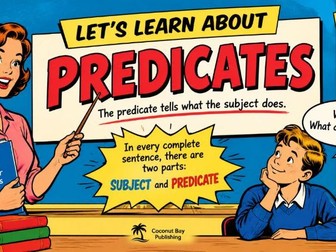
Make grammar clearer and more engaging with this colourful, modern lesson on Subjects and Predicates. Designed for English learners at approximately CEFR A2 level, the presentation introduces the two parts of a complete sentence and explains how to identify the predicate by finding the verb and asking what the subject does. Students work through clear examples such as “Emma and her dog run on the beach every day,” followed by guided practice using sentences about family, weddings and everyday situations. The lesson then introduces further examples, including “Elvis lives,” “Adam lives in London,” and “The telegram contained exciting news.” A printable worksheet provides ten sentences for students to identify subjects and predicates, followed by a 14-question review quiz and an exit activity. Ideal for classroom teaching, revision, homework, or independent practice. The beach-themed visuals help maintain attention while keeping the grammar focus simple and accessible.
2nd Conditional. Second Conditional ESL Second Conditional Worksheet Second Conditional PowerPoint SQuick View
CoconutBayResources

2nd Conditional. Second Conditional ESL Second Conditional Worksheet Second Conditional PowerPoint S

(0)
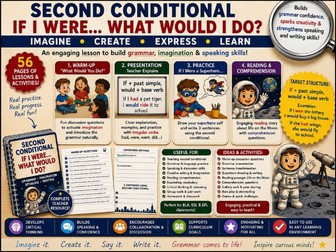
Second Conditional – Complete ESL Grammar Lesson | Presentation, Activities & Quizzes Make learning the Second Conditional fun and engaging with this ready-to-use PowerPoint lesson! Designed for ESL/EFL learners, this resource teaches students how to talk about imaginary or unreal situations using “If + past simple, would + base verb.” The lesson includes: • Warm-Up: Fun “What Would You Do?” questions to activate imagination and encourage speaking. • Grammar Presentation: Clear explanations, examples, pronunciation practice, and irregular verbs. • Creative Practice: Students design a superhero and write their own Second Conditional sentences. • Reading Comprehension: An engaging story about imagining life on the Moon, followed by 12 multiple-choice questions. • Grammar Quiz: 12 questions with an answer key. • Writing Activity & Wrap-Up: Creative writing and pair discussion tasks. Perfect for engaging classroom lessons, speaking practice, and grammar reinforcement!
Ordinal Numbers Ordinal Numbers PowerPointOrdinal Numbers ActivitiesZero ConditionQuick View
CoconutBayResources

Ordinal Numbers Ordinal Numbers PowerPointOrdinal Numbers ActivitiesZero Condition

(0)
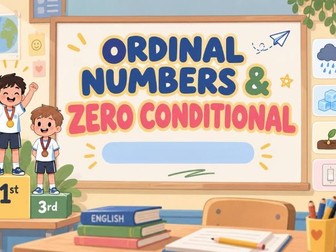
Ordinal Numbers & Zero Conditional | ESL PowerPoint Lesson | CEFR A2–B1 Make English learning engaging with this colourful, ready-to-use PowerPoint lesson combining Ordinal Numbers and the Zero Conditional. Designed for ESL/EFL learners at CEFR Level A2–B1, this resource helps students understand position, order, dates, and facts using clear explanations and practical examples. What’s Included: • Ordinal Numbers: Learn first, second, third, and more, with examples related to races, floors, birthdays, and dates. • Guided Practice: Interactive questions and activities to reinforce ordinal numbers. • Zero Conditional: Learn how to describe facts and general truths using If + present simple, present simple. • Examples: Understand the structure through clear, accessible sentences. • Speaking Activity: Students create short conversations using ordinal numbers and the Zero Conditional. • Review: A recap of key learning points to reinforce understanding. Perfect for classroom presentations, grammar practice, speaking activities, and engaging English lessons!
In the Hospital, ESL hospital lesson, English for hospital, hospital English, English in tQuick View
CoconutBayResources

In the Hospital, ESL hospital lesson, English for hospital, hospital English, English in t

(0)
In the Hospital — ESL Lesson CEFR Level: A2–B1 Take your students through a realistic hospital visit while building practical English they can use in everyday situations. This engaging, visual lesson introduces hospital people, jobs, rooms, signs, directions, equipment, symptoms and useful conversations. Students practise identifying people and places, asking where to go, understanding hospital signs, speaking with receptionists, nurses and doctors, describing how they feel, discussing medicine and understanding advice for going home. The lesson follows a LOOK → THINK → SAY → REVEAL → USE approach, giving students opportunities to think and speak before answers appear. It finishes with a practical mini hospital visit and role-play, allowing students to use the language they have learned in a realistic situation. Ideal for adult and young-adult ESL/EFL learners.
CEFR: B1–B2 conditionals, conditional clauses, conditional sentences, zero conditional, first conditQuick View
CoconutBayResources

CEFR: B1–B2 conditionals, conditional clauses, conditional sentences, zero conditional, first condit

(0)
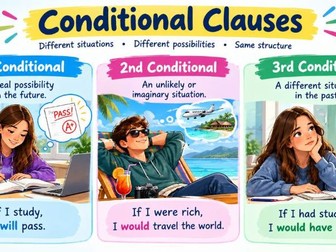
Conditional Clauses – Complete English Grammar PowerPoint Lesson A complete, ready-to-use PowerPoint lesson covering the Zero, First, Second and Third Conditionals, plus mixed conditionals. Students learn the structure and use of each conditional through clear explanations, examples and visual activities. The lesson also covers common mistakes, alternative conditional expressions and comma use. Includes 30 conditional exercises with answers, making this a useful resource for teaching, reviewing or practising conditional sentences.
Do / Does – Have / Has Grammar Lesson. Helping Verbs, Auxiliary Verbs, English Grammar, ESL Grammar,Quick View
CoconutBayResources

Do / Does – Have / Has Grammar Lesson. Helping Verbs, Auxiliary Verbs, English Grammar, ESL Grammar,

(0)
Do / Does – Have / Has Grammar Lesson Help students build confidence with Do, Does, Have and Has through a clear, engaging and practical English grammar lesson. Students practise affirmative and negative sentences, questions, helping verbs and the important rule of using the base form of the main verb after Do/Does/Did. The lesson includes guided examples, a “Who Has It?” warm-up, pair speaking practice, gap-fill exercises and a fun Quick Fire Grammar Game to finish. Everyday examples involving food, hobbies, family, pets, school and daily life make the grammar accessible and easy to practise. Ideal level: A2–B1 (Elementary–Intermediate ESL/EFL) Particularly suitable for secondary and high-school students. A ready-to-use PowerPoint lesson that combines explanation, controlled practice and speaking activities.
Broken Sentences, Sentence Building, Sentence Structure, Sentence Matching, Build a Sentence, Put thQuick View
CoconutBayResources

Broken Sentences, Sentence Building, Sentence Structure, Sentence Matching, Build a Sentence, Put th

(0)
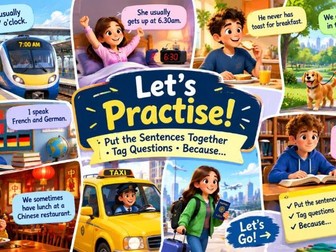
Broken Sentences 2 – English Grammar Practice Give your students an engaging way to practise building accurate English sentences with this interactive grammar lesson. Students begin by putting broken sentences together, matching sentence beginnings and endings to create complete ideas. They then practise tag questions, matching statements with the correct question tags, before moving on to a three-part sentence activity involving people, actions and places or time expressions. The final section focuses on using because to connect ideas and explain reasons. Everyday situations such as catching a train, walking a dog, taking a taxi, visiting a library and eating at a restaurant make the activities relatable and easy to understand. Ideal for intermediate ESL/EFL learners, this ready-to-use PowerPoint provides varied practice while keeping students actively thinking about sentence structure and meaning.
Subject and Verb, Subject, Verb, Grammar, English Grammar, ESL, EFL, ESL Grammar, English Language,Quick View
CoconutBayResources

Subject and Verb, Subject, Verb, Grammar, English Grammar, ESL, EFL, ESL Grammar, English Language,

(0)
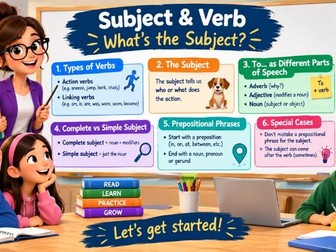
Subject & Verb – Grammar Lesson Help your students understand one of the most important building blocks of English sentences: the subject. This engaging lesson guides students through action and linking verbs, identifying the subject of a sentence, simple and complete subjects, prepositional phrases, and situations where the subject appears after the verb. Students also explore how to + verb can function differently depending on how it is used in a sentence. Clear explanations, memorable examples and humorous sentences make potentially challenging grammar concepts easier to understand and discuss. The lesson is designed for B1–B2 ESL/EFL learners, particularly secondary and high-school students, and works well as a classroom grammar lesson, review lesson or presentation-led teaching resource. A practical, engaging way to help students recognise sentence structure and understand how subjects and verbs work together.
Under the Sea. An Interactive ESL PowerPointQuick View
CoconutBayResources

Under the Sea. An Interactive ESL PowerPoint

(0)
UNDER THE SEA – Interactive ESL/EFL PowerPoint Lesson Take your students on an exciting journey beneath the waves with this engaging Under the Sea ESL/EFL PowerPoint! Designed for CEFR A2–B1 learners, this ready-to-use resource combines colourful visual activities, vocabulary practice, interactive questions, ocean-themed general knowledge and reading comprehension to create a lesson that is both educational and genuinely engaging. Students will encounter a wide variety of fascinating sea creatures while practising useful language including There is / There isn’t / There are / There aren’t, identifying and describing pictures, answering questions and developing their understanding of ocean-related vocabulary. As the lesson progresses, students are challenged with fun ocean knowledge questions covering marine life, coral reefs, the world’s oceans and other fascinating facts. The final section introduces a short reading passage followed by True, False, Maybe and Not Given comprehension questions, giving students valuable practice in reading for detail and understanding information from a text.
2nd Conditional PowerPointQuick View
CoconutBayResources

2nd Conditional PowerPoint

(0)
2nd Conditional – Imaginary Situations & Speaking Game Make the second conditional easier to understand, practise and use with this engaging, classroom-ready lesson. The resource introduces the structure “If + past simple, … would + base verb” and helps students recognise that the past form is being used to describe imaginary or unreal situations. The lesson begins with an interactive warm-up where students respond to imaginative questions such as what they would do if they could fly, were invisible or had a million dollars. Students then explore the grammar structure, practise pronunciation and identify the difference between real and imaginary situations. The practice stage encourages students to create their own superhero character and write sentences using the second conditional before sharing their ideas with classmates. An optional gallery walk provides another opportunity for students to read and respond to their peers’ imaginative answers. A fun, flexible resource for developing grammar accuracy, speaking, creativity and confidence, while giving students plenty of opportunities to use the target language meaningfully.
Job Detective Game CardsQuick View
CoconutBayResources

Job Detective Game Cards

(0)
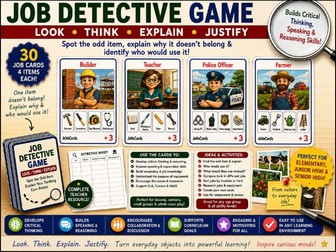
Jobs Detective Step into the world of work and become a Jobs Detective! Can you spot the item that doesn’t belong? These colourful, engaging cards introduce children to a wide variety of jobs, workplaces, tools and equipment while encouraging them to look closely, think carefully and talk about what they see. Each card presents a familiar job alongside a selection of objects. But something isn’t quite right. Children must use their knowledge, observation skills and reasoning to work out what has gone wrong. The real challenge comes when they have to explain their thinking and consider where the unusual item really belongs. With a mixture of straightforward and more challenging choices, Jobs Detective encourages children to question, discuss, justify and listen to one another. It is designed to promote vocabulary, communication and logical thinking while making learning feel like a game. The cards are ideal for small-group activities, classroom discussion, speaking practice or quick challenges between lessons. They can be used with different ages and abilities, with teachers able to adapt the level of questioning to suit their students. Look carefully. Think carefully. Explain your answer. There may be more than meets the eye on every card!
Product Origin CardsQuick View
CoconutBayResources

Product Origin Cards

(0)
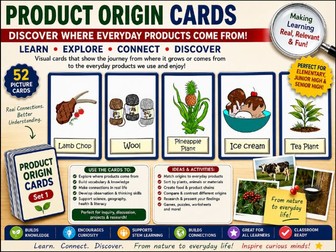
Product Origin Cards – Set 1 Help students discover where everyday products come from with Product Origin Cards – Set 1. This engaging educational resource contains 52 picture cards designed to help learners make connections between natural sources and the everyday products we use. Students can explore the relationship between plants, animals and materials and the products that come from them, making learning more visual, meaningful and memorable. The cards provide an excellent resource for developing vocabulary, general knowledge, observation, discussion, reasoning and critical-thinking skills. They can be used across a range of subjects and learning situations, including science, geography, health, literacy and research-based activities. For teachers, the cards offer a flexible resource that can be used with individual learners, pairs, small groups or whole-class teaching. They can be incorporated into existing lessons or used as a starting point for discussion, investigation and further research. The accompanying activities provide opportunities for students to match origins with products, sort and classify information, make connections, compare different origins, create product chains and explore ideas through games and puzzles. Suitable for Elementary, Junior High and Senior High learners, the cards can be adapted to different ages and abilities. Product Origin Cards is a practical, reusable classroom resource that turns familiar everyday products into opportunities for curiosity, discovery and deeper learning.
CEFR Level Suitability  A2 (Elementary): Clear, repetitive frames across 51 cards with basic high-frQuick View
CoconutBayResources

CEFR Level Suitability A2 (Elementary): Clear, repetitive frames across 51 cards with basic high-fr

(0)
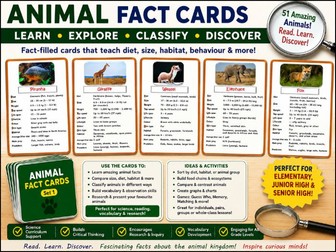
CEFR Level Suitability A2 (Elementary): Clear, repetitive frames across 51 cards with basic high-frequency data fields (diet, habitat, size, life span). B1 (Intermediate): Animal and science vocabulary (herbivore, carnivore, omnivore, nocturnal, diurnal, solitary, diurnal, predators, litter size), complex numerical ranges, and units of measurement. B2 (Upper Intermediate): Comparative analysis, data sorting, scientific classification, and complex classroom discussion tasks.Animal Fact Cards – Set 1 Suitable for all ages from young children to adults. Bring the animal kingdom into your classroom with this versatile set of 51 Animal Fact Cards, designed to encourage curiosity, discussion, reading, observation, research and critical thinking. Each card presents useful information about an animal, making the set suitable for a wide range of learning activities and adaptable to different ages and abilities. The resource can be used with young children, elementary students, junior high learners, senior high students, and even adult learners, with teachers able to adapt the level of questioning and discussion to suit their class. This is more than simply a collection of animal cards. Set 1 includes complete lessons, a classification activity and 25 classroom activities, giving teachers a ready-made resource that can be used for individual learning, pair work, small groups or whole-class teaching. The cards can support science, reading, vocabulary development, research, classroom discussion and independent learning, while giving students opportunities to compare information, develop ideas and explain their thinking. For teachers, this resource provides a flexible way to introduce animal-based learning without having to create every activity from scratch. Use the cards as a stand-alone resource, incorporate them into existing lessons, or return to them throughout the school year for different learning purposes. A flexible, engaging and reusable resource for learning about animals at almost any age.
Mystery Letter Detective – Phonics CardsQuick View
CoconutBayResources

Mystery Letter Detective – Phonics Cards

(0)
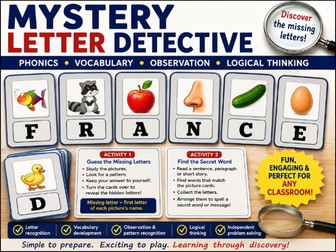
A fun phonics and vocabulary mystery game using picture cards to develop letter recognition, observation, logical thinking, vocabulary and independent learning. Mystery Letter Detective encourages children to discover answers for themselves rather than simply being given them. Students study picture cards, look for patterns and work out the missing letters before the answers are revealed. The missing letter is the first letter of each picture’s name. What students practice Letter recognition Phonics and early reading skills Vocabulary development Observation and pattern recognition Logical thinking Independent problem solving Confidence through discovery A second activity: Secret Words Once students understand the Mystery Letter Cards, they can be used with sentences, paragraphs and short stories. Students identify words in the text that match the picture cards and collect the corresponding letters. Teachers can arrange the letters to create a hidden word or message. Longer passages can be used as students become more confident. Classroom use This resource can be used as a whole-class activity, small-group activity or independent challenge. Encourage students to think quietly, avoid calling out answers and explain how they discovered the pattern. Familiar and unfamiliar vocabulary can be mixed to develop language skills. The Mystery Letter Cards turn phonics, vocabulary and reading practice into a puzzle-solving activity that encourages curiosity, careful thinking and independent discovery.
TensesQuick View
CoconutBayResources

Tenses

(0)
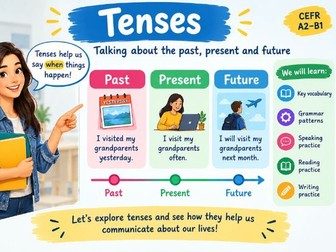
Tenses — ESL/EFL Grammar Lesson Tenses is a practical ESL/EFL grammar lesson designed to help students understand and use the main English tense patterns with greater confidence. The lesson introduces the three time frames—past, present, and future—and shows how each can be expressed through simple, continuous, perfect, and perfect continuous forms. Students are guided through clear examples such as “I do,” “I am doing,” “I have done,” “I did,” and “I will do,” helping them see how verb forms change to express different times and situations. The lesson also provides useful language practice with common verb combinations, including everyday expressions with have, take, do, and make. Later slides focus on the forms of be across past, present, and future, giving students a useful reference for building accurate sentences. Suitable for classroom presentation, review, consolidation, and guided speaking practice. It works well for learners needing an overview before detailed tense practice.
infinitives and -ing forms. to + verb infinitives, bare infinitives. gerunds (-ing forms) CEFR B1–B2Quick View
CoconutBayResources

infinitives and -ing forms. to + verb infinitives, bare infinitives. gerunds (-ing forms) CEFR B1–B2

(0)
Help students understand how and when to use infinitives and -ing forms with this practical grammar lesson for CEFR B1–B2 learners. Students learn to recognise and use to + verb infinitives, bare infinitives, and gerunds (-ing forms) in a range of common English structures. The lesson covers infinitives after specific verbs and expressions, bare infinitives after verbs such as feel, hear, help, let, make, see, and watch, adjectives followed by infinitives, gerunds after common verbs and expressions, gerunds after prepositions, and infinitives used to express purpose or intention. Clear explanations and real-world examples help students recognise the patterns and apply them accurately. Grammar focus: infinitives, bare infinitives, gerunds, verb patterns, and infinitives of purpose.
Grammar Mechanics: coordinating conjunctions worksheet, FANBOYS lesson plan, FANBOYS grammarQuick View
CoconutBayResources

Grammar Mechanics: coordinating conjunctions worksheet, FANBOYS lesson plan, FANBOYS grammar

(0)
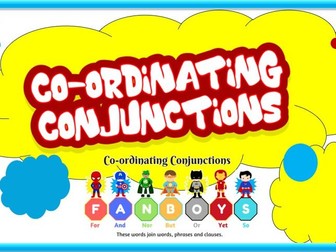
A2–B1 Coordinating Conjunctions (FANBOYS) – Grammar LessonHelp your students understand one of the most important building blocks of English sentences: coordinating conjunctions.This engaging lesson guides students through the FANBOYS framework (for, and, nor, but, or, yet, so). It covers identifying coordinating conjunctions, combining simple independent clauses, using proper comma punctuation, and understanding the distinct meaning differences between contrasting words like but and yet.Clear explanations, custom-illustrated comic panels, and a relatable reading comprehension story make potentially challenging grammar concepts easier to understand and discuss. The lesson is designed for Pre-Intermediate and Intermediate (A2–B1) ESL/EFL learners, particularly secondary students or adults, and works well as a classroom grammar lesson, review lesson, or presentation-led teaching resource.A practical, engaging way to help students master sentence structure, improve their writing flow, and understand how compound sentences work together. A 12-question quiz and complete answer key are included for quick assessment.