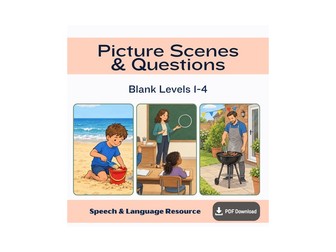
Support children’s understanding and language skills through five colourful everyday picture scenes: the beach, park, birthday party, classroom and family barbecue.
Each scene comes with questions across Blank’s Levels 1–4, covering naming and pointing, describing, predicting, sequencing, reasoning and problem solving. Suggested answers help adults guide the conversation while leaving room for children’s own ideas.
What’s included:
Five illustrated picture scenes
Questions across all four levels for each scene
Suggested answers
Adult guidance with tips for adapting questions and supporting different ways of communicating
Use the resource at home, in the classroom or during speech and language sessions, individually or in small groups
Choose questions to suit the child’s understanding and interests, and accept responses through speech, pointing, gestures, signs or AAC.
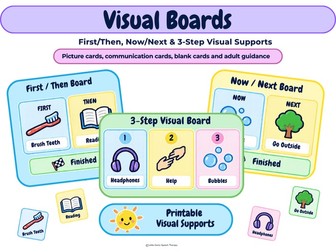
Printable Visual Timetable, First/Then and Now/Next Boards for Children - SEN Visual Supports
Support children’s understanding of daily routines, transitions and communication with this colourful, 27-page printable visual supports pack.
Created by a qualified Paediatric Speech and Language Therapist, this resource is designed for teachers, teaching assistants, SENCOs, parents and therapists supporting children with speech, language and communication needs (SLCN), autism and additional learning needs.
What’s Included?
First/Then visual boards
Now/Next visual boards
3-Step visual activity boards
60 colourful picture cards covering home routines, school and nursery activities, play, transitions and sensory activities
6 communication cards: Help, Break, Stop, More, Finished and Change
12 blank picture cards for personalisation
Practical adult guidance on introducing and using visual supports
Printing, laminating and preparation instructions
How Can This Resource Help?
These visual supports can help children:
Understand what is happening now and what comes next
Follow simple sequences and everyday routines
Feel more prepared for transitions between activities
Express preferences and communicate needs
Make choices and develop greater independence
Access visual information alongside spoken language
Who Is This Resource Suitable For?
This resource is particularly useful for:
Early Years Foundation Stage (EYFS)
Key Stage 1 (KS1)
SEND classrooms and specialist provisions
Autism support and inclusive learning environments
Speech and language therapy sessions
Home learning and daily routines
The boards and picture cards can be adapted for children of different ages and communication abilities.
How to Use
Download the PDF, print the visual boards and cut out the required picture cards. Laminate for durability if preferred, and use reusable hook-and-loop fasteners to attach the cards.
Introduce the visuals during familiar routines, using clear, simple language and allowing children time to process the information.
The pack also includes blank cards so you can personalise activities using familiar photographs, drawings or symbols.
A Neurodiversity-Affirming Approach
Visual supports should help children feel informed, understood and supported rather than pressured to comply.
This resource encourages meaningful choice, communication and flexibility, recognising that every child has individual needs and preferences.
Resource Details
Format: Printable PDF
Pages: 27
Colour: Full colour
Preparation: Printing and cutting required; laminating optional
Created by: Little Gems Speech Therapy
Please note: This is a digital download. No physical product will be posted. For personal, classroom or clinical use in accordance with the included terms of use.
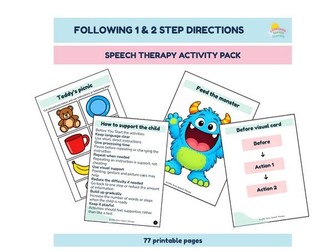
Support children’s understanding of spoken language with this comprehensive, visual speech and language resource designed for use at home, in school and during therapy sessions.
This full activity pack provides structured opportunities to practise following 1-step and 2-step directions, understanding colour, size and positional concepts, using first/then and before/after language, and developing the ability to process increasingly complex spoken information.
The resource has been designed to be flexible and supportive. Children can use picture cues, repetition, gestures and simplified language where helpful, and adults can gradually increase the level of challenge as the child becomes more confident.
What’s included:
simple 1-step direction activities
2-step directions using objects and actions
colour directions
size directions
colour + size directions
positional language including in, on, under and next to
First / Then activities and visual board
Before / After activities and visual supports
reusable visual support cards
interactive cut-and-use activities
Teddy’s Picnic
Feed the Monster
Pack the School Bag
Dressing Up
House activity
Farm activity
Beach activity
Treasure Hunt
real-life / no-print activities
differentiation guidance
observation and planning sheets
session notes
The interactive games give children opportunities to practise understanding directions in a more engaging, hands-on way, using familiar themes such as dressing up, school bags, farms, beaches and treasure hunts.
The pack also includes practical guidance on how to make activities easier or more challenging by changing the amount of language, number of choices, visual support and information-carrying words.
A printable observation sheet and session notes page are included to help adults record how the child responded, what level of support was helpful and what to practise next.
Ideal for:
Speech and Language Therapists
teachers and teaching assistants
SEN/SEND support
parents and carers
early language intervention
receptive language work
individual or small-group sessions
home practice
This resource is intended as a flexible teaching and therapy tool rather than a formal assessment.
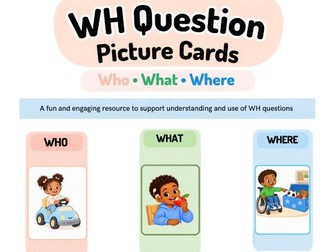
Support children to understand and answer WHO, WHAT and WHERE questions with this colourful, child-friendly speech and language therapy resource.
This 22-page printable PDF contains 48 WH question picture cards alongside practical adult guidance and activities designed to help children practise and generalise their understanding.
WHAT’S INCLUDED
• 16 WHO picture cards
• 16 WHAT picture cards
• 16 WHERE picture cards
• 48 picture cards in total
• Ready-to-use question prompt sheet
• Adult guidance for supportive, low-pressure practice
• Mixed WH activities for everyday generalisation
• 6-session progress tracker
• Suggestions for adapting the level of support
• Credits and terms of use
The resource has been designed with inclusive communication in mind. Children can respond through speech, pointing, gesture, signing or AAC, and adults are encouraged to allow processing time, offer choices and model answers when needed. who what where questions-4
IDEAL FOR
• Speech and Language Therapy sessions
• SEN / Special Education
• Autism support
• Early intervention
• Teaching assistants
• Small-group work
• 1:1 intervention
• Home practice
• Receptive and expressive language work
The cards can be introduced one question type at a time before progressing to mixed WHO, WHAT and WHERE activities. The included everyday-practice ideas help children use these skills beyond structured picture-card tasks. who what where questions-4
DIGITAL DOWNLOAD
This is a digital PDF product. No physical item will be posted.
Simply download, print and use, or display the cards digitally on a tablet or screen.
PLEASE NOTE
For personal, classroom or clinical use only. The file may not be shared, redistributed, uploaded online or resold.


 Quick View