Free Photosynthesis AQA GCSE – Limiting Factors Worksheet + DemoQuick View
SimulationLessons

Free Photosynthesis AQA GCSE – Limiting Factors Worksheet + Demo

(0)
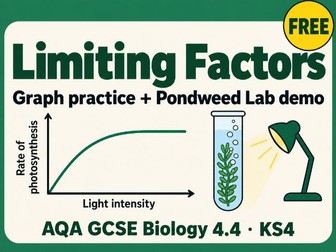
Free photosynthesis worksheet for AQA GCSE Biology: Limiting Factors Graph Practice (6 questions, 10 marks) in editable Word, with answers and a lab demo. Try the Pondweed Lab demo: move the lamp, count the bubbles and see your means plotted against distance. It works offline on a whiteboard, laptop or phone, so it works as a classroom simulation of lamp distance and bubble count when the practical can’t be carried out. Photosynthesis is the endothermic reaction in which plants and algae use light energy to make glucose and oxygen from carbon dioxide and water. A limiting factor is the one in short supply, such as light intensity, carbon dioxide concentration or temperature, that holds the rate back. What’s included Pondweed Lab demo (one mode: Run the practical), an offline HTML page Limiting Factors Graph Practice: a two-page editable Word student worksheet (6 questions, 10 marks) with a PDF copy A separate one-page teacher answer sheet (Word and PDF) Who it’s for: Year 10 and 11 students on AQA GCSE Biology or Combined Science: Trilogy, plus anyone revising graph skills before mocks. The questions ask students to read, describe and explain limiting factor graphs, which is where many lose marks. How to use it Starter (10 minutes): run the demo on the board. Ask the class to predict what happens to the bubble count as the lamp moves away, then test it. Main task (25 minutes): students complete the worksheet alone or in pairs. Plenary (10 minutes): mark with the answer sheet and pick out the “explain” questions for feedback. It also works as a homework, a revision lesson or a cover task, because the worksheet stands alone and the answers are separate. The Word file is editable if you want to change the data or add your own question. Want the whole topic? The full unit adds three 60-minute lessons with Teacher and Student slides, worksheets at three levels, the required practical write-up frame, an exam-style assessment with a mark scheme, and the full Pondweed Lab with the inverse square law (Higher) and the Limiting Factor Detective. The full version: Photosynthesis AQA GCSE Biology – 3 Lessons + Required Practical Alignment: AQA GCSE Biology (8461) and Combined Science: Trilogy (8464) 4.4.1.2, the rate of the reaction. Not endorsed by or affiliated with AQA. Free to use with your own classes under the Tes licence. Please don’t post the files publicly or share them beyond that licence. Last updated: 12/11/2026. The full version is available from the same author on Tes.
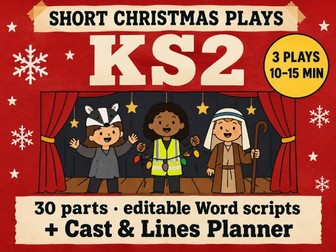
Short Christmas Play Scripts KS2 – 3 Plays, 30 Parts + PlannerQuick View
SimulationLessons

Short Christmas Play Scripts KS2 – 3 Plays, 30 Parts + Planner

(0)
Three short Christmas play scripts for a whole KS2 class: original 10–15 minute plays, 30 speaking parts each, editable Word scripts and a casting planner. Includes the Cast & Lines Planner: paste your class list and it shares out the parts by confidence, balances lines, prints a highlighted script or cue cards for every child, and runs a cue-card rehearsal mode. It works offline on a whiteboard, laptop, tablet or phone. A class Christmas play is a short script that the whole class performs together, often as a class assembly or an end-of-term show. Each play runs for about 10–15 minutes (spoken lines about 6–10 minutes, plus two songs, entrances and laughs). Nothing is based on a film, and every lyric is original, set to a traditional, out-of-copyright tune. The Great Lights Switch-On (secular comedy): the big red button fails and young inventor Ellie Spark saves the night with people power. The Longest Night in Hollow Wood (winter story for all faiths and none): Tiny Wren leads the woodland creatures to ask grumpy Badger to share the Winter Lantern. Full Up at the Inn (gentle nativity comedy): Bethlehem is packed, until there is one more knock at the door. What’s included Cast & Lines Planner (offline HTML) 3 scripts in editable Word + PDF: 14 pt, speakers colour-coded by part size, cast list with line counts, scene list, doubling guide for 20–24 children, song spots Narrator scripts, a rehearsal plan (9 short sessions over 2–3 weeks), 5 warm-up drama games and a scene-order card sort for each play Production kit: stage plans, props, costume ideas (from home, no buying), safety notes and a cue sheet for each play Song slides (editable PowerPoint + PDF): 3 original songs to traditional tunes Letter to families, a programme template (one per play), 6 certificates, a teacher guide and a START HERE page Part sizes for every child: lead (8+ lines), medium (4–7), small (1–3), narrators, and whole-cast lines for EAL learners and less confident readers. The plays work for about 20–36 children; extra children join the chorus. Licence: supplied under the Tes licence you choose at checkout (standard, or Multi-User/School Licence where purchased). You may copy the scripts for your pupils and families. In addition, the publisher gives permission to perform the plays to any audience, with no extra performance fee from the publisher. Try it free first: Free Christmas Play Script KS2 – 5-Minute Mini-Play, 12 Parts Last updated: 12/11/2026. If this helped your class, an honest review on Tes helps other teachers find it. Thank you!
Free KCSIE 2026 Changes – Staff Summary + 2 Demo ScenariosQuick View
SimulationLessons

Free KCSIE 2026 Changes – Staff Summary + 2 Demo Scenarios

(0)
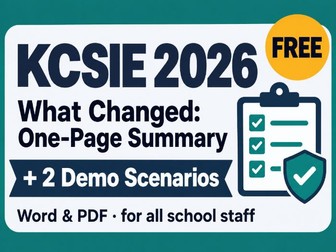
Free one-page summary of the KCSIE 2026 changes for staff: ten changes, each with its paragraph, in editable Word and PDF, plus 2 demo scenarios. Try 2 scenarios from the Part One Scenario Simulator: choose what you would do and get instant feedback that cites the paragraph in the guidance. It works offline on a projector, laptop or phone, with nothing to install and no log-in. Keeping children safe in education (KCSIE) is the Department for Education’s statutory safeguarding guidance for schools and colleges in England. Under the 2026 guidance, all staff, including those who do not work directly with children, must read Part one in full. This summary is a quick briefing aid, not a substitute for the guidance. What’s included “What changed”: a one-page summary of ten changes for staff, each with its paragraph or section number (editable Word + PDF) Scenario Simulator demo (offline HTML) with two scenarios: The classroom door (a disclosure) and An image going round (nudes and semi-nudes, including AI-made images) Who it’s for: DSLs, deputies, heads, business managers and anyone who briefs staff at the start of term or when new staff join. It also suits governors who want a quick view of the 2026 update. How to use it Staff briefing (10 minutes): put the summary on screen and talk through the ten changes, one line each. Scenario check (5 minutes): run one scenario on the projector and ask staff to vote before you reveal the feedback. Noticeboard: print the summary for the staffroom or add it to your induction pack. The Word file is editable, so you can add your DSL’s name, your own contacts or a local note under any change. The summary points to the exact paragraph, so staff can check the source rather than take our word for it. Need the full INSET? The full Part one pack adds all 10 scenarios with a named, dated completion certificate, 44 editable trainer slides covering all of Part one with notes, a facilitator guide (60, 45 and 20-minute routes), a staff handout and concern poster with local blanks, a 15-question knowledge check in two forms, activities and a training record. The full version: KCSIE 2026 Staff Training – Part One INSET + Scenario Simulator This summary supports, but does not replace, the statutory guidance, your child protection policy and your DSL. Not produced or endorsed by the Department for Education. Contains public sector information licensed under the Open Government Licence v3.0. Free to use under the Tes licence. Please don’t post the files publicly or share them beyond that licence. Last updated: 12/11/2026. The full version is available from the same author on Tes.
Safer Internet Day 2027 KS3 – Assembly, Lesson + Online GameQuick View
SimulationLessons

Safer Internet Day 2027 KS3 – Assembly, Lesson + Online Game

(0)
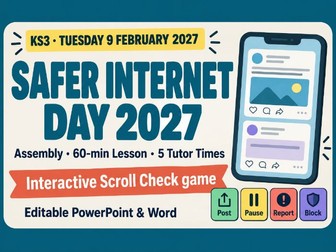
Safer Internet Day 2027 for KS3: an editable 15-minute assembly, a 60-minute lesson and five 10-minute tutor-time activities, plus an online safety game. Scroll Check: an offline mock social feed where pupils decide to Post, Pause, Report or Block 20 fictional posts, with the reason for every choice. It covers scams, oversharing and live location, AI-made and deepfake content, a confidently wrong chatbot, unkind comments, a stranger’s friend request, streak pressure and kind posts. Room vote mode for the hall or class; works offline on a whiteboard, laptop or phone. No answers are stored. Safer Internet Day is an annual day that promotes the safe and positive use of technology for children and young people; in the UK it is coordinated by the UK Safer Internet Centre. In 2027 it falls on Tuesday 9 February, with the theme ‘Reflect on tech: exploring digital wellbeing and our relationship with technology’, linked through a ‘Reflect on tech’ strand and editable theme slides. This is an independent resource, not made or endorsed by the UK Safer Internet Centre. What’s included Scroll Check (1 offline HTML file, 20 posts) Assembly: 16 editable slides with the script in the notes, plus a Word script Lesson: Teacher slides (24, with plan and answers) and Student slides (16) Worksheets at 3 levels (Support, Core, Stretch) 5 tutor-time activities: 23 slides and a Word pack with cards Answer key, teacher guide and a parent/carer tips letter 12 PDFs and a START HERE page: 4 PowerPoint decks, 8 Word documents, 2 HTML pages in all Safeguarding: no sexual content and no content about suicide or self-harm. The teacher guide reminds staff to follow school procedures and inform the DSL of any disclosure. Pupils are signposted to a trusted adult, Childline (0800 1111), CEOP and Report Harmful Content. Every person, account, app and post is invented. Alignment: DfE RSHE statutory guidance (from 1 September 2026): secondary RSE ‘Online safety and awareness’ (points 2, 3, 6, 7, 9, 14) and health and wellbeing ‘Wellbeing online’ (points 1, 3, 5); KS3 Computing programme of study (using technology safely and knowing how to report concerns). Licence: supplied under the Tes licence you choose at checkout (standard, or Multi-User/School Licence where purchased). Pupils may use Scroll Check at school or at home for school work. No public upload or resale. Try it free first: Free Safer Internet Day 2027 KS3 – Poster + Online Safety Demo Last updated: 12/11/2026. If this helped your class, an honest review on Tes helps other teachers find it. Thank you!
Hiroshima KS3 History Free Source Lesson: Reading a 1945 SourceQuick View
SimulationLessons

Hiroshima KS3 History Free Source Lesson: Reading a 1945 Source

(0)
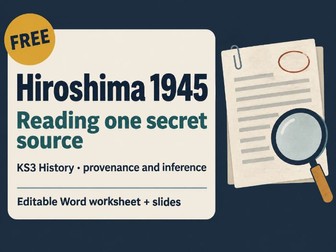
Free Hiroshima KS3 History source lesson: a 30-minute lesson on one secret 1945 record, the Interim Committee notes of 31 May 1945, with editable slides and a Word worksheet on provenance, inference and judgement. What is the lesson about? Weeks before the atomic bomb was dropped on Hiroshima, a secret US committee advising the Secretary of War, Henry L. Stimson, agreed not to give Japan any warning and chose the kind of target it wanted. Students read the declassified notes and ask the historian’s questions: who made this source, what is it, why was it made, and what can we infer from it? They finish by deciding whether this one source suggests the decision was justified, not justified, or both. Why use it? It is a ready-to-teach introduction to the enquiry ‘How far was the decision to drop the atomic bomb justified?’ and a strong source-skills lesson in its own right. It works as a starter for a Second World War unit, a cover lesson with full speaker notes, or a short source-analysis practice for Year 8 or Year 9. What’s included Slides (PowerPoint + PDF): content note, Do Now with answers, context, the source with Who? What? Why?, a glossary, inference questions and a judgement prompt, plus speaker notes and a 30-minute plan Worksheet (Word + PDF): the source in full, a glossary, seven questions in three parts (provenance, inference, judgement), an extension, and a teacher answer page with the historian’s note (the last page, kept separate for printing) START HERE page Accurate and sensitive: the extract is cut exactly from the declassified record in the US National Archives (public domain), with a full reference. There are no photographs or descriptions of the bombing’s human effects, and the content note is built into the slides and worksheet. Students act only as historians weighing evidence about a decision. Skills practised: provenance (who, what, why and when), inference from a primary source, the difference between a private record and a public statement, and a supported judgement using a quotation. These are the same skills students need for GCSE History source and interpretation questions. The full enquiry (paid) adds eleven more sources, including Britain’s consent of 4 July 1945, the Potsdam Declaration, a secret Japanese message, casualty estimates that name their sources and a survivor’s words; two complete 60-minute lessons; worksheets at three levels; a card sort and continuum; an assessment with mark scheme and model answers; and the Evidence Scales interactive, where students weigh twelve sources and compare what was known in July 1945 with hindsight. Related: Hiroshima KS3 History Enquiry: Was the Atomic Bomb Justified? (full version). Free for classroom use. Last updated: 04/11/2026 (first release). The full version is available from the same author on Tes.
Free Christmas Play Script KS2 – 5-Minute Mini-Play, 12 PartsQuick View
SimulationLessons

Free Christmas Play Script KS2 – 5-Minute Mini-Play, 12 Parts

(0)
A free Christmas play script for KS2: Who Ate the Last Mince Pie?, an original 5-minute mini-mystery with 12 parts, editable Word and PDF, plus a planner. Try the Cast & Lines Planner free: paste your class list and the planner casts this mini-play for you. It prints each child’s script with their lines highlighted and runs a cue-card rehearsal mode. It works offline on a whiteboard or a phone, so you can use it in the hall with no internet. A class Christmas play is a short script that a class performs together, often as an assembly or an end-of-term show. In Who Ate the Last Mince Pie? it’s the class party, the last mince pie has vanished, and Detective Sharp has five minutes to find the culprit. Three suspects, one very full class hamster and a headteacher who arrives at exactly the wrong moment. What’s included The script in editable Word, with a 5-page PDF copy: one scene, 14 pt text, speakers colour-coded, a cast list with line counts and one song spot Cast & Lines Planner taster (offline HTML), set up for this mini-play A START HERE page that opens each file in order Who it’s for: KS2 teachers who need something short, funny and quick to learn. Twelve speaking parts suit a small class, a club or a mixed-age group. Extra children can join as a chorus, and with fewer children one child can say two small parts. Most parts are one to three lines, so less confident readers can still take part. How to use it Read-through (20 minutes): read the script aloud together, then choose parts with the children or let the planner cast them. Rehearsals (15 minutes a day for 3 or 4 days): use the cue-card mode on the board, then print each child’s highlighted script to take home. Performance (5 minutes): a class assembly, a slot in a carol concert, or a treat before the party. Everything in Word can be changed: swap names, cut a line or add a local joke. No set is needed, just a table, an empty plate and a few chairs; the hamster is a child in paper ears. The song is a traditional carol, or swap in one your class knows. Want a bigger show? The full pack has three 10–15 minute plays for up to 30 children, with narrator scripts, a rehearsal plan, a production kit, song slides, a programme, certificates and the full planner for any class list. The full version: Short Christmas Play Scripts KS2 – 3 Plays, 30 Parts + Planner Free to use with your own classes under the Tes licence. Please don’t post the files publicly or share them beyond that licence. Last updated: 12/11/2026. The full version is available from the same author on Tes.
KCSIE 2026 Staff Training – Part One INSET + Scenario SimulatorQuick View
SimulationLessons

KCSIE 2026 Staff Training – Part One INSET + Scenario Simulator

(0)
KCSIE 2026 staff training for all staff: an editable INSET on Part one with 44 trainer slides, a facilitator guide and an offline scenario simulator. Includes the Part One Scenario Simulator: staff work through 10 school-day safeguarding scenarios (24 decisions), get instant feedback citing the KCSIE 2026 paragraph, and finish with a score summary and a printable, named, dated completion certificate. Room vote mode. Nothing typed is saved or sent. The certificate records participation in a practice activity; it is not an accredited qualification. Keeping children safe in education (KCSIE) is the Department for Education’s statutory safeguarding guidance for schools and colleges in England. In 2026 the condensed Part one was withdrawn, so every member of staff now reads Part one in full; this KCSIE 2026 staff training covers all of it, paragraph by paragraph. What’s included 44 editable PowerPoint slides: all of Part one (paras 1–82), a 4-slide “What’s new in 2026” section, activities, a local-arrangements slide, an optional governors slide; notes on every slide Facilitator guide (Word): 60- and 45-minute plans, a 20-minute first briefing for mid-year starters (not a substitute for full training), a self-study route, three levels, a slide-to-paragraph map and answer keys Simulator scenarios include a disclosure, a low-level concern, nudes and semi-nudes (including AI-made images), FGM and whistleblowing Staff handout (14 key points), concern poster and slide 42 with editable local-arrangements blanks for your DSL Knowledge check (15 questions, forms A and B, explained answers), two movement activities and a training record with sign-off slips START HERE page and 9 print-ready PDFs Accuracy: paraphrased from the DfE’s KCSIE 2026 (September 2026) and checked against the GOV.UK PDF, referenced to KCSIE 2026 paragraphs or the relevant DfE or UKCIS guidance, using the 2026 wording and renumbered annexes. Where something is a school’s own decision, the pack says so. Important: this training supports, but does not replace, your school’s child protection policy, your DSL and your local safeguarding procedures. Not produced or endorsed by the Department for Education. Contains public sector information licensed under the Open Government Licence v3.0. All scenario names are fictional. Licence: supplied under the Tes licence you choose at checkout (standard, or Multi-User/School Licence where purchased). The buyer may present and print the materials for staff training in their own school; sharing copies with colleagues is governed by that licence. No sharing with other schools (including other schools in a trust) or public upload. Try it free first: Free KCSIE 2026 Changes – Staff Summary + 2 Demo Scenarios Last updated: 12/11/2026.
Photosynthesis AQA GCSE Biology – 3 Lessons + Required PracticalQuick View
SimulationLessons

Photosynthesis AQA GCSE Biology – 3 Lessons + Required Practical

(0)
Photosynthesis lessons for AQA GCSE Biology 4.4: three 60-minute lessons with the light-intensity required practical, worksheets and an assessment. Includes the Pondweed Lab: an offline interactive where students move the lamp, count the bubbles, see their means plotted against distance and 1/d², and name the limiting factor. It works on a whiteboard, laptop or phone. If the practical cannot run (or for a cover lesson), the simulation or backup data keep the analysis going; they do not replace the hands-on required practical your students should still carry out. Photosynthesis is the endothermic reaction in which plants and algae use light energy to make glucose and oxygen from carbon dioxide and water. These lessons cover AQA GCSE Biology 4.4.1 for separate and combined science. What’s included 3 lessons (60 min each): 1) the reaction and the leaf, 2) limiting factors with the inverse square law and greenhouse economics (Higher), 3) the light-intensity required practical with data analysis (groups test 3 distances and pool class results) 6 editable PowerPoint decks: Teacher slides (answers and speaker notes) and Student slides 9 editable Word worksheets: Support, Core and Stretch for each lesson Required practical write-up frame and a backup results data sheet Exam-style assessment (48 marks Higher, 36 Foundation) with mark scheme, plus a full answer key Card pack for Limiting Factor Stand-Up and Pathway Relay Teacher guide (timings, technician checklist, safety notes, misconceptions), START HERE page and 22 print-ready PDFs Accuracy: the word equation, symbols and practical numbers are checked against the AQA specification; the balanced symbol equation (6CO₂ + 6H₂O → C₆H₁₂O₆ + 6O₂) is atom-checked and every answer is script-checked. Alignment: AQA GCSE Biology (8461) 4.4.1.1–4.4.1.3 and Required practical activity 6; AQA GCSE Combined Science: Trilogy (8464) 4.4.1 and Required practical activity 5; links to 4.2.3.1 (the leaf). Not endorsed by or affiliated with AQA. Licence: supplied under the Tes licence you choose at checkout (standard, or Multi-User/School Licence where purchased); sharing with colleagues is governed by that licence. Do not resell the files or upload them to a public website. Try it free first: Free Photosynthesis AQA GCSE – Limiting Factors Worksheet + Demo Last updated: 12/11/2026. If this helped your class, an honest review on Tes helps other teachers find it. Thank you!
Digestive System Diagram – 3 Levels FREE, KS3 & GCSE BiologyQuick View
SimulationLessons

Digestive System Diagram – 3 Levels FREE, KS3 & GCSE Biology

(0)
A free digestive system diagram labelling worksheet at three levels for KS3 Science and GCSE Biology, with a full answer sheet, in editable Word and PDF. What is the digestive system? An organ system in which several organs work together to digest food and absorb the small, soluble molecules into the blood. Three levels on one clear, labelled-by-number diagram: Level 1 (KS3 / Support): 8 organs with a word bank Level 2 (Core): 11 parts, no word bank (adds salivary glands, rectum and anus) Level 3 (Stretch): 12 parts including the duodenum, plus a table for the job of each organ What’s included Diagram worksheet, 3 levels (Word + PDF, 4 pages) Answers (Word + 2-page PDF): every label, a fully labelled diagram and the job of each organ Who it’s for: Year 7 to 9 science classes, and Year 10 and 11 students on AQA GCSE Biology or Combined Science who need a quick check of the organs before enzymes and digestion. The three levels let you give every student in a mixed class the same diagram at the right challenge. How to use it Starter (10 minutes): students label the diagram at their level from memory, then check with a partner. Main task (15 minutes): Stretch students complete the job-of-each-organ table, while others move up a level. Plenary (5 minutes): show the labelled answer diagram and ask which organ absorbs most of the digested food. It also works as a homework, a retrieval quiz before a test or a cover lesson, as the answers are on a separate sheet. The Word file is editable, so you can change the word bank or add your own questions. Because the parts are labelled by number, the same diagram works for all three levels, and students can move up a level as soon as they are ready. UK spelling throughout (oesophagus, gall bladder, large intestine). Fits KS3 Science and AQA GCSE Biology 4.2.2.1. Not endorsed by or affiliated with AQA. Want the full unit? The full unit adds three lessons with editable slides, both required practicals, exam questions and the Digestion Journey interactive, which follows a meal through the gut. The full version: Digestive System & Enzymes AQA GCSE Biology Unit + Practicals Free to use with your own classes under the Tes licence. Please don’t post the files publicly or share them beyond that licence. Last updated: 14/11/2026 (first release). The full version is available from the same author on Tes.
Digestive System & Enzymes AQA GCSE Biology Unit + PracticalsQuick View
SimulationLessons

Digestive System & Enzymes AQA GCSE Biology Unit + Practicals

(0)
Digestive system and enzymes unit for AQA GCSE Biology: three editable 60-minute lessons, both required practicals (food tests and the effect of pH on amylase) and an offline Digestion Journey interactive. What is the digestive system? An organ system in which several organs work together to digest food into small soluble molecules and absorb them into the bloodstream. Digestion Journey + Enzyme Lab (offline interactive): pupils pick a meal and follow its starch, protein and fat from the mouth to the bloodstream, choosing the enzyme, where it is made, its products and what bile does at each stop. In the Enzyme Lab they set the pH and temperature, test a drop against iodine every 30 seconds and plot rate = 1/t against pH. Quiz or Explore mode; class backup data built in. What’s included Lesson 1 – The digestive system: organs and their jobs (60 min, KS3 route) Lesson 2 – Enzymes, digestive enzymes and bile (60 min) Lesson 3 – Required practicals: food tests and amylase pH (60 min) 6 editable PowerPoint decks: Teacher (plan, answer slides, notes) and Student for each lesson 9 editable Word worksheets across 3 levels (Support, Core, Stretch), including organ labelling diagrams, enzyme graphs and practical calculations Required practical write-up frame, backup results data, food test station cards Exam-style questions (41 marks) with mark scheme, full answer key, knowledge organiser Card sort, Bolus-to-Bloodstream Relay, Enzyme Match Teacher guide: timings, technician list, general safety notes, misconceptions START HERE page and PDF copies of every Word document and PowerPoint deck Accurate to the spec: lock and key model, sites of production of amylase, proteases and lipases, products, the two jobs of bile, villi, and rate calculations. Every mean and rate in this unit is worked by code; data sets are invented for teaching and labelled. Alignment: AQA GCSE Biology (8461) 4.2.1 and 4.2.2.1, Required practicals 4 and 5; Combined Science: Trilogy (8464) 4.2.1 and 4.2.2.1, Required practicals 3 and 4. Links to 4.1.3.1 and 4.1.3.3. KS3 Science (Lesson 1 route). Free taster: Digestive System Diagram – 3 Levels, by the same author. Not endorsed by or affiliated with AQA. Check the current specification at aqa.org.uk. Licence: Supplied under the Tes licence you choose at checkout. A single licence is for the purchasing teacher and their own pupils. A school licence allows sharing with colleagues and pupils in one school, within Tes’s published limits and conditions. Please do not post or re-host the files on a public website. Last updated: 14/11/2026 (first release; spec codes and practical numbers checked against the AQA 8461 and 8464 specifications). If this helped your class, an honest review on Tes helps other teachers find it. Thank you!
Contact and Non-Contact Forces – KS3 & AQA GCSE Physics LessonsQuick View
SimulationLessons

Contact and Non-Contact Forces – KS3 & AQA GCSE Physics Lessons

(0)
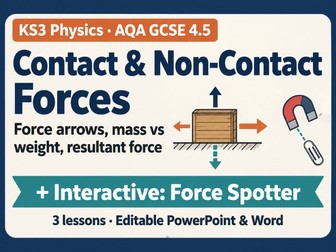
Contact and non-contact forces for KS3 Physics and AQA GCSE: three editable 60-minute lessons plus Force Spotter, an offline interactive where pupils draw force arrows and find the resultant. What are contact and non-contact forces? A force is a push or a pull from an interaction between two objects. Contact forces (friction, air resistance, tension, normal contact force, upthrust) act when the objects touch; non-contact forces (weight, magnetic, electrostatic) act across a gap. Force Spotter (works offline): 12 scenes, from a book on a table to a braking car, a skydiver at terminal velocity and a rocket. Pupils add each arrow (name, direction, size; solid for contact, dashed for non-contact), type the resultant and predict the motion; Check marks all four and gives hints. Planet Weigh-In shows W = m × g on ten worlds with NASA values; Contact or Not? is a quick-fire sort. Works on a whiteboard or phone and with a keyboard. What’s included Lesson 1 – Contact and Non-Contact Forces (interactions, newtons, force arrows, scalars and vectors) Lesson 2 – Mass, Weight and Resultant Force (W = m × g, resultants in a straight line, Newton’s First Law) Lesson 3 – Force Stations: 8 stations, each with a No-Lab Data Card so it runs with no equipment or as cover 6 editable PowerPoint decks (Teacher with plan, answers and notes; Student) 9 Word worksheets at 3 levels (Support, Core, Stretch) 32-card Contact or Not? sort, four corners signs and 12 statements, Myth or Fact hinge questions Planet Weigh-In sheet, quiz Forms A and B (12 marks each), answer key Teacher guide (station safety, misconceptions), cover lesson plan, START HERE page, PDF copies Accurate and exam-ready: every code checked against the saved AQA specifications; planet g values from the NASA Planetary Fact Sheet. Uses g = 9.8 N/kg (Support sheets use the KS3 value, 10 N/kg). Scene forces and station readings are illustrative and labelled. Alignment: AQA GCSE Physics 8463 4.5.1.1–4.5.1.4 and Combined Science: Trilogy 8464 6.5.1.1–6.5.1.4 (resultants in a straight line, free body diagrams; not resolving forces); introduces Newton’s First and Third Laws. DfE KS3 science programme of study: Forces, Balanced forces, Space physics. Not endorsed by AQA. Free taster: Mass and Weight KS3 Physics FREE – Planet Weigh-In Worksheet, from the same author. Licence: supplied under the Tes licence you choose at checkout. Last updated: 14/11/2026 (first release; facts and spec codes checked). If this helped your class, an honest review on Tes helps other teachers find it. Thank you!
Mass and Weight KS3 Physics FREE – Planet Weigh-In WorksheetQuick View
SimulationLessons

Mass and Weight KS3 Physics FREE – Planet Weigh-In Worksheet

(0)
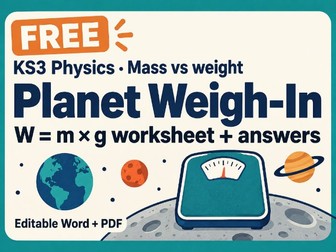
A free mass and weight worksheet for KS3 Physics: Planet Weigh-In, a Word sheet (with a PDF and answers) to find a 5 kg bag’s weight on six worlds. What is the difference between mass and weight? Mass is the quantity of matter in an object, in kilograms, and does not change from place to place. Weight is the force of gravity on it, in newtons, and depends on the gravitational field strength g. What’s included Planet Weigh-In: Mass v Weight (editable Word + PDF, 3 pages) g values for ten worlds from the NASA Planetary Fact Sheet (Earth 9.8 N/kg, Moon 1.6 N/kg, Jupiter 23.1 N/kg …), with the NASA note that gas giants have no solid surface Part A: weight of a 5 kg bag on Earth, the Moon, Mars, Jupiter, Neptune and Pluto, with working Part B: five thinking questions, including a stretch question that rearranges W = m × g Full answers on the last page Who it’s for: Year 7 to 9 science classes meeting forces and space, and Year 10 students who need a quick recap of W = m × g for GCSE Physics. Nobody weighs themselves: the sheet uses an object, so no pupil is made to feel uncomfortable. How to use it Starter (5 minutes): ask whether an astronaut’s mass changes on the Moon. Take a vote, then read the definitions. Part A (15 minutes): pupils work out the bag’s weight on each world, showing their working. Part B (15 minutes): pupils answer the thinking questions; the stretch question suits the quickest finishers. Check (5 minutes): go through the answers on the last page. It works as a starter, homework or cover task, and fits Lesson 2 of the full unit. Remove the answer page before printing if you set it as homework. The real NASA values give pupils a reason to check their units and round sensibly. Supports the DfE KS3 science programme of study (Space physics: weight = mass × g) and AQA GCSE Physics 8463 4.5.1.3 Gravity. Not endorsed by AQA or NASA. Want the full unit? Contact and Non-Contact Forces has three lessons, the Force Spotter interactive, a 32-card sort, eight force stations and quizzes, for KS3 and AQA GCSE Physics. The full version: Contact and Non-Contact Forces – KS3 & AQA GCSE Physics Lessons Free to use with your own classes under the Tes licence. Please don’t post the files publicly or share them beyond that licence. Last updated: 14/11/2026 (first release; facts checked). The full version is available from the same author on Tes.
T Level Health Normal Ranges & NEWS2 Quick Card – FREE PracticeQuick View
SimulationLessons

T Level Health Normal Ranges & NEWS2 Quick Card – FREE Practice

(0)
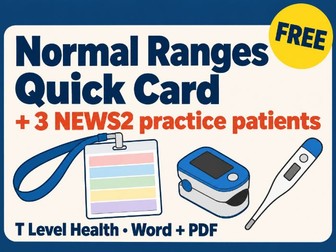
A free T Level Health normal ranges and NEWS2 quick card with three practice patients to score, plus a full answer sheet, in editable Word and PDF. What is NEWS2? The National Early Warning Score 2 turns seven routine observations, including whether the patient is on oxygen, into one score that shows how unwell an adult may be and how urgently to escalate. Page 1: the quick card Normal adult ranges from the Pearson T Level in Health specification: blood pressure, heart rate, respiration rate, temperature, oxygen saturation, blood sugar, BMI and urine output, with the equipment for each How NEWS2 scoring works, in plain words: the seven parameters, why the cut-offs differ for each one, and the response for each total or red score ACVPU and SBAR at a glance Page 2: NEWS2 practice Three invented patients (a routine score, an urgent score and an emergency score) to score row by row, using the official RCP NEWS2 colour chart (a free download; the link is on the card) Students write the response and who they tell What’s included Normal Ranges Quick Card + NEWS2 Practice (Word + PDF, 2 pages) Answers (Word + PDF): every sub-score, each total and the response, with the “think sepsis” note Why it helps: students often mix up normal ranges and NEWS2 scores. The card shows the normal adult ranges next to a plain explanation of how NEWS2 scoring works, then sends them to the official chart for every cut-off, so they learn to look scores up rather than guess. How to use it (30 minutes): print the official RCP chart, go through the quick card together (10 minutes), let pairs score the three patients (15 minutes), then check the answers and the escalation for each (5 minutes). Students can keep the card in their folder for placement prep. Fits the Pearson T Level Technical Qualification in Health (2026): core 8.18 and the Occupational Specialism core, Supporting Healthcare (SHK3.13, SHK3.22–SHK3.23). Also useful for Level 3 health and social care. Based on the Royal College of Physicians NEWS2 report (2017); the RCP charts are not reproduced. UK spelling throughout. Want the full unit? It adds three 60-minute lessons with Teacher and Student slides, worksheets at three levels, an obs chart audit, four-corners decision cards, SBAR role-plays, an exam-style assessment with mark scheme and the Obs Round NEWS2 simulator, which works offline. The full version: T Level Health Observations & NEWS2 – Lessons + Simulator 2026 Not endorsed by or affiliated with Pearson or the Royal College of Physicians. For education only: on placement, follow local policy. Free to use with your own classes under the Tes licence. Please don’t post the files publicly or share them beyond that licence. Last updated: 14/11/2026 (first release). The full version is available from the same author on Tes.
EPQ Taught Skills AQA 7993 – 8 Lessons + Research Lab InteractiveQuick View
SimulationLessons

EPQ Taught Skills AQA 7993 – 8 Lessons + Research Lab Interactive

(0)
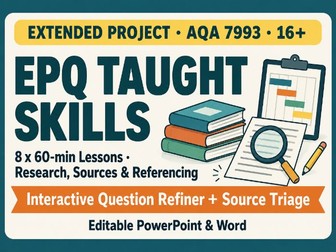
EPQ taught skills unit for the AQA Extended Project Qualification (7993): eight editable 60-minute lessons, a skills check and the EPQ Research Lab, an interactive that works offline. What is the EPQ? A Level 3 qualification in which students plan, research and complete their own project, usually a report of about 5,000 words, then present it and review it, recording every stage in a Production Log. EPQ Research Lab (offline HTML): Question Refiner: take a broad interest to a focused, researchable title in four checked steps (focused, debatable, researchable, ethical and safe), or self-check your own title. Ends with a model Production Log note. Title or not a title?: two rounds of 10 draft titles, with reasons and better versions. Source Triage: rate 12 invented sources for authority, evidence, bias risk and date, decide whether to use each, and get a Production Log line. Works on the whiteboard or a phone; nothing students type is saved or sent. What’s included Lesson 1 – What is the EPQ? AOs and the Production Log (60 min) Lesson 2 – Choosing and refining a title (60 min) Lesson 3 – Proposal and planning (60 min) Lesson 4 – Finding and evaluating sources (60 min) Lesson 5 – Referencing, plagiarism and honest use of AI (60 min) Lesson 6 – Literature review and synthesis (60 min) Lesson 7 – Academic writing and the 5,000-word report (60 min) Lesson 8 – Presentation, questions and reflection (60 min) 16 PowerPoint decks: Teacher (plan, answers, notes) and Student for each lesson 24 Word worksheets at 3 levels (Support, Core, Stretch), plus a Gantt project planner Production Log checkpoints mapped to AO1–AO4 (supervisor kit) Card sorts and movement: Which AO?, four corners, Credibility Line-Up, AI misuse sort, viva round 45-minute skills check (36 marks) with mark scheme Teacher guide, answer key, START HERE page, PDF copies This is an 8-hour taught-skills module, not a complete EPQ course: AQA expects about 30 taught hours in total. Honest use of AI: Lesson 5 teaches the JCQ AI Use in Assessments rules (revision two, 30 April 2025): what counts as misuse, and how to acknowledge an AI tool. Alignment: AQA Level 3 Extended Project Qualification 7993 (spec v1.4): taught element, proposal checklist, Production Log and AO1 Manage, AO2 Use resources, AO3 Develop and realise, AO4 Review. Notes for OCR H857, which uses the same four objectives and a Project Progression Record. Free taster: EPQ Title Check, by the same author. Not endorsed by or affiliated with AQA, OCR, Pearson, WJEC or JCQ. Practice sources are invented. Licence: Supplied under the Tes licence you choose at checkout. Please do not re-host the files on a public website. Last updated: 14/11/2026 (first release; checked against the AQA 7993 spec and JCQ AI guidance). If this helped your class, an honest review on Tes helps other teachers find it. Thank you!
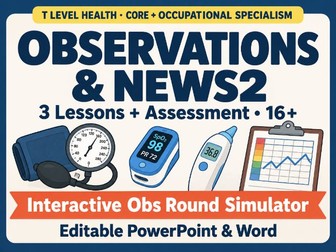
T Level Health Observations & NEWS2 – Lessons + Simulator 2026Quick View
SimulationLessons

T Level Health Observations & NEWS2 – Lessons + Simulator 2026

(0)
T Level Health observations and NEWS2 unit for the Pearson T Level in Health (2026): three editable 60-minute lessons, an assessment and the Obs Round NEWS2 simulator, which works offline. What is NEWS2? The National Early Warning Score 2 turns six routine observations, plus oxygen use, into one score that shows how unwell an adult is and how urgently to escalate. Obs Round simulator (offline HTML): students work a four-bed bay of invented patients across a shift (08:00, 12:00, 16:00). They take each patient’s observations, record them on the chart, choose ACVPU from what the patient says, score all seven NEWS2 rows and the total, choose the response, and order an SBAR report when escalation is needed. Feedback gives every sub-score. Practice or scored mode; works on the whiteboard or a phone. What’s included Lesson 1 – Normal ranges and taking observations (60 min) Lesson 2 – NEWS2: scoring and escalation (60 min) Lesson 3 – Recording, reporting (SBAR), consent and confidentiality (60 min) 6 editable PowerPoint decks: Teacher (plan, answer slides, notes) and Student for each lesson 9 editable Word worksheets across 3 levels (Support, Core, Stretch) Obs Chart Audit (find the 8 errors), Skills Check-Off Record, NEWS2 Quick Reference Escalate or Record? four corners (12 scenario cards), Range Match, Obs Skills Carousel, SBAR role-play and confidentiality cards 45-minute assessment (37 marks) using the Pearson command words, with a levels-based mark scheme Teacher guide, answer key, START HERE page, PDF copies Accurate: normal ranges are the Pearson specification figures; NEWS2 scoring is based on RCP NEWS2 (2017); students use the free official RCP chart. Every score is calculated by code. It tackles a common trap: a pulse of 95 is “normal” yet scores 1. Alignment: Pearson T Level Technical Qualification in Health (610/7438/X, first teaching September 2026): core 8.18 (Paper 2) and 3.3, 3.7–3.10 (Paper 1); Occupational Specialism core, Supporting Healthcare: SHS3.4–SHS3.7, SHK3.13–SHK3.23 and SHS2.6, preparing for OS Task 3, Recognising changes in an individual’s condition. Free taster: T Level Health Normal Ranges & NEWS2 Quick Card, by the same author. Not endorsed by or affiliated with Pearson or the Royal College of Physicians. For education only; follow local policy on placement. Licence: Supplied under the Tes licence you choose at checkout. A single licence is for the purchasing teacher and their own students. A school licence allows sharing with colleagues and students in one school or college, within Tes’s published limits and conditions. Please do not post or re-host the files on a public website. Last updated: 14/11/2026 (first release; codes checked against the Pearson specification v1.2, July 2026; NEWS2 scoring checked against the RCP charts). If this helped your class, an honest review on Tes helps other teachers find it. Thank you!
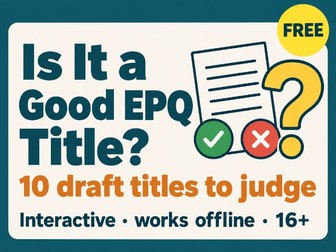
Free EPQ Title Check – AQA 7993 Interactive Game + WorksheetQuick View
SimulationLessons

Free EPQ Title Check – AQA 7993 Interactive Game + Worksheet

(0)
Free EPQ title check for the AQA Extended Project Qualification (7993): an offline interactive where students judge 10 draft titles, plus a worksheet. What makes a good EPQ title? One that is focused, debatable, researchable, and ethical and safe. These four checks are based on the proposal checklist in the AQA 7993 specification. Is it a good title? (offline HTML): students read each draft title and decide: good, or needs work? If it needs work they choose the main problem: too broad, just describes, can’t be researched well, ethics or safety risk, not balanced, or repeats a course topic. Every title has feedback and, where needed, a better version. First answers are scored out of 10. Works on the whiteboard or a phone, and nothing is saved or sent. What’s included Is_It_a_Good_EPQ_Title.html (interactive, 10 titles) Title Check worksheet: the same 10 titles on paper, a “now refine one” task and a teacher answer page (editable Word + 2-page PDF) START HERE page Who it’s for: EPQ coordinators and supervisors, and Year 12 students choosing a project. Use it in a first lesson, a taster session or with your supervisors before proposals are approved. How to use it (20 minutes): show the first title on the board and vote with hands up, then let pairs play on laptops or phones. Finish by asking each pair to refine one “needs work” title on the worksheet and to write down what they changed and why, just as they will in the Production Log. Why titles matter: the AQA proposal checklist asks whether a title lets students analyse and evaluate rather than describe, is manageable within the time and word total, can be carried out safely and ethically, and can be approached in a balanced way. A weak title makes every later stage harder, so ten minutes here can save weeks later. Want the full unit? The full EPQ Taught Skills unit has 8 lessons with Teacher and Student slides, worksheets at 3 levels, a project planner, Production Log checkpoints, a Credibility Line-Up, honest use of AI (JCQ rules), a skills check and the full EPQ Research Lab: the Question Refiner, a second round of 10 harder titles and Source Triage of 12 sources. The full version: EPQ Taught Skills AQA 7993 – 8 Lessons + Research Lab Interactive Not endorsed by or affiliated with AQA, OCR, Pearson, WJEC or JCQ. Free to use with your own classes under the Tes licence. Please don’t post the files publicly or share them beyond that licence. Last updated: 14/11/2026 (first release). The full version is available from the same author on Tes.
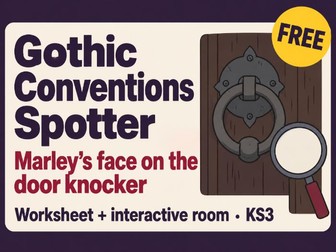
Free Gothic Conventions Spotter KS3 – Interactive + WorksheetQuick View
SimulationLessons

Free Gothic Conventions Spotter KS3 – Interactive + Worksheet

(0)
Free Gothic conventions activity for KS3 English: an offline interactive where students hunt for conventions in Marley’s face from A Christmas Carol. What are Gothic conventions? The familiar features of Gothic stories: isolated or decaying settings, pathetic fallacy, the supernatural, darkness and light, a fearful or trapped character, the monstrous or uncanny, and omens and symbols. The Spotter (offline HTML): students read the extract from Stave One, tap a phrase, tag the convention and the writer’s method, and get instant feedback with a model explanation. There are 11 marked pieces of evidence; finds go into an evidence journal with a What–How–Why paragraph builder. Works on the whiteboard or a phone; nothing is saved or sent. What’s included Gothic_Conventions_Spotter.html (interactive, one room) Worksheet: the extract with a glossary, the seven conventions, five questions (including a What–How–Why paragraph) and a separate teacher answer page (editable Word + 4-page PDF) START HERE page Who it’s for: KS3 English teachers starting a Gothic or A Christmas Carol unit, and Year 9 classes getting ready for GCSE analysis. The What–How–Why builder helps students turn a spotted phrase into a paragraph. How to use it (20–30 minutes): read the extract aloud, hunt for the first piece of evidence together on the board, then let pairs carry on with laptops or phones. Finish with the paragraph question on the worksheet. It works as a Gothic starter, a Christmas-term lesson or a cover lesson. No devices? Use the worksheet alone: the extract, glossary and questions are all on paper, with answers on a separate page. A second reading usually turns up more evidence, so let students go back to the extract before they write their paragraph, and share the best finds with the class. The extract is from a public-domain text (Project Gutenberg, cited). Not endorsed by or affiliated with AQA or the Department for Education. Want the full unit? The full Gothic Fiction KS3 unit has five 60-minute lessons (Dracula, The Red Room, The Masque of the Red Death, Frankenstein, Jane Eyre) with Teacher and Student slides, worksheets at 3 levels, Convention Corners and a Tension Line, an assessment with mark scheme, and all five rooms of Blackthorn Manor plus the Writing Desk. The full version: Gothic Fiction KS3 Unit – 5 Lessons + Interactive Convention Hunt Free to use with your own classes under the Tes licence. Please don’t post the files publicly or share them beyond that licence. Last updated: 14/11/2026 (first release). The full version is available from the same author on Tes.
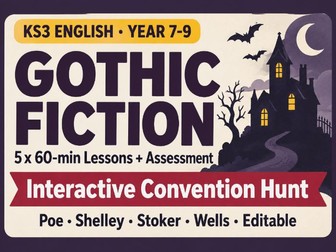
Gothic Fiction KS3 Unit – 5 Lessons + Interactive Convention HuntQuick View
SimulationLessons

Gothic Fiction KS3 Unit – 5 Lessons + Interactive Convention Hunt

(0)
Gothic fiction KS3 unit of work: five editable 60-minute lessons on real Gothic extracts, a reading and writing assessment, and Blackthorn Manor, an interactive Convention Hunt that works offline. What is Gothic fiction? Stories that use dark, isolated or decaying settings, the supernatural and suspense to make readers feel fear and wonder, from The Castle of Otranto (1764) to Dracula (1897). Blackthorn Manor Convention Hunt (offline HTML): five rooms, five classics. Students tap a phrase in a real extract, tag one of seven Gothic conventions and one of ten methods, and get instant feedback (43 marked pieces of evidence, with hints and model explanations). Finds go into an evidence journal that builds What–How–Why paragraphs; the Writing Desk turns them into a plan for a Gothic description. Whiteboard or phone; no accounts, internet connection or installation needed, and nothing is saved or sent. What’s included Lesson 1 – What makes a story Gothic? Dracula (60 min) Lesson 2 – Building suspense: The Red Room (60 min) Lesson 3 – Setting and symbol: The Masque of the Red Death (60 min) Lesson 4 – Creator and creature: Frankenstein (60 min) Lesson 5 – Writing Gothic description: Jane Eyre’s red-room (60 min) 10 PowerPoint decks: Teacher (plan, answers, notes) and Student 15 Word worksheets at 3 levels (Support, Core, Stretch), each with its extract, plus a writing planner SPaG in every lesson: noun phrases, short sentences, dashes and semicolons, exclamations Movement and drama: Convention Corners, Tension Line, The Clock Strikes, hot-seating Victor 60-minute assessment on an unseen extract from The Signal-Man (70 marks) with mark scheme and writing grid Extract booklet, teacher guide, answer key, START HERE page, PDF copies Every extract is from a public-domain text (Project Gutenberg, cited); graphic passages are left out, so it suits Year 7–8. Alignment: KS3 English National Curriculum: pre-1914 literature, how language and structure present meaning, inference with evidence, imaginative writing. Bridges to GCSE: AQA English Language Paper 1 descriptive writing (24 + 16 marks) and AQA English Literature AO1–AO3. Free taster: Gothic Conventions Spotter (A Christmas Carol), by the same author. Not endorsed by or affiliated with AQA or the Department for Education. Licence: Supplied under the Tes licence you choose at checkout. Please do not re-host the files on a public website. Last updated: 14/11/2026 (first release; extracts and dates checked against saved sources). If this helped your class, an honest review on Tes helps other teachers find it. Thank you!
AQA Psychology Research Methods A Level – 6 Lessons + Stats LabQuick View
SimulationLessons

AQA Psychology Research Methods A Level – 6 Lessons + Stats Lab

(0)
AQA Psychology research methods unit for A-level 7182: six editable 60-minute lessons, an exam-style assessment and the Research Methods Lab, an interactive page that works offline. What is research methods? The part of A-level Psychology on how psychologists design studies, collect and describe data, and use statistical tests to decide whether a result is significant. Research Methods Lab (offline HTML): students design a study (hypothesis, DV, design, sample, controls, ethics) and design flaws are flagged with reasons. They run it to get simulated data, calculate the mean and range, walk the Which Test? tree and do the sign test step by step. Then they reveal the Lab truth: a correct conclusion, a Type I or a Type II error. Turn off counterbalancing and watch an order effect hide a real difference. Plus a Which test? quiz and a sign test trainer. Works on the whiteboard or a phone. What’s included Lesson 1 – Aims, hypotheses and variables Lesson 2 – Experiments, designs and control Lesson 3 – Sampling, pilot studies and ethics Lesson 4 – Data, descriptive statistics and distributions Lesson 5 – Correlations, levels of measurement and choosing a test Lesson 6 – Probability, significance and the sign test 12 editable PowerPoint decks: Teacher (plan, answer slides, notes) and Student for each lesson 18 editable Word worksheets across 3 levels (Support, Core, Stretch) Card pack: Variables Card Sort, Design Four Corners (12 cards), Sampling Snap, Ethics Continuum Line (10 cards), Human Scattergram (36 data cards), Which Test? relay (10 cards) Stats Toolkit (sign test steps, critical values, Which Test? grid) and a spec RAG checklist 50-minute assessment (37 marks) with mark scheme Teacher guide, answer key, START HERE page, PDF copies Accurate: every statistic is calculated by code and the Lab is tested against the same model; questions are original, not past papers. Alignment: for the updated AQA A-level Psychology 7182 (first exams 2027), 4.2.3 (experimental method, correlations), 4.2.3.1, 4.2.3.2 and 4.2.3.3 (sign test, significance, Type I/II errors, choice of test); Lessons 1–4 also fit AS 7181 3.2.3. Not covered: observations, self-report, content analysis, case studies, reliability, validity, features of science, reporting. Free taster: Psychology Research Methods Spot the Variables, by the same author. Not endorsed by or affiliated with AQA. All studies and data are invented. Licence: Supplied under the Tes licence you choose at checkout. A single licence is for the purchasing teacher and their own students. A school licence allows sharing with colleagues and students in one school or college, within Tes’s published limits and conditions. Last updated: 14/11/2026 (checked against AQA spec v1.4, Sept 2025). If this helped your class, an honest review on Tes helps other teachers find it. Thank you!
Psychology Research Methods Spot the Variables – FREE LessonQuick View
SimulationLessons

Psychology Research Methods Spot the Variables – FREE Lesson

(0)
A free psychology research methods lesson, Spot the Variables: find the IV and DV, operationalise variables and spot extraneous and confounding variables. What is research methods? The part of A-level Psychology on how psychologists design studies, collect and describe data, and use statistical tests to decide whether a result is significant. The lesson (60 minutes) Editable PowerPoint (12 slides) with a Do Now, teaching slides, a Spot the Variables pairs task and an exit ticket, with answer slides and speaker notes Worksheet: 8 invented mini-studies (typing speed, flash cards, jigsaws, price labels and more) to label, then 8 questions (12 marks) Answer sheet: the IV, operationalised DV and a possible extraneous variable for every study, plus model answers Why use it? Students lose easy marks by writing “memory” instead of an operationalised DV, and by mixing up extraneous and confounding variables. This lesson drills both with fresh examples. How the hour runs (from the lesson plan slide): Do Now (5 minutes), teach the IV and DV (8), teach operationalising (7), Spot the Variables on studies 1 to 4 in pairs (10), teach extraneous and confounding variables (7), the worksheet (18) and an exit ticket (5). The Do Now asks whether typing on a phone takes longer than on a laptop, and the answer slides follow each task, so it also works as a cover lesson or a revision session before mocks. Who it’s for: Year 12 and 13 students on AQA A-level Psychology, and teachers who want a ready-made first lesson on variables. It also suits GCSE Psychology groups, as the same skills come up in their study design questions. Fits: AQA A-level Psychology 7182 4.2.3.1 (variables, operationalisation) and AS 7181 3.2.3.1, and GCSE Psychology units on study design. What’s included Spot_the_Variables_Slides (PowerPoint + PDF) Spot_the_Variables_Worksheet (Word + 2-page PDF) Spot_the_Variables_Answers (Word + 2-page PDF) START HERE page Want the whole topic? The full unit adds five more lessons, worksheets at 3 levels, a card pack, a stats toolkit, an assessment and the Research Methods Lab, where students design a study, get simulated data and run the sign test. The full version: AQA Psychology Research Methods A Level – 6 Lessons + Stats Lab Not endorsed by or affiliated with AQA. All studies are invented. Free to use with your own classes under the Tes licence. Please don’t post the files publicly or share them beyond that licence. Last updated: 14/11/2026 (first release). The full version is available from the same author on Tes.
Sentence Types Do Nows KS3 & GCSE English – 5 FREE StartersQuick View
SimulationLessons

Sentence Types Do Nows KS3 & GCSE English – 5 FREE Starters

(0)
Five free sentence types Do Nows for KS3 and GCSE English: 5-minute starters on simple, compound and complex sentences, comma splices and openers. What are sentence types? Simple sentences have one main clause; compound sentences join two main clauses with and, but or or; complex sentences add a subordinate clause; minor sentences have no main verb. The five Do Nows Do Now 1: Find the verb (and count the clauses) Do Now 6: Join with and, but, or (compound sentences) Do Now 11: Spot the subordinate clause (complex sentences) Do Now 16: Fix the comma splice, two ways Do Now 21: Open with an adverb Why use it? Students who think “long = complex” or “and = compound” lose technical-accuracy marks in their writing. Five minutes at the start of a lesson fixes that with fresh examples and instant answers. What’s included Five_Do_Nows_Slides: editable PowerPoint (13 slides), a key-words slide, each Do Now followed by its answer slide (+ PDF) Five_Do_Nows_Student_Sheet: answer boxes for the five Do Nows (Word + PDF) Five_Do_Nows_Answers: teacher answers (Word + PDF) START HERE page How to use it: one Do Now at the start of five lessons, about 5 minutes each. Show the Do Now slide as students come in, give them 3 minutes on the student sheet, then reveal the answer slide and take one or two examples. The sheet keeps all five in one place, so students can see their progress. Who it’s for: KS3 English classes and GCSE groups who need quick, regular grammar practice, plus intervention groups and tutors. It also suits form time as part of a literacy focus across subjects. Each Do Now uses fresh sentences, so students practise the skill rather than remember an answer, and the answer slides show the reason as well as the result. Fits: KS3 English grammar (the terms follow the DfE national curriculum glossary) and GCSE English Language AO6 sentence variety. Want the full unit? It adds three 60-minute lessons, 25 more Do Nows with a tracker, worksheets at three levels, Human Sentences cards, an end-of-unit check and the Sentence Rhythm Lab, where students sort sentences, build clauses and remix paragraphs for rhythm. The full version: Sentence Types KS3 & GCSE English – 3 Lessons, 30 Do Nows + Lab Not endorsed by or affiliated with AQA. Free to use with your own classes under the Tes licence. Please don’t post the files publicly or share them beyond that licence. Last updated: 14/11/2026 (first release). The full version is available from the same author on Tes.