Russian Cases Worksheet: Build the WordQuick View
kilolingo

Russian Cases Worksheet: Build the Word

(0)
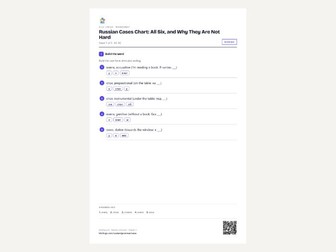
A one-page Russian cases worksheet for beginners: pupils build five case forms from a stem and an ending, across five cases, with the answers included. Each item names the case and gives a short phrase to fill, such as на ___ (on the table) or без ___ (without a book), then a stem and a choice of endings. Pupils see that a case is mostly a change at the end of the word. What it covers accusative: книгу prepositional: столе instrumental: столом genitive: книги dative: окну The answer key is printed at the foot of the page, so fold or trim it off before handing the sheet out. A gentle first look at the six cases, as a starter or homework. Free to print and share with your classes.
Mandarin Negation Worksheet: bù vs méiQuick View
kilolingo

Mandarin Negation Worksheet: bù vs méi

(0)
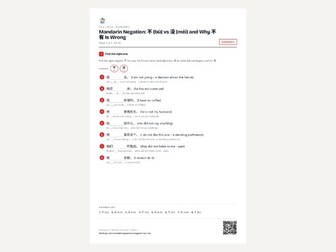
A one-page Mandarin negation worksheet: eight sentences where pupils choose 不 (bù) or 没 (méi), with pinyin, English and the answers included. Every sentence is printed in characters and in pinyin with an English meaning, so pupils who cannot yet read characters can still do it. The rule is on the sheet: 不 for the present, the future, habits and adjectives; 没 for what did not happen, and always with 有. What it covers 不 with decisions, preferences, 是 and 会 没 for the past and for things that have not happened yet 没有, and why 不有 is wrong The answer key is printed at the foot of the page, so fold or trim it off before handing the sheet out. Suits HSK 1 and beginner classes, as a starter or homework. Free to print and share with your classes.
German Modal Verbs Worksheet: MeaningsQuick View
kilolingo

German Modal Verbs Worksheet: Meanings

(0)
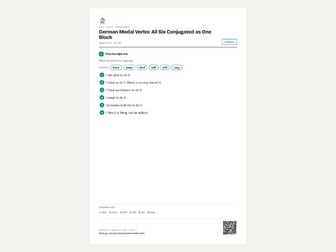
A one-page German modal verbs worksheet: pupils match six meanings to kann, muss, darf, soll, will and mag, with the answers included. Each line gives a meaning in English, such as “I have permission to do it” or “someone told me to do it”, and pupils pick the modal from the six at the top. It targets the pairs English speakers mix up most: muss and soll, darf and kann, will and mag. What it covers können (ability) and dürfen (permission) müssen (necessity) and sollen (being told to) wollen (wanting to) and mögen (liking a thing) The answer key is printed at the foot of the page, so fold or trim it off before handing the sheet out. Useful before conjugating the modals, as a starter, or for revision. Free to print and share with your classes.
French Numbers Worksheet: 70, 80 and 90Quick View
kilolingo

French Numbers Worksheet: 70, 80 and 90

(0)
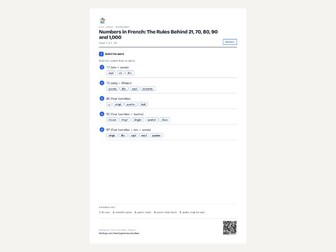
A one-page French numbers worksheet on the tricky ones: pupils build 17, 75, 80, 92 and 97 from word pieces, with the answers included. Each item gives the number with a hint at its structure (“four twenties + twelve”) and a set of pieces to put together, so pupils see why 92 is quatre-vingt-douze instead of learning it as a block. A few pieces are deliberate traps, such as vingts- with an s. What it covers dix-sept and the teens soixante-quinze (sixty + fifteen) quatre-vingts and when it keeps its s quatre-vingt-douze and quatre-vingt-dix-sept The answer key is printed at the foot of the page, so fold or trim it off before handing the sheet out. Good as a starter, a quick check after teaching 70 to 99, or homework. Free to print and share with your classes.
Ser vs Estar Worksheet: Story Gap-FillQuick View
kilolingo

Ser vs Estar Worksheet: Story Gap-Fill

(0)
A one-page ser vs estar worksheet for KS3 and beginner Spanish: a short story with seven gaps, each one a form of ser or estar, with the answers included. Pupils read María’s Monday, a five-sentence story about a doctor from Madrid who now works in Sevilla, and choose the right form for each gap from two options (es or está, son or están). Because the gaps sit inside a story, they have to read for meaning rather than spot a pattern in one line. What it covers ser for jobs, origin, days and the time estar for location and how someone feels one plural form (son las ocho) The answer key is printed at the foot of the page, so fold or trim it off before handing the sheet out. It suits a starter or plenary, homework, cover lessons and adult beginners. The vocabulary stays within the most common Spanish words. Free to print and share with your classes.