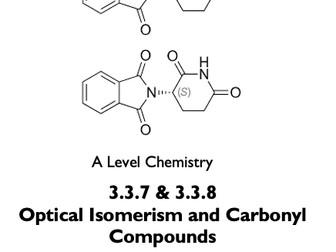
Optical  Isomerism and Carbonyl Compounds - AQA A Level ChemistryQuick View
et00pjm

Optical Isomerism and Carbonyl Compounds - AQA A Level Chemistry

(0)
Complete AQA A Level Chemistry booklet for 3.3.7 Optical Isomerism and 3.3.8 Aldehydes and Ketones. Nine lessons, worked examples and tiered practice questions. Written for Year 13 and ready to print or issue digitally. Each lesson follows the same structure: learning objectives, exposition, worked examples, a Common Mistake box, an Exam Tip box, and a set of independent practice questions with CHALLENGE items for stretch. Lessons cover: • Chirality and enantiomers • Optical activity and racemic mixtures • Nomenclature of aldehydes and ketones • Reactivity and formation of carbonyl compounds • Oxidation of aldehydes, Fehling’s solution and Tollens’ reagent • Reduction with NaBH₄, including the full nucleophilic addition mechanism • Nucleophilic addition of KCN, including hazards and control measures • Formation of enantiomers in nucleophilic addition • Review and consolidation, with a single-page reaction map linking every reaction in the topic Also includes a learning intentions checklist with RAG rating, Do Now spaces for retrieval practice, note-taking pages, exam-style questions, and a SLOP booklet of further practice. Written by a Head of Chemistry and practising AQA GCSE Chemistry examiner.
Chemistry and Biology IGCSE to AQA GCSE Science Curriculum PlanningQuick View
et00pjm

Chemistry and Biology IGCSE to AQA GCSE Science Curriculum Planning

(0)
Curriculum planning. Comparison of IGCSE and AQA GCSE Biology and chemistry mapping. the resources includes full mapping of these curriculum areas with comparisons, gap analysis, an overview. Also included is the overivew of GCSE AQA chemistry including lesson lists, for each topic along with learning objectives, the big questions and the lesson titles. Useful if you are transitioning from IGCSE to GCSE AQA.
Science APP Record SpreadsheetQuick View
et00pjm

Science APP Record Spreadsheet

(21)
This is an excel spreadsheet used to record and monitor progress of Science APP. There is a separate worksheet for each Assessment Focus (AF) and split into levels 3-8. When a student achieves a criteria you place a y in the cell, this will be highlight in green. If all the criteria are fulfilled for that level the record sheet will show the level. The record workbook will automatically update when a higher level has been obtained. If a student does not quite satisfy the criteria but has attempted it place an i in the cell, this will show up in orange. If there is no evidence for the criteria enter n and the cell turns red. This enables a clear visual analysis of what has been completed and what areas need to be addressed for both the teacher and student. There are examples on the AF1 worksheet.
OCR Chemistry A SpreadsheetQuick View
et00pjm

OCR Chemistry A Spreadsheet

(6)
A spreadsheet to record and track A-level Chemistry, Biology and Physics modular results. the spreadsheet displays graphical information on the progress and achievement of each student. Password is cHEMISTRY
Aromatic Compounds HandoutQuick View
et00pjm

Aromatic Compounds Handout

(0)
Aromatic Compounds; Azo Dyes, Arenes and Phenol reaction revision maps to accompany F324: Rings, Polymers and Analysis
Snakes and Ladders Board GameQuick View
et00pjm

Snakes and Ladders Board Game

(1)
Used as a revision tool for any subject. Before the lesson prepare 49 questions on separate pieces of paper (numbered) along with the answer, one for each square on the board. In small groups students roll the dice and move forward the number of places shown. In order to stay on this square they have to answer the corresponding question correctly, if they don't they move back to where they came from. The only exception to this is if you land on a snakes head, as this will automatically move them downwards without the need for a question.
Shapes of Molecules (VSEPR)Quick View
et00pjm

Shapes of Molecules (VSEPR)

(1)
Scan each side of the cube with the Augment app (available on both iOS and Android) to reveal the six main molecule shapes. These can then be manipulated to explore the molecule. http://www.youtube.com/watch?v=6EKXgJH-G7E
Tectonic Plates CollidingQuick View
et00pjm

Tectonic Plates Colliding

(0)
The formation of fold mountains through tectonic plates colliding. You Tube link: http://www.youtube.com/watch?v=ih5OMGeLeMM