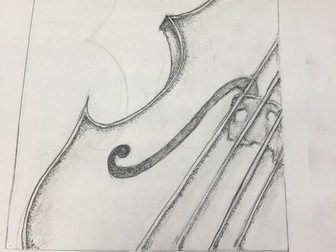
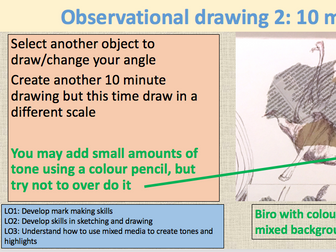
This lesson was created for the beginning of year 9/10 GCSE art. Students develop a range of drawing skills using different media and surfaces. The lesson is broken down into different activities and includes starter activities, examples and graded success criteria using the new 1-9 system. The lesson was graded outstanding when I delivered it and students were able to produce some excellent outcomes. Enjoy!!
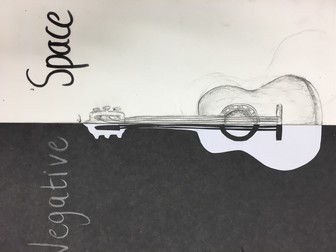
2 lessons based on the topic of positive and negative space for the purpose of lino printing. Activities include discussions and info on identifying positive and negative space for lino printing, mark making and observational drawing tasks, video and demonstrations, mark making for lino, planning for cutting, examples and discussion slides and a homework task. This lesson is aimed at yr8 but can be used for other age groups as a good intro to lino cutting. Follows on from a previous lesson on positive and negative space using collage. Each lesson can last up to 2 hours. Thanks for looking... Please leave a review if you download!!
This is a lesson created for the start of a year 8 art project with the aim of developing students understanding of positive and negative space in preparation for a printing project. The lesson includes some discussion and starter activities which promote understanding of the basic elements of positive and negative space, and a final outcome designed to develop learners observational drawing skills and awareness of positive and negative space.
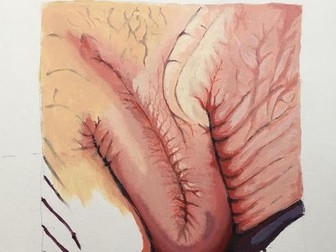
This is a resource I created for a yr10 GCSE painting project, using Edie Nadelhaft as a starting point for studying flesh tones and painting techniques. The presentation acts as a step by step guide to painting, and covers skills such as layering tones to create depth, basic modulation and brushwork. This project spans across 3-5 lessons and serves as a good introduction to painting with acrylics and exploring flesh tones. Visual examples and easy to follow steps included. I have also added the first lesson which introduces mixing flesh tones, colour swatches and briefly touches on modulation. Please leave a review and check out my other resources!
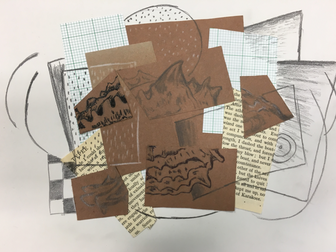
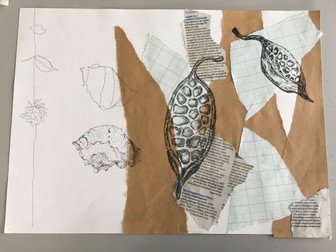
This is a lesson I created for a year 8 art lesson focussing on the topic of, The Natural World. Students develop observational drawing skills, learn about synthetic cubism and create a simple yet effective piece of synthetic cubism collage art. The presentation includes graded success criteria, examples and step by step help sheets. Was graded outstanding when I delivered it and outcomes were achievable and exciting! Can be adapted to suit different titles or topics and is also good as a general template for well structured art lessons. Enjoy!!
This is an updated version of a very successful drawing lesson. Students are guided through how to create different styles of drawings and textures from observation of natural objects. The PowerPoint includes full lesson breakdown, example outcomes, challenge activities, help sheets, success criteria, links to LO’s and plenary. This is a really useful lesson to develop drawing skills for GCSE or at the end of year 9 to develop skills in preparation for GCSE art. The lesson is for one hour but can be extended to 2 hours.
This lesson was graded outstanding as it has all of the elements needed for students to make excellent progress and challenge the G&T learners. Fully editable PowerPoint with all resources embedded.
Please leave some feedback if you find this useful!
Enjoy and thanks for downloading!!
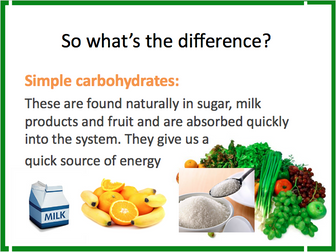
This is an outstanding lesson on carbohydrates, the outcome of which is a banana smoothie, although it is fully editable to create any outcome. The pack consists of a complete lesson including fun do now, starter activity, student booklet with learning checks and plenary and a detailed PowerPoint which includes full instructions and H&S guidelines, discussions and theory in a fun and engaging way.
Please leave me some feedback if you liked this resource!
Thanks for downloading!!
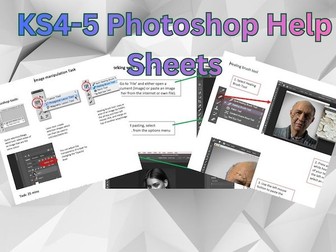
Pack of illustrated instruction sheets for GSCE and A level art & design or photography students, to support learning Photoshop skills. The help sheets can be used as a stand alone lesson or as classroom resources to support independent learning.
I created these sheets in a way that helps learners master the core aspects of Photoshop skills while at the same time encouraging creative thinking.
A basic Powerpoint slide show is included which can be adapted for lesson planning and a learner assessment grid for students to track their progress.
Can also be used to challenge gifted and talented students at KS3.
Photoshop technique sheets included:
Healing brush tool
Image manipulation techniques task
Working with layers
Also in the pack:
Basic Powerpoint with objectives
Learning assessment grid
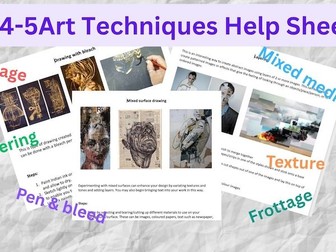
Pack of 15 illustrated instruction sheets for creative techniques for use with GSCE and A level art students, to promote independent learning and support learners at all stages of development and learning capabilities. Each help sheet gives visual examples and clear step by step guidance on how to create art works using the technique.
I created these help sheets to for use in creative subjects across Art & Design, Textiles and Photography. The sheets introduce and challenge students to explore a range of different creative techniques and concepts,including mixed media, textures and layering, print, negative and positive space, using a range of processes.
They are suitable for KS4-5 students primarily but may also be accessible for high achieving learners in years 8-9 if you’re looking to challenge gifted and talented students in KS3.
These sheets are gold dust for creating an outstanding learning environment as they encourage learners to go deeper into their own enquiry and support development across learning abilities.
The pack includes helps sheets for:
Collage
Drawing with bleach
Drawing with stitch
Drawing with wire
Layering
Mixed surface drawing
Paper weaving
Pen and bleed
Crayon Transfer
Frottage
Monoprinting
Negative Drawing
Acrylic gel transfer
Antiquing
Photocopier/scanner light drawing


 Quick View