Discussion Guidelines for High School | Oracy, Classroom Talk & Poster LessonQuick View
smh64

Discussion Guidelines for High School | Oracy, Classroom Talk & Poster Lesson

(0)
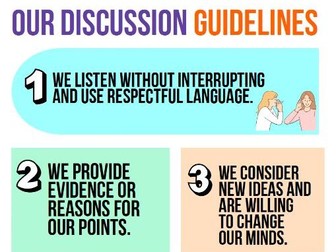
A practical, ready-to-use resource for establishing respectful, inclusive and productive classroom discussion. Students explore what makes a good conversation, why active listening matters and how respectful disagreement supports better classroom talk. They then work collaboratively to create their own class discussion guidelines, vote on the most important ideas and produce a poster that can be displayed and referred to throughout the school year. The resource includes: an introduction to discussion guidelines and their benefits practical teacher guidance and tips a complete 90-minute lesson plan collaborative group work class discussion and voting a talk-token strategy to support equal participation assessment ideas a role-play extension activity a completed Our Discussion Guidelines poster a blank poster template for students to personalise The suggested guidelines encourage students to: listen without interrupting use respectful language give evidence or reasons for their ideas consider new viewpoints ask questions to understand others invite quieter classmates to contribute Ideal for: oracy speaking and listening classroom discussion classroom community establishing discussion routines ESL / EFL secondary / high school Back to School A useful resource for setting expectations for good talk and creating a shared classroom culture in which students understand how to listen, contribute and disagree constructively. 8-page printable PDF.
10 Ways to Embed Oracy Across the Curriculum | Teacher Planning GuideQuick View
smh64

10 Ways to Embed Oracy Across the Curriculum | Teacher Planning Guide

(0)
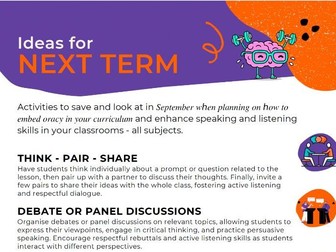
A concise teacher planning guide with practical ideas for embedding oracy, speaking and listening across the curriculum. This 2-page resource includes 10 adaptable classroom approaches: Think–Pair–Share debate or panel discussions collaborative group projects storytelling sessions role-play and dramatisation Socratic seminars public speaking opportunities multimedia presentations interview / talk show formats reflective discussions Each idea provides a brief explanation of how it can help develop communication, active listening, collaboration, critical thinking and presentation skills. The resource is designed to support teachers when planning for the new term or looking for simple ways to make oracy part of everyday classroom practice across different subjects. Ideal for: oracy planning speaking and listening teacher CPD staff meetings cross-curricular planning classroom discussion critical thinking new-term planning 2-page printable PDF. A useful quick-reference resource for teachers who want practical, adaptable ideas for developing confident communicators.
How to Boost Your Child’s Oracy Skills | Parent Guide for Speaking & ListeningQuick View
smh64

How to Boost Your Child’s Oracy Skills | Parent Guide for Speaking & Listening

(0)
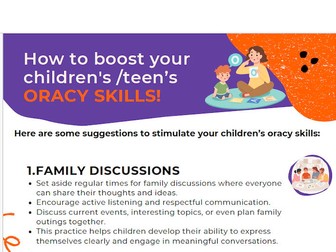
A practical 2-page guide for parents and carers with simple ideas for developing children’s and teenagers’ oracy skills at home. The resource includes six easy ways to encourage confident speaking and active listening: family discussions storytelling sessions mini-debates and presentations role-play and dramatic play podcasts and interviews public speaking opportunities Each suggestion gives parents practical ways to develop communication, creativity, critical thinking, active listening and confidence. The guide also encourages families to create a supportive environment, celebrate progress and provide constructive feedback. Ideal for: parent workshops home learning school-home communication speaking and listening oracy development family communication teachers sharing resources with parents 2-page printable PDF. A useful take-home resource for families looking for simple, realistic ways to support speaking and listening skills.
14. EFL Debate Toolkit + Balloon Debate Activity | Speaking & Critical ThinkingQuick View
smh64

14. EFL Debate Toolkit + Balloon Debate Activity | Speaking & Critical Thinking

(0)
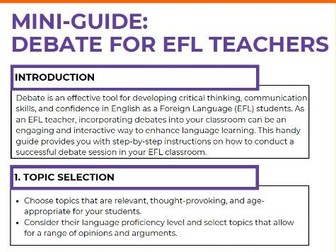
A practical EFL Debate Toolkit combining teacher guidance with an engaging classroom debate activity. This 6-page resource includes a concise Debate for EFL Teachers mini-guide together with a complete Balloon Debate Activity, making it ideal for teachers who want clear support for setting up debates and a ready-to-use activity for students. The teacher guide covers: topic selection preparing the debate debate structure opening statements rebuttals cross-examination closing statements persuasive language evaluation and feedback practical tips for participation and respectful discussion The Balloon Debate Activity then gives students the opportunity to put these skills into practice. Students work in groups, research an assigned topic, construct persuasive arguments and present their case to the class. They respond to questions and counterarguments before the class votes on which topic should be “saved”. The activity encourages students to develop: critical thinking research skills persuasive speaking active listening collaboration confidence in expressing opinions Ideal for: EFL / ESL speaking and listening oracy debate clubs persuasive language critical thinking secondary and adult education teacher CPD 6-page printable PDF. A useful combination of teacher methodology and practical classroom application for introducing structured debate in English.
Which Button Would You Press? | ESL Speaking and Discussion ActivityQuick View
smh64

Which Button Would You Press? | ESL Speaking and Discussion Activity

(0)
A fun speaking and discussion activity that encourages students to make choices, explain their opinions and use their imagination. Students work with a partner and choose which of six different buttons they would press. Each button offers a different wish, such as flying for a day, travelling to a magical world or being able to talk to a pet. Students discuss which button they would choose and why before completing a follow-up activity in which they create six wishes of their own and challenge a partner to choose one. The resource includes: 1 page with six imaginative discussion prompts 1 follow-up page for students to create their own choices Partner speaking practice Opinion and justification practice Creative thinking A built-in extension task Ideal for: ESL / EFL Speaking and listening Pair work Icebreakers Conversation classes Fast finishers Back to School Creative thinking activities 2-page printable PDF. A quick, low-preparation activity that gets students talking and sharing ideas.
Interactive Classroom Calendar | Days, Months, Weather & BirthdaysQuick View
smh64

Interactive Classroom Calendar | Days, Months, Weather & Birthdays

(0)
A colourful 14-page printable interactive classroom calendar for daily calendar time, morning routines and classroom displays. This reusable resource helps pupils practise days of the week, months of the year, numbers and dates, weather vocabulary and everyday classroom English. Print and laminate the pieces, then use Velcro, magnets, clips or reusable adhesive to create an interactive wall display that pupils can update each morning. The resource includes: 2026 year card Days of the Week cards Number cards 1–31 Months of the Year cards “The Weather Today Is…” display 8 illustrated weather cards Happy Birthday classroom section Personalised birthday spaces Instructions for assembling and using the display Example of the completed classroom calendar Weather vocabulary includes: sunny, windy, snowy, cloudy, foggy, rainy, partly sunny and stormy The calendar can become part of a regular morning classroom routine, with pupils taking turns to identify and update the day, date and weather. Ideal for: Primary classrooms ESL / EFL Morning routines Back to School Classroom displays Calendar and date vocabulary Weather vocabulary Speaking practice Daily classroom responsibilities 14-page printable PDF. Print, laminate and reuse throughout the school year.
Back to School Classmates Bingo | ESL Speaking & Getting to Know You ActivityQuick View
smh64

Back to School Classmates Bingo | ESL Speaking & Getting to Know You Activity

(0)
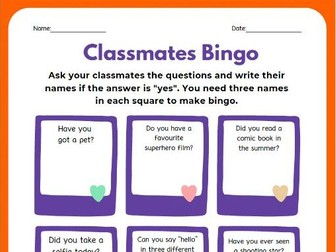
A fun Back to School Classmates Bingo activity designed to get students talking, moving around the classroom and finding out more about their classmates. Students ask one another a selection of fun questions and write classmates’ names in the squares when the answer is yes. They need to collect three names in each square to make bingo. The questions cover engaging, student-friendly topics including pets, superhero films, summer reading, selfies, languages, shooting stars, birthdays and family. The activity provides natural practice of a range of English question forms, including: Have you got…? Do you…? Did you…? Can you…? Have you ever…? Were you…? Does…? Ideal for: the first days back at school getting-to-know-you lessons ESL / EFL classes speaking and listening practice icebreakers communicative grammar revision 1-page printable PDF. A simple, low-preparation activity that encourages every student to speak and interact with their classmates.
50 Oracy Games & Speaking ActivitiesQuick View
smh64

50 Oracy Games & Speaking Activities

(0)
50 ready-to-use oracy games to develop confident speakers. **Practical, low-preparation activities that build speaking, listening, collaboration, critical thinking and confidence across the curriculum. **Suitable for Primary and Secondary classrooms, ESL/EFL, English, Drama and teacher training. Based on the internationally recognised Voice 21 Oracy Framework. Talking is one of the most powerful tools for learning—but many teachers struggle to find practical activities that genuinely develop students’ speaking and listening skills. 50 Oracy Games & Speaking Activities is a complete classroom handbook containing fifty engaging, low-preparation activities that help learners become confident, articulate and thoughtful communicators. Every activity has been classroom-tested and is designed to be used immediately, whether you have five spare minutes or want to build an entire oracy programme. Designed by international teacher trainers Sarah Howell and Lisa Kester-Dodgson, founders of Oracy Lab, this resource is grounded in the Voice 21 / Cambridge Oracy Framework, developing all four strands of oracy: Physical Linguistic Cognitive Social-Emotional What’s included ✔ 50 classroom-tested speaking games ✔ Activities suitable for Primary through Secondary ✔ Clear lesson structure for every activity: SPARK (engaging starter) DO (step-by-step instructions) Variation ideas Reflection questions Spotlight on Oracy skills ✔ Photocopiable classroom materials and discussion templates ✔ Flexible activities requiring little or no preparation ✔ Cross-curricular applications for English, Languages, Humanities, Science, Drama and PSHE/Citizenship **Activities include: Icebreakers and confidence builders Voice and expression games Storytelling and improvisation Debate and discussion activities Critical thinking challenges Collaborative speaking tasks Performance and presentation skills Listening and reflection activities Perfect for Primary teachers Secondary teachers ESL / EFL classrooms English Language Arts Drama teachers Speech & Communication Debate Clubs Teacher training Whole-school oracy programmes Intervention groups Public speaking clubs Whether you’re introducing oracy for the first time or embedding it across your curriculum, this book provides an extensive bank of engaging activities that help every learner find their voice. With an emphasis on collaboration, creativity, critical thinking and inclusion, these games transform classroom talk into meaningful learning experiences. 87 pages | 50 practical activities | Printable | No-prep | Photocopiable classroom resources
Vesak Lantern Design | A2–B1 ESL & CLIL Cultural Studies & ArtQuick View
smh64

Vesak Lantern Design | A2–B1 ESL & CLIL Cultural Studies & Art

(0)
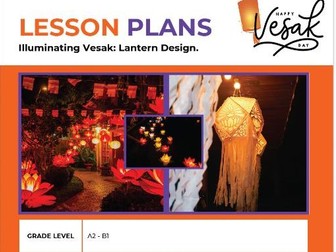
This ready-to-use lesson plan introduces students to the tradition and symbolism of Vesak lanterns through a creative art activity. Designed for A2–B1 learners, it combines CLIL Cultural Studies and Art with speaking, reflection and creativity. Students explore the significance of light and lanterns during Vesak before designing their own lantern inspired by Buddhist values such as kindness, compassion and harmony. The activity also encourages students to practise mindfulness through the creative process. The resource includes: Step-by-step lesson plan (60 minutes) Introduction to the meaning and symbolism of Vesak lanterns Exploration of traditional Vesak lantern designs Creative lantern design activity Focus on symbols, colours and messages connected with Vesak Speaking and reflection questions Assessment ideas Extension speaking activity in pairs Students begin by discussing light and darkness before learning how Vesak lanterns can symbolise dispelling ignorance and illuminating the path to enlightenment. They then look at examples of traditional lanterns and discuss their styles, colours and decorations. For the main creative activity, students design their own Vesak lantern, incorporating symbols, patterns and messages of peace or hope and reflecting values such as kindness, compassion and harmony. Learning Objectives Understand the significance of lanterns during Vesak celebrations Explore the symbolism associated with Vesak lanterns Create a lantern design reflecting Buddhist values Express ideas through art and visual symbolism Develop speaking and reflection skills Practise mindfulness through creative art The lesson finishes with students sharing their designs and discussing the messages and values they have represented. An extension activity encourages students to work in pairs and explain the symbols and messages in their lantern designs. Perfect for ESL, EFL and CLIL classrooms, as well as Cultural Studies, Art, world celebrations and cross-curricular lessons.
Historical Detective | Ancient Artefact Lesson Plan | A2–C1 ESL & CLIL HistoryQuick View
smh64

Historical Detective | Ancient Artefact Lesson Plan | A2–C1 ESL & CLIL History

(0)
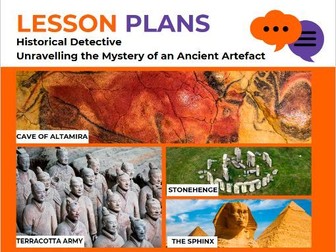
This ready-to-use lesson plan turns students into historical detectives as they investigate the mystery of an ancient artefact. Designed for A2–C1 learners, it combines CLIL History with observation, critical thinking, discussion, and collaborative speaking skills. Students begin by examining a mysterious artefact without being told its origin. They then work through a structured See–Think–Wonder investigation, developing hypotheses about what the artefact is, what it was made from, how it may have been used, and what it can tell us about people in the past. The resource includes: Step-by-step lesson plan (65 minutes) Historical artefact investigation See–Think–Wonder thinking routine Guided discussion questions Small-group analysis and discussion Research and whole-class sharing Closure activity revealing the artefact’s historical context Assessment ideas Extension task exploring which objects from today might become artefacts of the future Learning Objectives Develop critical thinking skills through historical analysis Observe and interpret evidence from historical artefacts Form and discuss hypotheses Compare different interpretations Develop speaking and collaborative discussion skills Encourage curiosity about the past The lesson can be adapted to different historical periods and artefacts. Examples featured in the resource include the Cave of Altamira, the Terracotta Army, Stonehenge and the Sphinx. Perfect for ESL, EFL and CLIL History classrooms, as well as speaking, critical-thinking and cross-curricular lessons.
Vesak Lesson Plan | A2–B1 ESL & CLIL Cultural Studies | Kindness & CompassionQuick View
smh64

Vesak Lesson Plan | A2–B1 ESL & CLIL Cultural Studies | Kindness & Compassion

(0)
This ready-to-use lesson plan introduces students to Vesak and its cultural significance while encouraging them to explore the values of kindness, compassion and enlightenment. Designed for A2–B1 learners, the lesson combines CLIL Cultural Studies with speaking, collaborative learning and creative reflection. Students learn about the meaning of Vesak, discuss how its key values can be applied in everyday life, and work together to create a class Values Mural. The resource includes: Step-by-step lesson plan (60 minutes) Introduction to Vesak and its cultural significance Exploration of the values of kindness, compassion and enlightenment Collaborative Values Mural activity Sentence stems to support speaking and discussion Reflection and sharing questions Assessment ideas Extension task: organise a school Kindness Campaign During the main collaborative activity, students work in small groups to brainstorm actions, phrases or ideas connected to one of the three key values. They then contribute their ideas to a shared class mural and discuss how these values can be practised at school, at home and in the wider community. Learning Objectives Understand the cultural significance of Vesak Explore the ideas of kindness, compassion and enlightenment Connect cultural values to students’ everyday lives Develop speaking and collaborative discussion skills Express ideas using supported sentence stems Create a collaborative visual project inspired by Vesak The lesson also includes structured speaking support such as “One way we can show kindness is…”, “Compassion looks like…” and “We can show compassion by…”, making it particularly suitable for ESL and EFL learners. Perfect for ESL, EFL and CLIL Cultural Studies classrooms, as well as lessons on world cultures, values, kindness and social-emotional learning.
Book Tok Lesson Plan | Book Reviews & Speaking ActivityQuick View
smh64

Book Tok Lesson Plan | Book Reviews & Speaking Activity

(0)
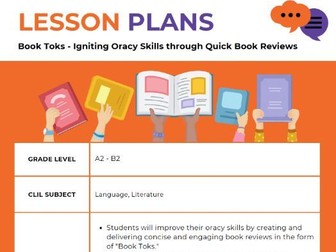
Engage students with Book Tok-inspired book reviews! Develop speaking, presentation, summarising, and literacy skills through this ready-to-use lesson. Book Tok Lesson Plan – Build Speaking, Literacy & Presentation Skills Bring reading to life with this engaging Book Tok-inspired lesson that encourages students to create short, persuasive book reviews inspired by today’s most popular social media format. Students develop essential oracy, public speaking, summarising, and presentation skills while sharing books they love in a creative and motivating way. Perfect for: ESL / EFL English Language Arts Reading & Literacy Library Lessons Book Week Public Speaking Middle School High School Speaking Clubs What’s Included Complete step-by-step lesson plan Learning objectives Materials list 2-hour lesson sequence Student planning guidance Peer feedback activities Assessment suggestions Extension activities Teaching notes Oracy Framework mapping The lesson guides students through: Understanding effective book reviews Planning a one-minute BookTok Summarising a book effectively Using persuasive language Presenting confidently Giving and receiving constructive feedback Reflecting on communication skills The lesson also explicitly develops multiple dimensions of oracy, including linguistic, cognitive, physical, and social-emotional communication skills. Skills Covered Speaking & Listening Oral Presentation Book Reviews Reading Comprehension Summarising Critical Thinking Public Speaking Communication Reflection Peer Feedback Confidence Building Literacy Grade Levels Grades 5–12 ESL/EFL CEFR A2–B2 **Why Teachers Love It ** Ready to teach Minimal preparation Highly engaging Encourages reading for pleasure Builds confidence in reluctant speakers Works with any fiction or non-fiction book** Keywords Book Tok, Book Review, Reading Response, Speaking Activity, Oral Presentation, Public Speaking, Literacy, Reading Comprehension, ESL Speaking, EFL Speaking, Secondary English, Middle School ELA, Library Lesson, Speaking and Listening, Oracy, Book Recommendation, Reading Project, English Lesson Plan, Communication Skills, Voice 21 Oracy.
Find Your Partner |Speaking Game | Back to SchoolQuick View
smh64

Find Your Partner |Speaking Game | Back to School

(0)
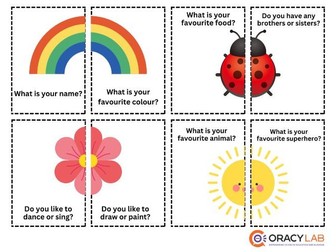
Get children talking from the very first lesson! This fun, low-preparation classroom game encourages children to introduce themselves, answer simple personal questions and build confidence speaking with their classmates. Students walk around the classroom searching for the matching half of their picture. Once they’ve found their partner, they take turns asking and answering the conversation questions before moving on to meet someone new. Perfect for building classroom relationships while developing speaking and listening skills. What’s Included 32 colourful matching conversation cards (16 matching pairs) Child-friendly discussion questions Bright, engaging illustrations Ready to print, cut and laminate Suitable for repeated classroom use Question Topics Include My name Favourite colour Favourite food Favourite animal Favourite superhero Brothers and sisters Pets Best friend Birthday Favourite subject Favourite book Favourite toy Favourite cartoon Favourite sport Family School Hobbies Music Food And much more! Perfect For Back to School First Week Activities Icebreakers Speaking & Listening Oracy ESL / EFL Kindergarten Preschool Grade 1–3 Conversation Practice Circle Time Morning Meetings Getting to Know You Activities **Learning Objectives ** Students will: develop confidence speaking in English practise asking and answering questions improve listening skills build friendships and classroom community develop turn-taking skills practise conversational language increase vocabulary develop social communication skills How to Play Print and cut out the cards. Give one card to each student. Students walk around the room looking for the matching half of their picture. Once partners are found, they ask and answer the questions on their cards. Mix the cards and play again! This versatile activity can also be used for pair work, speaking centres, intervention groups, conversation clubs or ESL warm-ups. Why Teachers Love It No Prep Print & Play Highly engaging Encourages every child to speak Supports Oracy and communication skills Builds classroom community Keywords Back to School • Icebreaker Activities • Find Your Partner • Speaking Game • Conversation Cards • Oracy • ESL • EFL • Speaking and Listening • Kindergarten • Preschool • Primary Classroom • First Day of School • Get to Know You • Pair Work • Communication Skills • Social Skills • Classroom Community • Oral Language
Our Talk Rules - Oracy PosterQuick View
smh64

Our Talk Rules - Oracy Poster

(0)
Create a positive classroom culture where every child feels confident to speak, listen and learn. This colourful classroom poster introduces simple, child-friendly talk rules that help establish respectful communication, active listening and confident participation from the very first day of school. Ideal for Primary classrooms, ESL/EFL lessons, English, Oracy, Circle Time, PSHE and classroom discussions, this poster provides a clear visual reminder of the behaviours that support productive talk and collaborative learning. Our Talk Rules We listen carefully. We wait for our turn to speak. We use kind words like “Please” and “Thank you.” We aren’t afraid to ask questions. We have fun and learn together. These simple expectations encourage children to become confident, respectful and thoughtful communicators while building a positive classroom community. Perfect For Classroom Displays Back to School Oracy Lessons Speaking & Listening ESL / EFL English Lessons Circle Time PSHE Classroom Management Whole-Class Discussions Early Years Primary School What’s Included 1 full-colour printable classroom poster High-quality PDF Print up to A3 for classroom display or A4 for individual learning spaces Skills Supported Speaking & Listening Active Listening Turn Taking Respectful Communication Classroom Behaviour Confidence Building Collaboration Social Skills Oracy Development Perfect for creating a classroom where every voice matters and every learner feels confident to contribute. Oracy Poster • Classroom Rules • Speaking and Listening •
Mother's Day Flower Card CraftQuick View
smh64

Mother's Day Flower Card Craft

(0)
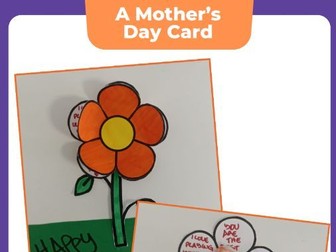
A fun Mother’s Day ESL craft with speaking activities! Create a beautiful 3D flower card while practising English speaking, expressing feelings, and building vocabulary. Perfect for KS1, KS2 and primary EFL/ESL learners. Looking for a meaningful Mother’s Day activity that combines creativity with purposeful language practice? This printable resource allows children to make an interactive flower card with hidden messages written inside the petals. As pupils colour, cut, assemble and personalise their flowers, they also develop speaking confidence through a series of engaging oral activities. What’s included Printable flower templates Step-by-step assembly instructions Easy-to-follow craft activity 5 ready-to-use speaking activities Opportunities to practise sentence starters, adjectives and personal responses Ideal for whole-class, pair work or small groups Speaking activities include I love my mum because… Describing mum using adjectives Pair-share conversations Guess whose mum it is Sharing favourite memories Learning objectives Develop speaking and listening skills Build confidence expressing opinions and emotions Practise simple sentence structures Expand vocabulary linked to family and feelings Encourage creativity and personal expression Promote meaningful classroom discussion Perfect for ESL / EFL lessons Primary English Mother’s Day celebrations Speaking and Listening Oracy Art integration End-of-lesson activities Cover lessons Seasonal classroom projects Age: 5–10 years (adaptable for different levels) This low-preparation resource creates a memorable Mother’s Day keepsake while giving every child plenty of opportunities to communicate in English in a natural, enjoyable way.
Christmas lapbook for Young Learner EFL/ESL/EALQuick View
smh64

Christmas lapbook for Young Learner EFL/ESL/EAL

(0)
This is a simple lapbook for young learners learning English as an additional language. It is based on vocabulary related to some of the customs used at Christmas that are not specifically religious. Lapbooks are creative dynamic learning tools that are extremely inclusive. The are 3d mind maps that help scaffold speaking.