KS2 Drama: Mime Unit – Telling Stories Without Words (6 Lessons, Slides, Resources & Assessment)Quick View
cswoollhead

KS2 Drama: Mime Unit – Telling Stories Without Words (6 Lessons, Slides, Resources & Assessment)

(0)
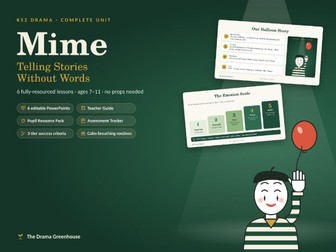
Turn any hall or classroom into a silent stage! Mime is one of the most inclusive art forms you can teach. It needs no scripts, no props and no confident readers, just bodies, faces and imagination. In this complete six-lesson KS2 unit, pupils start by copying simple actions and finish by devising and performing their own group mimed stories. Along the way they build focus, physical control, emotional literacy and evaluative talk. It was written by a Drama Curriculum Leader with over 15 years’ experience, and it works for specialists and non-specialists alike. Every slide has a full teacher script in the notes, so you can pick it up and teach. THE SIX LESSONS The Balloon: what is mime? Copy the Mime, watching mime artists and balloon stories The Invisible Object: size, shape, weight and fixed point, with The Mystery Gift Mime Illusions: the wall, the rope, the wind and the ladder, plus an Illusion Carousel and Trapped in a Box! Faces & Feelings: the Emotion Scale, the Double Take and The Picnic Building a Mimed Story: story structure, slow motion and freeze frame, and group devising from story cards Performance: polish, perform, evaluate with WWW/EBI and set targets EVERY LESSON INCLUDES A learning objective and a visual lesson journey Three-tier success criteria (Core, Stretch, Challenge) A game-based warm-up and clear modelling slides “Choose Your Challenge” tasks so every pupil can access the work and be stretched Performance and peer feedback, with WWW/EBI sentence starters A calm-breathing routine to finish, which is great for regulation and transitions Hand-signal self-assessment WHAT’S IN THE DOWNLOAD 6 editable PowerPoint lessons (11–13 slides each, with full teacher notes) Teacher Guide (8 pages): unit overview, minute-by-minute timings, curriculum links, assessment guidance, SEND/EAL adaptations and a glossary Pupil Resource Pack (11 pages): knowledge organiser, 4 illusion station cards, an emotion scale poster, 6 story cards, a group story planner, peer feedback slips, a “My Mime Journey” reflection sheet and a Mime Artist certificate Assessment Tracker (Excel): drop-downs for every lesson, automatic end-of-unit levels and a class summary CURRICULUM LINKS English spoken language (performance, role play and improvisation; evaluating and building on others’ ideas), PSHE and wellbeing (naming and showing emotions, calm breathing), PE (body control) and oracy. Suitable for ages 7–11. It was written for Year 4 and works well across Years 3–5. Please note: video clips aren’t included, for copyright reasons. Lesson 1 has clearly marked “insert your clip” slides, with suggested searches in the notes. If you enjoy using this unit, a review would mean a lot. Thank you! The Drama Greenhouse
Year 2 Drama Bundle: Essence Machines and The Boy Who Cried Wolf (6 Lessons, KS1)Quick View
cswoollhead

Year 2 Drama Bundle: Essence Machines and The Boy Who Cried Wolf (6 Lessons, KS1)

(0)
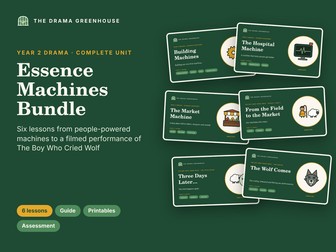
Turn your Year 2 class into machines, then into a whole village, then into a cast. This is a complete, ready-to-teach KS1 drama unit. Over six 30-minute lessons, children start by building essence machines: machines made of people, where each part repeats one action and one sound. They take those skills into a busy hospital and a noisy market. Then they use everything they’ve learned to perform Aesop’s The Boy Who Cried Wolf as an ensemble. The final lesson is filmed, watched back and evaluated. A drama specialist wrote it for teachers who aren’t drama specialists. Every slide has full speaker notes and a timing guide, so you can pick it up and teach it tomorrow, with no drama experience needed. What’s included 6 editable PowerPoint lessons (54 slides) with full speaker notes on every slide 6 one-page lesson plans with a timed lesson flow and key questions A 12-page Teacher Guide and Scheme of Work: aims, vocabulary, curriculum links, the assessment model, the full performance structure, plus adaptation, safety and filming guidance An 18-page Printable Pack: role cards, cue line cards, levels and stage map posters, hospital and market idea banks, emotion cards, a story map, a word wall and an original read-aloud retelling of the fable An Assessment Pack: a self-calculating Excel tracker, a clipboard record sheet, a pupil self-assessment sheet and an “Ensemble Star” certificate The lessons Building Machines: the copy circle, levels and a machine made of the whole class The Hospital Machine: using machines to show a setting The Market Machine: the stage map, upstage and downstage From the Field to the Market: cue lines and transitions Three Days Later: shocked or suspicious? The Wolf Comes: the ending, filming and evaluation Why teachers love it Three-tier success criteria in every lesson (working within, working above, greater depth), with child-friendly seed, sprout and flower icons Builds oracy through partner talk, choral speaking and “what went well / even better if” with reasons Inclusive by design: support and stretch ideas, non-speaking alternatives, and visual scripts for EAL and SEND learners Safe and calm: a no-contact, slow-motion wolf scene and a clear freeze-signal routine Links to the KS1 spoken language programme of study and to retelling traditional tales in reading Created by Charlie Woollhead, The Drama Greenhouse.
Greek Theatre Drama Unit Bundle – Upper KS2 (6 Lessons + Teacher Guide)Quick View
cswoollhead

Greek Theatre Drama Unit Bundle – Upper KS2 (6 Lessons + Teacher Guide)

(0)
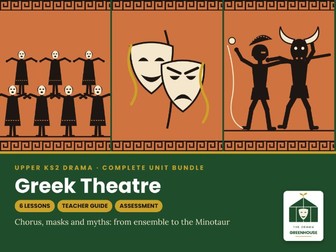
Take your class into the oldest theatre in the world. This complete six-lesson unit for Years 5–6 starts with ensemble games and ends with pupils devising their own Theseus and the Minotaur. Along the way they learn to move, speak and breathe as one Greek chorus. It’s written by a drama specialist with 15+ years’ experience for non-specialist primary teachers. Every slide has teacher notes, so you can open it and teach it with confidence. What’s included 6 complete lessons (89 slides), as editable PowerPoint and PDF Teacher notes on every slide Three-tier success criteria (Working Within / Working Above / Greater Depth) and a “Choose Your Challenge” task in every lesson Two assessed performances: a Choral Ode marked with a Voice / Body / Teamwork rubric, and a devised Minotaur piece with a performance checklist A 6-page printable Teacher Guide: unit overview, assessment rubric, large-print scripts, story planner and teacher background A breathing and grounding plenary at the end of every lesson, so pupils leave calm and focused Original illustrations throughout The lessons Meet the Ensemble: where theatre began, the parts of a Greek theatre, the chorus and five linked tableaux Gesture & the Chorus: the Flock, gesture vs facial expression and building a chorus phrase The Choral Ode, Part 1: the Chorus Toolbox (formation, unison, choral gesture and ripple) The Choral Ode, Part 2: the assessed performance, WWW/EBI feedback and written reflection The Minotaur, Part 1: telling the myth through narration and movement, with the chorus as the labyrinth The Minotaur, Part 2: devising, performing and reviewing the myth in groups Why teachers like it ✔ Ready to teach, with no drama background needed ✔ Builds teamwork, confidence and spoken language ✔ Links to KS2 History (Ancient Greece) and English spoken language ✔ Differentiated and assessed throughout
From Page to Stage: Complete KS2 Scripted Drama Unit (6 Lessons + Assessment)Quick View
cswoollhead

From Page to Stage: Complete KS2 Scripted Drama Unit (6 Lessons + Assessment)

(0)
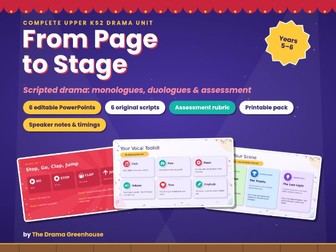
A complete, ready-to-teach six-lesson drama unit taking Upper KS2 pupils from “What is a script?” to a confident, off-script assessed performance. Every lesson comes as a vibrant, theatre-themed PowerPoint with full speaker notes, suggested timings and differentiated success criteria. Just open it and teach. What’s inside Lesson 1, From Page to Stage: drama space expectations, Stop Go Clap Jump, 1-2-3, anatomy of a script, and the same six-line script performed in different “worlds” Lesson 2, Finding Your Voice: breathing, diction and pitch warm-ups, a six-skill vocal toolkit, script mark-up symbols, and three original monologues Lesson 3, Before the Script: freeze frames, thought-tracking, “Yes, and…” improvisation, and three-frame stories built from mystery scene titles Lesson 4, Duologues: three original, differentiated duologue scripts, a five-step Rehearsal Ladder and pair-to-pair performance Lesson 5, Off Script: line-learning techniques, staying in role, building tension at the turning point, and a peer dress rehearsal Lesson 6, Showtime!: an assessed performance with audience roles, a running order, staging routine and self-reflection Key features 6 original scripts: 3 monologues and 3 duologues, each written for a different level of challenge Three-level success criteria in every lesson (Working Within, Working Above, Greater Depth) A five-strand assessment rubric covering vocal skills, physical skills, character, staging and evaluation 18 warm-up games, feedback sentence stems, and a self-reflection task for each level Speaker notes with timings, questions, common misconceptions and support ideas Fully editable PowerPoint files (about 60-minute lessons) Ideal for Years 5–6, transition units or drama clubs. No specialist drama experience needed. Created by The Drama Greenhouse, a drama specialist with 15+ years’ experience leading drama departments in the UK and internationally.