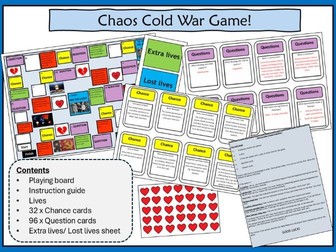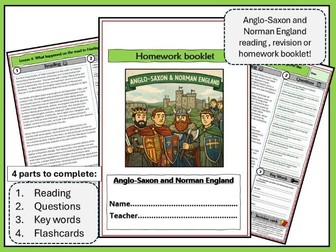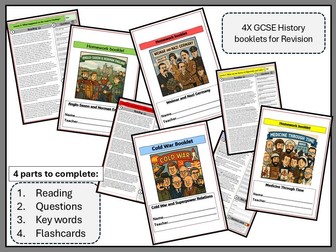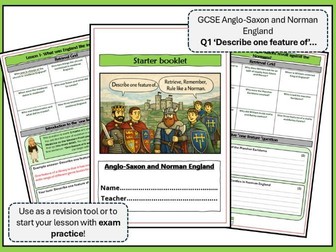
This Cold War–themed game is an effective instructional resource for students studying superpower relations and Cold War history. It incorporates retrieval practice through question-based cards, supporting knowledge recall and conceptual understanding. The resource includes clear instructions for gameplay, a printable board, and all necessary materials for classroom implementation. Student engagement was high, and feedback indicated that the game enhanced both understanding and enjoyment of the topic.
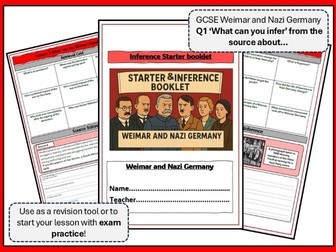
This booklet is designed to introduce students to inference questions on Paper 3 of Edexcel GCSE History: Weimar and Nazi Germany. It can be used as a revision resource, a starter activity for every lesson, or for regular retrieval practice.
The booklet includes retrieval questions alongside 19 exam-style inference questions, allowing students to build confidence and familiarity with the skills required for inference questions. Each page follows on directly from the previous lesson, ensuring that the inference task is always based on fresh knowledge. For example, if Lesson 11 focuses on the Reichstag Fire, then Lesson 12’s starter activity will be an inference question about the Reichstag Fire.
A retrieval grid is included that combines questions from across the entire topic, helping students to regularly revisit and strengthen prior learning. At the front of the booklet, there is a timeline which students can add to as they progress through the course, allowing them to record key events and make supporting notes.
I have found this to be a really helpful tool to use in the classroom, particularly for developing students’ confidence and consistency with inference questions.
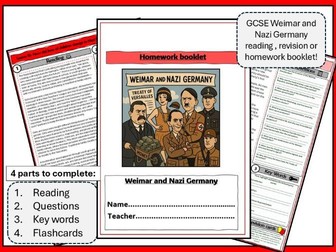
This student booklet contains a series of guided reading activities for the GCSE History: Weimar and Nazi Germany (1918–1939) topic. It covers the complete Edexcel unit, exploring how Germany changed after the First World War, why democracy struggled during the Weimar Republic, how Hitler rose to power, and how the Nazi dictatorship was established and maintained.
The booklet is divided into three main sections:
The Weimar Republic (1918–1929)
Hitler’s Rise to Power (1919–1933)
Nazi Germany (1933–1939)
There are 18 guided readings in total, each focusing on a key event, development, or turning point in Weimar and Nazi Germany. Each reading is followed by 10 guided reading questions designed to build understanding and prepare students for GCSE exam-style questions.
Students should:
Carefully read each passage before answering the questions
Write answers on the dotted lines provided
Define the key words included with each lesson to strengthen vocabulary and understanding
Create revision flashcards using key events, dates, and individuals to support revision
This booklet will help students develop a strong chronological understanding of Weimar and Nazi Germany, practise exam-style comprehension, and create clear revision notes to support success in their GCSE History: Weimar and Nazi Germany (1918–1939) exam.
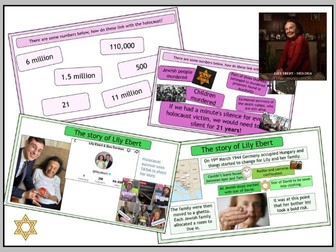
This assembly for Holocaust Memorial Month focuses on the story of Lily Ebert, a Holocaust survivor whose life story is both fascinating and heartbreaking.
The assembly begins with key statistics about the Holocaust, which immediately engage students and help them understand the scale and seriousness of what happened. It then moves on to Lily’s early life in Hungary and explains how everything changed when the Nazis took control. This helps students understand how quickly normal life was taken away from Jewish families.
Students connect even more deeply with Lily’s story because it has been shared widely thanks to her grandson, Dov Forman. Together, they wrote a book about Lily’s experiences, and more recently they have reached a huge audience on TikTok, where they educate people around the world about the Holocaust through Lily’s personal memories. This modern approach makes the history feel relevant and real to young people today. It also includes an example of her Tiktok and a link to a news report about Lily.
Since surviving the Holocaust, Lily has gone on to achieve incredible things. She has often said that living a full and successful life is her greatest revenge against the Nazis. One of her most notable achievements includes being awarded an MBE by the British monarchy for her work in Holocaust education.
Lily’s story is powerful and memorable, and it has had a lasting impact on students. Many still talk about this assembly long afterwards, showing how effective personal stories can be in helping young people understand history and remember its lessons.
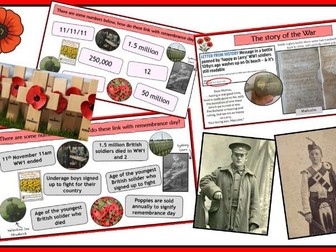
Here’s a 20-minute school assembly based on the recent 2025 discovery of the washed-up WWI letters from Private Malcolm Alexander Neville and Private William Kirk Harley in Australia.
It includes statistics, historical context, reflection, and a closing personal story section that can easily be personalized for your school.
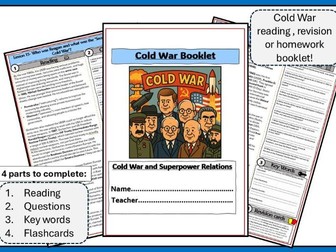
This student booklet contains a series of guided reading activities for the GCSE History: The Cold War and Superpower Relations (1941–1991) topic. It covers the complete Edexcel unit, exploring how tensions between the USA and the USSR developed, deepened, and eventually came to an end.
The booklet is divided into three main sections:
The Origins of the Cold War (1941–1958)
Cold War Crises (1958–1970)
The End of the Cold War (1970–1991)
There are 15 guided readings in total, each focusing on a key event, development, or turning point in the Cold War. Each reading is followed by 10 guided reading questions designed to build understanding and prepare students for GCSE exam-style topics.
Students should:
Carefully read each passage before answering the questions.
Write answers on the dotted lines provided.
Define the key words included with each lesson to strengthen vocabulary and understanding.
Create revision flashcards using key events, dates, and individuals to help review learning.
This booklet will help them develop a strong chronological understanding of the Cold War, practise exam-style comprehension, and create clear revision notes to support success in their GCSE History: Superpower Relations and the Cold War (1941–1991) exam.
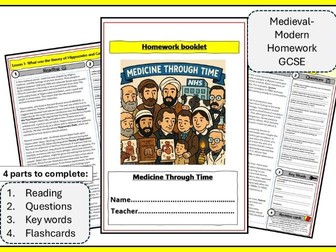
This booklet contains a series of guided reading activities for the GCSE History: Medicine Through Time topic. It covers the full Edexcel course from 1250 to the present day, including a focus study on Medicine on the Western Front.
The booklet is divided into four main periods:
Medieval Medicine (c.1250–1500)
Renaissance Medicine (c.1500–1750)
Industrial Medicine (c.1750–1900)
Modern Medicine (c.1900–present)
Plus a depth study on Medicine on the Western Front (1914–1918)
There is a guided reading and question set for every lesson, with 19 lessons in total. Each reading explains key events, discoveries, individuals, and changes in medicine, followed by 10 guided reading questions to check understanding.
Students should:
Read each passage carefully before answering the questions.
Use the dotted lines provided to write full-sentence answers.
Define the key words listed for each lesson.
Create revision flashcards using the key information and vocabulary from each topic.
This booklet is designed to help them build knowledg and create strong revision notes for their GCSE Medicine Through Time exam.
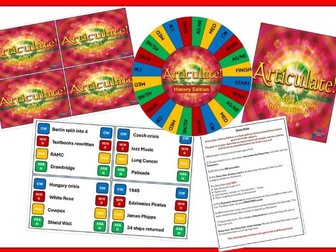
Articulate is a fast-talking, high-energy game where players describe key historical terms, events, and people — without saying the actual word! It’s designed to build confidence with subject vocabulary and strengthen recall through fun, competitive oracy practice.
Curriculum Links (Edexcel GCSE History):
This version supports topics such as:
Anglo-Saxon and Norman England
Weimar and Nazi Germany
Medicine Through Time
The Cold War
The resource can be easily adapted for any other topics you study. It’s brilliant for revising key terms, developing speaking and listening skills, and consolidating historical knowledge in an engaging way.
Resource includes game board, instructions and 104 game cards.
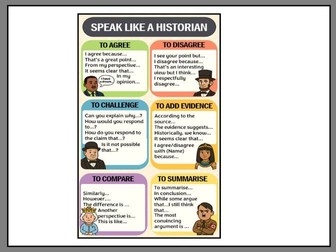
Use this sheet to help you develop your oracy skills throughout History lesson. Oracy means learning through speaking — building confidence in explaining, debating, and justifying your ideas aloud.
Students will use this resource to:
Discuss key events and turning points during the Cold War.
Debate different historical interpretations and viewpoints.
Explain causes, consequences, and significance using evidence.
Listen and respond to others respectfully and thoughtfully.
By practising these skills, you will improve your ability to:
Speak clearly and confidently.
Use historical vocabulary accurately.
Build structured arguments using evidence.
Think critically about events and decisions.
Regular use of this sheet will help increase your oracy and communication skills, strengthen your historical reasoning, and prepare you for exam questions that require explanation, evaluation, and judgement.