A revision mat covering the Biology required practicals for the AQA Combined Science (Trilogy) specification. It includes a range of questions and activities to help students revise key methods, variables and analysis skills ahead of exams.
Designed as a simple, ready-to-use resource for lessons, homework or independent revision. Supports students in recalling key information and practicing exam-style questions linked to the required practicals.
This resource is a complete GCSE Chemistry lesson on the effect of concentration on the rate of reaction, aligned with the Edexcel GCSE Chemistry specification.
The lesson introduces key ideas about particles, collisions and activation energy, before applying this understanding through data interpretation and a practical investigation measuring the rate of reaction.
Learning outcomes
State what must happen for a chemical reaction to take place
Describe what is meant by concentration
Interpret tables and graphs showing concentration versus time
Explain the effect of concentration on the rate of reaction
Included in this resource
Retrieval practice linking prior learning (rates, periodic trends, separation techniques)
Clear explanation of particle collisions and activation energy
Guided discussion on factors affecting the rate of reactions
Practical investigation measuring gas volume over time at different concentrations
Structured sections for results, conclusion and explanation
Plenary task focusing on reliability, comparisons and scientific explanations
Suitable for
GCSE Chemistry (Edexcel)
Foundation or Higher tier classes
Lesson delivery, revision or cover work
Ready to use with minimal preparation, this lesson supports conceptual understanding while developing practical and analytical skills required for GCSE Chemistry.
This resource is a structured GCSE Physics lesson (or masterclass) on Specific Latent Heat, designed to deepen understanding of energy changes during phase changes and develop confidence with calculations and graphs.
The lesson explicitly compares specific latent heat and specific heat capacity, before applying the formula E=mL to a range of increasingly challenging exam-style problems. Pupils also analyse heating and cooling curves to identify phase changes and explain why temperature remains constant.
Learning objectives
Compare and contrast specific latent heat and specific heat capacity
Deduce the units of specific latent heat and apply
𝐸=𝑚𝐿
Analyse heating and cooling graphs involving phase changes
Included in this resource
Retrieval practice on specific heat capacity and prior calculations
Guided reading task to identify and explain key ideas about latent heat
Clear comparison of latent heat of fusion and vaporisation
Heating curve interpretation and phase change analysis
Structured calculation questions with increasing demand
Extended and challenge problems involving real-world contexts
Mini whiteboard questions to check conceptual understanding
Exam-style written questions and structured summaries
Suitable for
GCSE Physics (Higher tier)
GCSE Combined Science (Higher)
Revision lessons, intervention sessions or masterclass delivery
This resource is ready to use with minimal preparation and is ideal for supporting pupils to link mathematical skills, energy concepts and exam-style explanations.
This resource is a complete GCSE Chemistry lesson on catalysts and their effect on rates of reaction, written specifically for the Edexcel GCSE Chemistry specification.
The lesson builds secure understanding through a structured sequence of retrieval practice, explanation, application and practical investigation, supporting pupils in developing both scientific knowledge and required working scientifically skills.
Learning outcomes
Recall that enzymes are biological catalysts
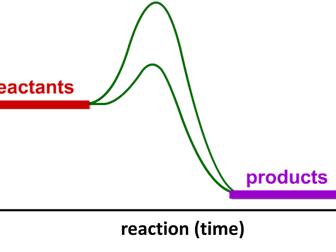
Explain how catalysts increase the rate of reaction
Deduce which catalysts are most effective
Included in this resource
Retrieval questions to recap key prior learning (temperature, redox, chromatography, gas tests)
Clear explanation of what catalysts are and how they work, including activation energy
Diagram labeling task
Video-linked comprehension questions on catalysts
Practical investigation into the decomposition of hydrogen peroxide using different metal oxides
Structured sections for results, conclusion and evaluation
Plenary activity focusing on reliability, validity and explanations of rate of reaction