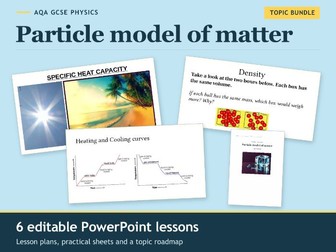
AQA GCSE Physics: Particle Model of Matter BundleQuick View
tobz360

AQA GCSE Physics: Particle Model of Matter Bundle

(0)
Begin with measurements pupils can make on the bench, then use the particle model to explain conservation of mass, heating curves and gas pressure. Includes 6 editable PowerPoint lessons, a timed plan and suggested practical for every lesson, printable pupil tasks with teacher answers, and a topic roadmap. Lessons included Density, mass and volume Changes of state and conservation of mass Internal energy and heating curves Comparing specific heat capacities Specific latent heat Gas pressure and temperature Bonus practical-only session: Measuring density at three stations (AQA Trilogy required practical 17). Teach it after the first PowerPoint. Physics-only gas laws and a formal test are outside the pack. Bought separately the lessons total £6. The topic pack is £3. The topic pack also includes worksheets for density calculations, particle diagrams, specific heat capacity and gas pressure, with worked answers for the specific heat capacity calculations.
Science Skills Introduction Unit - Booklet, Powerpoint, Worksheets and Practicals.Quick View
tobz360

Science Skills Introduction Unit - Booklet, Powerpoint, Worksheets and Practicals.

(0)
The Science Skills Introduction unit is a comprehensive and engaging program designed to equip students with foundational scientific skills essential for their academic journey. This unit is crafted to foster curiosity, enhance critical thinking, and develop practical abilities in young scientists. This comes with the support and scaffolding of a booklet designed to promote engagement and understanding for inquisitive pupils and enables teachers to demonstrate progress and give students the skills and knowledge needed to work safely in the lab. Key Features Interactive Lessons: The curriculum includes interactive lessons that break down complex concepts into easily digestible segments, ensuring students grasp fundamental scientific principles. Hands on Experiments: Students will engage in hands-on experiments that promote experiential learning, allowing them to observe, hypothesize, and draw conclusions in a controlled environment. Skill Development: Focus on essential scientific skills such as observation, measurement, data collection, and analysis, critical thinking, and scientific reasoning. Multimedia Resources: Incorporates a variety of multimedia resources, including videos, animations, and interactive simulations to enhance understanding and retention. Assessment Tools: Includes a range of assessment tools such as quizzes, practical assignments, and projects to evaluate student progress and reinforce learning. This pack includes fully developed Lesson Plans, resources and activities for six lessons: Lab Rules/Safety in the Lab Apparatus and Glassware/Reading Scales The Bunsen Burner Constructing a Bar Chart Constructing a Line Graph Collecting and Communicating Continuous Data
KS3 Physics: Measuring potential differenceQuick View
tobz360

KS3 Physics: Measuring potential difference

(0)
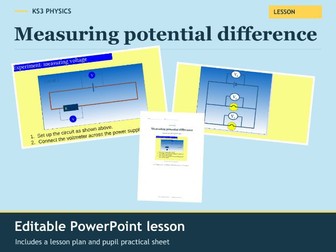
A 3 V supply powers two lamps. Will each lamp have 3 V across it? Measure potential difference with a voltmeter and compare the readings across series and parallel components. Pupils try “Map potential difference”. Includes the editable PowerPoint, a 50-minute lesson plan and a printable pupil sheet with equipment, instructions, example evidence and worked teacher answers. KS3 physics for ages 11–14. Part of the electric charge and circuits sequence.
AQA GCSE Chemistry: Chemical analysis bundleQuick View
tobz360

AQA GCSE Chemistry: Chemical analysis bundle

(0)
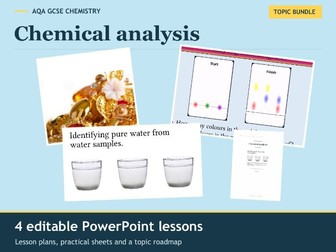
Start with a pure substance. Build and test a mixture with a purpose, separate a mixture into its dyes, then use observations to identify gases. Includes 4 editable PowerPoint lessons. Each has a timed lesson plan, a suggested practical or modelling activity, a printable pupil sheet and teacher answers. The topic roadmap shows the sequence and equipment. Lessons included Pure substances and mixtures Formulations and emulsions Paper chromatography and Rf values Identifying common gases The chromatography lesson includes the paper method, Rf calculations and an unknown dye for AQA Trilogy required practical 12. The gas lesson uses four evidence stations. This pack covers the Combined Science chemical analysis unit. Bought separately the lessons total £4. The topic pack is £2. The topic pack also includes the chromatography cloze sheet, separation loop cards and a printable four-gas card sort.
Edexcel GCSE Biology: Key concepts in biology bundleQuick View
tobz360

Edexcel GCSE Biology: Key concepts in biology bundle

(0)
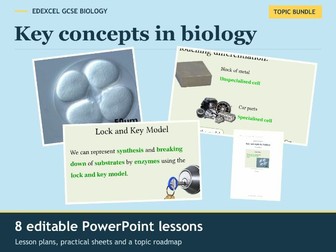
Move from visible structures to the processes they make possible. Revisit scale when pupils compare bacteria, reaction rates when they work with enzymes, and percentage change when they measure osmosis. Includes 8 editable PowerPoint lessons. Each has a timed lesson plan, a suggested practical or modelling activity, a printable pupil sheet and teacher answers. The topic roadmap shows the sequence and equipment. Lessons included Microscopes, magnification and resolution Animal and plant cells Specialised cells and their adaptations Inside bacterial cells Enzymes and digestion Enzyme action and specificity Factors affecting enzyme activity Diffusion, osmosis and active transport This is the Edexcel Combined Science CB1 sequence, including the microscopes and magnification lesson. The enzyme and potato activities support core practicals 1.10 and 1.16. Bought separately the lessons total £8. The topic pack is £4. The pack also includes 7 independently written practice sheets with separate teacher answers. The sheets are filed with the lessons that use them.
KS3 Physics: Magnetism and electromagnets bundleQuick View
tobz360

KS3 Physics: Magnetism and electromagnets bundle

(0)
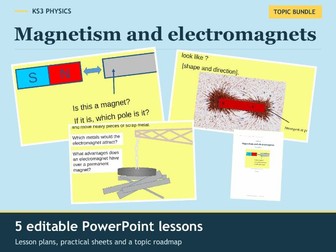
Start with a test that distinguishes a magnet from a magnetic material. Map its field, switch a second field on with a current, and use the evidence to design a lifting device. Includes 5 editable PowerPoint lessons. Each has a timed lesson plan, a suggested practical or modelling activity, a printable pupil sheet and teacher answers. The topic roadmap shows the sequence and equipment. Lessons included Magnets and magnetic materials Mapping magnetic fields The magnetic field of a current Investigating electromagnet strength Using electromagnets in devices This pack covers the five magnetism lessons in the Year 9 Electricity and Fields sequence. The earlier circuit recap and end test are outside this pack. Bought separately the lessons total £5. The topic pack is £3. The topic pack includes the maths challenge used in both electromagnet lessons. Pupils compare coil turns, core material and supplied lifting data. The pack also includes 9 independently written practice sheets with separate teacher answers. The sheets are filed with the lessons that use them.
Edexcel GCSE Biology: Diffusion, osmosis and active transportQuick View
tobz360

Edexcel GCSE Biology: Diffusion, osmosis and active transport

(0)
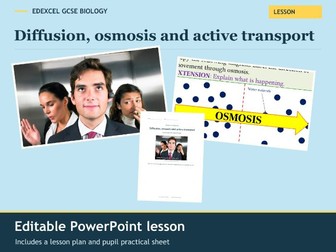
Why can two potato strips from the same potato finish the lesson at different masses? Compare diffusion, osmosis and active transport and use percentage change in mass to interpret potato-strip data. Pupils try “Measure osmosis in potato strips”. Includes the editable PowerPoint, a 50-minute lesson plan and a printable pupil sheet with equipment, instructions, example evidence and worked teacher answers. Edexcel GCSE biology for ages 14–16. Part of the key concepts in biology sequence. The download also includes an independently written practice sheet with teacher answers. The activity is Water movement in potato tissue.
Edexcel GCSE Biology: Enzyme action and specificityQuick View
tobz360

Edexcel GCSE Biology: Enzyme action and specificity

(0)
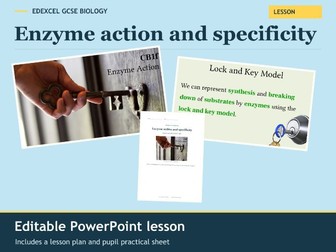
What would happen if the substrate still had the same shape but the active site changed? Use an active-site model to explain specificity, product release and denaturation. Pupils try “Test a model active site”. Includes the editable PowerPoint, a 50-minute lesson plan and a printable pupil sheet with equipment, instructions, example evidence and worked teacher answers. Edexcel GCSE biology for ages 14–16. Part of the key concepts in biology sequence. The download also includes an independently written practice sheet with teacher answers. The activity is Enzyme temperature and specificity.
KS3 Sound: How Vibrations TravelQuick View
tobz360

KS3 Sound: How Vibrations Travel

(0)
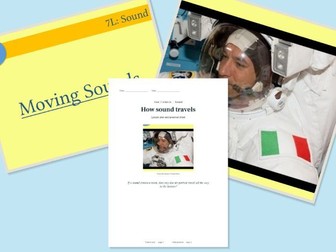
Can a sound cross the room while one coil of a spring stays almost in the same place? A ribbon tied to a slinky lets Year 7 pupils follow the vibration and the travelling disturbance separately. They then compare sound speeds in air, water and steel. The editable PowerPoint is accompanied by a lesson plan and printable practical sheet. The activity, “Follow one coil”, includes equipment, instructions, evidence to interpret and three questions with worked answers. For KS3 science, ages 11–14. The download also includes 5 independently written practice sheets with teacher answers. The activities are A sound race through materials, Which sound reaches the sensor first?, Listening through a tube, Timing an ultrasound echo and Which signals could be detected?.
KS3 Sound: Pitch, Loudness and VibrationsQuick View
tobz360

KS3 Sound: Pitch, Loudness and Vibrations

(0)
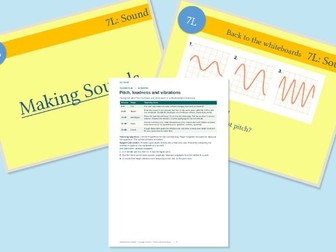
Can the same ruler make two different notes? Pupils test what happens when they shorten its overhang, then use wave traces to separate pitch from loudness. This Year 7 science lesson includes an editable PowerPoint, a 50-minute lesson plan and a printable practical sheet with equipment, recording prompts and worked exit answers. Pupils compare a quiet low note, a loud low note and a quiet high note. The practical includes a visual route for pupils who prefer to observe the vibrations. Lesson 1 in the KS3 Sound sequence.
KS3 Sound: Line Graphs and Scatter GraphsQuick View
tobz360

KS3 Sound: Line Graphs and Scatter Graphs

(0)
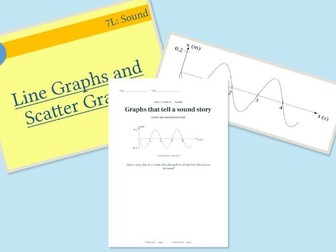
A wavy line can describe one vibration. A scatter graph can show what happens across six ruler lengths. Pupils make both graphs and investigate what each can tell them about sound. The editable PowerPoint is accompanied by a lesson plan and printable practical sheet. The activity, “Plot a vibrating ruler”, includes equipment, instructions, evidence to interpret and three questions with worked answers. For KS3 science, ages 11–14. The download also includes an independently written practice sheet with teacher answers. The activity is Which graph answers the question?.
KS3 Chemistry: Acids and alkalis bundleQuick View
tobz360

KS3 Chemistry: Acids and alkalis bundle

(0)
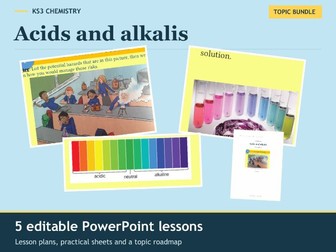
Use indicator colours as the link between testing an unknown, placing it on a scale and explaining neutralisation. Includes 5 editable PowerPoint lessons. Each has a timed lesson plan, a suggested practical or modelling activity, a printable pupil sheet and teacher answers. The topic roadmap shows the sequence and equipment. Lessons included Hazards in the science lab Indicators and colour changes Reading the pH scale Neutralisation and word equations Neutralisation in everyday life Bought separately the lessons total £5. The topic pack is £3. The pack also includes 1 independently written practice sheet with separate teacher answers. The sheets are filed with the lessons that use them.
KS3 Physics: Electric charge and circuits bundleQuick View
tobz360

KS3 Physics: Electric charge and circuits bundle

(0)
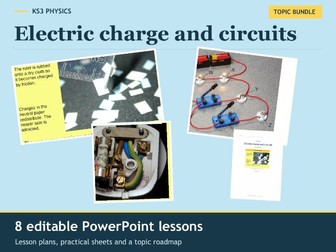
Why do two lamps on one loop behave differently from two lamps on separate branches? Build and draw both circuits, take meter readings and use them to test your explanations. Includes 8 editable PowerPoint lessons. Each has a timed lesson plan, a suggested practical or modelling activity, a printable pupil sheet and teacher answers. The topic roadmap shows the sequence and equipment. Lessons included Static electricity and charge Building and drawing simple circuits Series and parallel circuits Measuring current in circuits Measuring potential difference Models of electric circuits Investigating electrical resistance Electrical safety and fuses The pack includes a circuit-drawing handout and printable partner vocabulary cards. The Year 9 recap presentations repeat activities in this sequence. The source discussion about a day without electricity and the end test are outside this eight-lesson pack. Bought separately the lessons total £8. The topic pack is £4. The pack also includes 16 independently written practice sheets with separate teacher answers. The sheets are filed with the lessons that use them. A morning without electricity is included as a bonus literacy task.
KS3 Chemistry: Indicators and colour changesQuick View
tobz360

KS3 Chemistry: Indicators and colour changes

(0)
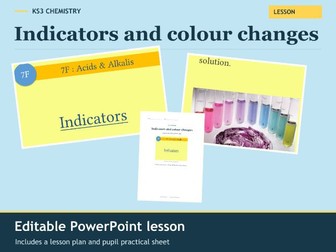
Can the colour from a cabbage identify the mystery liquid? Use a reference colour series to classify solutions as acidic, neutral or alkaline. Pupils try “Make a three-colour indicator key”. Includes the editable PowerPoint, a 50-minute lesson plan and a printable pupil sheet with equipment, instructions, example evidence and worked teacher answers. KS3 chemistry for ages 11–14. Part of the acids and alkalis sequence. The download also includes an independently written practice sheet with teacher answers. The activity is Interpreting indicator evidence.
KS3 Chemistry: Hazards in the science labQuick View
tobz360

KS3 Chemistry: Hazards in the science lab

(0)
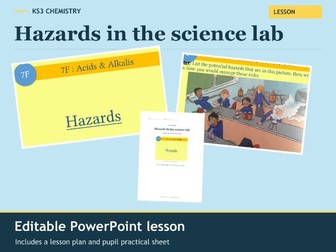
Who would you stop first in the lab scene, and why? Use the classroom cartoon and a three-station label investigation to help Year 7 pupils distinguish a hazard from a risk. Includes an editable PowerPoint, a 50-minute lesson plan and a printable pupil sheet for “Read the label before you act”, with equipment, sample labels, questions and worked teacher answers. Part of the KS3 acids and alkalis sequence.
KS3 Chemistry: Neutralisation and word equationsQuick View
tobz360

KS3 Chemistry: Neutralisation and word equations

(0)
What happens to pH when the next drop of alkali is one drop too many? Describe how pH changes during neutralisation and name the salt formed from a named acid and alkali. Pupils try “Find the colour change”. Includes the editable PowerPoint, a 50-minute lesson plan and a printable pupil sheet with equipment, instructions, example evidence and worked teacher answers. KS3 chemistry for ages 11–14. Part of the acids and alkalis sequence.
KS3 Chemistry: Neutralisation in everyday lifeQuick View
tobz360

KS3 Chemistry: Neutralisation in everyday life

(0)
Why does a grower test the soil before adding lime? Use evidence about pH to explain an application of neutralisation and predict the effect of adding excess material. Pupils try “Model liming an acidic sample”. Includes the editable PowerPoint, a 50-minute lesson plan and a printable pupil sheet with equipment, instructions, example evidence and worked teacher answers. KS3 chemistry for ages 11–14. Part of the acids and alkalis sequence.
KS3 Chemistry: Reading the pH scaleQuick View
tobz360

KS3 Chemistry: Reading the pH scale

(0)
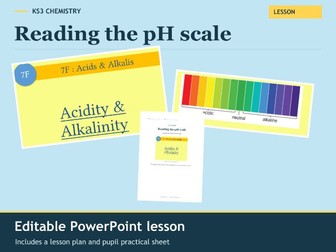
Two liquids both look clear. Which measurement would put them in order? Read an approximate pH, rank three solutions and distinguish an estimate from an exact measurement. Pupils try “Rank coded solutions by pH”. Includes the editable PowerPoint, a 50-minute lesson plan and a printable pupil sheet with equipment, instructions, example evidence and worked teacher answers. KS3 chemistry for ages 11–14. Part of the acids and alkalis sequence.