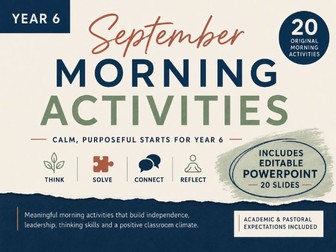
Create a calm, purposeful and increasingly independent start to every school day with this complete Year 6 September Morning Mission Pack.
Designed specifically for the beginning of Year 6, this resource provides 20 original morning activities, each planned to take approximately 20–30 minutes. Rather than repetitive worksheets or simple filler tasks, pupils are challenged to think, reason, communicate, organise themselves and make responsible decisions.
The resource is particularly useful during September when teachers are establishing expectations, independence and classroom routines.
Included in the download:
23-page Year 6 September Morning Mission pupil booklet
20 complete morning activities
20-slide editable PowerPoint
One clear board-display slide for every activity
Independent, partner and independent-to-partner tasks
Year 6 academic expectations
Year 6 pastoral expectations
Daily pupil self-checks
20-day mission tracker
The accompanying PowerPoint is designed to be displayed as pupils arrive. Each slide clearly shows what pupils need to do, when partner discussion is appropriate and what they should check before considering the activity complete. This makes the resource particularly useful for establishing a morning routine with minimal repeated teacher explanation.
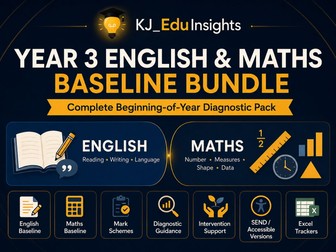
Start Year 3 with a clear, detailed picture of pupils’ starting points in both English and Maths.
Assess → Diagnose → Intervene
This complete baseline assessment bundle combines the Year 3 English Baseline Assessment and Year 3 Maths Baseline Assessment, giving teachers ready-to-use assessments, marking guidance, diagnostic analysis, intervention support and tracking tools in one resource.
Designed for the beginning of Year 3, both assessments focus primarily on retained Year 2 and prerequisite KS1 knowledge, helping teachers identify what pupils can apply independently, where misconceptions remain and which areas need immediate support or additional challenge.
Year 3 English Baseline
Assesses key areas of English including:
Reading
Grammar and Punctuation
Spelling
Writing
Results can be used to identify strengths, gaps and intervention priorities across individual pupils and the wider class.
Year 3 Maths Baseline
Includes:
Core Year 2 Prior Attainment – /90
Separate Year 3 Readiness – /10
Arithmetic and Fluency
Reasoning and Problem Solving
Number and Place Value
Calculation
Fractions
Measurement
Geometry and Position
Statistics and Reasoning
The Year 3 Readiness section is reported separately and helps teachers decide the appropriate starting pace, scaffolding and level of challenge without lowering the pupil’s Year 2 prior-attainment judgement.
Across the bundle you will receive
Teacher Administration Guides
Ready-to-print Student Assessment Booklets
English Reading Insert
Detailed Teacher Mark Schemes
Diagnostic Frameworks and Worked Exemplification
Intervention Guides linked to assessment outcomes
National Curriculum Objective Mapping
SEND / Accessible Assessment Booklets
Inclusive Assessment Teacher Guidance
Parent Communication Templates
Excel Assessment Trackers for recording, analysing and interpreting results
More than just two tests
These resources are designed to help teachers move directly from assessment to action.
Use the results to:
establish clear beginning-of-year starting points
identify individual and whole-class misconceptions
highlight pupils requiring targeted intervention
recognise pupils ready for additional challenge
support early planning and grouping decisions
track attainment across key areas
generate useful pupil and class-level information
communicate starting points clearly with parents
The SEND / accessible versions maintain the same assessment content and mathematical or English demand while reducing unnecessary barriers through clearer formatting, increased spacing and additional response space.
Suitable for Year 3 class teachers, English and Maths leads, KS2 leaders, teaching assistants and schools following the National Curriculum for England.
A comprehensive beginning-of-year bundle designed to reduce assessment preparation, marking, analysis and intervention planning while giving teachers meaningful information they can use immediately.
Start the new academic year with a clear picture of pupils’ strengths, gaps and next steps across English and Maths.
Assess → Diagnose → Intervene
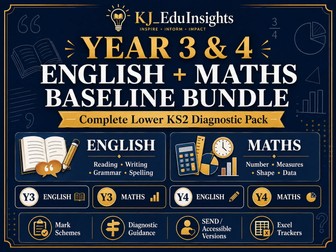
This comprehensive Year 3 and Year 4 Baseline Assessment Bundle brings together four complete beginning-of-year assessment packs:
Year 3 English Baseline Assessment
Year 3 Maths Baseline Assessment
Year 4 English Baseline Assessment
Year 4 Maths Baseline Assessment
Designed for teachers working across Lower KS2, these assessments help identify what pupils have retained from the previous year, where misconceptions remain and which pupils may require additional support or greater challenge.
Rather than providing only an overall score, the resources are designed to support diagnosis, intervention and planning at the start of the year.
English assessment
The English baselines assess key areas including:
Reading comprehension
Grammar and punctuation
Spelling
Writing
Teachers can use the results to identify individual and whole-class strengths, pinpoint gaps in prior learning and establish early English priorities.
Maths assessment
The Maths baselines assess a broad range of curriculum knowledge through a combination of:
Arithmetic and fluency
Number and place value
Calculation
Fractions
Measurement
Geometry and position
Statistics
Reasoning and problem solving
The assessments are designed to establish secure prior attainment while also helping teachers identify pupils ready for additional challenge.
Across the bundle you will find
Depending on the individual assessment pack, resources include:
Teacher Administration Guides
Ready-to-print Student Assessment Booklets
Teacher Mark Schemes and answers
Diagnostic guidance
Worked exemplification
Intervention guidance linked to assessment outcomes
National Curriculum objective mapping
SEND / accessible assessment versions
Assessment trackers
Inclusive assessment guidance
Parent communication resources
Designed to support assessment beyond the test
Use the results to:
establish reliable beginning-of-year starting points
identify gaps from the previous year
highlight individual and class-wide misconceptions
support intervention grouping
identify pupils ready for greater challenge
inform first-term planning
support pupil progress discussions
provide evidence for English and Maths leaders
communicate starting points more clearly with parents
The SEND / accessible versions are designed to reduce unnecessary barriers while maintaining the intended curriculum demand, allowing pupils to demonstrate their mathematical and English understanding more effectively.
Ideal for
Year 3 teachers
Year 4 teachers
Lower KS2 teams
English and Maths subject leaders
Phase leaders
Teaching assistants
Schools following the National Curriculum for England
A practical Lower KS2 assessment bundle that brings English and Maths together in one resource and reduces the time teachers spend creating assessments, mark schemes, trackers, intervention plans and supporting documentation.
Four complete baseline assessments in one bundle – assess, diagnose, plan and support from the very beginning of the year.
Start Year 3 with a clear picture of what pupils have retained from Year 2 and where teaching needs to begin.
Assess → Diagnose → Intervene
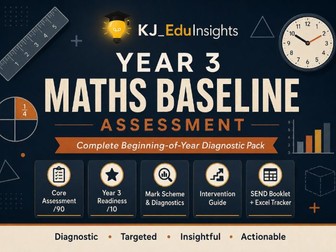
This comprehensive Year 3 Maths Baseline Assessment is designed for use at the beginning of the academic year. It assesses secure Year 2 and prerequisite KS1 mathematical knowledge while also including a short, separate Year 3 Readiness section to identify pupils who are already beginning to access selected Year 3 concepts.
The assessment combines arithmetic fluency, reasoning and problem solving, giving teachers much more than a single overall score. Results are broken down across six diagnostic strands so that gaps, misconceptions, strengths and intervention priorities can be identified quickly.
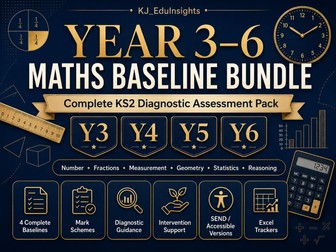
Assess pupils confidently from the very start of the year with this comprehensive Year 3–6 Maths Baseline Assessment Bundle.
Assess → Diagnose → Intervene
This bundle brings together four complete maths baseline assessment systems for Years 3, 4, 5 and 6, designed to identify what pupils have retained from the previous year, highlight misconceptions and gaps, and give teachers practical information to use immediately for planning, intervention and challenge.
Rather than providing only a test and a score, each year-group pack is designed as a complete diagnostic toolkit, taking teachers from assessment through to analysis and next steps.
Four complete Maths baseline packs included
Year 3 Maths Baseline Assessment
Year 4 Maths Baseline Assessment
Year 5 Maths Baseline Assessment
Year 6 Maths Baseline Assessment
Each assessment focuses primarily on the previous year’s National Curriculum knowledge, making the bundle suitable for beginning-of-year assessment, transition information and establishing accurate starting points.
The Year 3 assessment includes a Core Year 2 Prior Attainment score /90 plus a separate Year 3 Readiness /10 section, allowing teachers to identify secure prior learning while also seeing which pupils are already beginning to access selected Year 3 concepts.
Maths areas assessed across the collection
Depending on the year group, assessment covers key areas including:
Number and Place Value
Addition, Subtraction, Multiplication and Division
Arithmetic and Fluency
Fractions
Decimals and Percentages where age appropriate
Measurement
Geometry and Position
Statistics
Mathematical Reasoning
Problem Solving
The assessments include a balance of fluency and application so teachers can identify not only whether pupils can calculate accurately, but whether they can reason, explain and apply their mathematical understanding.
Each year-group toolkit includes
Teacher Administration Guide
Ready-to-print Student Assessment Booklet
Detailed Teacher Mark Scheme and answers
Diagnostic notes and strand analysis
Diagnostic Framework and Worked Exemplification
Targeted Intervention Guide
National Curriculum Objective Mapping
SEND / Accessible Student Assessment Booklet
Inclusive Assessment Teacher Guidance
Parent Communication Template
Excel Assessment Tracker
Assessment that leads directly to action
The accompanying diagnostic resources allow teachers to move beyond an overall percentage and identify exactly where support is needed.
Use the results to:
establish accurate beginning-of-year starting points
identify retained knowledge from the previous year
spot individual and whole-class misconceptions
identify weaker mathematical domains
group pupils for targeted intervention
recognise pupils ready for additional challenge
inform medium-term and first-term planning
support pupil progress and transition discussions
provide useful evidence for Maths and phase leaders
communicate strengths and priorities clearly with parents
The intervention guidance links assessment outcomes to practical next steps, helping teachers focus support on specific misconceptions rather than reteaching an entire strand unnecessarily.
SEND and accessibility included
Each pack contains a SEND / accessible assessment version designed to reduce unnecessary barriers while maintaining the mathematical demand of the standard assessment.
Accessible versions use features such as clearer layouts, increased spacing, larger response areas and reduced visual load so pupils have a fair opportunity to demonstrate their mathematical understanding.
Excel tracking included
The assessment trackers support efficient analysis of pupil and class performance, including:
automatic score calculations
strand-level analysis
overall diagnostic judgements
class performance information
identification of intervention groups
individual pupil profiles and reporting information
Ideal for
Year 3, Year 4, Year 5 and Year 6 teachers
KS2 teams
Maths subject leaders
Phase leaders
Teaching assistants
Schools preparing for a new academic year
Transition and beginning-of-year assessment
Schools following the National Curriculum for England
This Years 3–6 Maths Baseline Bundle provides a consistent approach to diagnostic assessment across KS2 while still ensuring that each assessment is appropriate to the curriculum knowledge pupils should have secured before entering their new year group.
Four year groups. Four complete diagnostic systems. One comprehensive KS2 Maths assessment bundle designed to help teachers assess, diagnose, plan and intervene from the very beginning of the year.
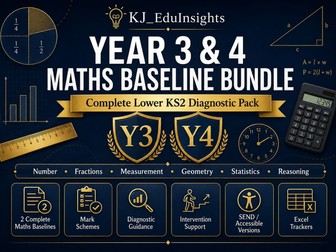
Start the new academic year with a clear understanding of pupils’ mathematical starting points with this comprehensive Year 3 and Year 4 Maths Baseline Assessment Bundle.
Assess → Diagnose → Intervene
This bundle combines complete beginning-of-year maths baseline resources for Year 3 and Year 4, designed to identify what pupils have retained from the previous year, highlight misconceptions and gaps, and help teachers make informed decisions about planning, intervention and challenge from the very start of the year.
Rather than simply producing an overall test score, these assessments are designed as diagnostic tools, allowing teachers to identify strengths and areas for development across key mathematical strands.
Two complete Maths baseline assessments included
Year 3 Maths Baseline Assessment
Year 4 Maths Baseline Assessment
The assessments focus primarily on the mathematical knowledge pupils should have secured before entering their new year group, making them ideal for September assessment, transition information and establishing beginning-of-year starting points.
**Mathematical areas assessed
**
Across the two assessments, pupils are assessed in areas including:
Number and Place Value
Addition and Subtraction
Multiplication and Division
Arithmetic and Fluency
Fractions
Measurement
Geometry and Position
Statistics
Mathematical Reasoning
Problem Solving
Questions include a combination of fluency, reasoning and application so teachers can see not only whether pupils can calculate accurately, but also whether they can apply and explain their mathematical understanding.
Comprehensive teacher resources
The packs include supporting materials designed to take teachers from assessment through to analysis and next steps, including:
Teacher Administration Guides
Ready-to-print Student Assessment Booklets
Detailed Teacher Mark Schemes
Diagnostic guidance
Worked exemplification
Intervention guidance linked to assessment outcomes
National Curriculum objective mapping
SEND / accessible assessment versions
Inclusive assessment guidance
Parent communication resources
Excel assessment trackers
From assessment to action
Use the results to:
establish reliable beginning-of-year starting points
identify gaps in prior learning
highlight individual and whole-class misconceptions
identify weaker mathematical strands
plan targeted intervention
group pupils according to specific needs
recognise pupils ready for additional challenge
inform first-term planning
support transition and pupil progress discussions
provide useful evidence for Maths and phase leaders
The intervention guidance helps teachers move directly from a pupil’s assessment performance to focused teaching priorities, reducing the need to analyse every question and create intervention plans from scratch.
SEND / accessible versions included
Accessible pupil versions are included to reduce unnecessary barriers while maintaining the intended mathematical demand. Clearer layouts, increased spacing and additional response space help pupils demonstrate their understanding without changing what is being assessed.
Ideal for
Year 3 teachers
Year 4 teachers
Lower KS2 teams
Maths subject leaders
Phase leaders
Teaching assistants
Transition and beginning-of-year assessment
Schools following the National Curriculum for England
A practical Lower KS2 Maths assessment bundle that provides much more than two tests. Assess pupils, identify their needs and move directly into informed planning, targeted intervention and appropriate challenge.
Two year groups. Two complete diagnostic assessment systems. One ready-to-use Lower KS2 Maths baseline bundle.
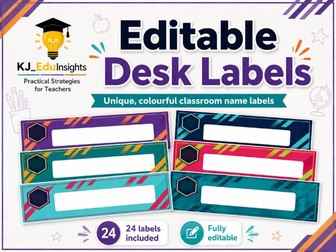
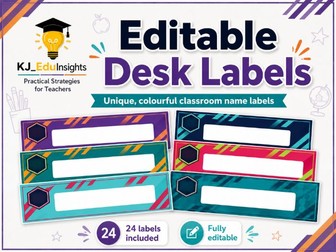
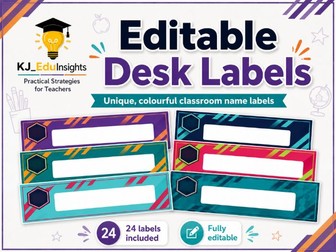
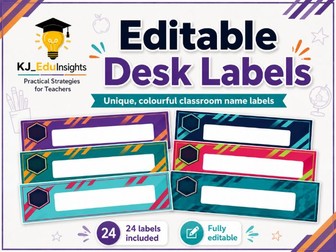
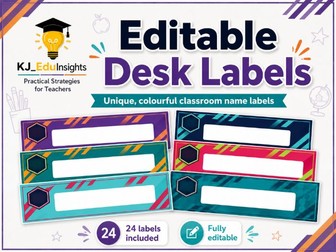
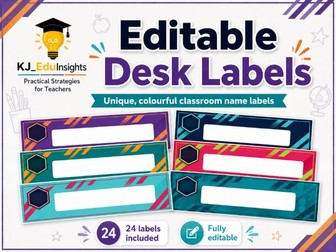
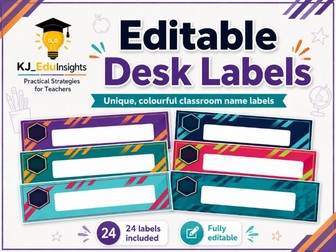
Give your classroom a polished, organised look from the very first day with these fully editable desk labels.
Designed with older primary pupils in mind, these labels have a bold, modern style with bright colour combinations that feel fun without looking too young. They are particularly suited to KS2 classrooms and are ideal for the start of a new school year.
The pack contains 24 individual desk labels in a range of coordinated colour designs. Each label includes space for:
Pupil name
Surname
Class
Year group
Individual pupil number
The labels are supplied as an editable PowerPoint, allowing you to personalise each one with your own pupils’ details before printing.
The different colourways include combinations of purple, teal, blue, yellow, orange, pink and green, giving pupils an individual label while still creating a coordinated classroom display.
Simply edit the text, print and place on pupils’ desks.
Perfect for:
Back-to-school classroom preparation
New class set-up
Seating organisation
Classroom displays and organisation
A practical, colourful classroom resource that can be edited and reused with a new class each year.
Bring a bold, modern gaming feel to your classroom with these fully editable arcade-inspired desk labels.
This pack contains 24 individual desk labels, designed in a range of striking neon and gaming-style colour combinations. The dark backgrounds, geometric details and bright accents give the labels an arcade-inspired look that stands out without feeling overly childish.
Each desk label includes editable spaces for:
Pupil name
Surname
Class
Year
Individual pupil number
The full set contains 24 numbered labels, making it easy to prepare a complete class set while keeping a coordinated overall look.
Across the pack, pupils receive different colour combinations including neon blue, cyan, pink, purple, lime, yellow and orange, alongside hexagonal gaming-style details and bold geometric backgrounds.
The resource is supplied as an editable PowerPoint, so you can simply type in your pupils’ details before printing.
Perfect for:
Classroom desk name labels
Back-to-school preparation
New class set-up
Seating organisation
Gaming or arcade-themed classrooms
Teachers looking for a more modern alternative to traditional name labels
Simply edit, print and use. The labels can be personalised again for a new class, making them a reusable classroom resource year after year.
Modern. Colourful. Fully editable. A desk label set designed to stand out.
Turn every desk into a destination with this set of editable passport and global explorer desk labels.
Designed especially for older primary pupils, these labels move away from traditional classroom name tags and use a modern passport, boarding pass and travel card theme instead. Each pupil can have their own destination, making the classroom feel coordinated without every desk looking exactly the same.
The set includes 24 different worldwide destinations, including London, Paris, New York, Tokyo, Sydney, Cairo, Barcelona, Reykjavik, Singapore, Miami, Athens and Dubai, with further destinations including Cape Town, Delhi, Lisbon, Bangkok, Hong Kong, Dublin, Helsinki and Vancouver.
Two coordinated travel styles
The resource contains two complementary editable designs:
Passport-style desk labels featuring destination names, airport codes and a clean travel-card layout.
Global Explorer labels inspired by passports, boarding passes and travel tickets, with details such as flight numbers, gates, coordinates and destination codes.
Across the Explorer collection, pupils receive different styles including Passport, Travel Pass, Boarding Pass, Explorer Pass, Adventure Pass and Travel Card designs.
Fully editable
Each label includes editable areas for:
First name
Surname
Class
Year
The PowerPoint format means teachers can quickly personalise the labels for their own class before printing.
What’s included
24 different global destinations
Two coordinated travel-themed label styles
Editable PowerPoint files
Passport, boarding pass and explorer-inspired designs
Individual destination and airport codes
Space for pupil name, surname, class and year
A consistent classroom theme without identical labels
Ready to personalise, print and use
Perfect for Year 5, Year 6, upper KS2 classrooms, geography-inspired classrooms, travel themes, back-to-school displays and new-class preparation.
These desk labels are designed to feel a little more grown-up than standard primary classroom name tags, while still being colourful, engaging and easy to read.
A practical classroom resource with a distinctive global explorer theme – edit, print and your class is ready for take-off.
Give your classroom a festival feel with this set of 28 editable backstage pass desk labels.
Designed to look like real festival, VIP and backstage passes, these colourful name labels are a fun alternative to standard classroom desk tags. Each pupil can have their own individual festival pass while the whole class still has a coordinated theme.
The collection includes 28 different designs, featuring a range of fictional stages, festivals and music zones such as Rock Stage, Harmony Stage, Sparkle Stage, Groove Garden, Melody Stage, Beat Zone, Pop Stage, Electric Stage, Star Stage, Dream Stage, Rhythm Zone, Starburst Stage and Moon Stage.
Backstage-inspired designs
The labels use a mixture of VIP, All Access, Crew and Sound Check styling, along with individual pass numbers and stage names to give each design its own identity.
Each label includes space for:
First name
Surname
Class
Year
The editable PowerPoint version makes it quick and easy to personalise the complete set for your own class before printing.
What’s included
28 festival-inspired desk label designs
Editable PowerPoint version
Ready-to-use PowerPoint version
A different design for pupils across the class
VIP, All Access, Crew and Sound Check themes
Individual stage names and pass numbers
Editable pupil name, surname, class and year
Bright, modern designs that work particularly well for older primary pupils
Ready to personalise, print and use
Perfect for back-to-school preparation, classroom makeovers, music-themed classrooms, festival themes, upper KS2 and creating a more individual desk space for each pupil.
These labels are designed to feel more modern and grown-up than traditional classroom name tags, while still being fun, colourful and easy for pupils to identify.
Give every pupil their own backstage pass to your classroom.
Turn your classroom into its own mini museum with this set of 24 editable museum-inspired desk labels.
Designed as part of “The Class Collection”, each label looks like an individual museum exhibit card, complete with its own collection number, display-style artwork and space for pupil details.
Rather than every pupil having the same desk label, the set contains 24 different designs, creating a coordinated classroom theme while still giving each pupil something individual.
24 different museum-style exhibits
The collection includes a wide range of themes inspired by natural history, science, art, geography and world cultures. Across the two sheets, designs include:
Dinosaur fossils
Butterflies and insects
Space and the solar system
Coral reefs and ocean life
Tropical wildlife
Ancient Egypt
Robots and technology
Pottery and artefacts
Crystals and gemstones
Castles and medieval history
Marine life
Sculpture and art
Savannah wildlife
Volcanoes
Moon phases
Mythical creatures
Underwater exploration
Fossil footprints
Mountain wildlife
World maps
Botanical specimens
The full collection can be seen across the two-page Class Collection matrix, with each pupil label presented as its own museum-style exhibit.
Fully editable
Each label includes editable spaces for:
First name
Surname
Class
Year
Each design also has its own numbered collection reference, helping to create the look of a real curated museum collection.
What’s included
24 unique museum-inspired desk label designs
Fully editable PowerPoint file
A different exhibit theme for pupils across the class
Editable first name, surname, class and year
Individual collection numbers
Natural history, science, geography, art and culture-inspired designs
Coordinated vintage museum/display-card styling
Ready to personalise, print and use
Perfect for KS2 classrooms, upper primary, history classrooms, science classrooms, museum or discovery themes, back-to-school preparation and classroom makeovers.
These labels offer something different from standard classroom name tags. The whole class becomes part of The Class Collection, while each pupil has their own individual exhibit.
24 pupils. 24 exhibits. One unique Class Collection.
Give your classroom a fresh, modern look with this set of 24 editable magazine-style desk labels. Each label has been designed to look like the front cover of a colourful children’s magazine, making them much more engaging than a standard classroom name tag.
The pack includes 24 different designs, so pupils can have their own individual magazine cover rather than every desk looking exactly the same. Themes include animals, sport, gaming, art, space, books, science, nature, puzzles, dinosaurs, dance, eco, fantasy, design, history, technology, comics, magic, travel, food and music.
Each desk label includes editable areas for:
First name
Surname
Class
Year
The magazine-style headlines and bold layouts give each design its own personality, with features such as Amazing Places, Epic Adventures, Cool Planets, Crack the Code, Build a Bot and Save Our Planet.
Included:
24 unique magazine-inspired desk label designs
Fully editable PowerPoint file
Space to personalise each label for individual pupils
A wide range of themes to suit different interests
Bright, eye-catching designs suitable for upper primary classrooms
Ready to edit, print and use
Perfect for classroom organisation, back-to-school preparation, new class displays or refreshing your classroom for a new term.
A fun and practical alternative to traditional desk name labels, helping every pupil’s place in the classroom feel a little more individual.
Bring an adventure and expedition theme to your classroom with this set of 24 editable topographical desk labels.
Designed to look like miniature expedition maps, each label combines striking landscape artwork with topographical contour lines, coordinates, compass details, route markings and elevation information. The designs feel more grown-up than traditional classroom name tags, making them particularly suitable for KS2 and upper primary classrooms. The two-page label system includes landscapes ranging from mountains and glaciers to jungles, deserts, coastlines, volcanoes and forests.
24 different adventure designs
Rather than giving every pupil the same label, the set includes a variety of expedition themes, including:
Glacier Expedition
Ridge Trail
River Run
Jungle Trail
Night Navigation
Desert Expedition
Summit Route
Wild Falls Expedition
Canyon Trail
Coastal Route
Lava Ridge
Cloud Peak
Coral Bay
Savannah Trail
River Gorge
Aurora Trail
Hidden Temple
Canyon Bridge
Snowy Pass
Forest Camp
Island Cove
Volcano Trail
The individual designs include their own expedition-style details such as coordinates, elevations and abbreviated route codes, helping each desk label feel unique while still keeping a consistent classroom theme.
Editable for your class
Each label contains editable areas for:
First name
Surname
Class / Year Group
Simply personalise the labels in PowerPoint, print and add them to pupils’ desks.
What’s included
24 unique topographical adventure desk labels
Editable PowerPoint file
A different expedition-inspired design for pupils across the class
Space for first name, surname and class/year group
Topographical map and contour-line styling
Compass, coordinate and elevation details
Mountain, jungle, desert, coastal, forest, glacier and volcanic themes
Ready to personalise and print
Perfect for back-to-school preparation, classroom makeovers, explorer themes, adventure classrooms, geography-inspired displays and upper KS2 classrooms.
These labels create a coordinated classroom without making every desk identical. Pupils can each have their own expedition while the complete set still works together as one distinctive classroom theme.
Personalise. Print. Explore.
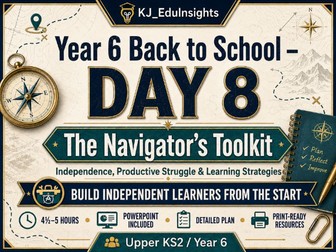
Help pupils become more independent learners with a complete **Day 8 Year 6 teaching pack **focused on recognising barriers, choosing useful strategies and asking for help precisely.
The Navigator’s Toolkit teaches pupils that being “stuck” can mean very different things. A pupil might be genuinely confused, missing important information, unsure how to begin, challenged but still thinking, or simply seeking reassurance.
Instead of immediately raising a hand or giving up, pupils learn a practical five-step independence routine:
STOP → REREAD → CHECK → TRY → ASK PRECISELY
They then apply this routine across six very different challenges before creating their own personalised Navigator Toolkit and completing an evidence-based Learning Profile.
Designed for approximately 4 hours 30 minutes–4 hours 55 minutes of structured learning, Day 8 provides a substantial full-day sequence of individual reflection, paired analysis, team challenges and whole-class discussion.
What is included?
13-slide Day 8 teaching presentation
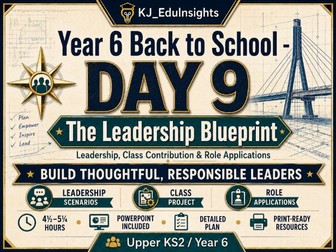
Move beyond traditional classroom jobs and help pupils understand what responsible leadership actually looks like with this complete Day 9 Year 6 teaching pack.
The Leadership Blueprint is a full-day sequence designed to redefine leadership as contribution, responsibility, service and evidence, rather than popularity, confidence or simply being the loudest person in the room.
Pupils challenge common leadership myths, explore ten different ways people can contribute, diagnose realistic classroom situations, design a genuine Class Contribution Project and use evidence from their first eight days to apply for a meaningful classroom responsibility.
The lesson culminates in either a one-minute leadership pitch or structured paired interview, giving every pupil an opportunity to explain what they can contribute and why.
Designed for approximately 4 hours 30 minutes–5 hours 20 minutes of structured learning, Day 9 provides a substantial full-day programme of individual reflection, team analysis, project design, written application and communication.
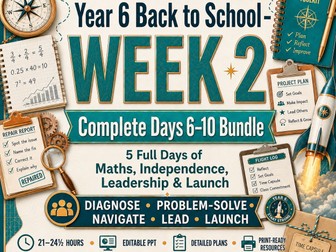
Start the second week of Year 6 with five complete, connected teaching days already planned.
Year 6: Start Strong – Week 2 takes pupils from academic diagnosis and problem-solving through independence, leadership and finally into evidence-based reflection and goal setting.
This is not a collection of unrelated worksheets or filler activities for the first weeks back. Days 6–10 form a deliberate progression:
DIAGNOSE → PROBLEM-SOLVE → BECOME INDEPENDENT → LEAD → LAUNCH
Across the five days, pupils investigate their maths and SPaG starting points, learn how to respond productively when they are stuck, apply mathematical reasoning to a substantial real-world project, build personalised learning strategies, explore responsible leadership and finish by setting precise Year 6 goals.
Together, Days 6–10 provide approximately 21–24½ hours of structured learning, excluding breaks and lunch. Each day combines independent work, paired discussion, collaborative challenges and purposeful reflection.
Five complete Year 6 teaching days
DAY 6 – Maths Fluency & SPaG Repair Agency
Diagnose • Repair • Apply • Explain
Day 6 combines an independent maths diagnostic with a substantial SPaG investigation.
Pupils become linguistic repair specialists and learn a four-stage editing protocol:
SPOT IT → NAME IT → CORRECT IT → EXPLAIN IT
After diagnosing a damaged text, pupils rotate through six specialist repair stations covering:
sentence boundaries
punctuation
apostrophes
verb agreement and tense
word classes
spelling patterns and statutory spellings
pronouns and cohesion
They finish by independently repairing a complete text and explaining the grammatical reasoning behind their changes.
The lesson provides teachers with useful evidence about both mathematical fluency and pupils’ ability to identify, correct and explain SPaG errors rather than simply guessing the answer.
Approx. 3¾–4½ hours
DAY 7 – The Problem-Solving Blueprint
Diagnose • Struggle • Build • Defend
Day 7 moves beyond mathematical calculation and investigates how pupils actually approach difficult problems.
Pupils explore productive struggle before learning a repeatable six-stage Problem-Solving Engine:
READ → REPRESENT → CHOOSE → TRY → CHECK → EXPLAIN
They then apply these strategies to a substantial Year 6 Activity Day Master Plan.
Working within fixed budget and timetable constraints, teams must compare options, calculate costs, create a viable schedule and justify their decisions.
Just when they believe the plan is complete, a Parameter Update changes the conditions and forces pupils to recalculate and adapt.
This gives teachers valuable evidence about mathematical reasoning, resilience, communication and how pupils respond when their original solution no longer works.
Approx. 4–4½ hours
DAY 8 – The Navigator’s Toolkit
Diagnose • Navigate • Reflect
Day 8 explicitly teaches pupils how to become more independent learners.
Rather than treating every difficulty as simply being “stuck”, pupils investigate different barriers and decide what kind of response is actually needed.
They learn the five-step Navigator Sequence:
STOP → REREAD → CHECK → TRY → ASK PRECISELY
Every pupil builds a personalised Navigator Toolkit before completing an evidence-based Learning Profile across Reading, Writing, SPaG, Maths, Teamwork and Independence.
The focus is not on refusing help. It is on knowing what to try first and how to ask for useful support precisely.
Approx. 4½–5 hours
DAY 9 – The Leadership Blueprint
Contribute • Design • Apply • Lead
Day 9 challenges the idea that leadership means being loud, popular or holding a badge.
Pupils explore leadership as responsible contribution.
They investigate ten different contribution styles, challenge common leadership myths and use a four-stage diagnostic framework to respond to realistic classroom situations.
Teams then design a genuine Class Contribution Project.
Pupils then review evidence gathered during Days 1–8 and complete an evidence-based application for a genuine classroom responsibility.
The final communication task can be delivered as either a one-minute leadership pitch or structured paired interview.
Approx. 4½–5⅓ hours
DAY 10 – The Year 6 Flight Path
Review • Verify • Target • Commit • Launch
Day 10 brings the entire ten-day journey together.
Rather than finishing the transition period with a simple celebration, pupils revisit the evidence they have gathered and use it to decide who they are as learners and where they need to go next.
Pupils:
complete a Ten-Day Flight Log
compare their Day 1 and Day 10 thinking
recalibrate their Top Five Year 6 qualities
build a Mission Specialist Profile
verify strengths using specific evidence
set three precise goals
write a Time-Capsule letter
recognise the contributions of classmates
create the Year 6 Commitment
complete Launch Portfolio Entry 10
Every pupil sets one:
Academic Goal
Independence Goal
Contribution Goal
Each goal includes an exact action, reason, support system, evidence of success and review point.
The programme ends with three shared pillars:
WE BELONG • WE DISCOVER • WE LEAD
and one immediate action that begins the pupil’s Year 6 journey.
Approx. 4⅓–5⅓ hours
Important information about the Maths Baseline
Days 6 and 7 are designed to connect with an existing Year 6 Maths Baseline Assessment.
Maths Diagnostic Part A and Maths Baseline Part B are not duplicated within these Day 6–10 resources.
Day 6 uses the existing Part A assessment for its initial maths diagnostic, while Day 7 uses the existing Part B reasoning assessment.
This bundle therefore contains the teaching, reflection, strategy and application resources surrounding those assessments, not the complete separate Maths Baseline Assessment pack.
Move from assessment to independence – and from independence to leadership.
By the end of Day 10, pupils have not simply completed two weeks of back-to-school activities.
They have gathered evidence about their academic strengths, practised strategies for dealing with difficulty, learned how to ask for help more effectively, solved substantial problems, considered how they contribute to others and created precise goals for the year ahead.
Five purposeful days. One connected journey. Your second week of Year 6 – planned.
Part of the Year 6: Start Strong programme:
BELONG → DISCOVER → LEAD → LAUNCH.
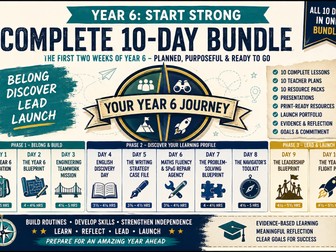
Start Year 6 with the entire first two weeks planned.
Year 6: Start Strong is a complete 10-day transition and induction programme designed to do much more than keep pupils busy at the beginning of the year. Across approximately 40–48 hours of structured learning, pupils build classroom routines, develop teamwork, complete meaningful English and maths diagnostic work, explore how they learn, strengthen independence, practise leadership and finish the programme with precise goals for the year ahead.
The ten days form one connected journey:
BELONG → BUILD → DISCOVER → LEAD → LAUNCH
Instead of ten unrelated first-day activities, evidence and learning carry forward from one day to the next. By the end of Day 10, pupils have created a detailed Launch Portfolio showing what they have discovered about themselves as learners, while teachers have gathered useful evidence about academic starting points, communication, independence, resilience, organisation, problem-solving and contribution.
PHASE 1 – BELONG & BUILD
DAY 1 – The Year 6 Expedition
Belong • Discover • Lead
Begin Year 6 by helping pupils feel secure, understand their new environment and develop a positive class identity.
Pupils explore classroom systems and support, investigate successful Year 6 habits, solve realistic situations, rank the qualities they believe matter most and create their first team agreement. The day is designed to reveal early evidence about confidence, organisation, independence and how pupils interact with a new group.
Approx. 3½–5 hours
DAY 2 – The Year 6 Blueprint
Diagnose • Rehearse • Remember • Agree
Turn classroom expectations into routines pupils can actually use independently.
Pupils diagnose ineffective classroom behaviours before rehearsing core routines, productive help-seeking, organisation and multi-step instruction skills. They finish by helping construct a clear and observable Class Charter.
The emphasis is not simply on telling pupils the rules. They practise the systems that protect learning time until expectations become visible and repeatable.
Approx. 4–4¾ hours
DAY 3 – Engineering Teamwork Mission
Communicate • Collaborate • Engineer
An active teamwork day built around communication laboratories and a substantial STEM challenge.
Pupils investigate the difference between hearing and listening, talking and explaining, arguing and disagreeing, and taking over and genuinely helping.
They apply these behaviours through Barrier Drawing, Back-to-Back Construction, disagreement scenarios and the main Paper Bridge Engineering Challenge, where teams must plan, build, test, analyse failure and improve their design.
The day develops precise communication, inclusion, organisation, resilience and evidence-based problem-solving rather than simply rewarding the strongest final bridge.
Approx. 4¼–5 hours
PHASE 2 – DISCOVER YOUR LEARNING PROFILE
DAY 4 – English Discovery Day
Assess • Train • Interrogate • Reflect
Establish meaningful English starting points while teaching pupils practical reading strategies.
Pupils complete the Year 6 English baseline before learning the Five Fluency Gears:
Pace • Accuracy • Punctuation • Phrasing • Expression
They then investigate The Keeper of the Clockwork Owl, using A.E.E. – Answer, Evidence, Explain to explore vocabulary, retrieval, inference, authorial intent and prediction.
The day finishes with individual reading reflection and a specific next-step target.
Approx. 3½–4¼ hours
Included for Day 4: the Year 6 English Baseline Student Assessment Booklet and teacher answers required for the lesson.
The wider diagnostic framework, trackers, intervention resources, SEND assessment materials and other components from the complete Year 6 English Baseline Assessment Toolkit are not included in this bundle and remain available separately.
DAY 5 – The Writing Strategy Case File
Investigate • Plan • Craft • Revise
A complete narrative-writing workshop designed to show pupils that strong writing begins long before the first sentence is drafted.
Pupils investigate effective narrative writing before moving through idea-generation stations. They generate several possible story concepts, evaluate them for originality, depth and feasibility, create an eight-point narrative blueprint and complete an independent narrative.
The final stage moves beyond simple proofreading. Pupils revise deliberately to improve meaning, atmosphere, cohesion and the reader’s experience.
Approx. 3¾–4½ hours
DAY 6 – Maths Fluency & SPaG Repair Agency
Diagnose • Repair • Apply • Explain
Begin the second week with academic diagnosis and explicit SPaG teaching.
Pupils first complete Maths Diagnostic Part A before entering the SPaG Repair Agency and learning the four-stage forensic protocol:
SPOT IT → NAME IT → CORRECT IT → EXPLAIN IT
They diagnose a damaged text and work through six specialist repair stations covering sentence boundaries, punctuation, apostrophes, verb agreement and tense, word classes, statutory spellings, pronouns and cohesion.
The day culminates in an independent Final Field Test where pupils must not only make accurate corrections but explain the rule behind them.
Approx. 3¾–4½ hours
DAY 7 – The Problem-Solving Blueprint
Diagnose • Struggle • Build • Defend
Day 7 investigates what pupils actually do when mathematics becomes difficult.
After Maths Baseline Part B and an individual confidence profile, pupils explore productive struggle and learn a transferable six-stage Problem-Solving Engine:
READ → REPRESENT → CHOOSE → TRY → CHECK → EXPLAIN
Teams then design a complete Year 6 Activity Day within fixed budget and timetable constraints. They calculate, compare options, justify decisions and build a feasible plan.
Just when the project appears complete, teams receive a Parameter Update that changes the conditions and forces them to recalculate, adapt and defend their revised solution.
Approx. 4–4½ hours
DAY 8 – The Navigator’s Toolkit
Diagnose • Navigate • Reflect
Teach pupils how to become genuinely more independent rather than simply telling them to “try harder”.
Pupils investigate different meanings of being stuck and learn a five-step Navigator Sequence:
STOP → REREAD → CHECK → TRY → ASK PRECISELY
They then test these strategies across six Challenge Circuit outposts involving logic, reading, instruction-following, maths reasoning, practical construction and organisation.
Every pupil creates a personalised Navigator Toolkit before completing an evidence-based Learning Profile across Reading, Writing, SPaG, Maths, Teamwork and Independence.
Approx. 4½–5 hours
PHASE 3 – LEAD & LAUNCH
DAY 9 – The Leadership Blueprint
Contribute • Design • Apply • Lead
Challenge the idea that leadership belongs only to the loudest, most confident or most popular pupils.
Day 9 reframes leadership as responsible contribution.
Pupils investigate leadership myths, explore ten different contribution styles and diagnose realistic classroom situations before deciding what type of response is actually needed.
Teams then design a genuine Class Contribution Project, considering actions, responsibilities, resources, risks, inclusion and measurable impact.
Finally, pupils use evidence collected during Days 1–8 to apply for a classroom responsibility through either a written application and one-minute pitch or a structured paired interview.
Leadership becomes something pupils can prove through actions, rather than simply claim.
Approx. 4½–5⅓ hours
DAY 10 – The Year 6 Flight Path
Review • Verify • Target • Commit • Launch
Bring the entire programme together in a meaningful final launch.
Pupils revisit their original Day 1 beliefs and complete a Ten-Day Flight Log before recalibrating the qualities they now believe successful Year 6 pupils need.
They create a Mission Specialist Profile and learn to verify strengths using an evidence equation rather than unsupported statements.
Every pupil then sets three precise targets:
Academic Focus
Independence Focus
Contribution Focus
Each target includes an exact action, reason, support system, success evidence and review point.
Pupils also write a Time-Capsule Letter to their future selves, recognise specific contributions from classmates, agree the three Year 6 Commitment pillars and complete Launch Portfolio Entry 10.
Approx. 4⅓–5⅓ hours
The final programme commitment is built around:
WE BELONG • WE DISCOVER • WE LEAD
What is included in the complete 10-day bundle?
10 complete classroom presentations
10 detailed teacher lesson plans
10 extensive print-ready resource packs
approximately 40–48 hours of structured teaching and learning
Year 6 English Baseline Student Assessment Booklet + teacher answers for Day 4
detailed printing and preparation guidance
classroom routines and independence resources
teamwork and communication activities
complete Paper Bridge STEM challenge
English reading-fluency and comprehension resources
narrative planning, drafting and editing resources
six SPaG Repair Stations
maths reasoning and productive-struggle resources
complete Activity Day budgeting and timetable project
Navigator independence strategy
six-station Challenge Circuit
pupil Learning Profiles
leadership scenarios and Contribution Styles
Class Contribution Project
responsibility applications, pitch and interview resources
Ten-Day Flight Log
evidence-based profile and target-setting resources
Time-Capsule activities
Peer Recognition Comm-Links
Year 6 Class Commitment
teacher answer guidance, model responses and worked calculations where appropriate
SEND, EAL and access guidance
teacher observation and evidence-recording tools
Launch Portfolio Entries 1–10
final cohort reflection and next-step tools.
The complete programme is built around ten presentations, ten teacher plans and ten print-ready pupil/teacher resource packs, alongside printing guidance, support materials, observation tools, portfolio reflections and model/answer guidance where tasks have checkable outcomes.
More than two weeks of back-to-school activities
By the end of the programme, teachers have gathered evidence about far more than who completes a worksheet correctly.
The sequence helps reveal who settles independently, who needs repeated reassurance, who communicates precisely, who includes others, who can recover when an idea fails, who uses evidence, who sustains independent writing, who understands reading strategies, who can explain SPaG rules, who reasons mathematically, who uses classroom support effectively and who is ready to take on responsibility.
Day 10 then brings this evidence together so pupils leave the programme with a profile and goals they can actually explain rather than simply a completed transition booklet.
Important Maths Baseline information
Days 6 and 7 are designed to work alongside the Year 6 Maths Baseline Assessment.
Maths Diagnostic Part A and Maths Baseline Part B are not included in this 10-day bundle.
Day 6 requires the existing Maths Diagnostic Part A and mark scheme. Day 7 uses the existing Maths Baseline Part B as its initial reasoning diagnostic.
If you already own the KJ_EduInsights Year 6 Maths Baseline Assessment, these lessons are designed to integrate directly with it.
Designed for real Year 6 classrooms
Year 6: Start Strong is written in British English and designed specifically for Year 6 / Upper KS2. It combines individual reflection, paired learning, structured teamwork, practical challenges, independent assessment, English, mathematics, speaking and listening, self-regulation, leadership and classroom culture.
The programme is designed to reduce the enormous planning load of the first two weeks while still allowing teachers to adapt classroom routines, roles, support systems and examples to their own setting.
Most importantly, the first ten days produce information teachers can actually use when planning the weeks that follow.
Ten complete days. Three connected phases. One clear Year 6 journey.
BELONG → BUILD → DISCOVER → LEAD → LAUNCH
Your first two weeks of Year 6 – planned.
Bring your Year 6 transition programme to a purposeful and memorable conclusion with Day 10: The Year 6 Flight Path.
This complete final-day resource gives pupils time to look back over everything they have discovered during the first ten days, identify evidence of their strengths, set meaningful goals and decide how they want to contribute to their Year 6 community.
Rather than ending the transition period with a simple celebration, Day 10 asks pupils to review, verify, target, commit and launch.
The lesson brings together evidence from Days 1–9 through a structured sequence of reflection, self-assessment, goal setting, time-capsule writing, peer recognition and whole-class commitment.
What is included?
15-slide Day 10 teaching presentation
14-page detailed editable teacher lesson plan
40-page editable print-ready resource pack
Final Pre-Flight Checklist
Ten-Day Flight Log
Day 1 versus Day 10 Top Five comparison
Year 6 Quality Bank
Final Top Five ranking
Mission Specialist Profile
Evidence Verification
Evidence Equation resources
three Target Zone planners
Target Verification Matrix
Time-Capsule Blueprint
two-page Time-Capsule Letter
envelope label and sealing checklist
Peer Recognition Comm-Link protocol
printable Comm-Link slips
recognition tracking sheet
Year 6 Commitment
individual commitment page
class signature page
Launch Portfolio Entry 10
Final Launch Sequence Checklist
optional Mission Specialist Certificate
teacher guidance
observation records
final cohort trajectory summary.
Stage 1 – Review the Ten-Day Flight Log
Pupils begin by looking back across the complete Year 6 Start Strong journey.
They revisit evidence from:
Days 1–3 – Belong and Build
Days 4–8 – Discover Your Learning Profile
Days 9–10 – Lead and Launch
Rather than attempting to remember every activity, pupils identify the experiences that genuinely changed their thinking or revealed something useful about themselves as learners.
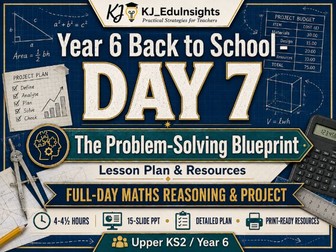
Turn mathematical reasoning into a real-world design challenge with this complete Day 7 Year 6 teaching pack.
The Problem-Solving Blueprint combines independent diagnostic assessment, maths confidence profiling, productive struggle, structured problem-solving and a substantial team project in which pupils must design a complete Year 6 Activity Day within fixed time and budget constraints.
Rather than focusing only on whether pupils can reach an answer, Day 7 explores how they respond when mathematics becomes difficult.
Pupils learn a repeatable six-stage Problem-Solving Engine:
READ → REPRESENT → CHOOSE → TRY → CHECK → EXPLAIN
They then apply this process to a genuine constrained planning challenge where calculations, budgeting, timetabling, decision-making and mathematical explanation all matter.
Designed for approximately 4–4½ hours of structured learning, this resource can be used for a substantial part of the school day. A shorter core route is also included where timetable constraints require it.
What is included?
15-slide Day 7 teaching presentation
Detailed editable teacher lesson plan, including:
full-day teaching sequence and timings
preparation and printing guidance
Maths Baseline Part B administration guidance
confidence-profile teaching
productive struggle modelling
Problem-Solving Engine guidance
step-by-step Activity Day project instructions
complete worked teacher model
Parameter Update solutions
mathematical communication guidance
assessment opportunities
SEND, EAL and higher-attainer adaptations
shorter-day teaching route
31-page editable print-ready resource pack, including:
Maths Confidence Profile
Evidence for My Profile reflection
Struggle vs Stagnation diagnostic
Productive Struggle behaviour cards
Struggle Analysis and Repair Record
Problem-Solving Engine reference
Problem-Solving Engine rehearsal
complete Master Plan mission brief
engineering team role cards
Initial Project Parameters
Activity Package Options
Catering Options
calculation records
Master Budget Calculator
Activity Day Timetable
Master Plan Approval Summary
Assumptions and Rejected Options record
Parameter Update cards
Parameter Update Adaptation Record
Mathematical Communication planner
Architect’s Review questions
Audience Audit and Peer Review
Launch Portfolio Entry 7
teacher answers
observation checklist and evidence summary
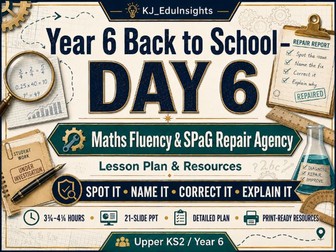
Start Week 2 with a purposeful day that combines mathematical fluency assessment with explicit SPaG teaching, editing and independent application.
Maths Fluency and SPaG Repair Agency is designed to help teachers identify early learning needs while pupils learn a clear process for diagnosing and repairing errors:
SPOT IT → NAME IT → CORRECT IT → EXPLAIN IT
Rather than completing pages of disconnected grammar questions, pupils work as linguistic repair specialists. They investigate damaged texts, classify faults precisely, rotate through six specialist repair stations and finally apply everything independently in a complete Workshop Reactivation Field Test.
The full sequence provides approximately 3¾–4¼ hours of structured learning, excluding breaks and lunch, with a shorter route included for schools with tighter timetables.
What is included?
21-slide Day 6 teaching presentation
detailed teacher lesson plan with timings, preparation guidance, teaching sequence, model answers, differentiation and assessment opportunities
35-page editable print-ready resource pack
Forensic Protocol reference
Active Case File diagnostic text
Partner Verification activity
Master Diagnostic Matrix
Agency Workbench Passport
team role cards
six complete SPaG repair stations
pupil response sheets
purple-pen self-correction record
full teacher answer guidance
Final Field Test
Restoration Draft
repair explanation record
peer verification
Mission Debrief / Launch Portfolio Entry 6
teacher observation and grouping summary.
Part 1 – Maths Diagnostic Part A
The day begins with an independent maths fluency diagnostic designed to establish a genuine starting point.
Pupils work under assessment conditions, showing their working, maintaining an appropriate pace and checking their responses carefully.
The aim is not to rank pupils. It is to identify which mathematical systems are secure and which areas may require further teaching.
The teaching sequence allocates approximately 38–42 minutes to this diagnostic phase.
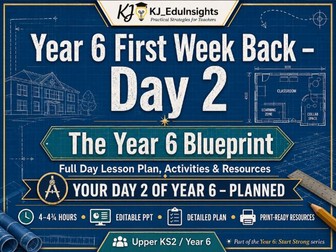
Build the classroom routines, independence and learning behaviours you want to see all year with this complete Day 2 Year 6 induction pack.
The Year 6 Blueprint moves beyond simply telling pupils the classroom rules. Instead, pupils diagnose ineffective behaviours, practise real classroom routines, develop precise help-seeking strategies, strengthen listening and working memory, and help create a meaningful class charter.
Designed for approximately 4–4¾ hours of structured learning, this resource can be used for most of the school day. A shorter core route is also provided if your timetable is more limited.
The lesson follows naturally from Day 1 of the Year 6: Start Strong series, but it can also be used as a standalone first-week-back resource.
What is included?
15-slide editable Year 6 Blueprint presentation
Detailed 16-page teacher lesson plan, including:
suggested timings and lesson structure
preparation and personalisation guidance
step-by-step teaching instructions
model responses
routine rehearsal guidance
assessment opportunities
shorter-day teaching route
guidance for adapting systems to your own classroom
41-page fully editable print-ready resource pack, including:
Logistics Troubleshooting scenario cards
Response classification activities
Culture Troubleshooting scenarios
Diagnostic Flow sheets
Readiness Sort mat and cards
Readiness Justification Record
Performance Dashboard
Routine Training Camp records
Boot Sequence scorecard
Logistics Pathway scorecard
Productive Struggle resources
Shutdown Sequence scorecard
Instruction Vault memory challenges
Paired and team listening tasks
Class Charter pillar cards
Charter drafting sheets
Master Class Charter
Launch Portfolio Entry 2
Teacher observation and tracking tools
Four substantial learning blocks
1. Readiness Diagnosis
Pupils investigate realistic classroom situations such as missing equipment, finishing early, losing track of an instruction or making a mistake.
Rather than simply being told the correct response, teams classify behaviours as Effective, Partly Effective or Unhelpful, justify their decisions and re-engineer weaker responses.
They then sort behaviours into:
Not Ready • Nearly Ready • Ready
This creates meaningful discussion around what independence actually looks like in Year 6.
2. Routine Training Camp
Pupils actively rehearse four essential classroom systems rather than simply listening to the teacher explain them.
Teams work through:
the Boot Sequence
the Logistics Pathway
the Problem-Solving Algorithm
the Shutdown Sequence
Each routine is rehearsed and evaluated for precision, efficiency and independence, giving pupils the opportunity to improve between attempts.


 Quick View