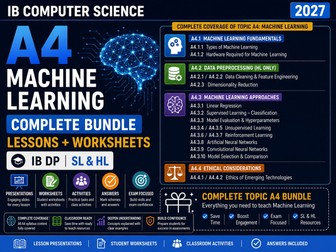
IB Computer Science 2027 – A4 Machine Learning – Complete Lesson & Worksheet BundleQuick View
fatihunal

IB Computer Science 2027 – A4 Machine Learning – Complete Lesson & Worksheet Bundle

13 Resources
IB DP Computer Science Topic A4 Machine Learning complete lesson and worksheet bundle for the new 2027 syllabus. A comprehensive collection of classroom-ready resources covering machine learning fundamentals, data preprocessing, machine learning approaches and ethical considerations. IB Computer Science 2027 – A4 Machine Learning A complete teaching bundle for IB Diploma Programme Computer Science, aligned with the new IB Computer Science syllabus for first assessment in May 2027. This bundle brings together the full set of Topic A4 Machine Learning lesson resources, providing a structured collection of presentations, worksheets, activities and answers. What is included Lesson presentations Student worksheets Classroom activities Student tasks Questions to check understanding Mark schemes / answers Syllabus coverage A4.1 Machine Learning Fundamentals A4.1.1 Types of Machine Learning A4.1.2 Hardware Required for Machine Learning A4.2 Data Preprocessing – HL only A4.2.1 / A4.2.2 Data Cleaning & Feature Engineering A4.2.3 Dimensionality Reduction A4.3 Machine Learning Approaches A4.3.1 Linear Regression A4.3.2 Supervised Learning – Classification A4.3.3 Model Evaluation & Hyperparameters A4.3.4 / A4.3.5 Unsupervised Learning A4.3.6 / A4.3.7 Reinforcement Learning A4.3.8 Artificial Neural Networks A4.3.9 Convolutional Neural Networks A4.3.10 Model Selection & Comparison A4.4 Ethical Considerations A4.4.1 / A4.4.2 Ethics of Emerging Technologies Suitable for IB Diploma Programme Computer Science SL and HL New 2027 syllabus First assessment May 2027 Secondary students aged 16–18 This bundle provides a complete set of teaching resources for Topic A4 and can be used as the foundation of an entire Machine Learning unit. Please note: These are original teaching resources and are not affiliated with or endorsed by the International Baccalaureate Organisation.
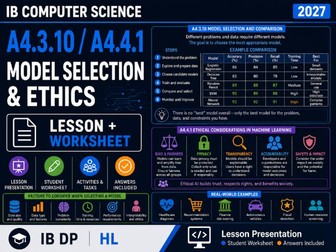
IB Computer Science 2027 – A4.3.10/A4.4.1 Model Selection & Ethics – Lesson & WorksheetQuick View
fatihunal

IB Computer Science 2027 – A4.3.10/A4.4.1 Model Selection & Ethics – Lesson & Worksheet

(0)
IB DP Computer Science A4.3.10/A4.4.1 Model Selection & Ethics lesson and worksheet for the new 2027 syllabus. A classroom-ready resource covering machine learning model selection, comparison and ethical considerations. IB Computer Science 2027 – A4.3.10/A4.4.1 Model Selection & Ethics A classroom-ready lesson resource for IB Diploma Programme Computer Science, aligned with the new IB Computer Science syllabus for first assessment in May 2027. What is included Lesson presentation Student worksheet Classroom activities Student tasks Questions to check understanding Mark scheme / answers Syllabus coverage A4.3 Machine Learning Approaches A4.3.10 Model Selection and Comparison Students explore why different machine learning models may be more suitable for different datasets and problems. Topics include: Model selection Comparing machine learning models Choosing an appropriate algorithm Data characteristics Problem complexity Model performance Evaluating different approaches The lesson also introduces the ethical considerations that arise when machine learning models are used in real-world situations. Suitable for IB Diploma Programme Computer Science HL New 2027 syllabus First assessment May 2027 Secondary students aged 16–18 The resource can be used as a standalone lesson or incorporated into an existing IB Computer Science scheme of work. Please note: This is an original teaching resource and is not affiliated with or endorsed by the International Baccalaureate Organisation.
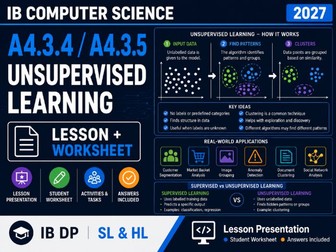
IB Computer Science 2027 – A4.3.4/A4.3.5 Unsupervised Learning – Lesson & WorksheetQuick View
fatihunal

IB Computer Science 2027 – A4.3.4/A4.3.5 Unsupervised Learning – Lesson & Worksheet

(0)
IB DP Computer Science A4.3.4/A4.3.5 Unsupervised Learning lesson and worksheet for the new 2027 syllabus. A classroom-ready resource covering unsupervised learning, clustering and pattern identification. IB Computer Science 2027 – A4.3.4/A4.3.5 Unsupervised Learning A classroom-ready lesson resource for IB Diploma Programme Computer Science, aligned with the new IB Computer Science syllabus for first assessment in May 2027. What is included Lesson presentation Student worksheet Classroom activities Student tasks Questions to check understanding Mark scheme / answers Syllabus coverage A4.3 Machine Learning Approaches A4.3.4 / A4.3.5 Unsupervised Learning Students explore how unsupervised learning identifies patterns and structures within data without using labelled training data. Topics include: Unsupervised learning Unlabelled data Clustering Identifying patterns and groups Similarity between data points Applications of unsupervised learning Comparing supervised and unsupervised learning Real-world machine learning scenarios Students apply their understanding to practical examples and consider when unsupervised learning is appropriate. Suitable for IB Diploma Programme Computer Science SL and HL New 2027 syllabus First assessment May 2027 Secondary students aged 16–18 The resource can be used as a standalone lesson or incorporated into an existing IB Computer Science scheme of work. Please note: This is an original teaching resource and is not affiliated with or endorsed by the International Baccalaureate Organisation.
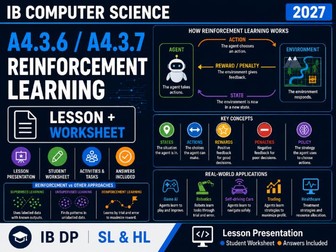
IB Computer Science 2027 – A4.3.6/A4.3.7 Reinforcement Learning – Lesson & WorksheetQuick View
fatihunal

IB Computer Science 2027 – A4.3.6/A4.3.7 Reinforcement Learning – Lesson & Worksheet

(0)
IB DP Computer Science A4.3.6/A4.3.7 Reinforcement Learning lesson and worksheet for the new 2027 syllabus. A classroom-ready resource covering agents, environments, rewards and learning through interaction. IB Computer Science 2027 – A4.3.6/A4.3.7 Reinforcement Learning A classroom-ready lesson resource for IB Diploma Programme Computer Science, aligned with the new IB Computer Science syllabus for first assessment in May 2027. What is included Lesson presentation Student worksheet Classroom activities Student tasks Questions to check understanding Mark scheme / answers Syllabus coverage A4.3 Machine Learning Approaches A4.3.6 / A4.3.7 Reinforcement Learning Students explore how reinforcement learning allows an agent to learn through interaction with an environment and feedback from rewards or penalties. Topics include: Reinforcement learning Agents and environments States and actions Rewards and penalties Learning through interaction Exploration and exploitation Policies Real-world applications of reinforcement learning Students apply their understanding to reinforcement learning scenarios and consider how an agent can improve its behaviour through experience. Suitable for IB Diploma Programme Computer Science SL and HL New 2027 syllabus First assessment May 2027 Secondary students aged 16–18 The resource can be used as a standalone lesson or incorporated into an existing IB Computer Science scheme of work. Please note: This is an original teaching resource and is not affiliated with or endorsed by the International Baccalaureate Organisation.
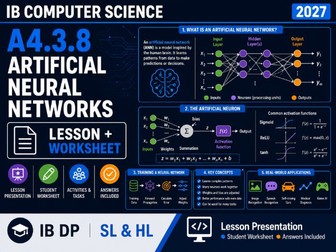
IB Computer Science 2027 – A4.3.8 Artificial Neural Networks – Lesson & WorksheetQuick View
fatihunal

IB Computer Science 2027 – A4.3.8 Artificial Neural Networks – Lesson & Worksheet

(0)
IB DP Computer Science A4.3.8 Artificial Neural Networks lesson and worksheet for the new 2027 syllabus. A classroom-ready resource introducing neural networks, neurons, layers and how artificial neural networks process data. IB Computer Science 2027 – A4.3.8 Artificial Neural Networks A classroom-ready lesson resource for IB Diploma Programme Computer Science, aligned with the new IB Computer Science syllabus for first assessment in May 2027. What is included Lesson presentation Student worksheet Classroom activities Student tasks Questions to check understanding Mark scheme / answers Syllabus coverage A4.3 Machine Learning Approaches A4.3.8 Artificial Neural Networks Students explore the structure and operation of artificial neural networks and how they can be used for machine learning tasks. Topics include: Artificial neural networks Artificial neurons Inputs and weights Bias Activation functions Input, hidden and output layers Forward propagation Training neural networks Applications of neural networks Suitable for IB Diploma Programme Computer Science SL and HL New 2027 syllabus First assessment May 2027 Secondary students aged 16–18 The resource can be used as a standalone lesson or incorporated into an existing IB Computer Science scheme of work. Please note: This is an original teaching resource and is not affiliated with or endorsed by the International Baccalaureate Organisation.
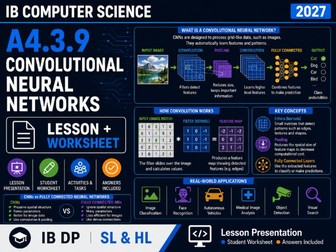
IB Computer Science 2027 – A4.3.9 Convolutional Neural Networks – Lesson & WorksheetQuick View
fatihunal

IB Computer Science 2027 – A4.3.9 Convolutional Neural Networks – Lesson & Worksheet

(0)
IB DP Computer Science A4.3.9 Convolutional Neural Networks lesson and worksheet for the new 2027 syllabus. A classroom-ready resource introducing CNNs, convolution, filters and image recognition. IB Computer Science 2027 – A4.3.9 Convolutional Neural Networks A classroom-ready lesson resource for IB Diploma Programme Computer Science, aligned with the new IB Computer Science syllabus for first assessment in May 2027. What is included Lesson presentation Student worksheet Classroom activities Student tasks Questions to check understanding Mark scheme / answers Syllabus coverage A4.3 Machine Learning Approaches A4.3.9 Convolutional Neural Networks Students explore how convolutional neural networks process visual data and identify patterns in images. Topics include: Convolutional neural networks Convolution Filters and kernels Feature detection Convolutional layers Pooling Image classification Applications of CNNs Suitable for IB Diploma Programme Computer Science SL and HL New 2027 syllabus First assessment May 2027 Secondary students aged 16–18 The resource can be used as a standalone lesson or incorporated into an existing IB Computer Science scheme of work. Please note: This is an original teaching resource and is not affiliated with or endorsed by the International Baccalaureate Organisation.
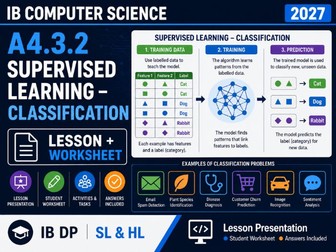
IB Computer Science 2027 – A4.3.2 Supervised Learning – Classification – Lesson & WorksheetQuick View
fatihunal

IB Computer Science 2027 – A4.3.2 Supervised Learning – Classification – Lesson & Worksheet

(0)
IB DP Computer Science A4.3.2 Supervised Learning – Classification lesson and worksheet for the new 2027 syllabus. A classroom-ready resource covering classification, labelled data and supervised machine learning. IB Computer Science 2027 – A4.3.2 Supervised Learning – Classification A classroom-ready lesson resource for IB Diploma Programme Computer Science, aligned with the new IB Computer Science syllabus for first assessment in May 2027. What is included Lesson presentation Student worksheet Classroom activities Student tasks Questions to check understanding Mark scheme / answers Syllabus coverage A4.3 Machine Learning Approaches A4.3.2 Supervised Learning – Classification Students explore how supervised learning can be used to classify data into categories using labelled training data. Topics include: Supervised learning Training data Labels and features Classification Classification categories Training and prediction Real-world applications of classification Examples of classification problems Students apply their understanding to classification scenarios and consider how labelled data is used to train machine learning models. Suitable for IB Diploma Programme Computer Science SL and HL New 2027 syllabus First assessment May 2027 Secondary students aged 16–18 The resource can be used as a standalone lesson or incorporated into an existing IB Computer Science scheme of work. Please note: This is an original teaching resource and is not affiliated with or endorsed by the International Baccalaureate Organisation.
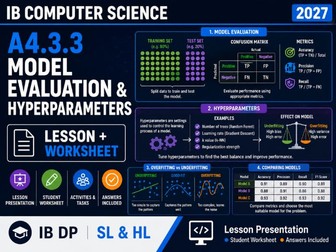
IB Computer Science 2027 – A4.3.3 Model Evaluation & Hyperparameters – Lesson & WorksheetQuick View
fatihunal

IB Computer Science 2027 – A4.3.3 Model Evaluation & Hyperparameters – Lesson & Worksheet

(0)
IB DP Computer Science A4.3.3 Model Evaluation & Hyperparameters lesson and worksheet for the new 2027 syllabus. A classroom-ready resource covering how machine learning models are evaluated and how hyperparameters affect model performance. IB Computer Science 2027 – A4.3.3 Model Evaluation & Hyperparameters A classroom-ready lesson resource for IB Diploma Programme Computer Science, aligned with the new IB Computer Science syllabus for first assessment in May 2027. What is included Lesson presentation Student worksheet Classroom activities Student tasks Questions to check understanding Mark scheme / answers Syllabus coverage A4.3 Machine Learning Approaches A4.3.3 Model Evaluation & Hyperparameters Students explore how machine learning models are evaluated and how hyperparameters can be adjusted to improve model performance. Topics include: Model evaluation Training and testing Accuracy Model performance Overfitting and underfitting Hyperparameters The effect of hyperparameter choices on a model Comparing machine learning models Students apply their understanding to machine learning scenarios and evaluate the effectiveness of different models. Suitable for IB Diploma Programme Computer Science SL and HL New 2027 syllabus First assessment May 2027 Secondary students aged 16–18 The resource can be used as a standalone lesson or incorporated into an existing IB Computer Science scheme of work. Please note: This is an original teaching resource and is not affiliated with or endorsed by the International Baccalaureate Organisation.
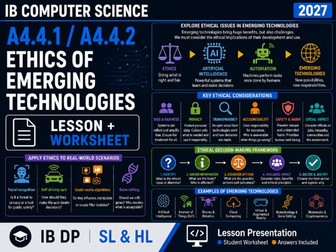
IB Computer Science 2027 – A4.4.1/A4.4.2 Ethics of Emerging Technologies – Lesson & WorksheetQuick View
fatihunal

IB Computer Science 2027 – A4.4.1/A4.4.2 Ethics of Emerging Technologies – Lesson & Worksheet

(0)
IB DP Computer Science A4.4.1/A4.4.2 Ethics of Emerging Technologies lesson and worksheet for the new 2027 syllabus. A classroom-ready resource exploring ethical issues arising from emerging technologies. IB Computer Science 2027 – A4.4.1/A4.4.2 Ethics of Emerging Technologies A classroom-ready lesson resource for IB Diploma Programme Computer Science, aligned with the new IB Computer Science syllabus for first assessment in May 2027. What is included Lesson presentation Student worksheet Classroom activities Student tasks Questions to check understanding Mark scheme / answers Syllabus coverage A4.4 Ethical Considerations A4.4.1 / A4.4.2 Ethics of Emerging Technologies Students explore ethical issues associated with the development and use of emerging technologies. Topics include: Ethical considerations in technology Bias and fairness Privacy Transparency Accountability Safety and potential harm Social impact Responsible development and use of technology Ethical decision-making Students apply ethical principles to real-world technology scenarios and evaluate different perspectives. Suitable for IB Diploma Programme Computer Science SL and HL New 2027 syllabus First assessment May 2027 Secondary students aged 16–18 The resource can be used as a standalone lesson or incorporated into an existing IB Computer Science scheme of work. Please note: This is an original teaching resource and is not affiliated with or endorsed by the International Baccalaureate Organisation.
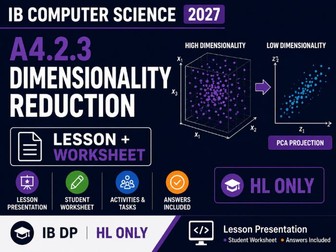
IB Computer Science 2027 – A4.2.3 Dimensionality Reduction – Lesson & WorksheetQuick View
fatihunal

IB Computer Science 2027 – A4.2.3 Dimensionality Reduction – Lesson & Worksheet

(0)
IB DP Computer Science A4.2.3 Dimensionality Reduction lesson and worksheet for the new 2027 syllabus. A classroom-ready HL resource introducing dimensionality reduction and its role in machine learning. IB Computer Science 2027 – A4.2.3 Dimensionality Reduction A classroom-ready lesson resource for IB Diploma Programme Computer Science, aligned with the new IB Computer Science syllabus for first assessment in May 2027. What is included Lesson presentation Student worksheet Classroom activities Student tasks Questions to check understanding Mark scheme / answers Syllabus coverage A4.2 Data Preprocessing – HL only A4.2.3 Dimensionality Reduction Students explore how dimensionality reduction can simplify datasets while retaining important information for machine learning. Topics include: High-dimensional datasets Features and dimensions The problems caused by excessive numbers of features Reducing the number of features Benefits of dimensionality reduction Principal Component Analysis (PCA) Applications of dimensionality reduction in machine learning Students apply their understanding to machine learning scenarios and consider how reducing the number of dimensions can improve efficiency and model performance. Suitable for IB Diploma Programme Computer Science HL only New 2027 syllabus First assessment May 2027 Secondary students aged 16–18 The resource can be used as a standalone lesson or incorporated into an existing IB Computer Science HL scheme of work. Please note: This is an original teaching resource and is not affiliated with or endorsed by the International Baccalaureate Organisation.
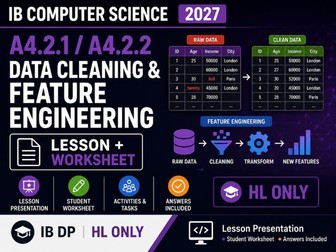
IB Computer Science 2027 – A4.2.1/A4.2.2 Data Cleaning & Feature Engineering – Lesson & WorksheetQuick View
fatihunal

IB Computer Science 2027 – A4.2.1/A4.2.2 Data Cleaning & Feature Engineering – Lesson & Worksheet

(0)
IB DP Computer Science A4.2.1/A4.2.2 Data Cleaning and Feature Engineering lesson and worksheet for the new 2027 syllabus. A classroom-ready HL resource covering data preparation for machine learning. IB Computer Science 2027 – A4.2.1/A4.2.2 Data Cleaning & Feature Engineering A classroom-ready lesson resource for IB Diploma Programme Computer Science, aligned with the new IB Computer Science syllabus for first assessment in May 2027. What is included Lesson presentation Student worksheet Classroom activities Student tasks Questions to check understanding Mark scheme / answers Syllabus coverage A4.2 Data Preprocessing – HL only A4.2.1 / A4.2.2 Data Cleaning and Feature Engineering Students explore how raw data can be prepared and transformed before being used to train machine learning models. Topics include: Data cleaning Missing data Incorrect or inconsistent data Data quality Removing or correcting problematic data Feature engineering Selecting and transforming useful features Preparing data for machine learning Students apply these concepts to practical data-preprocessing scenarios. Suitable for IB Diploma Programme Computer Science HL only New 2027 syllabus First assessment May 2027 Secondary students aged 16–18 The resource can be used as a standalone lesson or incorporated into an existing IB Computer Science HL scheme of work. Please note: This is an original teaching resource and is not affiliated with or endorsed by the International Baccalaureate Organisation.

IB Computer Science 2027 – A4.1.2 Machine Learning Hardware – Lesson & WorksheetQuick View
fatihunal

IB Computer Science 2027 – A4.1.2 Machine Learning Hardware – Lesson & Worksheet

(0)
IB DP Computer Science A4.1.2 Machine Learning Hardware lesson and worksheet for the new 2027 syllabus. A classroom-ready resource covering the hardware requirements of machine learning systems. IB Computer Science 2027 – A4.1.2 Machine Learning Hardware A classroom-ready lesson resource for IB Diploma Programme Computer Science, aligned with the new IB Computer Science syllabus for first assessment in May 2027. What is included Lesson presentation Student worksheet Classroom activities Student tasks Questions to check understanding Mark scheme / answers Syllabus coverage A4.1 Machine Learning Fundamentals A4.1.2 Hardware Required for Machine Learning Students explore the hardware used to support machine learning, including: CPUs GPUs Memory Storage Specialised machine learning hardware The role of hardware in machine learning performance Choosing appropriate hardware for different machine learning tasks Suitable for IB Diploma Programme Computer Science SL and HL New 2027 syllabus First assessment May 2027 Secondary students aged 16–18 The resource can be used as a standalone lesson or incorporated into an existing IB Computer Science scheme of work. Please note: This is an original teaching resource and is not affiliated with or endorsed by the International Baccalaureate Organisation.
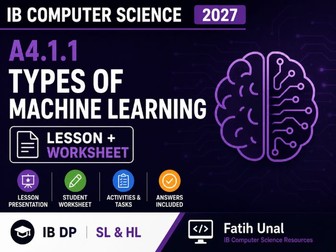
IB Computer Science 2027 – A4.1.1 Types of Machine Learning – Lesson & WorksheetQuick View
fatihunal

IB Computer Science 2027 – A4.1.1 Types of Machine Learning – Lesson & Worksheet

(0)
IB DP Computer Science A4.1.1 Types of Machine Learning lesson and worksheet for the new 2027 syllabus. A classroom-ready resource introducing the main types of machine learning and their applications. IB Computer Science 2027 – A4.1.1 Types of Machine Learning A classroom-ready lesson resource for IB Diploma Programme Computer Science, aligned with the new IB Computer Science syllabus for first assessment in May 2027. What is included Lesson presentation Student worksheet Classroom activities Student tasks Questions to check understanding Mark scheme / answers Syllabus coverage A4.1 Machine Learning Fundamentals A4.1.1 Types of Machine Learning Students explore the main types of machine learning, including: Supervised learning Unsupervised learning Reinforcement learning Key characteristics of each approach Real-world applications Comparing different machine learning approaches Suitable for IB Diploma Programme Computer Science SL and HL New 2027 syllabus First assessment May 2027 Secondary students aged 16–18 The resource can be used as a standalone lesson or incorporated into an existing IB Computer Science scheme of work. Please note: This is an original teaching resource and is not affiliated with or endorsed by the International Baccalaureate Organisation.
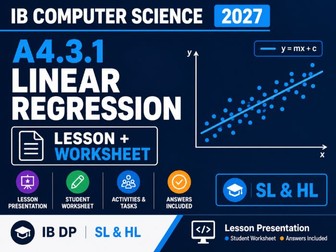
IB Computer Science 2027 – A4.3.1 Linear Regression – Lesson & WorksheetQuick View
fatihunal

IB Computer Science 2027 – A4.3.1 Linear Regression – Lesson & Worksheet

(0)
IB DP Computer Science A4.3.1 Linear Regression lesson and worksheet for the new 2027 syllabus. A classroom-ready resource introducing linear regression, relationships between variables and predictions using machine learning. IB Computer Science 2027 – A4.3.1 Linear Regression A classroom-ready lesson resource for IB Diploma Programme Computer Science, aligned with the new IB Computer Science syllabus for first assessment in May 2027. What is included Lesson presentation Student worksheet Classroom activities Student tasks Questions to check understanding Mark scheme / answers Syllabus coverage A4.3 Machine Learning Approaches A4.3.1 Linear Regression Students explore how linear regression can be used to identify relationships between variables and make predictions. Topics include: Linear relationships Independent and dependent variables Scatter plots Line of best fit Linear regression Making predictions Interpreting regression models Real-world applications of linear regression Students apply their understanding to data and prediction scenarios. Suitable for IB Diploma Programme Computer Science SL and HL New 2027 syllabus First assessment May 2027 Secondary students aged 16–18 The resource can be used as a standalone lesson or incorporated into an existing IB Computer Science scheme of work. Please note: This is an original teaching resource and is not affiliated with or endorsed by the International Baccalaureate Organisation.
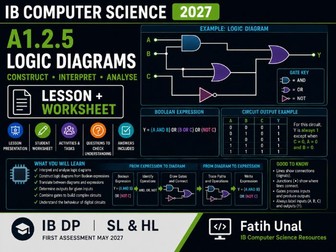
IB Computer Science 2027 – A1.2.5 Logic Diagrams – Lesson & WorksheetQuick View
fatihunal

IB Computer Science 2027 – A1.2.5 Logic Diagrams – Lesson & Worksheet

(0)
IB DP Computer Science A1.2.5 Logic Diagrams lesson and worksheet for the new 2027 syllabus. A classroom-ready resource covering the construction, interpretation and analysis of logic diagrams and digital circuits. IB Computer Science 2027 – A1.2.5 Logic Diagrams A classroom-ready lesson resource for IB Diploma Programme Computer Science, aligned with the new IB Computer Science syllabus for first assessment in May 2027. This resource covers A1.2.5 Logic Diagrams and includes a structured lesson presentation, student worksheet and supporting activities. What is included Lesson presentation Student worksheet Classroom activities Logic diagram exercises Questions to check understanding Student tasks Answer materials Syllabus coverage A1.2 Data Representation and Computer Logic A1.2.5 Logic Diagrams The lesson develops students’ ability to construct and analyse logic diagrams using standard logic gates and Boolean expressions. Students learn to: Interpret logic diagrams Identify inputs and outputs Trace signals through a logic circuit Construct logic diagrams from Boolean expressions Translate between logic diagrams and Boolean expressions Determine circuit outputs for given inputs Combine multiple logic gates to create more complex circuits Analyse the behaviour of digital logic circuits Suitable for IB Diploma Programme Computer Science SL and HL New 2027 syllabus First assessment May 2027 Secondary students aged 16–18 The resource can be used as a standalone lesson or incorporated into an existing IB Computer Science scheme of work. Please note: This is an original teaching resource and is not affiliated with or endorsed by the International Baccalaureate Organisation.
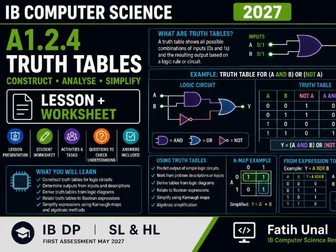
IB Computer Science 2027 – A1.2.4 Truth Tables – Lesson & WorksheetQuick View
fatihunal

IB Computer Science 2027 – A1.2.4 Truth Tables – Lesson & Worksheet

(0)
IB DP Computer Science A1.2.4 Truth Tables lesson and worksheet for the new 2027 syllabus. A classroom-ready resource covering the construction and analysis of truth tables, Boolean expressions and logic circuits. IB Computer Science 2027 – A1.2.4 Truth Tables A classroom-ready lesson resource for IB Diploma Programme Computer Science, aligned with the new IB Computer Science syllabus for first assessment in May 2027. This resource covers A1.2.4 Construct and Analyse Truth Tables and includes a structured lesson presentation, student worksheet and supporting activities. What is included Lesson presentation Student worksheet Classroom activities Questions to check understanding Logic circuit tasks Truth table exercises Answer materials Syllabus coverage A1.2 Data Representation and Computer Logic A1.2.4 Construct and Analyse Truth Tables The lesson develops students’ ability to construct and analyse truth tables and apply them to logical problems. Topics include: Constructing truth tables Predicting the output of simple logic circuits Determining outputs from given inputs and problem descriptions Relating truth tables to Boolean expressions Deriving truth tables from logic diagrams Using truth tables to analyse and simplify logical expressions Introduction to Karnaugh maps Algebraic simplification of logical expressions Suitable for IB Diploma Programme Computer Science SL and HL New 2027 syllabus First assessment May 2027 Secondary students aged 16–18 The resource can be used as a standalone lesson or incorporated into an existing IB Computer Science scheme of work. Please note: This is an original teaching resource and is not affiliated with or endorsed by the International Baccalaureate Organisation.
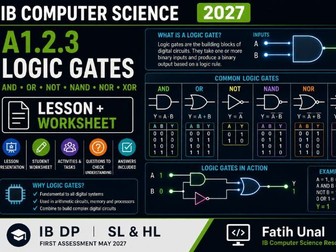
IB Computer Science 2027 – A1.2.3 Logic Gates – Lesson & WorksheetQuick View
fatihunal

IB Computer Science 2027 – A1.2.3 Logic Gates – Lesson & Worksheet

(0)
IB DP Computer Science A1.2.3 Logic Gates lesson and worksheet for the new 2027 syllabus. A classroom-ready resource covering logic gates, their functions, inputs, outputs and applications in digital systems. IB Computer Science 2027 – A1.2.3 Logic Gates A classroom-ready lesson resource for IB Diploma Programme Computer Science, aligned with the new IB Computer Science syllabus for first assessment in May 2027. This resource covers A1.2.3 Logic Gates and includes a structured lesson presentation, student worksheet and supporting activities. What is included Lesson presentation Student worksheet Classroom activities Questions to check understanding Student tasks Answer materials Syllabus coverage A1.2 Data Representation and Computer Logic A1.2.3 Logic Gates The lesson develops students’ understanding of the fundamental logic gates used in digital systems. Topics include: AND gate OR gate NOT gate NAND gate NOR gate XOR gate Inputs and outputs Boolean logic Understanding gate behaviour Applying logic gates to digital systems Students work with logic gate symbols and determine the output produced from different combinations of inputs. Suitable for IB Diploma Programme Computer Science SL and HL New 2027 syllabus First assessment May 2027 Secondary students aged 16–18 The resource can be used as a standalone lesson or incorporated into an existing IB Computer Science scheme of work. Please note: This is an original teaching resource and is not affiliated with or endorsed by the International Baccalaureate Organisation.
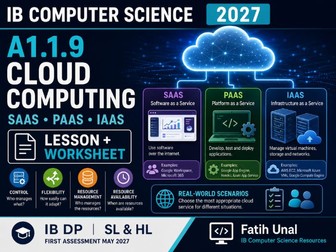
IB Computer Science 2027 – A1.1.9 Cloud Computing – Lesson & WorksheetQuick View
fatihunal

IB Computer Science 2027 – A1.1.9 Cloud Computing – Lesson & Worksheet

(0)
IB DP Computer Science A1.1.9 Cloud Computing lesson and worksheet for the new 2027 syllabus. A classroom-ready resource covering SaaS, PaaS, IaaS, control, flexibility and real-world scenarios. IB Computer Science 2027 – A1.1.9 Cloud Computing A classroom-ready lesson resource for IB Diploma Programme Computer Science, aligned with the new IB Computer Science syllabus for first assessment in May 2027. This resource covers A1.1.9 Different Types of Services in Cloud Computing and includes a structured lesson presentation, student worksheet and supporting activities. What is included Lesson presentation Student worksheet Classroom activities Questions to check understanding Real-world scenario tasks Student activities Answer materials Syllabus coverage A1.1 Computer Hardware and Operation A1.1.9 Different Types of Services in Cloud Computing The lesson develops students’ understanding of the three main cloud service models: Software as a Service (SaaS) Platform as a Service (PaaS) Infrastructure as a Service (IaaS) Students compare the different service models and consider how control, flexibility, resource management and resource availability vary between SaaS, PaaS and IaaS. The lesson also applies these concepts to real-world scenarios, helping students identify the most appropriate cloud service model for different situations. Suitable for IB Diploma Programme Computer Science SL and HL New 2027 syllabus First assessment May 2027 Secondary students aged 16–18 The resource can be used as a standalone lesson or incorporated into an existing IB Computer Science scheme of work. Please note: This is an original teaching resource and is not affiliated with or endorsed by the International Baccalaureate Organisation.
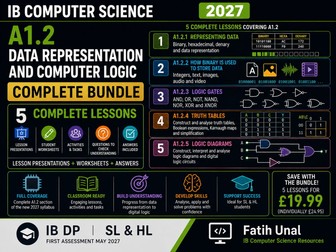
IB Computer Science 2027 – A1.2 Data Representation and Computer Logic – Complete BundleQuick View
fatihunal

IB Computer Science 2027 – A1.2 Data Representation and Computer Logic – Complete Bundle

5 Resources
IB DP Computer Science A1.2 Complete Bundle for the new 2027 syllabus. Includes all five A1.2 lessons with lesson presentations, student worksheets, activities, questions and answers. IB Computer Science 2027 – A1.2 Data Representation and Computer Logic A complete classroom-ready resource bundle for IB Diploma Programme Computer Science, aligned with the new IB Computer Science syllabus for first assessment in May 2027. This bundle covers the complete A1.2 Data Representation and Computer Logic section. What is included Five complete lessons: A1.2.1 Representing Data A1.2.2 How Binary Is Used to Store Data A1.2.3 Logic Gates A1.2.4 Truth Tables A1.2.5 Logic Diagrams Each lesson includes: Lesson presentation Student worksheet Classroom activities Student tasks Questions to check understanding Answer materials Syllabus coverage A1.2 Data Representation and Computer Logic The bundle provides a complete teaching sequence covering data representation, binary data, digital logic, truth tables and logic diagrams. Students develop their understanding of: Representing data using binary and hexadecimal How binary is used to store different types of data AND, OR, NOT, NAND, NOR, XOR and XNOR logic gates Constructing and analysing truth tables Constructing and interpreting logic diagrams Translating between Boolean expressions, truth tables and logic diagrams Analysing digital logic circuits Suitable for IB Diploma Programme Computer Science SL and HL New 2027 syllabus First assessment May 2027 Secondary students aged 16–18 This bundle can be used as a complete teaching sequence for A1.2 or alongside an existing IB Computer Science scheme of work. Why buy the bundle? The five individual lessons are also available separately. This bundle provides the complete A1.2 section at a discounted price. Please note: This is an original teaching resource and is not affiliated with or endorsed by the International Baccalaureate Organisation.
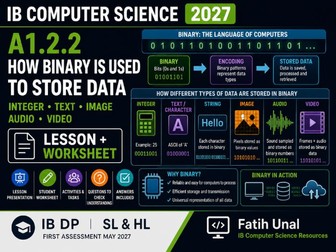
IB Computer Science 2027 – A1.2.2 How Binary Is Used to Store Data – Lesson & WorksheetQuick View
fatihunal

IB Computer Science 2027 – A1.2.2 How Binary Is Used to Store Data – Lesson & Worksheet

(0)
IB DP Computer Science A1.2.2 How Binary Is Used to Store Data lesson and worksheet for the new 2027 syllabus. A classroom-ready resource covering binary encoding and how different types of data are stored using binary. IB Computer Science 2027 – A1.2.2 How Binary Is Used to Store Data A classroom-ready lesson resource for IB Diploma Programme Computer Science, aligned with the new IB Computer Science syllabus for first assessment in May 2027. This resource covers A1.2.2 How Binary Is Used to Store Data and includes a structured lesson presentation, student worksheet and supporting activities. What is included Lesson presentation Student worksheet Classroom activities Questions to check understanding Student tasks Answer materials Syllabus coverage A1.2 Data Representation and Computer Logic A1.2.2 How Binary Is Used to Store Data The lesson develops students’ understanding of how binary encoding allows computers to store and retrieve different types of data. Topics include: Fundamentals of binary encoding The role of bits and binary patterns How integers are stored in binary How characters and strings are encoded How images are represented using binary data How audio is stored using binary data How video is stored using binary data The impact of binary encoding on data storage and retrieval Suitable for IB Diploma Programme Computer Science SL and HL New 2027 syllabus First assessment May 2027 Secondary students aged 16–18 The resource can be used as a standalone lesson or incorporated into an existing IB Computer Science scheme of work. Please note: This is an original teaching resource and is not affiliated with or endorsed by the International Baccalaureate Organisation.
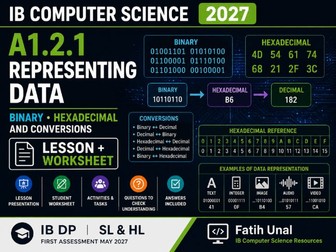
IB Computer Science 2027 – A1.2.1 Representing Data – Lesson & WorksheetQuick View
fatihunal

IB Computer Science 2027 – A1.2.1 Representing Data – Lesson & Worksheet

(0)
IB DP Computer Science A1.2.1 Representing Data lesson and worksheet for the new 2027 syllabus. A classroom-ready resource covering binary, hexadecimal and methods of representing data. IB Computer Science 2027 – A1.2.1 Representing Data A classroom-ready lesson resource for IB Diploma Programme Computer Science, aligned with the new IB Computer Science syllabus for first assessment in May 2027. This resource covers A1.2.1 Representing Data and includes a structured lesson presentation, student worksheet and supporting activities. What is included Lesson presentation Student worksheet Classroom activities Questions to check understanding Student tasks Answer materials Syllabus coverage A1.2 Data Representation and Computer Logic A1.2.1 Representing Data The lesson develops students’ understanding of the principal methods of representing data, including: Binary representation Hexadecimal representation Converting binary integers to decimal Converting decimal integers to binary Converting hexadecimal integers to decimal Converting decimal integers to hexadecimal Converting binary and hexadecimal integers Suitable for IB Diploma Programme Computer Science SL and HL New 2027 syllabus First assessment May 2027 Secondary students aged 16–18 The resource can be used as a standalone lesson or incorporated into an existing IB Computer Science scheme of work. Please note: This is an original teaching resource and is not affiliated with or endorsed by the International Baccalaureate Organisation.