Reflection in a Plane MirrorQuick View
davidjohnba

Reflection in a Plane Mirror

(0)
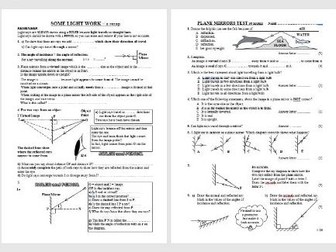
The first Word document has a page of recap questions aimed at reinforcing previous work. It includes light travels in straight lines, the normal, angle of incidence, angle of reflection and the image is virtual, upright, laterally inverted and the same distance behind the mirror as the object is in front. It then concentrates on how to draw an accurate and labelled ray diagram. The recap requires words to be filled in, questions be answered and a ray diagram to be completed by the student. The recap is followed by a test, worth 30 marks, to check on learning and understanding. The second Word document gives the answers to the all the missing words, questions and diagrams, including a mark scheme for the test diagrams.
INDUCED CURRENT in a COIL ANIMATIONQuick View
davidjohnba

INDUCED CURRENT in a COIL ANIMATION

(0)
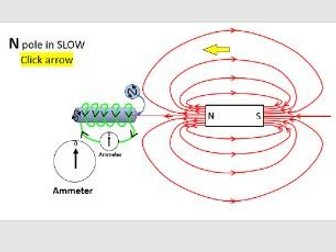
This PowerPoint shows how a current is induced to flow in a coil using a bar magnet. It shows how the magnetic field surrounding the bar magnet cuts the coil. By clicking on an arrow you can make the bar magnet move towards and away from a coil. An ammeter needle shows how the direction and size of the induced current changes as the N pole of the bar magnet is moved towards and away slowly and quickly and also as the S pole of the magnet is moved towards and away slowly and quickly. Importantly, current only flows when the bar magnet is moving. The final slide explains that the induced current always flows in a direction to oppose the change that produced it, which is Lenz’s Law and that work has to be done in order to overcome this opposition and is transformed into electrical energy. If this did not happen it would violate the Principle of Conservation of energy.
Introduction to Forces Work BookQuick View
davidjohnba

Introduction to Forces Work Book

(0)
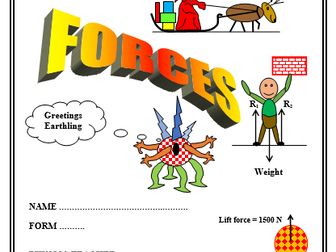
This is a work book is a comprehensive introduction to forces. The first file is the front page if you decide to use this resource as a booklet. The second file has 10 pages that covers resultant (net) force, equilibrium, friction, mass, weight, gravitational fields, calculation of net force and of weight, balanced and unbalanced forces, force diagrams which includes weight, reaction, tension and friction. It also covers the idea that unbalanced forces cause acceleration and balanced forces mean an object is stationary or moving at constant speed. There are plenty of questions to reinforce the concepts and it briefly touches on electrostatic, magnetic and gravitational fields. It does NOT cover F = ma and terminal velocity. The third file has the answers to all the missing words and calculations.
Introduction to FORCESQuick View
davidjohnba

Introduction to FORCES

6 Resources
This is a complete unit of work on the topic of forces. It includes the different types of forces, mass, weight,balanced forces, net force, net force = ma, Newton’s laws, g, force diagrams and terminal velocity. There are plenty of examples of different situations and plenty of questions, all aimed at consolidating understanding and learning. The answers to all questions are also given. There is also a test, with answers and mark scheme to check on understanding,
Current in Series and Parallel Circuits PowerPointQuick View
davidjohnba

Current in Series and Parallel Circuits PowerPoint

(0)
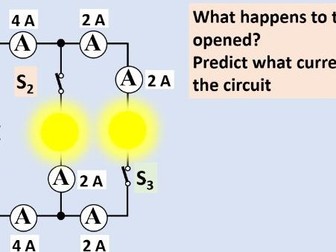
This PowerPoint consists of 9 slides. It begins by reminding students of the symbols used in the the following circuits. It shows how current flows through series and parallel circuits. When a switch is closed it shows that the current is the same in a series circuit and is reduced if the resistance is increased. This is illustrated by showing ammeter readings and bulb brightnesses. It explains that current is not ‘used up’ by a resistance. It shows current splits up in a parallel circuit with most current going through the branch of least resistance. It also shows how switches can operate different parts of a circuit. There is then a series of questions to reinforce what has been learned. The last slide is a summary, giving the rules of how current behaves in series and parallel circuits which have been made clear in the previous slides.
VOLTAGE (PD) in SERIES and PARALLEL CIRCUITSQuick View
davidjohnba

VOLTAGE (PD) in SERIES and PARALLEL CIRCUITS

(0)
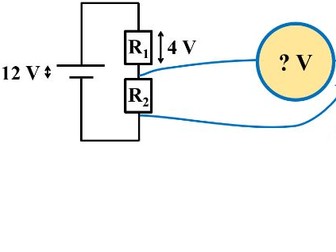
I have over 30 years of experience of teaching physics and I have found that voltage is a topic that many students find very difficult to grasp. I have found that this approach works well and so have now made it into a PowerPoint. The PowerPoint consists of 13 slides. At the beginning it introduces the concept of voltage as the potential difference across two points and looks at the idea that potential difference is not used up by the conducting leads, only by a resistance. It also looks at the potential at different parts of simple circuits and then goes on to look at the potential difference across various points in the circuits. It shows that the potential difference across resistances in series add up to the supply voltage and explains why the bigger potential difference is across the bigger resistance. It also gives a numerical example of this. It shows that the potential difference across resistances in parallel is the same and explains why the bigger current flows through the branch of smaller resistance. It also gives a numerical example of this. It ends with a recap followed by a series of ‘Find the Voltage Questions’ aimed at reinforcing and checking on student learning. I have found that the more examples you do the better. This PowerPoint would be useful as an introduction, as reinforcement and for revision.
Physics KS4, KS5  CIRCULAR  MOTION INTRODUCTIONQuick View
davidjohnba

Physics KS4, KS5 CIRCULAR MOTION INTRODUCTION

(0)
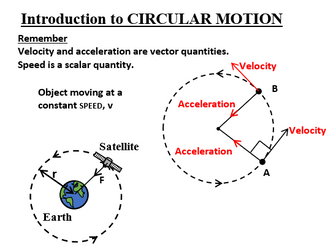
This powerpoint shows an object moving in a circle. Its aim is to explain the difficult concept of how an object moving in a circle at constant speed is accelerating. It explains this in terms of changing velocity and in terms of their being a resultant force. It emphasizes that the object is not in equilibrium and there is no outwards force. It shows how an object flies off along the tangent when the centripetal force ceases.
Physics KS4, KS5   CIRCULAR MOTION Introduction - Student Notes and QuestionsQuick View
davidjohnba

Physics KS4, KS5 CIRCULAR MOTION Introduction - Student Notes and Questions

(0)
The first file has student notes which explain why an object moving in a circle at constant speed is accelerating towards the centre of the circle. It goes step by step through this difficult concept. It refers to Newton’s First Law, centripetal force, centripetal acceleration, the definition of velocity and the definition of acceleration. It explains why the velocity changes yet the speed does not change. It gives examples of circular motion and explains the relationship between centripetal force and the mass, speed and radius of orbit of the object. It also relates the speed to the radius of orbit and the time period. There are words to be completed by the student as the teacher explains each step. The third, and last, page has questions designed to check on the understanding of the previous two pages. There is NO reference to the equation F = mv2/r. The second file has the missing words and answers to the questions.
Physics KS4, KS5 Introduction to  CIRCULAR MOTION notes and powerpointQuick View
davidjohnba

Physics KS4, KS5 Introduction to CIRCULAR MOTION notes and powerpoint

2 Resources
The powerpoint shows an object moving in a circle. Its aim is to explain the difficult concept of how an object moving in a circle at constant speed is accelerating. It explains this in terms of changing velocity and in terms of their being a resultant force. It emphasizes that the object is not in equilibrium and there is no outwards force. It shows how an object flies off along the tangent when the centripetal force ceases. The first file has student notes which explain why an object moving in a circle at constant speed is accelerating towards the centre of the circle. It goes step by step through this difficult concept. It refers to Newton’s First Law, centripetal force, centripetal acceleration, the definition of velocity and the definition of acceleration. It explains why the velocity changes yet the speed does not change. It gives examples of circular motion and explains the relationship between centripetal force and the mass, speed and radius of orbit of the object. It also relates the speed to the radius of orbit and the time period. There are words to be completed by the student as the teacher explains each step. The third, and last, page has questions designed to check on the understanding of the previous two pages. There is NO reference to the equation F = mv2/r. The second file has the missing words and answers to the questions.
ENERGY CHANGES QUIZ - Self MarkingQuick View
davidjohnba

ENERGY CHANGES QUIZ - Self Marking

(0)
This spreadsheet covers stored energy and energy changes. You can see what it looks like in the sceenshot. It marks the student’s answers question by question, giving instant feedback and allowing them to change their answers. It covers chemical, gravitational, elastic, nuclear, electrical, light, sound, kinetic and heat (thermal) energy. There is a total of 40 one word answers. The second file has the answers.
MASS and WEIGHT QUIZ - Self MarkingQuick View
davidjohnba

MASS and WEIGHT QUIZ - Self Marking

(0)
This spreadsheet marks the student’s answers question by question, giving hints if their answer is nearly correct and allowing them to correct their thinking. You can see what it looks like in the screenshot. Section A is a quiz which requires an understanding of mass, weight and their units. It includes an alien from the planet Ytivarg who visits Earth bringing her war hammer from the planet Scisyhp. Section B is only accessible when all the section A answers are correct. It is a table whose values depend on the length of the students name which must be entered on the sheet. Thus different pupils get different values to deal with. These numerical question require a full understanding of mass and weight. It could also be used for fun revision! The second file has the answers (section B is for a person with name “Teacher".
REFRACTION of LIGHT  through a PRISMQuick View
davidjohnba

REFRACTION of LIGHT through a PRISM

(0)
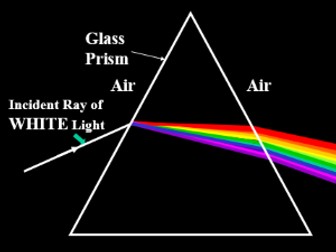
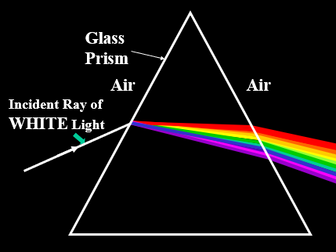
This PowerPoint shows how rays refract, step by step, through a glass prism for monochromatic light and white light. Includes normal, angle of deviation and dispersion.
REFRACTION of LIGHT through GLASS and WATERQuick View
davidjohnba

REFRACTION of LIGHT through GLASS and WATER

(0)
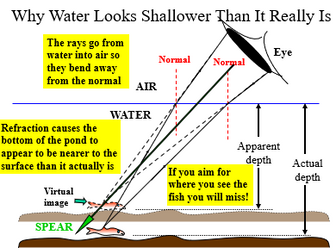
This Powerpoint shows step by step how a ray of light refracts into and out of a parallel sided glass block. Includes normal, angle of incidence and angle of refraction. It also explains step by step why water looks shallower than it really is, including real and apparent depth. (It also shows how spear fishermen will miss a fish if they aim for the image!)
LIGHT Reflection, Refraction and Total internal Reflection PowerpointsQuick View
davidjohnba

LIGHT Reflection, Refraction and Total internal Reflection Powerpoints

4 Resources
6 Powerpoints to show clearly how rays of light are reflected from a plane mirror and refracted through a glass block, water and a prism. They also shows how TIR occurs and explains the critical angle. It shows exactly how a virtual image is formed in a plane mirror and explains lateral inversion. It explains how to draw an accurate ray diagram and image. It shows how a ray of light refracts through a parallel sided glass block and through water. Includes normal, angle of incidence and angle of refraction. It also explains why water looks shallower than it really is. It shows how rays refract through a glass prism for monochromatic light and white light and Includes normal, angle of deviation and dispersion. TIR is shown for rays travelling from glass into air and from water into air. It includes critical angle and critical ray. It shows how TIR is used in an optical fibre and illustrates the need for cladding glass. It also shows how to find the critical angle using a semicircular glass block and gives the two conditions necessary for TIR to occur. It shows how 45 degree prisms can be used to turn a light ray through 90 degrees and through 180 degrees. A non-45 degree prism is used to further reinforce the concept of TIR. Rays are drawn in stages to show all the steps in constructing an accurate ray diagram.
CHRISTMAS QUIZ (92 + 4 bonus questions) ages 14-18Quick View
davidjohnba

CHRISTMAS QUIZ (92 + 4 bonus questions) ages 14-18

(0)
This has Christmas questions which are interesting, informative and fun. Adults can have fun too - you could even use it for a staff quiz! They have a range of difficulty, including some with a diagram or extra information as a hint. For flexibility it comes as a Word document AND as PowerPoint presentations. The Word document XMAS QUIZ has 4 sections. It’s Christmas. 10 questions plus a bonus question linked to the word Christmas. Christmas Anagrams. 10 two-word anagrams. Christmas General Knowledge. 54 questions plus 3 bonus questions. Christmas Dingbats. 18 questions. The quiz can be given to individuals or teams. The Word document XMAS QUIZ ANS has all the answers. The same questions are also in the form of 3 separate PowerPoints. It’s Christmas. 10 questions plus a bonus question linked to the word Christmas. Christmas Anagrams and Christmas Dingbats. 10 two-word anagrams and 18 dingbats Christmas General Knowledge. 54 questions plus 3 bonus questions. The PowerPoints have animations to liven it up and make the answers more memorable. I certainly had fun making all the diagrams! The answers are revealed by clicking on a diagram of Santa on each slide apart from the dingbats where the answers are revealed by clicking on a diagram of a Christmas Cracker. Since the cursor pointer disappears after a few seconds it is recommended that the cursor pointer is set to visible. In case you do not know how to do this I have included instructions in the Word document How to Keep Cursor Pointer Visible in PowerPoint.
REFLECTION of LIGHT in a PLANE MIRRORQuick View
davidjohnba

REFLECTION of LIGHT in a PLANE MIRROR

(0)
This powerpoint shows how rays reflect off a plane mirror. It explains how to draw an accurate ray diagram and image. It includes lateral inversion. Third and last slide shows how Pepper’s Ghost illusion works.
ATOMIC ENERGY LEVELS, SPECTRA, EXCITATION and FLUORESCENT TUBEQuick View
davidjohnba

ATOMIC ENERGY LEVELS, SPECTRA, EXCITATION and FLUORESCENT TUBE

(0)
This powerpoint shows how a de-exciting atom emits photons of different wavelengths. It then relates the energy jumps, in eV, to photon wavelengths, in nm, and therefore to their position in the line emission spectrum. It also shows, in animation, how an atom is ecited by collision and by a photon. Lastly it shows, in animation, how a fluorescent tube works. To aid understanding everything is done in stages so that each step can be explained.
NEWTON'S LAWSQuick View
davidjohnba

NEWTON'S LAWS

(0)
The first file covers Newtons three laws. It includes the definition of the newton, net force = ma and the relationship between net force, mass and acceleration. There are questions to consolidate understanding. It ends with questions on net force = ma and weight which get progressively harder. The second file has the answers to all the missing words and questions.
TOTAL INTERNAL REFLECTIONQuick View
davidjohnba

TOTAL INTERNAL REFLECTION

(0)
The first powerpoint uses rays travelling from glass into air and from water into air to illustrate TIR. Includes critical angle and critical ray. As an example of a use of TIR there is also a slide showing how light totally internally reflects along an optical fibre and illustrates the need for cladding glass. The second powerpoint shows how you can find the critical angle using a semicircular glass block and gives the two conditions necessary for TIR to occur. The third powerpoint is meant to reinforce the concept of TIR. It shows how 45 degree prisms can be used to turn a light ray through 90 degrees and through 180 degrees. A non-45 degree prism is used to further reinforce the concept of TIR. Rays are drawn in stages to show all the steps in constructing an accurate ray diagram.
HOW TO FIND THE HALF-LIFE FROM A GRAPHQuick View
davidjohnba

HOW TO FIND THE HALF-LIFE FROM A GRAPH

(0)
This powerpoint shows how to find the half-life of a radioisotope from a count-rate, corrected for background, versus time graph. It shows the randomness and the effect of not correcting for background. It also shows how to find the half-life from a number of undecayed nuclei versus time graph.
CONVERGING and DIVERGING LENSESQuick View
davidjohnba

CONVERGING and DIVERGING LENSES

(0)
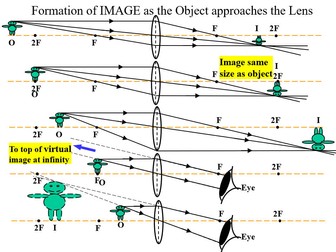
This PowerPoint shows how light rays travel through convex and concave lenses. It also shows the formation of images with the object at different distances from each type of lens. As an illustration of the use of a convex lens it includes showing how the camera and the magnifying glass each form an image. Rays are drawn in stages to show all the steps in constructing an accurate ray diagram.