A Level Biology: Student’s t-test (Statistical Testing & Significance)Quick View
lumleyimerson

A Level Biology: Student’s t-test (Statistical Testing & Significance)

(0)
A Level Biology: Student’s t-test (Statistical Testing & Significance) AQA Spec | Year 1 & 2 | Maths for Biologists Series A complete, ready-to-use lesson covering the Student’s t-test for A Level Biology, guiding students through one of the most important and often challenging statistical tests required for exam success. This lesson provides a clear, step-by-step introduction to the purpose of the Student’s t-test, before walking students through how to carry out the calculation using a structured, click-by-click interactive PowerPoint. Students are then supported in developing deeper understanding by learning how to interpret calculated values, apply degrees of freedom, and determine statistical significance in a biological context. Designed to support both teaching and independent learning, this resource includes structured explanations, worked examples, and opportunities for consolidation and practice. Fully resourced, no-prep lesson Step-by-step modelling of Student’s t-test calculations Supports interpretation of results and significance Includes links to A Level Biology content (Year 1 & 2) and specification mapping Ideal for class teaching, revision, or self-study This is part of a “Maths for Biologists” series, covering the ~10% of exam marks linked to mathematical skills in A Level Biology. Also available in the series: Descriptive statistics & standard deviation Hypothesis testing & significance Student’s t-test (paired & unpaired) Chi-squared Spearman’s rank Simpson’s Index of Diversity Perfect for busy teachers and students aiming for top grades, especially in an area that is often under-resourced and difficult to master.
A Level Biology: Unpaired t-test (Statistical Testing & Significance)Quick View
lumleyimerson

A Level Biology: Unpaired t-test (Statistical Testing & Significance)

(0)
A Level Biology: Unpaired t-test (Statistical Testing & Significance) AQA Spec | Year 1 & 2 | Maths for Biologists Series A complete, ready-to-use lesson covering the unpaired Student’s t-test for A Level Biology, helping students confidently tackle one of the most challenging statistical skills required for exam success. This lesson introduces when and why to use the unpaired t-test, before guiding students through the calculation process step-by-step using a clear, click-by-click interactive PowerPoint. Students then develop deeper understanding by learning how to interpret results, apply degrees of freedom, and determine statistical significance in a biological context. To support mastery, the lesson also includes consolidation and practice, alongside video links to reinforce understanding and support independent learning. Designed for both classroom teaching and self-study, this resource provides clear explanations, worked examples, and opportunities to practise and apply key skills. Fully resourced, no-prep lesson Step-by-step modelling of unpaired t-test calculations Includes consolidation workbook pages and practice tasks Video links to support understanding and revision Supports interpretation of results and significance Ideal for class teaching, revision, or independent learning This is part of a “Maths for Biologists” series, covering the ~10% of exam marks linked to mathematical skills in A Level Biology. Also available in the series: Descriptive statistics & standard deviation Hypothesis testing & significance Student’s t-test (paired & unpaired) Chi-squared Spearman’s rank Simpson’s Index of Diversity Perfect for busy teachers and students aiming for top grades, especially in an area that is often under-resourced and difficult to master.
A Level Biology: Hypothesis testing and significanceQuick View
lumleyimerson

A Level Biology: Hypothesis testing and significance

(0)
A Level Biology: Hypothesis testing and significance AQA Spec | Year 1 & 2 | Maths for Biologists Series A complete, ready-to-use lesson covering Hypothesis testing and significance for A Level Biology, including a full walkthrough of standard deviation—one of the most challenging maths skills for students. This lesson begins by securely revisiting last lesson, before guiding students step-by-step through how to use the scientific method to design experiments and carry out research using a clear, click-by-click interactive PowerPoint. It also develops deeper understanding by teaching students how to define and operationalise variables and write clear hypotheses, fully aligned with the AQA specification. Designed to support both teaching and independent learning, this resource includes structured explanations, worked examples, and opportunities for consolidation and practice. Fully resourced, no-prep lesson Step-by-step modelling Supportsresearch methods skills Ideal for class teaching, revision, or self-study This is Lesson 2 in a “Maths for Biologists” series, covering the ~10% of exam marks linked to mathematical skills in A Level Biology but can also be used to teach A level psychology. Also in the series: L1 - Stabdard Deviation L3 - Student’s t-test (paired & unpaired) L4 - Chi-squared L5 - Spearman’s rank L6 - Simpson’s Index of Diversity Perfect for busy teachers and students aiming for top grades, especially in an area that is often under-resourced and difficult to master.
A Level Biology: Descriptive Statistics (Mean, Median, Mode, Range & Standard Deviation)Quick View
lumleyimerson

A Level Biology: Descriptive Statistics (Mean, Median, Mode, Range & Standard Deviation)

(0)
A Level Biology: Descriptive Statistics (Mean, Median, Mode, Range & Standard Deviation) AQA Spec | Year 1 & 2 | Maths for Biologists Series A complete, ready-to-use lesson covering descriptive statistics for A Level Biology, including a full walkthrough of standard deviation—one of the most challenging maths skills for students. This lesson begins by securely revisiting mean, median, mode, and range, before guiding students step-by-step through how to calculate standard deviation using a clear, click-by-click interactive PowerPoint. It also develops deeper understanding by teaching students how to interpret standard deviation and draw and analyse error bars, fully aligned with the AQA specification. Designed to support both teaching and independent learning, this resource includes structured explanations, worked examples, and opportunities for consolidation and practice. Fully resourced, no-prep lesson Step-by-step modelling of standard deviation calculations Supports interpretation skills (including error bars) Includes links to A Level Biology content (Year 1 & 2) and specification mapping Ideal for class teaching, revision, or self-study This is Lesson 1 in a “Maths for Biologists” series, covering the ~10% of exam marks linked to mathematical skills in A Level Biology. Also in the series - 5 more lessons: Hypothesis testing & significance Student’s t-test (paired & unpaired) Chi-squared Spearman’s rank Simpson’s Index of Diversity Perfect for busy teachers and students aiming for top grades, especially in an area that is often under-resourced and difficult to master.
Remix the LearningQuick View
lumleyimerson

Remix the Learning

(0)
Creativity & Social Skills Lesson | Any Subject | KS2–KS4 A high-energy lesson where students transform learning into raps, songs, adverts, or performances. Designed to build confidence, teamwork, and communication, this session encourages all students to contribute in different ways. Ideal for creating a positive classroom atmosphere while deepening understanding through creative explanation. No specialist resources needed Inclusive and accessible for all learners Perfect for engagement and classroom culture Focus: Social skills & empathy + deep explanation
Make the Game LessonQuick View
lumleyimerson

Make the Game Lesson

(0)
Confidence & Ownership Lesson | Any Subject | KS2–KS4 Turn students into teachers. In this creative lesson, students design a game to help others learn key content—boosting confidence, independence, and deeper understanding. By explaining rules and testing each other’s ideas, students actively monitor and refine their thinking while developing a sense of ownership over their learning. Engaging, student-led learning Works across all subjects Great for collaborative classrooms Focus: Self-esteem + monitoring understanding
Whole School Wellbeing Day – 5 No-Prep Lessons for Any Subject (Primary & Secondary)Quick View
lumleyimerson

Whole School Wellbeing Day – 5 No-Prep Lessons for Any Subject (Primary & Secondary)

(0)
A complete, ready-to-use Wellbeing Day resource for primary and secondary schools, featuring 5 fully resourced lessons that can be delivered in any subject. Perfect for PSHE, tutor time, or a whole-school wellbeing day, this flexible package combines metacognition and social and emotional wellbeing to help students build resilience, confidence, and self-awareness. Each lesson includes a clear, engaging PowerPoint and requires minimal preparation, making it ideal for drop-down days, enrichment days, or off-timetable learning. The activities work in any subject area, allowing schools to run a consistent wellbeing day without disrupting curriculum planning. What’s included: 5 ready-to-teach PowerPoints (one per lesson) Adaptable activities suitable for any subject Clear instructions and structure for each session The 5 lessons: No Pens, Big Brains – Activate prior knowledge without writing Build It to Get It – Develop resilience through problem-solving Make the Game – Build confidence by teaching others Remix the Learning – Strengthen social skills through creativity Glow-Up & Go – Reflect, connect, and end positively Each session can focus on metacognition, wellbeing, or both, making this resource flexible for different school priorities. Perfect for: Whole-school wellbeing days PSHE lessons Tutor time programmes Enrichment or drop-down days A practical, engaging way to support student wellbeing while strengthening how students think about their learning.
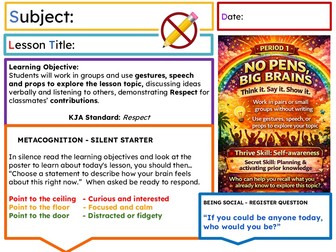
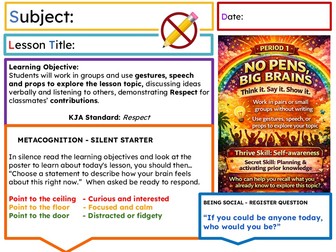
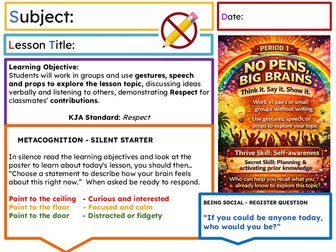
No Pens, Big Brains Lesson 1Quick View
lumleyimerson

No Pens, Big Brains Lesson 1

(0)
Wellbeing & Metacognition Lesson | Any Subject | KS2–KS4 A high-engagement, no-writing lesson designed to help students access prior knowledge without pressure. Perfect for building confidence, especially for reluctant learners, this lesson uses talk, movement, and creative approaches to unlock understanding in any subject. Students explore key concepts through discussion, drama, and visual methods while teachers probe thinking with simple, effective questioning. No prep, ready-to-use PowerPoint Works in any subject (Science, Maths, English, Humanities, MFL) Ideal for wellbeing days, PSHE, or low-stakes retrieval Focus: Self-awareness + activating prior knowledge
Glow-Up & Go LessonQuick View
lumleyimerson

Glow-Up & Go Lesson

(0)
Glow-Up & Go Reflection & Wellbeing Lesson | Any Subject | KS2–KS4 A calm, structured reflection lesson that helps students recognise progress, celebrate effort, and build positive relationships. Through guided prompts and peer feedback, students develop self-awareness, motivation, and a sense of achievement—ending the day on a high. Simple, powerful structure Works in any subject or tutor time Ideal for ending a wellbeing or enrichment day Focus: Reflection, connection, and positive mindset
Build It to Get It LessonQuick View
lumleyimerson

Build It to Get It Lesson

(0)
Resilience & Problem-Solving Lesson | Any Subject | KS2–KS4 A hands-on lesson that develops resilience, adaptability, and problem-solving through practical challenges. Students are tasked with building or representing an idea using simple materials—then adapting when the rules change. This structured struggle helps students learn how to persist, rethink, and improve, making it ideal for both wellbeing and deeper learning. Minimal resources required Fully adaptable across subjects Encourages teamwork and perseverance Focus: Emotional resilience + strategy and adaptability
Whole School Wellbeing Day – 5  Thrive Lessons for Any Subject (Primary & Secondary)Quick View
lumleyimerson

Whole School Wellbeing Day – 5 Thrive Lessons for Any Subject (Primary & Secondary)

(0)
A complete, ready-to-use Wellbeing Day resource for primary and secondary schools, featuring 5 fully resourced lessons that can be delivered in any subject. Perfect for PSHE, tutor time, or a whole-school wellbeing day, this flexible package combines metacognition and social and emotional wellbeing to help students build resilience, confidence, and self-awareness. Each lesson includes a clear, engaging PowerPoint and requires minimal preparation, making it ideal for drop-down days, enrichment days, or off-timetable learning. The activities work in any subject area, allowing schools to run a consistent wellbeing day without disrupting curriculum planning. What’s included: 5 ready-to-teach PowerPoints (one per lesson) Adaptable activities suitable for any subject Clear instructions and structure for each session The 5 lessons: No Pens, Big Brains – Activate prior knowledge without writing Build It to Get It – Develop resilience through problem-solving Make the Game – Build confidence by teaching others Remix the Learning – Strengthen social skills through creativity Glow-Up & Go – Reflect, connect, and end positively Each session can focus on metacognition, wellbeing, or both, making this resource flexible for different school priorities. Perfect for: Whole-school wellbeing days PSHE lessons Tutor time programmes Enrichment or drop-down days A practical, engaging way to support student wellbeing while strengthening how students think about their learning.