All @ellalessons resources are created for printing AND for interactive use
For Teachers, Parents and Tutors
Robot Reboot – A simple and effective activity to support the writing of metaphors and similes
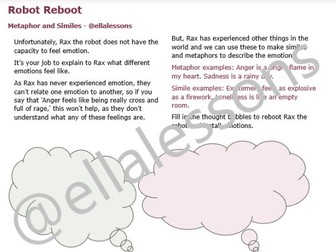
Rax the Robot cannot feel emotions – help Rax out by coming up with metaphors and similes to describe how emotions feel.
Is anger a bright flame in your heart? Is sadness like a rainy day?
This one-page worksheet is perfect for classroom warm-ups, extra practise at home, homeschooling and tuition lessons.
Ideal for upper KS2, lower KS3 or supplementary 11+ practise.
Covers the following skills:
metaphors
similes
creative writing
literary techniques
Year group: UKS2 and lower KS3
Topic: Literary techniques
No. of pages: 1
Always Dyslexia-Friendly!
Sans serif font.
Clear, uniform spacing as far as possible
Any/all images used are copyright-free – sourced from Unsplash
Thanks for downloading!
Made by Ella (@ellalessons) - A full-time tutor and resource creator.
All @ellalessons resources are created for printing AND for interactive use
For Teachers, Parents and Tutors
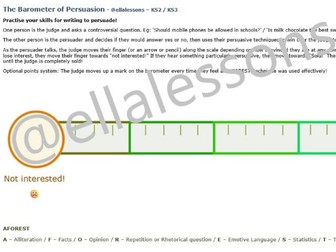
The Barometer of Persuasion - A simple and effective activity for practising persuasive techniques.
This fun English activity is perfect for working on AFOREST and other ‘writing to persuade’ devices.
Follow the simple instructions and play as ‘judge’ and ‘persuader’. The persuader must use their best persuasion to win over the judge!
Optional: Use the arrow cut-out option for some extra interactivity!
Perfect for classroom warm-ups, extra practise at home, homeschooling and tuition lessons.
Ideal for UKS2, lower KS3 or supplementary 11+ practise.
Covers the following skills:
Writing to persuade
AFOREST
Rhetorical devices
Writing a speech
Year group: UKS2 and lower KS3
Topic: Persuasive Writing
No. of pages: 2
Always Dyslexia-Friendly!
Sans serif font.
Clear, uniform spacing as far as possible
Any/all images used are copyright-free – sourced from Unsplash
Thanks for downloading!
Made by Ella (@ellalessons) - A full-time tutor and resource creator.
All @ellalessons resources are created for printing AND for interactive use
For Teachers, Parents and Tutors
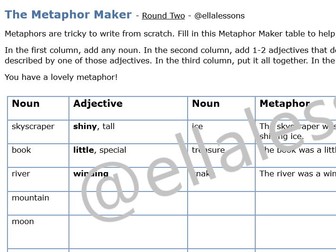
A quick and easy step-by-step way to build a metaphor from scratch.
Perfect for those students who don’t know where to start with metaphors and also for those who need a little inspiration and a starting point to get going.
Follow the simple instructions to fill in the table and the metaphor will come together as if by magic.
Perfect for classroom warm-ups, extra practise at home, tutoring lessons and 11+ work.
This two-page worksheet has two rounds of practise to be used all in one go or over two separate lessons for a recap.
Ideal for UKS2, lower KS3 or supplementary 11+ practise.
Covers the following skills:
literary techniques
metaphors
literary devices
creative writing
Year group: UKS2 and lower KS3
Topic: creative writing
No. of pages: 2
Always Dyslexia-Friendly!
Sans serif font.
Clear, uniform spacing as far as possible
Any/all images used are copyright-free – sourced from Unsplash
Thanks for downloading!
Made by Ella (@ellalessons) - A full-time tutor and resource creator.
All @ellalessons resources are created for printing AND for interactive use
For Teachers, Parents and Tutors
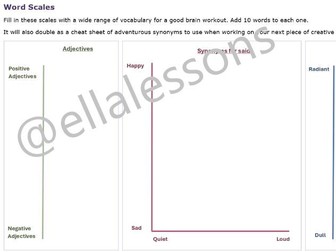
Word Scales – Vocabulary Builder: A simple and effective activity for expanding vocabulary
Fill in the scales and graphs with a variety of words that fit the descriptions.
Can you think of an adverb that feels positive? Can you think of a colour that sounds dull?
Can you think of a synonym for said that is both happy and loud?
Test these skills here!
This two-page worksheet is perfect for classroom warm-ups, extra practise at home, homeschooling and tuition lessons.
Ideal for upper KS2, lower KS3 or supplementary 11+ practise.
Covers the following skills:
synonyms
vocabulary
word classes
powerful verbs
uplevelling vocabulary
Year group: UKS2 and lower KS3
Topic: Vocabulary
No. of pages: 2
Always Dyslexia-Friendly!
Sans serif font.
Clear, uniform spacing as far as possible
Any/all images used are copyright-free – sourced from Unsplash
Thanks for downloading!
All @ellalessons resources are created for printing AND for interactive use
For Teachers, Parents and Tutors
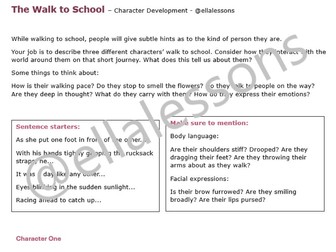
The Walk to School – Work on character development and ‘show, don’t tell’ skills with this straight-forward and quick-start activity
This 2-page worksheet prompts students to describe three different characters on their walk to school. They must consider how the characters interact with the world around them on that short journey and what this tells us about them. Using body language and facial expressions, they can bring these different personalities to life.
Some sentence starters and other suggestions are provided.
Ideal for upper KS2, KS3 or supplementary 11+ practise.
Covers the following skills:
character development
show, don’t tell
body language
facial expressions
creative writing
characterisation
Year group: UKS2 and KS3
Topic: Creative writing
No. of pages: 2
Always Dyslexia-Friendly!
Sans serif font.
Clear, uniform spacing as far as possible
Any/all images used are copyright-free – sourced from Unsplash
Thanks for downloading!
Made by Ella (@ellalessons) - A full-time tutor and resource creator.
All @ellalessons resources are created for printing AND for interactive use
For Teachers, Parents and Tutors
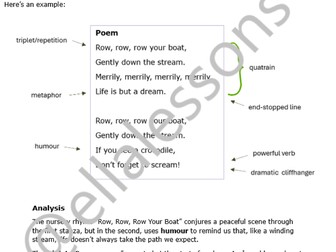
Nursery Rhyme Analysis – Put essay writing skills to the test by analysing even these simple nursery rhymes in depth.
This 3-page worksheet prompts students to pick out and analyse literary devices and structural features, putting together a short essay analysing the nursery rhyme as a whole.
An effective and targeted resource that brings the fun back into essay writing and comprehension.
Great for poetry analysis in particular.
An example analytical essay is provided, plus worksheets for students to try it out themselves.
Ideal for upper KS2, KS3 or supplementary 11+ practise.
Covers the following skills:
metaphors
similes
essay writing
literary techniques
structural features
poetry analysis
Year group: UKS2 and KS3
Topic: Text Analysis
No. of pages: 3
Always Dyslexia-Friendly!
Sans serif font.
Clear, uniform spacing as far as possible
Any/all images used are copyright-free – sourced from Unsplash
Thanks for downloading!
Made by Ella (@ellalessons) - A full-time tutor and resource creator.
All @ellalessons resources are created for printing AND for interactive use
For Teachers and Tutors
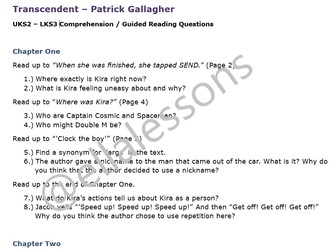
An extensive set of Reading Comprehension Questions to use alongside the entire story of ‘Transcendent’ by Patrick Gallagher!
Perfect for 11+ practise and prep.
Perfect for a readalong/guided reading
Book synopsis: “JOIN THE TEAM. SAVE THE WORLD. Twin geniuses Jacob and Kira are recruited to take part in a high-tech mission to protect the planet … but will their dreams of adventure come true, or is the threat too great to handle? Twin geniuses, Jacob and Kira, have their lives in Uganda turned upside down when they discover someone has been watching their every move in the hopes to enlist them in a top-secret agency called Transcendent. Only, the twins soon realise they have more to contend with than they bargained for … is there a more sinister reason they have been chosen?”
This fourteen-page worksheet, with 100+ comprehension questions AND detailed suggested answers, provides comprehensive and in-depth practise of key reading and comprehension skills.
Children are asked a variety of different kinds of comprehension questions, targeting the skills of retrieval, prediction, analysis and more. From finding similes, to explaining the effectiveness of short, snappy sentences, to summarising their opinion on aspects of the text.
Questions are in chronological order so you can read a little and then answer a little.
Perfect for UKS2, lower KS3 or 11+ practise.
Covers the following skills:
comprehension
writing full sentences
analysing the effects of using certain techniques in a text
formulating own opinions on a text
reading
Year group: UKS2 and lower KS3
Topic: Comprehension
No. of pages: 14
Answers: Detailed suggested answers included
Always Dyslexia-Friendly!
Sans serif font.
11pt/12pt minimum font size as far as possible
Clear, uniform spacing as far as possible
Any/all images used are copyright-free – sourced from Unsplash
Thanks for downloading!
Made by Ella (@ellalessons) - A full-time tutor and resource creator.
For Printing
For Interactive Use
For Teachers and Tutors
Check out my easier ‘Level One’ board game activity on the dis- prefix!
Check out my board game activities for other prefixes and suffixes too!
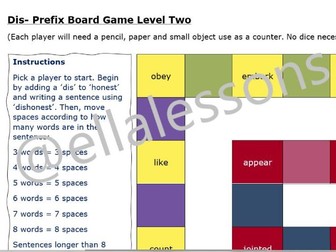
For practising adding the dis- prefix and writing related sentences.
This one-page board game worksheet challenges children to add the dis- prefix to words and then write sentences using these words.
The longer the sentence, the further they will move along the board! Instructions are included on the sheet. Each player will need a pencil, paper and a small object to use as a counter. No dice necessary!
Level Two difficulty = The prefix is not added for them, but the words used require no change to the spelling of the root word when dis- is added.
Suitable for KS1 Word Reading.
Covers the following skills:
dis- prefix (where no change is needed in the spelling of root words.)
Word reading
Writing sentences
Spelling
Year group: KS1
Topic: Prefixes
No. of pages: 1
Always Dyslexia-Friendly!
Sans serif font.
Clear, uniform spacing as far as possible
All images used are copyright-free – sourced from Unsplash
Thanks for downloading!
Made by Ella (@ellalessons) - educator and resource creator.
For Printing
For Interactive Use
For Teachers and Tutors
Comprehensive Maths worksheets on related multiplication and division calculations, including decimals.
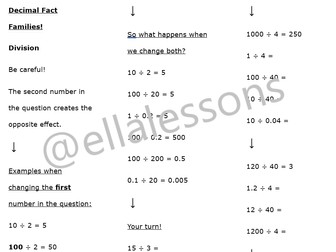
This 6-page Maths worksheet (inc. 2-pages of answers) has students answering sets of questions on number fact families, decimal multiplication and division.
Students are given a multiplication calculation, eg: 60 x 50 = 3000, and they must apply it to a related multiplication calculation, eg: 0.6 x 0.5.
They are also given a division calculation, eg: 600 ÷ 2 = 300, and they must apply it to a related division calculation, eg: 6 ÷ 20.
There are two pages on multiplication and two on division, with added instructions for division and two answer pages!
The worksheet is suitable for Y6, Y7, Y8, Y9. UKS2 or KS3.
Optimised for Microsoft Word.
Use as an interactive worksheet by equipping the pencil drawing tool and adding the answers straight onto the document! Or simply typing answers.
Covers the following skills:
Arithmetic
Multiplication and Division
Number Facts
Decimals
Fact Families
Year group: UKS2 / KS3
Topic: Decimals / Place Value / Number
No. of pages: 6
Answers: Yes
Always Dyslexia-Friendly!
Clear, uniform spacing as far as possible
Any/all images used are copyright-free – sourced from Unsplash
Thanks for downloading!
Made by Ella (@ellalessons) - A full-time tutor and resource creator.
For Printing
For Interactive Use
For Teachers and Tutors
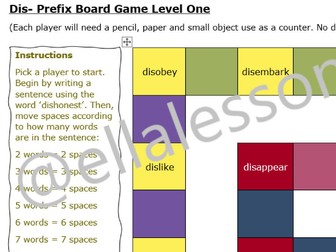
Check out my harder ‘Level Two’ board game activity on the dis- prefix!
Check out my board game activities for other prefixes and suffixes too!
For practising the dis- prefix and writing related sentences.
This one-page board game worksheet challenges children to write sentences using words with the dis- prefix.
The longer the sentence, the further they will move along the board! Instructions are included on the sheet. Each player will need a pencil, paper and a small object to use as a counter. No dice necessary!
Level One difficulty = The prefix is already added for them and the words used require no change to the spelling of the root word when dis- is added.
Suitable for KS1 Word Reading.
Covers the following skills:
dis- prefix (where no change is needed in the spelling of root words.)
Word reading
Writing sentences
Spelling
Year group: KS1
Topic: Prefixes
No. of pages: 1
Always Dyslexia-Friendly!
Sans serif font.
Clear, uniform spacing as far as possible
All images used are copyright-free – sourced from Unsplash
Thanks for downloading!
Made by Ella (@ellalessons) - educator and resource creator.
For Printing
For Interactive Use
For Teachers and Tutors
Check out my other mad libs!
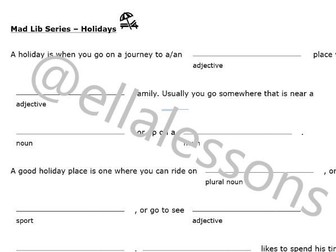
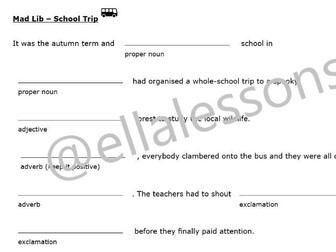
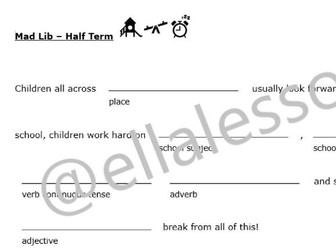
A ‘mad lib’ activity sheet – a funny and entertaining way to practise grammar and word classes
This 5-page English activity is based on the game ‘mad libs’ and encourages students/children to shout out different kinds of words to fill in the gaps in the story!
For best results: don’t show students the story in advance, only ask them for the words. Then the finished story will be a hilarious surprise!
These always go down so well and encourage children to practise word classes without them even realising.
They are reusable as words can be filled in again and again! (Particularly on the interactive version.)
The pages consist of:
Printed version of the story
Interactive/online-use version of the same story
Useful information about the different word classes and how to fill in the gaps!
Suitable for KS1, KS2 or KS3 – in general the children themselves set the difficulty depending on the words they want to come up with!
Optimised for Microsoft Word.
Covers the following skills:
Grammar
Word classes
Adjectives, Nouns, Adverbs, Verbs and more!
Year group: KS1, KS2 or KS3
Topic: Word classes
No. of pages: 5
Answers: N/A
Always Dyslexia-Friendly!
Clear, uniform spacing as far as possible
Any/all images used are copyright-free – sourced from Unsplash
Thanks for downloading!
Made by Ella (@ellalessons) - educator and resource creator.
For Printing
For Interactive Use
For Teachers and Tutors
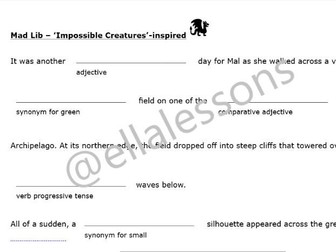
Check out my other mad libs!
A ‘mad lib’ activity sheet – a funny and entertaining way to practise grammar and word classes
This 5-page English activity is based on the game ‘mad libs’ and encourages students/children to shout out different kinds of words to fill in the gaps in the story!
This one is based on Katherine Rundell’s Impossible Creatures Novel.
For best results: don’t show students the story in advance, only ask them for the words. Then the finished story will be a hilarious surprise!
These always go down so well and encourage children to practise word classes without them even realising.
They are reusable as words can be filled in again and again! (Particularly on the interactive version.)
The pages consist of:
Printed version of the story
Interactive/online-use version of the same story
Useful information about the different word classes and how to fill in the gaps!
Suitable for KS1, KS2 or KS3 – in general the children themselves set the difficulty depending on the words they want to come up with!
Perfect for SATs revision.
Optimised for Microsoft Word.
Covers the following skills:
Grammar
Word classes
Adjectives, Nouns, Adverbs, Verbs and more!
Year group: KS1, KS2 or KS3
Topic: Word classes
No. of pages: 5
Answers: N/A
Always Dyslexia-Friendly!
Clear, uniform spacing as far as possible
Any/all images used are copyright-free – sourced from Unsplash
Thanks for downloading!
Made by Ella (@ellalessons) - educator and resource creator.
For Printing
For Interactive Use
For Teachers and Tutors
Check out my other mad libs!
A ‘mad lib’ activity sheet – a funny and entertaining way to practise grammar and word classes
This 5-page English activity is based on the game ‘mad libs’ and encourages students/children to shout out different kinds of words to fill in the gaps in the story!
For best results: don’t show students the story in advance, only ask them for the words. Then the finished story will be a hilarious surprise!
These always go down so well and encourage children to practise word classes without them even realising.
They are reusable as words can be filled in again and again! (Particularly on the interactive version.)
The pages consist of:
Printed version of the story
Interactive/online-use version of the same story
Useful information about the different word classes and how to fill in the gaps!
Suitable for KS1, KS2 or KS3 – in general the children themselves set the difficulty depending on the words they want to come up with!
Optimised for Microsoft Word.
Covers the following skills:
Grammar
Word classes
Adjectives, Nouns, Adverbs, Verbs and more!
Year group: KS1, KS2 or KS3
Topic: Word classes
No. of pages: 5
Answers: N/A
Always Dyslexia-Friendly!
Clear, uniform spacing as far as possible
Any/all images used are copyright-free – sourced from Unsplash
Thanks for downloading!
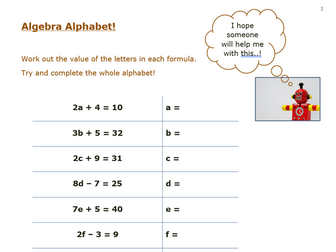
**Solving equations to find the missing letters of the alphabet! **
Suitable for the Algebra topic for KS2 children who need a challenge!
Page 1 in the format ‘2x + 3 = 11’
Page 2 is tricker and involves division with algebra.
Could be split in half, with one half of the class on Page 1 and the other on page 2, then coming together at the end to reveal the whole alphabet. I also used this one-on-one with a tutee.
ANSWERS INCLUDED
For Printed and Interactive Use!
Helpful comments embedded.
Perfect for teachers and tutors.
Dyselxia-friendly!
Sans serif font.
Font size 12 minimum
Clear spacing
A fun way to solve algebra equations for children who are excelling with algebra. I actually used this with a Year 3 tutee (!) but this was very unusual. I would recommend it for Y4 and above definitely. Suitable for Y6 and even Y7 as a fun starter.
Page 1 requires knowledge of solving 2-step algebra equations.
Page 2 requires knowledge of dividing 3 digit numbers by 10 and using division in algebra.
Made by Ella (@ellalessons) A full-time tutor and resource creator.
Thanks for downloading!
Made by Ella (@ellalessons) - A full-time tutor and resource creator.
For Printing
For Interactive Use
For Teachers and Tutors
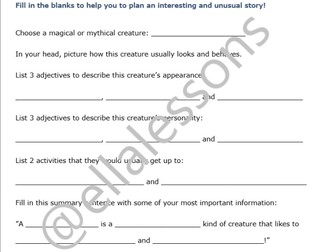
A simple self-guided worksheet to support story planning for creative writing
This 2-page English worksheet leads students through a ‘quiz’ and asks them to ‘fill in the blanks’ – but really it’s a story planning and structuring worksheet!
Students will end up with a plan for a story about a mythical or magical creature, which they can then use to write their story out in full.
This is a self-guided worksheet that requires little to no support.
(But it would also be fun to support a student with this to challenge them further!)
Suitable for KS2 or KS3.
Optimised for Microsoft Word.
Covers the following skills:
creative writing
composition
planning
using imagination!
Year group: KS2 or KS3
Topic: Creative writing
No. of pages: 2
Answers: N/A
Always Dyslexia-Friendly!
Clear, uniform spacing as far as possible
Any/All images used are copyright-free – sourced from Unsplash
Thanks for downloading!
Made by Ella (@ellalessons) - educator and resource creator.
For Printing
For Interactive Use
For Teachers and Tutors
A Maths worksheet on key multiplication and division facts
This 2-page Maths activity asks students answer sets of questions on key arithmetic facts that they should really know by heart, eg: 125 / 5 or 5 x 20, etc. I often find that students don’t have these at the forefront of their minds when reaching Secondary School so this kind of extra practise always comes in very handy!
Both sheets have a slightly different mixture of questions, with the second sheet being a little more difficult but still within the same range, so one student can use both!
The worksheet is suitable for Y5, Y6, Y7, Y8, Y9. UKS2 or KS3
Optimised for Microsoft Word.
Use as an interactive worksheet by equipping the pencil drawing tool and adding the answers straight onto the document!
Covers the following skills:
Arithmetic
Multiplication and Division
Number Facts
Number Bonds
Year group: UKS2 / KS3
Topic: Number
No. of pages: 2
Answers: No
Always Dyslexia-Friendly!
Clear, uniform spacing as far as possible
Any/all images used are copyright-free – sourced from Unsplash
Thanks for downloading!
Made by Ella (@ellalessons) - educator and resource creator.
For Printing
For Interactive Use
For Teachers and Tutors
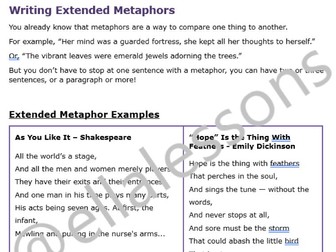
A worksheet, with examples, for use when learning how to write extended metaphors
This 3-page English worksheet leads students through examples of extended metaphors in literature, prompts students to decode these examples, then gently leads them to plan and write their first extended metaphors themselves.
Suitable for self-guided work or for working with a little support, depending on the student’s ability.
Suitable for UKS2 or KS3.
Optimised for Microsoft Word.
Covers the following skills:
creative writing
composition
literary devices
descriptive techniques
using imagination!
Year group: UKS2 or KS3
Topic: Writing extended metaphors
No. of pages: 3
Answers: N/A
Always Dyslexia-Friendly!
Clear, uniform spacing as far as possible
Any/All images used are copyright-free – sourced from Unsplash
Thanks for downloading!
Made by Ella (@ellalessons) - A full-time tutor and resource creator.
For Printing
For Interactive Use
For Teachers and Tutors
Practise calculations with money and finding change from £10 and £20.
This 4-page Maths worksheet, plus answers, tests students on their ability to calculate finding change with worded questions and varying levels of difficulty.
Suitable for KS2.
Magic-themed and involves mysterious magical items bought in a magic shop!
Covers the following skills:
Worded question comprehension
Addition and Subtraction
Finding change from £10
Finding change from £20
Year group: KS2
Topic: Money and Measurement
No. of pages: 5 (inc. answers)
Answers: Included
Always Dyslexia-Friendly!
Clear, uniform spacing as far as possible
Any/All images used are copyright-free – sourced from Unsplash
Thanks for downloading!
Made by Ella (@ellalessons) - A full-time tutor and resource creator.
All @ellalessons resources are created for printing AND for interactive use
For Teachers and Tutors
Check out my easier Level One resource on show, ‘don’t tell’ skills.
For practising ‘show, don’t tell’ and related writing and composition skills
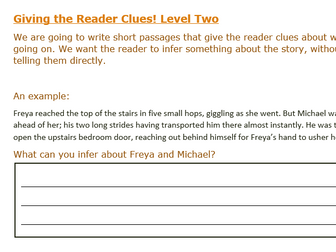
This three-page worksheet encourages children to write using ‘show, don’t tell’ skills to the best of their ability. Children are asked to describe different scenarios and leave ‘clues’ for the reader. There are helpful prompts to get them started.
On Pages 1 & 2 - an example ‘show, don’t tell’ passage as a warm up and for practising their inference skills. Followed by 3 different scenarios that the children have to write about, using ‘show, don’t tell’ skills to get the main points across.
On Page 3 – There is an extension task with 2 harder scenario suggestions.
One child can work through all three sheets, or they can be used as standalone sheets.
Suitable for UKS2 (Year 5 or Year 6) as more of a main activity or KS3 (Year 7 / Year 8 / Year 9) as more of a warm up.
For interactive users – textboxes are included to type inside.
Covers the following skills:
writing / composition
show, don’t tell
handwriting
comprehension
Year group: UKS2 and KS3
Topic: Show, don’t tell
No. of pages: 3
Always Dyslexia-Friendly!
Sans serif font.
12pt minimum font size as far as possible
Clear, uniform spacing as far as possible
Any/all images used are copyright-free – sourced from Unsplash
Thanks for downloading!
Made by Ella (@ellalessons) - A full-time tutor and resource creator.
All @ellalessons resources are created for printing AND for interactive use
For Teachers and Tutors
Check out my other resources!
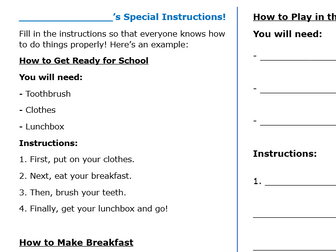
For practise with writing instructions (and using time conjunctions and adjectives – optional)
This two-page worksheet encourages children to write simple instructions. Page 1 has a simpler example (with time conjunctions) and page 2 has a trickier example (with time conjunctions, adjectives and adverbs.) One child can work through both sheets, or they can be used as standalone sheets. There is a space for the child to fill in their name to personalise the instructions.
Suitable for KS1 - Year 1 or Year 2.
For interactive users – textboxes are included
Covers the following skills:
writing instructions
writing sentences
handwriting
using time conjunctions
using simple adjectives and adverbs
Year group: KS1
Topic: Writing Instructions
No. of pages: 2
Always Dyslexia-Friendly!
Sans serif font.
12pt minimum font size as far as possible
Clear, uniform spacing as far as possible
Any/all images used are copyright-free – sourced from Unsplash
Thanks for downloading!
Made by Ella (@ellalessons) - A full-time tutor and resource creator.*
For Printing
For Interactive Use
For Teachers and Tutors
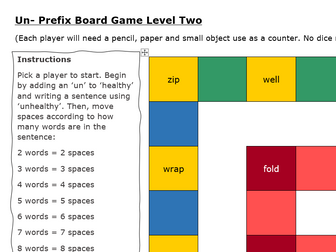
Check out my easier ‘Level One’ board game activity on the un- prefix!
Check out my board game activities for other prefixes and suffixes too!
For practising adding the un- prefix and writing related sentences.
This one-page board game worksheet challenges children to add the un- prefix to words and then write sentences using these words.
The longer the sentence, the further they will move along the board! Instructions are included on the sheet. Each player will need a pencil, paper and a small object to use as a counter. No dice necessary!
Level Two difficulty = The prefix is not added for them, but the words used require no change to the spelling of the root word when un- is added.
Suitable for KS1 Word Reading.
Covers the following skills:
un- prefix (where no change is needed in the spelling of root words.)
Word reading
Writing sentences
Spelling
Year group: KS1
Topic: Prefixes
No. of pages: 1
Always Dyslexia-Friendly!
Sans serif font.
12pt minimum font size
Clear, uniform spacing as far as possible
All images used are copyright-free – sourced from Unsplash
Thanks for downloading!