5. Tu veux aller au cafeQuick View
Kivic

5. Tu veux aller au cafe

(0)
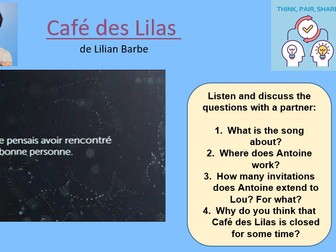
This is a resource to get students able to discuss going out for food when talking about activities ‘en ville’, it can be used with an appropriate sentence builder, or as a stand alone resource. It is worth noting, that in the curriculum for which this was designed, some basic food items had already been presented. It will start with some useful warm tasks - familiar phrases (depending of your curriculum). There is a listening task related to Café des Lilas  de Lilian Barbe which offers some authentic french exposure. Students are not expected to understand everything (of course). There is a brief reading task, which could be expanded into a writing task too, at the preference of the teacher. There is also the game le téléphone cassé for listening and speaking training, which could be done first as a class and then in small groups - up to the teacher’s style, class discipline and attainment. If not suitable, trap door is provided instead. The plenary task is a simple reflection French (but could change to English for ease) to act as a formative and summative assessment asking and answering: Où aimerais-tu inviter ton ami(e) ? Aimerais-tu aller dans un café avec un(e) ami(e) ? Que voudrais-tu commander dans un café ?
4. Ou vas-tu le weekend P2Quick View
Kivic

4. Ou vas-tu le weekend P2

(0)
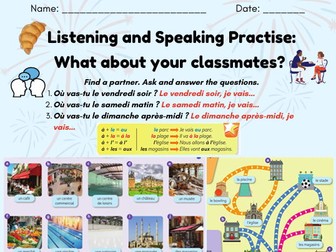
Please note this has some repeated materials, so if you have already purchased the second or third one in the series you may not find this as helpful. That said, there is some new reading input on: Le Monument de la Renaissance africaine in Senegal, which could act as an interesting cultural item to move away from francophonie as purely French. The reading can used as a translation and pronunciation task too, or teachers could expand it into a self-led or group-led independent research task on Francophone culture and monuments outside of France. Otherwise, the Sondage en classe speaking an listening task, getting students out of their seats and conversing (in French) with their classmates is equipped with a handy worksheet for taking notes and subsequent class-sharing.
En ville: point de departQuick View
Kivic

En ville: point de depart

(0)
This is a resource to get students started on the new topic of ‘en ville’, it can be used with an appropriate sentence builder, or as a stand alone resource. It will start with some useful warm tasks - familiar phrases (depending of your curriculum) and monuments worldwide. There is a listening task which originally matched a Dynamo textbook, however the teacher can do this on-the-spot, using the vocabulary bank provided (unless a script is preferred). There is a reading task, which it is suggested to use for pronunciation training also - as a read aloud task, the order of which could be changed, at the preference of the teacher. The plenary task is a simple reflection in English (can be changed to French) to act as a formative and summative assessment for effective teaching in future.
2. Ou vas-tu le weekendQuick View
Kivic

2. Ou vas-tu le weekend

(0)
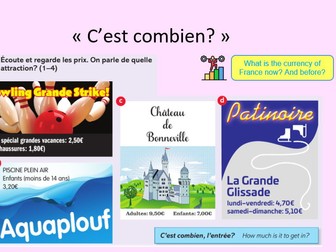
This resource may be used with a suitable sentence builder or as a stand alone material. The first activity is a starter task, involving translation and image to sentence matching as a mini vocab recognition/ reading comprehension. The lesson then continues on a brief cultural theme, pricing questions, conjugation of ‘aller’ and reading comprehension and speaking practice. The resource has more material than could be covered in a 45 or 1 hour class. It is therefore recommended that the teacher looks at reducing material or spreading over two classes with necessary modifications.
3. Dans ma ville il y aQuick View
Kivic

3. Dans ma ville il y a

(0)
Dans ma ville il y a is about giving details of what is in your town. It is recommended to prepare and deliver this as a speaking and listening skills-based class, encouraging students to use and practise exisiting vocab as much as possible. This could be done with the PPT as is, or using the first 2 of the series (and sentence builders, if used) to complement.
Revision: La vie en familleQuick View
Kivic

Revision: La vie en famille

(0)
This is a great revision resource for the theme of ‘La vie en famille’ for students studying from the Dynamo 1 curriculum. It is designed as a fun, competitive, team learning with mini-games and quizzes embedded in the PPT. Suitable for 1 hour lesson, but with more than enough activities for more time than that.
Beginners French IntroductionQuick View
Kivic

Beginners French Introduction

(0)
This resource is designed to fill a 1h15 workshop for beginners in French. It is an introduction to greetings/ personal info (basic) and food preferences with likes/ dislikes expressions.
As-tu un animal?Quick View
Kivic

As-tu un animal?

(0)
This lesson has speaking, listening, reading and grammar tasks. To complete every activity as presented in the PPT would likely require quite a rapid pace or a longer lesson of about 1h15-1h20. It would be suitable to break things up/ adapt, with the ‘avoir’ gap-fills having the potential to be extended into a translation task for extra challenge/ activity out of the same resource. The final slide is a plenary game which overs fun higher order thinking, focused on categorisation - if you can’t spot the rules, leave a comment!
Introduction: La Culture MartiniquaiseQuick View
Kivic

Introduction: La Culture Martiniquaise

(0)
This lesson is designed to be approx 30 mins, used as an introduction to Martinique and its culture. It looks at the geographical location, a few key monuments and their visuals as well as simple sentence structures to introduce them. A post card template is also provided on which the full sentences could be recorded to make a short descriptive text of Martinique. It is possible to extend this using the long PPT (originally for EFL) which introduces different food types, with a vocab sheet to complement.
Elle est comment ta famille?Quick View
Kivic

Elle est comment ta famille?

(0)
This resource was originally designed for a Y7 class, but ultimately could be used across KS3. It was planned for a class of 50mins-1hour in duration, perhaps it could be used for those a little longer with some minor adaptations. The lesson features everything you would need in th PPT and the reading worksheet which is available as a print out. There are reading, listening and mini-speaking (numbers) activities, reading could be used to inspire writing or read aloud tasks for speaking.
Une famille en Martinique vs. Une famille au CanadaQuick View
Kivic

Une famille en Martinique vs. Une famille au Canada

(0)
This is a resource aimed at decolonising the teaching of home features in French language instruction, focusing on the objective differences in housing related to climate. That sees us compare different aspects of the Francophone world beyond France. This resource documents differences between Martinique (DOM) and Canada. It is not exhaustive, but merely a whistle stop tour which could feature as one lesson in a unit on home while also discussing culture.
Qu'est-ce qu'il y a dans ta maison ou ton appartQuick View
Kivic

Qu'est-ce qu'il y a dans ta maison ou ton appart

(0)
This is a resource for those with an existing foundation in French, it could be used for KS3 or KS4 learners, depending on your goals and objectives and attainment of the student(s). The resource focuses on features of the home/ apartment, drawing on previous learning in resource 1 (Emily in Paris-themed), but expanding by looking at features of the house eg: le salon, la terrasse, la cuisine etc. It features focused vocab study, choral repetition game (beat the teacher) for numbers up to 31 and two reading activities, 1 with a discussion focus, another longer one with more comprehension focus - both introducing different cultural elements at the same time. Readings could be adapted into listening tasks too - all content is in the PPT slides. Enjoy!
Speaking Task for 1. Ou habites-tu, ParisQuick View
Kivic

Speaking Task for 1. Ou habites-tu, Paris

(0)
This is a speaking task developed from the previous Emily in Paris - L’influenceuse à Paris Reading task and subsequent writing task - Répondez à Emily par MP. Here students are encouraged to read their text aloud to a partner, who will answer the comprehension questions about their text in the space below. Answers could be in French or any other language used as a Medium of Instruction!
Family Unit Revision & GamesQuick View
Kivic

Family Unit Revision & Games

(0)
Here you will find three comprehensive PPTs with lots of resources to revise the unit of family: who is in the family, how many people, numbers, appearance, home and its features, houses in Martinique vs Canada. Use as you see fit!
Pâques en AlsaceQuick View
Kivic

Pâques en Alsace

(0)
This resource should fill a 50mins lesson. it could be used for either KS3 or KS4 to present some cultural notions about Easter, focusing on Alsace in particular.
Il/ elle est comment?Quick View
Kivic

Il/ elle est comment?

(0)
There are two different PPT options for this, some crossover in activities means they are not two completely different lessons, but different forms of the same content. For both PPT options, there is a ‘Trouvez Qqn qui…’ human bingo card which can be used as a fun structured read aloud/ mini conversation practise. Naturally, this speaking task could be extended through class feedback, translating the boxes and adding extra detail/ transforming sentences into negatives or using different nouns to practise adjectival agreement.
Où  habites-tu? À ParisQuick View
Kivic

Où habites-tu? À Paris

(0)
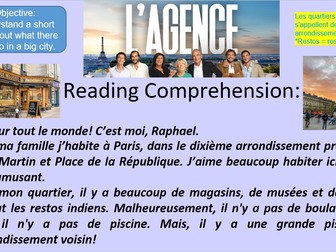
A resource to share how to describe the place (city, neighbourhood) where you live based on Emily in Paris to introduce French learners to the idea of living in Paris and its arrondissements. Suitable for a 50 minute - 1 hours lesson. Likely you will find there is more content than you might need so you can spend more or less time/ adapt the resources by removing items as you see fit. It is designed to be a challenge for a learner with some foundational skills in French, implicit TL learning was the primary mode of delivery.
Le petit dejeunerQuick View
Kivic

Le petit dejeuner

(0)
What do they eat in France? There are some aspects of culture embedded in implicit learning resources - reading and listening about breakfast food. There is one advice to follow a link to the resource on Bitesize, so be aware this is of course NOT developed by myself and could be subject to removal/ copy right rules on use in class. That link is embedded in the resource. This lesson was originally planned for a mixed ability year 7 group, but could be suitable for various KS3 classes, perhaps if used for lower attainment classes, more imagery and vocabulary support would need to be provided. The resource is longer than could be delivered in the 50mins lesson for which it was designed.