 Quick View
Shakespeare Evidence Circle Lesson
Teach any Shakespeare extract with a lesson pack: 30-slide PowerPoint, student handout & teacher guide. Evidence Circle activity builds inference.
Get students arguing about evidence, not just retelling the plot.
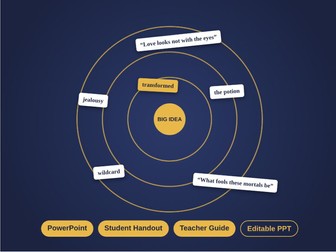
The Shakespeare Evidence Circle turns close reading into a hands-on, discussion-rich lesson. Students sort a set of 15 cards (quotes, key moments, single words and wildcards) onto a concentric circle, placing the most central evidence closest to the middle, then defend their choices with a clear claim and a precise detail. It works with any play and any extract, and a fully worked example from A Midsummer Night’s Dream is included so you can teach it tomorrow. What is in the pack
• A 30-slide editable PowerPoint with speaker notes, covering the starter, modelling, the circle activity, stretch tasks, writing and reflection
• A student handout (6 pages) with a Fact / Inference / Wonder organiser, sentence stems, extension prompts, a 60-word writing task, self-check and feedback space, plus a glossary and the example extracts
• A teacher guide with timings, step-by-step notes, differentiation and SEND support, a three-level rubric (Emerging / Secure / Extending), and instructions for building your own card set for other plays
Skills it builds
• Making inferences and supporting them with evidence
• Writing in a “claim, then detail” structure
• Reading Shakespeare’s language with confidence
• Speaking and listening through structured discussion and a gallery walk
• Reflecting on learning, so you can see what students have gained
How to use it
• A single lesson, or four short lessons or one full masterclass day (the guide includes the plan for each)
• Three pathways (Detective, Director, Critic) let students choose how to respond, and stretch tasks challenge your most able
• Suits Year 7–9 / KS3, high-ability groups and mixed-ability classes, and works well for in-person and remote teaching
• Suggested extracts for Julius Caesar, Macbeth, Twelfth Night and The Tempest are included for reuse across the year
Please note
Shakespeare’s text is in the public domain. Extracts in this pack are lightly trimmed for classroom use, so please check them against your own edition. No film or performance clips are included. Licensed for use by one teacher in their own classroom; please see the terms slide in the PowerPoint.