OCR GCSE Computer Science Pseudocode Tutor – 54 Interactive Auto-Marked Coding Tasks.Quick View
sukhg123

OCR GCSE Computer Science Pseudocode Tutor – 54 Interactive Auto-Marked Coding Tasks.

(1)
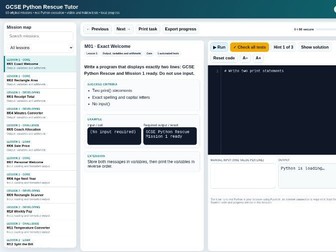
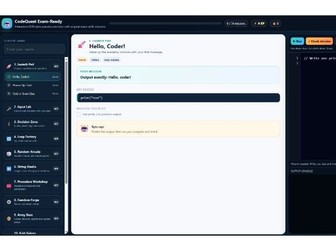
CodeQuest Exam-Ready: Interactive OCR GCSE Pseudocode Tutor Help students develop confidence in programming with this engaging, interactive OCR-style pseudocode tutor. CodeQuest Exam-Ready contains 54 progressively challenging coding missions covering the key programming skills required for OCR GCSE Computer Science. Students write, run, test and improve their pseudocode directly inside the resource, receiving immediate feedback when their solution is incorrect. The resource works completely in a web browser and requires no installation, account or internet connection. Simply open the HTML file and start coding. Topics covered Output and variables User input Arithmetic operators and MOD Selection using if, elseif and else Boolean logic switch and case for loops while loops do until loops Random numbers String manipulation Procedures and parameters Functions and return values One-dimensional arrays Searching and updating arrays Two-dimensional arrays Nested loops File handling Character codes using ASC and CHR Tracing, debugging, searching and sorting Exam-style programming challenges Key features 54 original coding missions Tasks arranged from beginner to exam-ready level Built-in OCR-style pseudocode editor and runner Automatic marking and instant feedback Helpful error messages that identify the relevant line Progressive hints for students who become stuck Model solutions for every mission XP, progress tracking, streaks and achievement rewards Student progress saved automatically in the browser Exportable progress report Reset buttons for individual tasks and the complete course Built-in syntax guide Open and save student pseudocode files Dark, light, green and red editor themes Interactive input entered directly into the output console Works offline with no adverts or subscriptions Ideal for OCR GCSE Computer Science Year 10 and Year 11 programming lessons Mixed-ability classes Independent learning Homework and revision Cover lessons Intervention groups Students who need additional coding practice Early finishers Exam preparation The missions begin with simple output statements and gradually develop towards more demanding tasks involving functions, arrays, nested loops, file handling, searching, sorting and debugging. Students can work independently while the automatic checking, hints and model solutions reduce the need for constant teacher support. This makes the resource particularly useful for classes containing students with very different levels of programming confidence. All practice missions are original and designed to develop the programming techniques and problem-solving skills needed for GCSE Computer Science examinations. File supplied One self-contained HTML file. Open the file using Chrome, Edge or another modern web browser. No specialist software or internet connection is required.
OCR J277 GCSE Computer Science – Programming Escape Room (Runner-Based Lesson + Teacher Answers)Quick View
sukhg123

OCR J277 GCSE Computer Science – Programming Escape Room (Runner-Based Lesson + Teacher Answers)

(0)
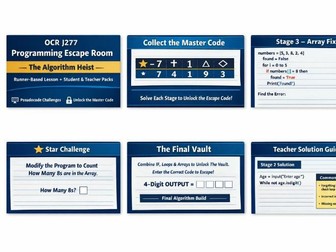
A complete 45–70 minute OCR GCSE programming escape room designed to run entirely inside a pseudocode runner – no prep required. A fully runnable GCSE Computer Science escape room built specifically for OCR J277 and designed to work inside a pseudocode runner. Students must: Debug broken programs Fix accumulators Correct selection logic Repair validation loops Verify functions Combine arrays + iteration in a final synoptic vault build Each stage reveals a digit of the Master Code. Only when all stages are solved correctly does the final vault open. What’s Included ✔ Student Escape Room Pack (printable, structured, large-font) ✔ 6 structured programming stages ✔ Star extension challenges in every stage ✔ Exam-style written questions embedded ✔ Synoptic final build task ✔ Master Code strip + printable certificate ✔ Full Teacher Pack with complete solutions ✔ Common misconceptions guidance ✔ Clear facilitation guidance Topics Covered Variables & assignment IF / ELSE / nested selection FOR loops & accumulators WHILE loops & validation Arrays & linear search Functions MOD operator Synoptic algorithm design ⏱ Suggested Use 45–70 minute high-impact lesson End-of-topic reinforcement Year 10 programming confidence build Year 11 intervention session Revision lesson with engagement
OCR GCSE Computer Science (J277) – Debugging Mastery (40 Drills G3–9 + Pseudocode Runner + Answers)Quick View
sukhg123

OCR GCSE Computer Science (J277) – Debugging Mastery (40 Drills G3–9 + Pseudocode Runner + Answers)

(0)
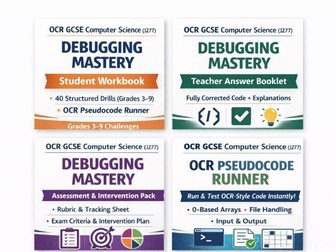
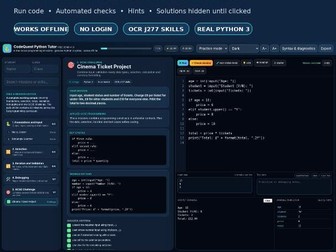
40 Structured Run–Fix–Prove Challenges (Grades 3–9) A complete, ready-to-use debugging system for OCR J277. This resource includes 40 structured debugging drills AND a fully functional OCR-style pseudocode runner – allowing students to run, test, debug and prove solutions immediately with zero setup. No planning. No extra tools. Just open and teach. OCR GCSE Pseudocode Runner Browser-based (no installation required) OCR-style syntax 0-based arrays (including 2D arrays) File handling (virtual file system) Input in output panel (no pop-ups) Built-in help and self-tests Multiple theme options for classroom display Students can run and debug every task directly inside the runner. 40 carefully structured debugging challenges covering: Syntax errors Logical errors Boundary and indexing mistakes Validation faults Function return errors Array and 2D array bugs File handling errors Grade 9 synoptic multi-bug programs Each task includes: Bug type checklist Clear goal Testing table (Run–Fix–Prove structure) Explanation section Teacher Answer Booklet Fully corrected code for all 40 drills Clear teacher notes explaining each bug Marking guidance Assessment & Intervention Pack Grade 3–9 rubric 40-task progress tracker 6-lesson intervention outline Common OCR debugging misconceptions
R093 workbook and answersQuick View
sukhg123

R093 workbook and answers

(0)
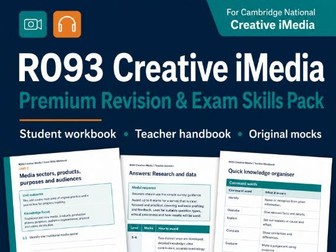
Brand new resource aimed at supporting the R093 unit of Cambridge Nationals Creative IMedia, it contains 48 tests and answers and covers material relating to the examination unit R093.
GCSE Computer Science Coding Workbook and Interactive OCR-Style Pseudocode Runner – 40 PagesQuick View
sukhg123

GCSE Computer Science Coding Workbook and Interactive OCR-Style Pseudocode Runner – 40 Pages

(0)
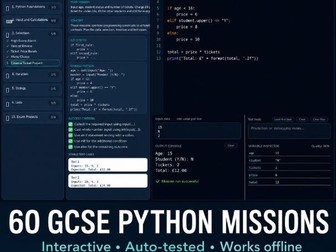
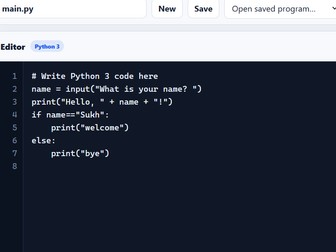
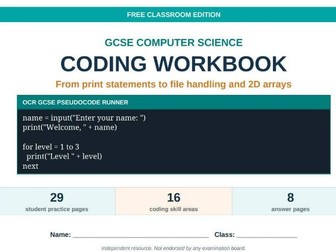
GCSE Computer Science Coding Workbook + Interactive Pseudocode Runner A complete 40-page GCSE Computer Science coding workbook supplied with an interactive, browser-based OCR-style pseudocode runner. This resource takes students from their first print() statement through to more advanced GCSE programming skills, including loops, arrays, functions, procedures, string manipulation and file handling. The workbook is designed for mixed-ability classes and includes clear worked examples, short knowledge checks, scaffolded practice, debugging activities, trace tables, test-data tasks and exam-style programming challenges. Topics covered Output using print() Variables and calculations User input Selection using if, else and elseif for loops while loops do until loops Totals and counters Random numbers String manipulation Procedures Functions and return values One-dimensional arrays Two-dimensional arrays File handling Testing and debugging Boundary, normal and invalid test data Mixed programming challenges What is included A professionally formatted 40-page PDF workbook 29 student practice pages Coverage of 16 coding skill areas 8 pages of model answers Worked examples and quick checks Debugging and trace activities Large spaces for students to write code Progress tracker and diagnostic assessment Print-friendly code examples using black text on a white background An interactive HTML pseudocode runner Interactive pseudocode runner The included runner opens directly in a web browser and does not require students to create an account or install specialist software. It supports: Input entered directly in the output window Selection and loops Functions and procedures One-dimensional and two-dimensional arrays OCR-style string commands Random number generation Virtual file handling Saving and opening pseudocode programs Automatic indentation and line numbers Clear error messages Multiple colour themes Students can write, run, test and improve their programs immediately, making the resource ideal for independent practice, homework, intervention sessions, cover lessons and full-class teaching. Suitable for OCR GCSE Computer Science Year 9 introductory GCSE programming Year 10 and Year 11 coding practice Mixed-ability and lower-confidence learners Revision and intervention Non-specialist teachers Independent learning Homework and cover lessons The pseudocode uses an OCR-style classroom syntax, but the programming concepts are suitable for most GCSE Computer Science courses. Independent resource. Not endorsed by OCR or any other examination board.