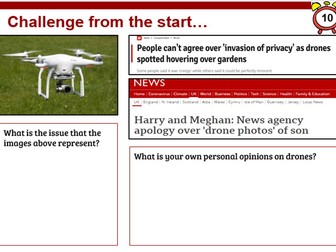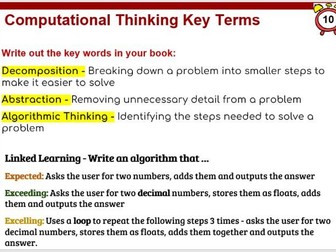
A set of flashcards ready to be printed for all the key terms/definitions for the CPU and storage
I have also included slides with student instructions for two different activities to do with the cards.
Designed of OCR GCSE Computer Science spec J277
A set of flashcards ready to be printed for all the key terms/definitions for the topics of software and legislation
I have also included slides with student instructions for two different activities to do with the cards.
Designed of OCR GCSE Computer Science spec J277
A cover lesson suitable for any KS3 class - it starts with a simple Do Now task (answers given for peer/self marking) then gives students written task linked to ethical issues in computing (this task could be removed if you don’t use books).
The rest of the lesson gives students a range of fun, engaging but relevant computing tasks to choose from. No input required from cover teacher and it is engaging enough that students will want to just get on with their choices of tasks.
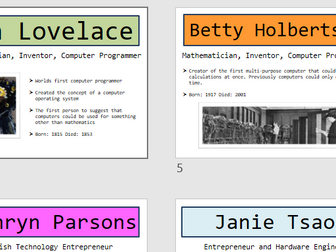
Display consisting of 11 different women who have been influential in Computer science (past and present). Perfect for showing girls that computing isn’t just for the boys!
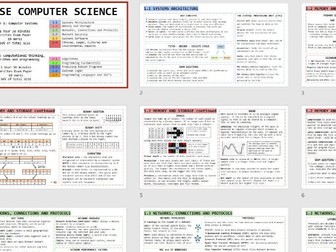
Revision Guide / Knowledge Organiser for the entire OCR GCSE Computer Science Spec (J277)
Colour coded, 21 pages.
PDF suitable for printing and Powerpoint file incase you want to edit it.
Each topic can be printed separately as a lesson resource/Do Now task/Revision Sheet/Homework/Flipped learning resource.
Each topic has examples of exam questions which can be answered by students.
Key vocabulary is highlighted.
You are welcome to share with students on a password protected area of your website but please do not share publicly online.
Please write a review if you find it useful :)
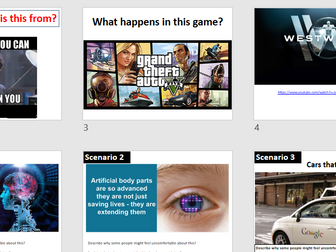
A lesson powerpoint on ethical issues in technology.
Gives students the opportunity to investigate various ethical issues relating to new use of technology.
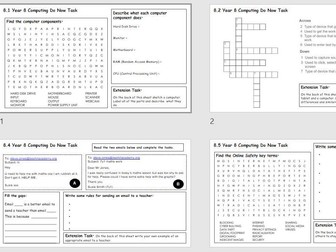
Printable Do Now Tasks for KS3 computing (10 for year 7, 10 for year 8 and 10 for year 9).
All single sided A4 but include an extension activity to be done on the reverse of the sheet. Without the extension each sheet would take around 7 minutes to complete but with the extension it could be around 15 mins so can be used flexibly.
Layering of concepts across the year groups - accessible for lower literacy students, calming activities to encourage focus.
Perfect for:
having ready for cover lessons to allow the teacher to get themselves organised.
students who in isolation/moved to another classroom to give them something relevant and paper based to do
Everyday lessons
Homework
Extension tasks for finished students
A fully resourced lesson to help students GCSE students understand how to program and call procedures in python. The lesson uses the children’s story “we’re going on a bearhunt” and “Old Mac Donald had a farm” to teach the concepts in a way that students will be able to relate to.
Three lessons (each planned to be 100 minutes but could be split in half for shorter lessons)
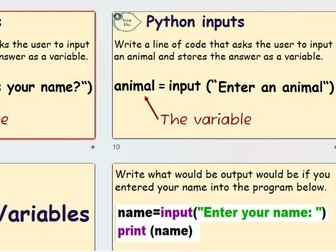
Introducing KS3 to python using I do/We do/ You do modelling to build up their understanding.
Lesson worksheets to take students through data security. Sheets include grade criteria, starter activity question, key words wordsearch, table to complete about risks and protection methods, plenary exam question about anti-phishing and anti-virus software and room for teacher feedback.
One worksheet for higher ability and one for lower.
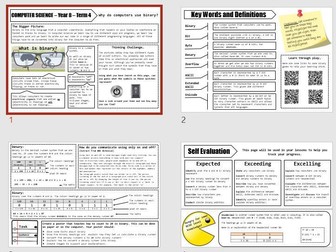
Knowledge organiser to accompany a Key Stage 3 unit introducing binary. Includes differentiated learning objectives for the term.
Mine is labelled as year 8 but feel free to adapt it to suit your needs.
A series of 8 lessons covering legal, ethical, environmental and cultural issues in computer science.
Lessons are intended to be used alongside exercise books as well as some computer based activities but could easily be adapted to make the lessons 100% electronic.
Each lesson has three levels of differentiation by task rather than outcome.
Literacy and reading opportunities included
All lessons start with an engaging starter that students can get on with straight away.
Opportunities for students to practice long answer questions.
5 Computational thinking lessons for GCSE. Each lesson includes three levels of differentiation by task rather than outcome.
Each lesson has an engaging starter activity that students can get on with straight away.
The lessons were originally written to be used with exercise books as well as some computer based work but could easily be adapted to make them 100% computer based.
The lessons cover abstraction, decomposition and algorithmic thinking. Programming opportunities are included (python) as well as links to identifying programming errors and flowcharts.
Lessons include literacy and reading opportunities.
A lesson which gets students to employ a range of ICT skills to complete a series of Easter related tasks. Great for KS3 for the last lesson before the Easter holidays.
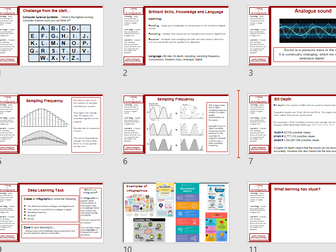
A lesson powerpoint with starter and main activity as well as all the key info for teaching sound.
Planned according to the OCR spec for computer science but could be used for others.
Can be used as an unplugged lesson as students can complete the tasks on paper or on a computer.