EYFS Continuous Provision Sentence Stems | Autumn, Spring & Summer | Oracy & Language PromptsQuick View
RebeccaPTaylor1

EYFS Continuous Provision Sentence Stems | Autumn, Spring & Summer | Oracy & Language Prompts

(0)
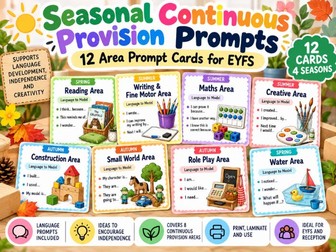
EYFS Continuous Provision Sentence Stems – Autumn, Spring & Summer Support communication, language and independent learning across your EYFS environment with these colourful, ready-to-use Continuous Provision Sentence Stem Cards! Designed specifically for Reception and Early Years settings, these cards provide purposeful language prompts to encourage children to talk about their learning, explain their thinking, share ideas and develop confidence when communicating. The sentence stems are carefully structured to develop children’s language progressively throughout the year, moving from simple statements in Autumn to more detailed explanations, reasoning and reflection in Spring and Summer. Perfect for displaying around your classroom to support high-quality interactions, independent learning and vocabulary development. What’s included? 33 colourful sentence stem cards covering three seasons: 11 Autumn cards – introducing simple language and encouraging children to describe their learning. 11 Spring cards – developing explanations, sequencing, reasoning and vocabulary. 11 Summer cards – encouraging deeper thinking, reflection, problem-solving and more complex language. Continuous Provision Areas Covered Reading Area Writing & Fine Motor Area Maths Area Creative Area Construction Area Small World Area Role Play Area Water Area Sand Area Playdough Area Woodland Area Learning Opportunities Communication and Language: Encourages children to speak in full sentences, develop vocabulary and communicate their ideas confidently. Oracy Development: Provides accessible sentence stems to support discussion, reasoning, explanation and reflection. Independent Learning: Gives children visual prompts to help them articulate their thinking without always relying on adult support. Progression Across the Year: Language becomes increasingly challenging as children’s confidence and communication skills develop. Adult Interactions: Supports practitioners in modelling purposeful language and extending children’s thinking during continuous provision. How to Use Simply print, laminate and display the relevant seasonal cards in your continuous provision areas. Adults can model the sentence stems during play, encouraging children to use them naturally when describing, explaining and reflecting on their learning. Change the cards each term to introduce new vocabulary and progressively develop children’s communication skills. Perfect For EYFS and Reception classrooms, continuous provision, communication and language development, oracy, vocabulary building, language-rich environments and supporting EAL learners. A simple, practical resource to make language development a purposeful part of everyday play and learning!
EYFS Outdoor Construction Challenge Cards Block Building ActivitiesQuick View
RebeccaPTaylor1

EYFS Outdoor Construction Challenge Cards Block Building Activities

(0)
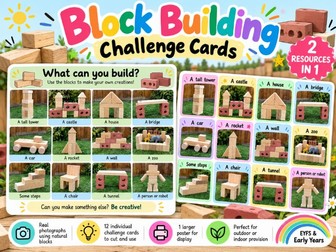
What can you build? Get little builders thinking, creating and problem-solving with these colourful Block Building Challenge Cards! Perfect for EYFS construction areas, this ready-to-use resource encourages children to explore different ways of building using wooden blocks, construction bricks and loose parts. With bright, child-friendly designs and realistic building examples, children can independently choose a challenge, recreate a structure or use the pictures as inspiration for their own creations! What’s included? 12 colourful building challenge cards featuring different structures, including towers, castles, bridges, houses, rockets and more! 1 large ‘What Can You Build?’ poster featuring all 12 challenges. Realistic photographic-style examples to support independent learning. Learning opportunities: Develops problem-solving and critical thinking. Encourages creativity and imaginative play. Supports spatial awareness and understanding of shape, size and balance. Promotes communication, language and collaborative play. Develops fine motor skills and hand-eye coordination. Perfect for: EYFS and Reception classrooms, indoor and outdoor construction areas, continuous provision, independent learning challenges and loose parts play. Simply print, laminate and add to your construction area for an engaging, low-preparation activity that children can return to again and again!
EYFS Oracy Curriculum - Full Year of Communication and Language SessionsQuick View
RebeccaPTaylor1

EYFS Oracy Curriculum - Full Year of Communication and Language Sessions

(0)
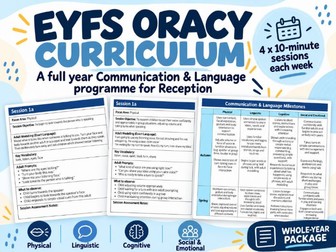
A complete, progressive EYFS already curriculum for reception, designed to develop children’s speaking, listing, and understanding in communication skills through short, focused sessions across the whole academic year. These lessons were created and used in my own reception classroom after identifying communication and language as an area of need within our cohort. In a setting where approximately 70% of children are EAL developing confident speakers and listeners was a major priority. After implementing regular, focused oracy sessions across the year, we saw a significant positive impact on children’s Communication and Language development and assessment outcomes. So much so, I was asked by my local LA to present to all head teachers in my area about the impacts of my sessions. Although the curriculum was developed within a high-EAL cohort, it is designed to support all Reception children, including confident communicators, children learning English as an additional language and children who need additional support with speaking, listening, vocabulary or social communication. How does the curriculum work? The lessons are designed to be taught four times each week, with each session lasting approximately 10 minutes. Sessions can be delivered: as a whole-class input with a smaller group as an intervention for children requiring additional Communication and Language support Each of the four weekly sessions focuses on a different strand of oracy and communication: Physical Developing the physical skills needed for effective communication, including eye contact, facial expression, gesture, body orientation, voice volume, tone and expression. Linguistic Developing spoken language, vocabulary and sentence structure, including extending sentences, introducing new vocabulary, joining ideas and explaining thoughts. Cognitive Developing listening, attention, understanding, memory, sequencing and the ability to respond appropriately to information, stories and instructions. Social and Emotional Developing turn-taking, conversation, responding to others, expressing feelings and preferences, sharing opinions and adapting communication to different situations. These strands are revisited throughout the year, with expectations gradually increasing as children become more confident and independent communicators. What is included? The resource provides a full academic year of planned oracy sessions, covering Autumn, Spring and Summer. Each session includes: a clear Communication & Language / oracy objective adult modelling and suggested language key vocabulary adult prompts and questions skills to observe space for assessment notes progressive development across the year
EYFS Oracy Curriculum / Sessions - Free Trial WeekQuick View
RebeccaPTaylor1

EYFS Oracy Curriculum / Sessions - Free Trial Week

(0)
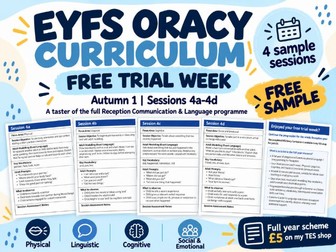
Try a free week from my full EYFS Oracy Curriculum for Reception. This sample includes four short Communication and Language sessions from Autumn 1, with each session focusing on a different strand of oracy: Physical Linguistic Cognitive Social and Emotional Each session is designed to take around 10 minutes and can be taught as a whole-class input, with a small group, or used as targeted Communication and Language support. The four sessions included in this free sample focus on: Using body orientation and eye contact during partner talk Using “and” to join two ideas Talking about something that has recently happened Taking part in a short back-and-forth conversation with a peer Each session includes a clear objective, exact adult modelling, key vocabulary, adult prompts, observation points and space for assessment notes. Planning The full EYFS Oracy Curriculum is designed to be taught four days each week, with one short session for each strand of Communication and Language. Skills are revisited and progressively developed across Autumn, Spring and Summer. I originally developed this approach for use within my own Reception class, where Communication and Language was an area of particular focus. The short, regular sessions helped to give children consistent opportunities to practise speaking, listening, vocabulary, conversational skills and confidence. The programme can be used with any Reception cohort and is particularly useful for classes with children who may need additional support with Communication and Language, including EAL learners. If you enjoy this free trial, the complete full-year EYFS Oracy Curriculum is available in my TES shop for £5. The full resource includes a whole year of progressive planning, four sessions per week, all four strands of oracy, adult modelling, vocabulary, prompts, observation points and Communication and Language milestones. A simple, manageable way to build explicit oracy teaching into your Reception week.
FREE EYFS Letter Formation Tracker – WritingQuick View
RebeccaPTaylor1

FREE EYFS Letter Formation Tracker – Writing

(0)
This FREE EYFS Letter Formation Tracker has been created to support teachers and practitioners in monitoring and assessing children’s letter formation in a practical, manageable way. Aligned with the EYFS Statutory Framework and the new Stronger Foundations guidance for writing, this tracker supports observation of how children form letters, rather than relying on repetitive tracing or over-recording.
FREE EYFS Language Milestones – Practitioner GuidanceQuick View
RebeccaPTaylor1

FREE EYFS Language Milestones – Practitioner Guidance

(0)
This FREE EYFS Language Milestones Guidance has been created to support teachers and practitioners in understanding, identifying and setting realistic language milestones for children in Reception. Aligned with the EYFS Statutory Framework and the Stronger Foundations.