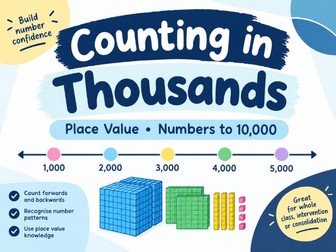
A Year 4 maths resource focused on counting in thousands.
Includes engaging activities to help children practise counting forwards and backwards in 1,000s, recognise number patterns and develop confidence with numbers up to 10,000.
Ideal for whole-class teaching, independent work, consolidation or intervention.
A clear and engaging maths resource linked to the White Rose Maths Place Value unit.
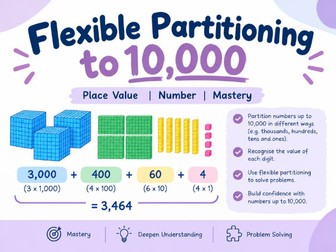
Children develop their understanding of flexible partitioning to 10,000, exploring different ways to partition numbers into thousands, hundreds, tens and ones.
Includes activities to support:
Flexible partitioning
Place value understanding
Reasoning and problem-solving
Numbers up to 10,000
Ideal for whole-class teaching, independent practice, consolidation or intervention.
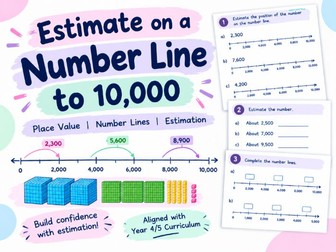
A clear and engaging White Rose Maths resource focusing on estimating numbers to 10,000 using number lines.
Children develop their understanding of number lines, estimation and place value, using known numbers and intervals to make sensible estimates.
Ideal for whole-class teaching, guided practice, independent work, consolidation or intervention.
For the cover, I can make it in the same clean pastel style as your other TES covers, with a number line to 10,000 and estimation activities. A screenshot of one page would let me match the actual resource more closely.
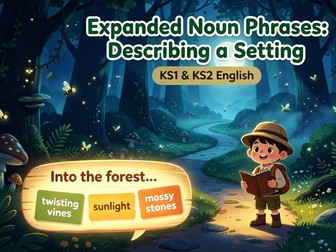
A fun and engaging English resource designed to help pupils develop their use of expanded noun phrases to create detailed and vivid setting descriptions.
This resource is suitable for KS1 and KS2 and can be adapted to different year groups and abilities.
What’s included:
Clear explanation of expanded noun phrases
Identifying nouns and adjectives
Building expanded noun phrases
Descriptive vocabulary activities
Setting description activities
Opportunities to develop and improve sentences
Independent writing task
Differentiated activities suitable for a range of abilities
Opportunities for discussion and sharing ideas
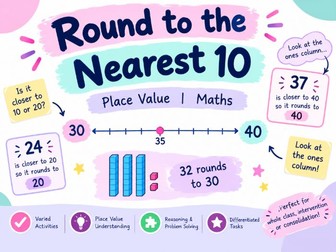
A clear and engaging maths resource focusing on rounding numbers to the nearest 10.
Children develop their understanding of place value and use number lines and practical examples to decide whether numbers round up or down to the nearest 10.
Includes:
Rounding to the nearest 10
Number lines
Place value activities
Rounding up and down
Reasoning and problem-solving
Ideal for whole-class teaching, independent practice, consolidation or intervention.
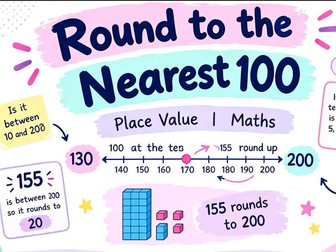
A clear and engaging maths resource focusing on rounding numbers to the nearest 100.
Children use number lines and place value to identify which hundred a number is closest to and complete rounding sentences.
Includes:
Rounding to the nearest 100
Number lines
Place value activities
Rounding up and down
Reasoning and problem-solving
Ideal for whole-class teaching, independent practice, consolidation or intervention.
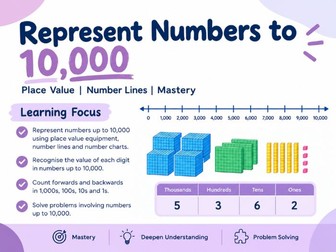
A clear and engaging maths resource designed to support teaching and practising how to represent numbers to 10,000.
Includes activities to help children understand the value of each digit, use place value equipment and representations, and develop confidence with numbers up to 10,000.
Ideal for whole-class teaching, independent practice, consolidation and intervention. Linked to the White Rose Maths Place Value unit.
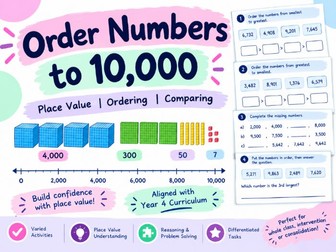
A clear and engaging maths resource focusing on ordering numbers to 10,000.
Children use their understanding of place value to order numbers from smallest to greatest and greatest to smallest.
Includes:
Ordering numbers to 10,000
Place value activities
Comparing numbers
Number sequences
Reasoning and problem-solving
Ideal for whole-class teaching, independent practice, consolidation or intervention.
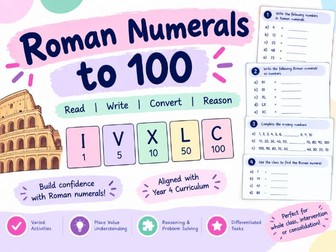
A clear and engaging maths resource introducing and practising Roman numerals.
Children develop their understanding of Roman numerals and practise reading, writing and converting numbers using Roman numeral notation.
Includes:
Roman numerals
Reading and writing Roman numerals
Converting between numerals and Roman numerals
Number activities
Reasoning and problem-solving
Ideal for whole-class teaching, independent practice, consolidation or intervention.
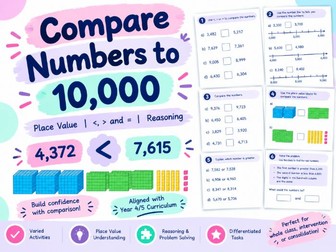
A clear and engaging resource focusing on comparing numbers to 10,000.
Children develop their understanding of place value and use <, > and = to compare numbers, supported by visual representations and number-based activities.
Includes:
Comparing numbers to 10,000
Place value understanding
Using <, > and =
Visual and written activities
Reasoning and problem-solving
Ideal for whole-class teaching, independent practice, consolidation or intervention.
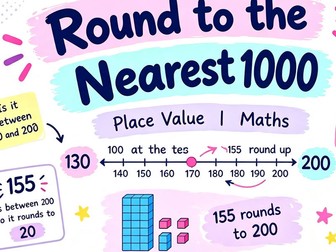
A clear and engaging maths resource focusing on rounding numbers to the nearest 1,000.
Children use number lines and place value to identify which thousand a number is closest to and complete rounding sentences.
Includes:
Rounding to the nearest 1,000
Number lines
Place value activities
Rounding up and down
Reasoning and problem-solving
Ideal for whole-class teaching, independent practice, consolidation or intervention.
A comprehensive and engaging KS2 non-chronological report writing resource based on natural disasters, with strong links to the Geography curriculum.
Pupils learn about different types of natural disasters while developing the key features and writing skills needed to create their own informative non-chronological reports.
What’s included:
Introduction to natural disasters
Research and information-gathering activities
Different types of natural disasters, including earthquakes, volcanoes, tsunamis, hurricanes and floods
Key geographical vocabulary
Features of a non-chronological report
Identifying and organising key information
Planning a non-chronological report
Sentence and paragraph writing activities
Headings and subheadings
Formal and factual language
Independent report-writing task
Opportunities to apply geographical knowledge through writing
Learning Objective
Curriculum Links
English – Writing
Organising ideas into paragraphs
Using headings and subheadings
Selecting appropriate vocabulary
Writing in a formal and factual style
Using conjunctions and cohesive devices
Editing and improving written work
Geography
Understanding different types of natural disasters
Developing geographical vocabulary
Understanding physical geographical processes
Exploring how natural disasters affect people and places
Ideal for KS2 English, Geography, cross-curricular lessons, topic work, guided writing, independent writing, homework or a natural disasters topic.
A versatile resource that combines geographical knowledge with purposeful writing, helping pupils understand how information can be researched, organised and communicated effectively.
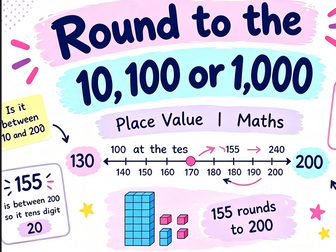
A clear and engaging maths resource focusing on rounding numbers to the nearest 10, 100 and 1,000.
Children use number lines and place value to identify which value a number is closest to and practise rounding up or down.
Includes:
Rounding to the nearest 10
Rounding to the nearest 100
Rounding to the nearest 1,000
Number line activities
Reasoning and problem-solving
Ideal for whole-class teaching, independent practice, consolidation or intervention.
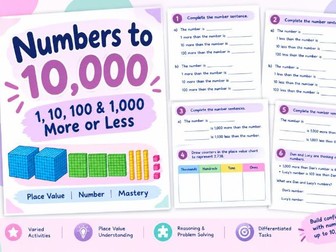
A clear and engaging resource focusing on numbers to 10,000 and place value.
Children practise finding 1, 10, 100 and 1,000 more or less, representing numbers using a place value chart and applying their understanding to reasoning and problem-solving questions.
Includes:
1, 10, 100 and 1,000 more and less
Representing numbers using place value
Number sentences
Place value charts
Reasoning and problem-solving activities
Ideal for whole-class teaching, independent practice, consolidation or intervention.
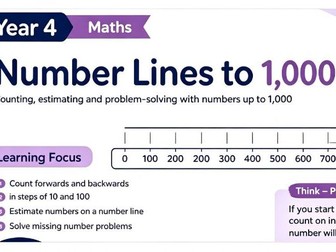
Designed to support the White Rose Maths Year 4 Place Value unit, this resource gives pupils opportunities to develop their understanding of numbers to 1,000 and locate numbers accurately on number lines.
Pupils will:
Read and interpret number lines to 1,000
Locate numbers on a number line
Estimate the position of numbers
Use their understanding of place value to explain their answers
Develop mathematical reasoning and discussion skills
Ideal for:
Year 4 Maths
Place Value
Number Lines
Numbers to 1,000
White Rose Maths
Maths reasoning and problem solving
A useful, engaging resource for whole-class teaching, independent work or maths intervention.
Cloud Busting Oracy Lesson | Voice 21 | Year 4/5
A ready-to-use oracy lesson inspired by Cloud Busting, designed to develop pupils’ confidence, communication and discussion skills.
Pupils are encouraged to share and justify their ideas, listen actively to others and respond thoughtfully through structured speaking and listening activities.
The lesson provides opportunities for pupils to:
Express and justify their opinions
Develop and explain ideas
Listen and respond to others
Agree and disagree respectfully
Build on the ideas of their peers
Use discussion sentence stems
Develop confidence when speaking aloud
Ideal for: Year 4/5, English, Oracy, Speaking & Listening, PSHE and whole-class discussion.
A useful, engaging resource for teachers looking to develop purposeful classroom talk and pupil voice.
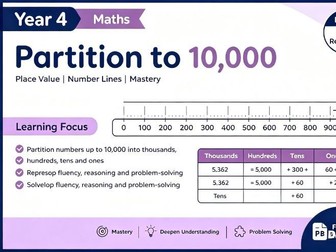
A ready-to-use Year 4 maths resource designed to support pupils in understanding partitioning numbers to 10,000 as part of the Place Value unit.
This resource includes engaging teaching activities to help pupils recognise the value of each digit and partition numbers into thousands, hundreds, tens and ones.
Includes:
Clear teaching slides
Interactive partitioning activities
Differentiated tasks
Reasoning and discussion opportunities
Consolidation activities
Suitable for whole-class teaching, group work or independent practice
Ideal for use alongside the White Rose Maths Year 4 Place Value unit.
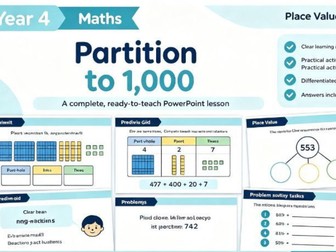
A ready-to-use Year 4 maths lesson on partitioning numbers to 1,000, designed around the White Rose Maths approach to Place Value.
This lesson helps pupils develop a secure understanding of 3-digit numbers, place value and partitioning, using a progression from concrete and pictorial representations to abstract calculations and reasoning.
The resource includes:
Clear learning objective and success criteria
Starter activity to recap place value
Teacher input and worked examples
Hundreds, tens and ones place-value activities
Part-whole models
Numbers containing zeroes
Guided practice
Fluency questions
Reasoning and explanation questions
Challenge activities for higher-attaining pupils
Independent practice
Learning objective:
To partition 3-digit numbers into hundreds, tens and ones.
Key vocabulary:
partition, place value, digit, hundreds, tens, ones, value, part-whole model
Suitable for Year 4, classroom teaching, intervention, revision, consolidation or maths mastery sessions.
Please note: This is an independently created resource inspired by the teaching approach and progression used in White Rose Maths. It is not an official White Rose Maths resource.
A ready-to-use lesson investigating amplitude and sound waves. Includes practical activities, explanations and worksheets to develop understanding.
Covers:
• Understanding amplitude and loudness
• How sound vibrations change
• Practical exploration activities
• Key vocabulary and explanations
Designed to support the Sound unit
A complete lesson exploring solids and their properties. Includes activities, investigations and printable resources to support the Science curriculum.
Identifying solid materials and their characteristics
• Comparing solids, liquids and gases
• Sorting activities and investigation tasks
• Fluency questions and discussion prompts
Ready to use — includes lesson guidance and printable activities on flipchart.
This lesson focuses on understanding the key components that make up a circuit and aims to answer the following questions:
What is electricity?
How is it made?
what is a circuit?
How does a circuit work?
what are components of a circuit?
A complete Year 4 Science lesson identifying and understanding electrical circuit components. Explore what each part does and how they work together. Includes activities, diagrams and investigation ideas to support the Electricity unit.


 Quick View