A comprehensive and editable risk assessment designed for outdoor activities in schools, nurseries, and early years settings. This resource helps practitioners identify potential hazards, assess risks, and implement appropriate control measures to support safe, enjoyable, and engaging outdoor learning experiences. Suitable for a wide range of outdoor environments and activities, it can be easily adapted to meet the specific needs of your setting and age group.
A comprehensive and editable risk assessment designed for general classroom environments in schools, nurseries, and educational settings. This resource supports practitioners in identifying potential hazards, assessing risks, and implementing effective control measures to help maintain a safe, organised, and inclusive learning environment. Suitable for a wide range of age groups and easily adaptable to meet the specific needs of your setting.
A comprehensive and editable risk assessment designed for sand and water play activities in schools, nurseries, and early years settings. This resource helps practitioners identify potential hazards, assess risks, and implement suitable control measures to support safe, hands-on learning and sensory exploration. Ideal for indoor and outdoor provision, it can be easily adapted to meet the specific needs of your setting, children, and activities.
A comprehensive and editable risk assessment designed for indoor learning and play environments in schools, nurseries, and early years settings. This resource helps practitioners identify potential hazards, assess risks, and implement effective control measures to maintain a safe, welcoming, and well-organised indoor environment. Suitable for a wide range of activities and educational settings, it can be easily adapted to meet your specific requirements.
A comprehensive and editable risk assessment designed for the use of climbing equipment in schools, nurseries, and early years settings. This resource helps practitioners identify potential hazards, assess risks, and implement appropriate control measures to support safe, active play and physical development. Suitable for both indoor and outdoor climbing equipment, it can be easily adapted to meet the specific needs of your setting and age group.
A comprehensive and editable risk assessment designed for food preparation activities in schools, nurseries, and early years settings. This resource helps practitioners identify potential hazards, assess risks, and implement suitable control measures to promote safe food handling, hygiene, and cooking practices. Suitable for a range of educational environments and easily adaptable to meet the needs of your setting and planned activities.
A comprehensive and editable risk assessment designed for creative and arts-based activities in schools, nurseries, and early years settings. This resource supports practitioners in identifying potential hazards, assessing risks, and implementing effective control measures to create a safe and inspiring environment for children to explore, create, and express themselves. Suitable for a variety of educational settings and easily adaptable to meet individual requirements
A comprehensive and editable risk assessment designed for construction and loose parts play areas in schools, nurseries, and early years settings. This resource helps practitioners identify potential hazards, assess risks, and implement appropriate control measures to support safe, engaging, and creative play. Suitable for a range of educational environments, it can be easily adapted to meet the specific needs of your setting and activities.
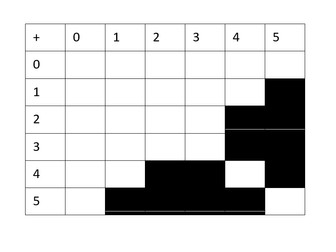
This EYFS Maths Fluency Grid has been designed to support children in developing confidence and automaticity with addition and subtraction within 5. This resource helps children practise key early number skills while building speed, accuracy and mathematical understanding.
Ideal for assessment, intervention groups, independent practice or whole-class fluency sessions, the grid enables practitioners to identify children’s strengths and next steps in their understanding of number.
This resource aligns with the EYFS Framework and promotes mathematical fluency by giving children regular opportunities to revisit and secure essential addition and subtraction facts within 5, laying strong foundations for future learning.
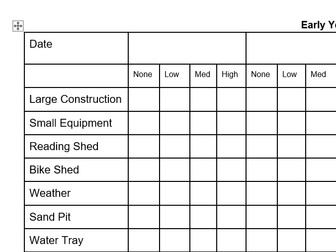
Support a safe and well-organised learning environment with this EYFS Daily Risk Assessment. Designed specifically for Early Years settings, this easy-to-use checklist helps practitioners carry out routine safety checks before children access the learning environment.
It encourages staff to identify and address any risks promptly, ensuring children can learn and play in a safe, secure and stimulating environment.
Ideal for nurseries, preschools and Reception classes, this resource promotes good health and safety practice while supporting compliance with EYFS safeguarding and welfare requirements. The clear layout makes it quick to complete each day, providing an effective record of daily safety checks.
These printable labels encourage children to write letters, cards and pictures to Santa while developing early literacy skills in a meaningful and engaging way. Royal Mail Santa PO box address.
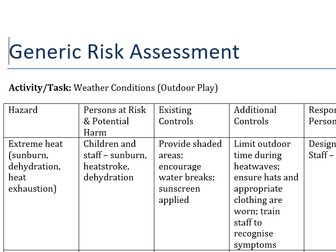
A comprehensive and editable risk assessment designed to help schools, nurseries, and early years settings manage risks associated with varying weather conditions. This resource supports practitioners in identifying potential hazards linked to hot, cold, wet, windy, or icy weather and implementing appropriate control measures to keep children and staff safe during outdoor activities and daily routines. Easily adaptable to suit the needs of your setting and local environment.
A bundle of editable risk assessments for an Early Years setting including:
Climbing Equipment Risk Assessment
Construction Area Risk Assessment
Creative Area Risk Assessment
EYFS daily risk assessment
Food Preparation Area Risk Assessment
General Classroom Environment Risk Assessment
home visit risk assessment
Indoor Area Risk Assessment
Outdoor Activities Risk Assessment
Sand and Water Play Risk Assessment
A comprehensive and editable risk assessment designed for sensory play activities in schools, nurseries, and early years settings. This resource helps practitioners identify potential hazards, assess risks, and implement appropriate control measures to support safe, inclusive, and engaging sensory experiences. Suitable for a wide range of sensory materials and activities, it can be easily adapted to meet the specific needs of your setting and the children in your care.
A comprehensive and editable risk assessment designed for toileting and personal care routines in schools, nurseries, and early years settings. This resource helps practitioners identify potential hazards, assess risks, and implement appropriate control measures to support children’s health, hygiene, dignity, and wellbeing. Suitable for a range of educational and care environments, it can be easily adapted to meet the individual needs of children and the requirements of your setting.
This risk assessment provides a structured overview of the potential risks associated with EYFS home visits and the control measures required to keep staff, children and families safe. It supports safe practice, safeguarding procedures and compliance with health and safety expectations during home visits
An EYFS Literacy Planning Overview provides a clear, structured framework to support early writing, reading and communication development across the early years setting. It is designed to help practitioners deliver engaging, age-appropriate literacy experiences that build confidence and foundational skills in line with early learning goals.
The overview includes a range of practical lesson ideas that can be easily adapted to suit different cohorts and learning needs. These activities are designed to encourage children’s speaking and listening skills, early mark-making, phonological awareness, and emerging writing confidence through play-based and purposeful learning opportunities.
It also provides suggested children’s word banks to support independent writing. These vocabulary ideas are carefully selected to match themes and topics, helping children access and use new language in their own work while developing sentence-building skills in a meaningful context.
In addition, the resource includes model text examples to support practitioner modelling and shared writing. These examples demonstrate clear, simple structures that children can explore, imitate, and adapt in their own learning. They are intended to support both adult-led input and continuous provision writing opportunities.
A selection of supporting resources is included to enhance teaching and learning; however, not all materials are provided in full due to copyright restrictions. This ensures that the overview remains compliant while still offering a rich bank of adaptable ideas and prompts that practitioners can use to create engaging literacy experiences.
Overall, the EYFS Literacy Planning Overview is designed to support high-quality provision, promote early writing development, and inspire confident, independent communicators through purposeful and creative literacy activities.
PowerPoint Resource – Modelling Simple Sentence Writing (Phase 2 Phonics)
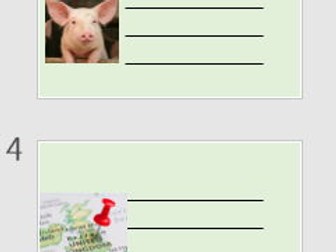
This PowerPoint is designed to support early writing by modelling how to compose simple sentences and captions based on images. Each slide features a clear, engaging picture to prompt discussion and idea generation, giving children a meaningful context for writing.
The teacher uses the images to model how to orally rehearse a sentence before writing it, demonstrating key skills such as segmenting words using Phase 2 phonics, saying the sentence slowly, and writing it in a clear, simple form. The suggested sentence for each image is provided in the slide notes, allowing practitioners to confidently model accurate sentence structure while adapting to children’s responses.
The focus is on short, achievable sentences using decodable words, helping children to apply their phonics knowledge in writing. Teachers can also model key concepts such as:
Saying a sentence out loud before writing
Finger spaces between words
Writing from left to right
Using initial sounds and simple CVC words
Re-reading to check it makes sense
The resource is flexible and can be used in whole-class teaching, small groups, or as part of continuous provision enhancements.
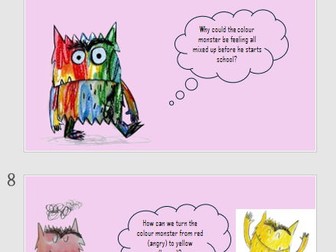
PowerPoint Resource – The Colour Monster Goes to School
This PowerPoint is designed to support children’s understanding of emotions through the story The Colour Monster Goes to School by Anna Llenas.
The PowerPoint pauses at key moments to explore emotions in context, helping children to identify, name, and discuss a range of feelings such as happiness, worry, calmness, fear, and excitement.
Visual prompts, simple text, and discussion questions are used throughout to support engagement and understanding.
The resource supports:
Communication and language development through discussion and questioning
Personal, social and emotional development, with a focus on recognising and managing feelings
Turn-taking, listening, and sharing ideas within a group
PowerPoint Resource – Phase 2 CVC Word Writing
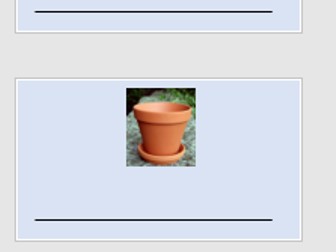
This PowerPoint is designed to support children in applying their Phase 2 phonics knowledge to write simple CVC (consonant-vowel-consonant) words.
Each slide includes a clear, engaging image (e.g. dog, sun) to provide a visual prompt for identifying and writing the corresponding word.
The teacher models how to say the word aloud, listen for each sound, and segment it into individual phonemes before writing. The correct CVC word is provided in the slide notes, enabling practitioners to confidently model accurate sound-to-letter correspondence while responding to children’s ideas.
The focus is on building confidence in segmenting and encoding, using familiar Phase 2 sounds.
Teachers can model key early writing skills such as:
Saying the word slowly and clearly
Segmenting into individual sounds (e.g. c-a-t)
Matching each sound to the correct grapheme
Writing in the correct order from left to right
Re-reading the word to check it
The PowerPoint can be used flexibly across whole-class teaching, guided groups, or as part of continuous provision to reinforce phonics learning.
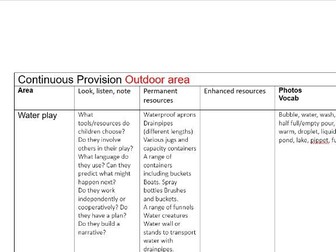
Continuous Provision Plan Template – Outdoor Provision
This template is designed to support practitioners in planning, observing, and developing high-quality outdoor continuous provision. It promotes an intentional and reflective approach to outdoor learning, recognising the unique opportunities the outdoor environment offers for physical development, exploration, and open-ended play.
Each section of the template supports effective practice:
Area
Identifies the specific outdoor provision space (e.g. mud kitchen, water area, construction, gross motor, sand, small world, mark-making). This ensures a broad and balanced outdoor offer.
Look, Listen, Note
Captures meaningful observations of children’s play, language, and interactions outdoors. This helps practitioners understand interests, schemas, and developmental needs in a more active, exploratory context.
Permanent Resources
Lists the core, consistently available resources that enable children to access the area independently. These should be durable, open-ended, and suitable for outdoor use.
Enhanced Resources
Details any additional or seasonal enhancements introduced to extend learning, respond to children’s interests, or create new provocations. These are carefully planned to deepen engagement and challenge thinking.
Photos
Provides visual evidence of the provision and how children interact with it. This supports reflection, assessment, and sharing practice with colleagues and families.
Vocabulary
Identifies key language that practitioners will model and reinforce during outdoor play, supporting communication and language development in a rich, real-world context.
Why this?
Explains the purpose of the provision, including how it supports areas of learning such as physical development, problem-solving, teamwork, and the characteristics of effective learning.
Why now? (Skills Progression)
Links the provision to children’s current developmental stages and next steps. Ensures that outdoor experiences are appropriately challenging and support progression over time.