French Tenses Tests is an easily accessible set of 10 multiple choice tests containing 10 exercises on 10 French tenses: the present tense, the perfect tense, the imperfect tense, the pluperfect tense, the simple future, the near future, the conditional, the imperative, the present subjunctive and the passive voice. It is aimed at students aged 17-18 years. An answer key is also provided.
Uses
-As individual worksheets during class following instruction of each tense to test students’ comprehension and recognition of tenses and conjugation skills;
-As a complete assessment of all tenses at the end of a semester or school year;
-For quick 5-10 minutes revision work at the start or end of a class;
-To clear up any confusion of commonly confused tenses by students.
FRENCH PRESENT TENSE EXERCISES is a no-prep, easy-to-use product aimed at students aged 15-18 years. Broken down into 4 main parts, it provides tables and exercises on 3 verb types in the present tense - 1.regular verbs; 2.irregular verbs; 3. reflexive verbs and also on the recent past (le passé récent).
1.Regular Verbs (Verbes réguliers) - includes a table of regular -er, -ir and -re verb endings, clear examples of how a French verb conjugated in the present tense can mean 5 different things in English followed by 30 written exercises which require students to write French verbs in brackets in the present tense, for example: Tu (manger - to eat) ____________________, Elle (donner - to give) _________________ and to translate English verbs into French, for example, I listen = _________________, She has been tidying = ____________________, etc.
2.Irregular Verbs (Verbes irréguliers) - includes writing 30 irregular verbs in brackets in the present tense, for example, Tu (aller - to go) ________________, Le prof (suivre - to follow) _________________, etc. and 30 exercises requiring students to translate English verbs into French in the present tense, for example, He goes = ___________ , She’s sleeping = _______________, They are running = ____________________etc.
3.Reflexive Verbs (Verbes pronominaux) - includes important points about reflexive verbs, a table of reflexive pronouns and 30 sentence completion exercises involving writing reflexive verbs in brackets in the present tense, for example, Je (se laver = to wash oneself) _____________________ et je (s’habiller = to get dressed) ______________________.
4.The Recent Past (Le passé récent) - the use of the present tense to express the recent past with a table showing a breakdown of how it’s formed followed by 15 translation exercises from French into English, for example, Les enfants viennent de se réveiller and 15 translation exercises from English into French, for example, I have just made, The girls have just written, etc.
USES:
For classwork following instruction of the present tense, for testing your students’ conjugation superpowers, for revision work throughout or at the end of the school year or as final assessment material.
French Question Words is a no-prep, easily accessible product containing examples in use and a variety of exercises on 16 French question words ranging from “comment” …? and “combien” …? to “pourquoi” …? and “y a-t-il” …? for use with students aged 17-18 years. An answer key is also included.
Three translated examples (from French into English) are provided for each question word to reinforce their meaning and use.
EXERCISES
gapfill which requires students to fill in a blank in a question with the correct French question word.
choose the correct question word which involves students, recognising, identifying and selecting the correct French question word from a list of 3 question words to complete a question.
translate question words in a passage into French which requires students to read the passage carefully and choose the correct question word learned in the clearly demonstrated examples.
translate questions from French into English which test the students’ knowledge and use of all question words learned.
Reminders are also given of the long forms of some question words, for example, “qu’est-ce que” …? instead of “que” …? and “qu’est-ce qui” …? instead of “qui” …? with examples indicating verb inversion and no verb inversion.
USES
This product can be used for classwork, following instruction of French question words, testing, revision work and assessment.
If you want your students to fully grasp knowledge of key French question words enabling them to understand and use them in an oral assessment or exam, to easily navigate French reading and listening comprehensions, to engage in classroom discussions or carry out interviews in French among their peers, then this product is for them.
Christmas German Quiz is a no-prep printable quiz packed full of questions on Christmas traditions and customs in Germany and other countries. It is aimed at 15–18-year-old students and adults. All of the questions are in German and an answer key is provided.
The types of questions are:
multiple-choice
true or false
picture identification and labelling
completing lyrics
finding the odd one out
fill in the blanks
Students can choose to circle or underline the correct answer in the multiple-choice questions.
Full marks awarded for all correct answers = 64
As indicated on the scoresheet in German (before the answer key), award one mark each for questions requiring one answer. Award one mark each for question 3. (total marks = 2 marks) and award one mark each for question 48. (total marks = 4 marks.)
This product is a great way of engaging students and testing their knowledge and comprehension of German Christmas vocabulary, customs and traditions. It also tests students’ ability to read and understand questions in German. You can use it in class in groups or individually as a winding down activity before the Christmas break!
Christmas French Quiz is a no-prep printable quiz packed full of questions on Christmas traditions and customs in France and other countries. It is aimed at 15–18-year-old students and adults. All of the questions are in French and an answer key is provided.
The types of questions are:
1.multiple-choice
2.true or false
3.picture identification and labelling
4.completing lyrics
5.finding the odd one out
6.fill in the blanks
Students can choose to circle or underline the correct answer in the multiple-choice questions.
Full marks awarded for all correct answers = 64
As indicated on the scoresheet in French (before the answer key), award one mark each for questions requiring one answer. Award one mark each for question 3. (total marks = 2 marks) and award one mark each for question 48. (total marks = 4 marks.)
This product is a great way of engaging students and testing their knowledge and comprehension of French Christmas vocabulary. It also tests students’ ability to read and understand questions in French. You can use it in class in groups or individually as a winding down activity before the Christmas break!
GERMAN RELATIVE PRONOUNS is a step-by-step guide that clearly explains, with examples, everything that students aged 17-18 years need to know about German relative pronouns. The guide contains:
a definition of relative pronouns with a detailed example
a colour-coded table of the pronouns in German only
a colour-coded table of the pronouns and their meanings in English
a ‘How do I know which relative pronoun to use?’ section which includes steps to determine the right case - 4 examples are provided showing relative pronouns in each of the 4 cases.
examples in the 4 cases using words from the same sentence
a section on relative clauses containing prepositions
a section on the use of the relative pronoun was
100 exercises which require students to find relative clauses in sentences/questions, to complete 20 sentences (for each case) with the correct pronoun and to complete sentences choosing either was or any of the other pronouns (NOTE: Words from the nominative case exercises are used in the other 3 case exercises to reinforce understanding for students of each relative pronoun.)
an answer key.
USES:
Use this product to teach German relative pronouns to students, to practise using them, to enable students to recognise and identify them, and to complete exercises independently using the tables and step-by-step examples provided.
It can also be used as a reference guide for revision purposes in preparation for an end-of-semester or end-of-year German exam.
The exercises could also be distributed as homework tasks or used by teachers as assessment material.
You can also check out my product, GERMAN GRAMMAR EXERCISES - SECTION 3, for more relative pronouns exercises.
German Adjective Endings - Tables, Examples and Exercises is a no-prep, comprehensive printable pack aimed at students aged 17-18 years and contains:
4 colour-coded tables
60 examples of adjective endings in use
40 exercises
profitable pointers on the German adjective endings tables.
Colour-coding is used in each table to help students identify and memorise all German adjective endings, especially those shared among other genders and cases. The product’s 60 clear examples have fully translated sentences (5 separate sentences for each of the 3 genders) containing German adjective endings broken down into all 4 cases, nominative, accusative, dative and genitive.
The 40 exercises are fill in the blanks exercises which require students to add the correct adjective ending in each sentence.
USES
The 4 tables are all on one single page for quick and easy reference. This page could be printed and distributed to students for storage in a revision folder or for display on a study board at home to use for homework activities. Teachers could also print a copy of the colour-coded tables sheet and display it on the classroom wall.
The examples and exercises in each case are also on a single page.
The exercises could be used in class as practice activities following instruction of German adjective endings, as homework exercises or for an upcoming end-of-term or end-of-year assessment.
Ideal for easy reference when completing class assignments, homework, etc. and for revision.
German Declension Tables is a quick and easy access guide containing ALL German declension tables you will need for teaching German grammar to students of all ages from 13 years +.
All tables are colour-coded and include the declension of nouns with:
1.definite and indefinite articles - der, die, das, die, etc.
2.no, not a, not any - kein, keine, etc.
3.possessive adjectives - mein, dein, sein, ihr, etc.
4.this, every, which - dies-, jed-, welch-
5.adjective endings - der gute Mann, die gute Frau, das gute Kind, etc.
6.adjective endings without the or* a* - guter Rat, gute Bildung, gutes Benehmen, etc.
USES: These printable tables could be distributed to students for use in class when completing written German language activities, for example, filling in blanks with the correct definite article, adjective ending or pronoun in grammar activities, writing emails to friends and helping students recognise and identify number, genders and cases in reading and listening comprehensions. By frequently referring to this colour-coded product when completing activities, students will be able to improve their German grammar skills.
The tables can also be used as an ideal revision tool for an upcoming class test, assessment or oral exam to ensure accuracy in writing and speaking.
This neat bundle is also ideal for homework use! All tables could be displayed on the classroom wall and/or stored in students’ folders.
BONUS reference tables are also provided for prepositions and conjunctions!
This fun bumper German quiz pack will keep your students active and engaged as it tests their knowledge of German language and culture. There are 5 quizzes in total with each one containing 20 questions, all of which are written in German. Question types include filling in blanks, multiple choice and true or false questions. An answer key is provided. As indicated in the answer key, where there is one answer to be provided, award 1 point and where there are two answers to be provided, award .5 points each. Each quiz can be used during class as a fun group activity or an individual assessment at a time of your choosing during the school year, making it a convenient German classroom resource.
German Grammar Exercises - Section 3 is a no-prep German grammar activities product for teenagers (14-18yrs) and adults. It contains 600+ exercises on:
The Imperative in the du, ihr, Sie and wir forms & its use in public signs and notices
All Pronouns: personal, direct object, indirect object, relative, interrogative and reflexive pronouns
The Passive Voice: present passive, imperfect passive, perfect passive, pluperfect passive and future passive
Word Order: verb second item rule & time, manner, place rule
Conjunctions: coordinating, subordinating, adverbial & correlative conjunctions
Brief reminders of important grammar rules, for example, on the position of the verb in a German sentence, how the imperative and passive voice are formed, and lists & tables of pronouns, etc. are displayed at the top of the activity pages to help reinforce learning for the students.
This product is ideal for end of term or end of year assessment, revision and homework. The activity pages may also be used in class by students for practice after each grammar topic has been taught.
An answer key is provided.
German Prepositions And Their Cases equips teachers and students with an essential guide packed full of examples and exercises to help learn and memorise German prepositions. The guide includes:
the sets of prepositions that always take the accusative, dative, genitive and accusative OR dative case along with mnemonic phrases
examples of all prepositions in use
accusative OR dative prepositions with pictorial examples
the use of tricky prepositions auf, in, an, zu & bei, followed by exercises and an answer key.
GERMAN STRONG VERBS - TABLES & TESTS IN 3 TENSES contains 12 tables of 186 strong verbs in the present, imperfect and perfect tenses, and 4 test sheets for students aged 16 - 18 years and adults, followed by an answer key.
Each table is coloured and categorised according to similar vowel changes in the third person singular of verb stems (in bold) in each tense, for example:
in the dark blue table, ä in the present tense changes to i in the imperfect tense and a in the past participle; in the orange table,*** ie in the present tense changes to a in the imperfect tense and o in the past participle. In the dark green table, ei in the present tense changes to ie in the imperfect tense and in the past participle, and in the grey table,**** ie**** in the present tense changes to o in the imperfect tense and in the participle.
USES: This no-prep product can be printed and distributed to students to show them the variety of similar patterns in vowel changes all grouped together in single tables. Recognising similar patterns in each table will help students memorise the verbs more easily in each tense. The tables can then be used as study material for upcoming class tests or assessments (oral and written). The test sheets (which involve testing students’ knowledge of each verb in all 3 tenses in the third person singular form) could be used randomly by the teacher at different stages during a school year as class tests. The product could also be used as an independent work packet for students who are eager to study and test themselves on all 186 verbs.
Students could also display the tables on a study board at home and/or the tables could be displayed on the classroom wall.
I use these tables frequently to test students’ knowledge (oral and written) of these commonly used German irregular verbs. The result is an overall improvement in reading, listening and oral language skills.
German Plurals Mind Maps is a no-prep product ideal for teaching or revising German plural rules to/with students of all ages from 12 years +. Through their simple and organised layout, each mind map aims to help students visually remember the plurals of masculine, feminine and neuter nouns.
This practical and interactive product contains:
Plurals of masculine nouns and examples (with some exceptions)
Plurals of feminine nouns and examples (with some exceptions)
Plurals of neuter nouns and examples (with some exceptions)
Examples of nouns that are plural in English but singular in German
Examples of nouns that are plural in German but singular in English
German plurals activities which require students to correctly categorise German nouns in their plural forms
Answer key
The mind maps showcasing the German plurals of nouns in the three genders could be displayed on the classroom wall(s) for quick and easy access/reference. The activities pages could be used as a class exercise, a homework exercise or as part of an end-of-term or end-of-year assessment.
GERMAN WEAK VERBS - TABLE & TESTS IN 3 TENSES contains an A-Z table of over 100 weak verbs in the present, imperfect and perfect tenses, and 4 test sheets, for students aged 16 - 18 years and adults, followed by an answer key.
The table of verbs is colour-coded to help students identify similar patterns in each tense. All verbs are in the er/sie/es/man (and ich for the imperfect) forms.
3 test sheets contain a list of 22 verbs each in the infinitive form. Students are tasked with entering the correct form of each verb in each of the 3 tenses.
The 4th more challenging test sheet comprises 30 fill in the blanks exercises in which students must provide the correct German translation of an English verb in brackets in one of the three tenses.
USES: This no-prep product can be printed and distributed to students to show them the variety of very similar patterns in common weak verb endings all grouped together in a single table. The table can then be used as study material for upcoming class tests or assessments (oral and written). The test sheets could be used randomly by the teacher at different stages during a school year as class tests. The product could also be used as an independent work packet for students who are eager to study and test themselves on all 100+ verbs.
Students could also display the tables on a study board at home and/or the tables could be displayed on the classroom wall.
I use this table of verbs frequently to test students’ knowledge (oral and written) of these commonly used German regular verbs. The result is an overall improvement in reading, listening and oral language skills.
GERMAN VERBS IN ALL TENSES provides teachers of students aged 14 - 18 years with an easily accessible guide on all 7 German verb types (regular weak, irregular strong, mixed, separable, inseparable, reflexive and modal) in all tenses (present, perfect, pluperfect, imperfect, future, conditional and imperative) in the first and third person singular forms, followed by assessments on common German verbs in a range of tenses.
The product comprises 3 sections:
An All Verb Types in all Tenses guide that can be distributed to students for easy reference / use in class when completing verbs exercises or as an all-in-one study/revision aid for end-of-term or end-of-year assessments.
A set of 22 German Verbs and Tenses exercises containing 6 exercises per verb in which students must provide the correct German translations, for example, fragen = to ask
I ask = ..................... He asked = .................... They will ask = ...................
She had asked = .................... I would ask = .................
A section on 50 German verbs and their opposites, which could be distributed to students as another very useful reference tool and study/revision aid, followed by 18 exercises in which students must complete an arrow with the correct opposite, for example, hassen - lieben, etc. These could also be used for assessment purposes.
An answer key is provided.
German Verbs with Prefixes - Separable and Inseparable is a practical no-prep resource which is very useful for teachers who want to enable their students to recognise and memorise a wide range of tricky common German verbs with prefixes (separable and inseparable) that feature in typical German dialogues, reading and aural comprehensions, etc. for example, abmachen, anmachen, aufmachen and ausmachen. This is achieved via the use of clear and colourful graphics.
12 pages of the resource may be used as wall charts.
Multiple Choice exercises which require students to underline the correct verb and True or False exercises along with an answer key are provided.
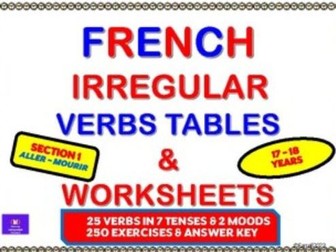
French Irregular Verbs Tables and Worksheets - Section 1 is a pack of 25 French irregular verbs tables displaying fully conjugated verbs in 7 tenses and 2 moods and worksheets with an answer key aimed at students aged 17 - 18 years. The verbs range in alphabetical order from ALLER to MOURIR and each page contains:
an irregular verbs table displaying the verb fully conjugated in the present, the imperfect, the perfect, the pluperfect, the past historic, the present subjunctive, the future, the conditional and the imperative followed by
a worksheet containing 10 fill in the blanks exercises testing students’ knowledge and use of each tense and mood.
USES:
Combining verbs tables and a fill in the blanks worksheet all on the one page makes this product ideal for:
eliciting recognition, knowledge and use of each verb in each tense and mood at the start of a new term
classwork activities after completing learning of the uses of all or most tenses and moods on each page
testing students’ knowledge of the correct use of each tense, particularly the past tenses, and ensuring accuracy by students in terms of subject - verb agreement
testing students’ ability to choose the correct tense to be used for each irregular verb according to the context given in each French sentence on the individual worksheets
revision use for end of term or end of year assessment. The verbs tables and completed exercises could be retained by students as an essential irregular verbs tables guide to help with homework and study for upcoming assessments or exams.
Teachers could choose to distribute any given number of the verbs pages over a period of weeks or months to students in class for on-the-spot testing or for use as part of a class French quiz.
The layout of the verbs tables has been presented in such a way as to enable students to easily memorise the forms of some tenses and the stems of the verbs in some tenses that are similar. The present and the imperfect tenses are placed side by side for each verb, as are the perfect and pluperfect and the future and conditional.
German Dialogues in Public Places - Section 1 is an easily accessible reading and speaking practice pack of 30 German dialogues in 15 public places followed by dialogue completion activities for use with 16-18-year-old students.
The product contains:
A table of contents indicating all 15 public places covered
30 typical, everyday dialogues in 15 public places (2 dialogues per place) ranging from those taking place at the airport to those occurring in a department store
A glossary of vocabulary used in each of the dialogues
15 short follow-up dialogue completion exercises in which students are required to translate English sentences, from 15 of the 30 dialogues practised in class, into German. All of the answers are in the dialogues.
Both dialogues for each public place and glossary fit onto one page making it a highly accessible product.
When completing the dialogue activities, students may use alternative ways of expressing words and phrases, for example, of course, thank you, great!, Anything else? in German.
USES:
This is ideal for reading and speaking practice with students, for testing their knowledge or short-term recall of what they have just learned, for testing and/or boosting students’ vocabulary skills and for developing students’ listening skills.
Students could practise each dialogue aloud in class in pairs.
The product could be used as supplementary material when working through many units and topic areas with students during the school year, or as assessment material during or at the end of term or the school year.
German Dialogues in Public Places - Section 2 is an easily accessible reading and speaking practice pack of 30 German dialogues in 15 public places followed by dialogue completion activities for use with 16-18-year-old students.
The product contains:
A table of contents indicating all 15 public places covered
30 typical, everyday dialogues in 15 public places (2 dialogues per place) ranging from those taking place at the doctor’s to those occurring at a museum.
A glossary of vocabulary used in each of the dialogues
15 short follow-up dialogue completion exercises in which students are required to translate English sentences, from 15 of the 30 dialogues practised in class, into German. All of the answers are in the dialogues.
Both dialogues for each public place and glossary fit onto one page making it a highly accessible product.
When completing the dialogue activities, students may use alternative ways of expressing words and phrases, for example, of course, thank you, great!, Anything else? , certainly, ok, I would like, Would you like….?, etc. in German.
USES:
This is ideal for reading and speaking practice with students, for testing their knowledge or short-term recall of what they have just learned, for testing and/or boosting students’ vocabulary skills and for developing students’ listening skills.
Students could practise each dialogue aloud in class in pairs.
The product could be used as supplementary material when working through many units and topic areas with students during the school year, or as assessment material during or at the end of term or the school year.
German Speaking Activities - Section 1 is a no-prep oral practice pack for students aged 17-18 years. It contains:
12 detailed dialogues on 5 general conversation topics: Details zur Person, Familie, Wohnort, Schule and Sprachenlernen.
glossaries containing key vocabulary and expressions.
an Over To You section which requires students to answer typical written exam questions and then practise speaking in pairs.
Topic 1: Details zur Person contains 3 dialogues between a teacher and student in the classroom, in the language laboratory and between two students in the school canteen.
Topic 2: Familie contains 2 dialogues occurring before the cinema and after the cinema.
Topic 3: Wohnort contains 2 dialogues on living in town and living in the country.
Topic 4: Schule contains 3 dialogues on school in general, school rules and a school timetable.
Topic 5: Sprachenlernen contains 2 dialogues on the German language and foreign languages.
USES:
The dialogue scripts can be used for pair work speaking practice in class.
The glossaries and other vocabulary and expressions in each script could be used by students when completing the written questions in the *Over To You *section.
The completed tailored answers to the written questions could be practised in preparation for an end-of-term or end-of-year final oral exam.
German Speaking Activities - Section 2 is a no-prep oral practice pack for students aged 17-18 years. It contains:
-12 detailed dialogues on 5 general conversation topics: Berufsplaene, Nebenjobs, Freizeitbeschaeftigung, Ferien / Reisen and Aufenthalt in Deutschland / im deutschsprachigen Raum.
-glossaries containing key vocabulary and expressions
-an Over To You section which requires students to answer typical written exam questions and then practise speaking in pairs.
Topic 1: Berufsplaene contains 2 dialogues, 1 between 2 students in which they discuss dream jobs, and 1 between a teacher and a student who discuss not having any career plans.
Topic 2: Nebenjobs contains 2 dialogues, 1 between a teacher and a student in which they discuss the student’s part-time job, and 1 between 2 students in which they discuss a new part-time job.
Topic 3: Freizeitbeschaeftigung contains 3 dialogues, the first between 2 students discussing hobbies and interests, the second between 2 students discussing a favourite hobby, and the third between 2 students discussing ownership of a Youtube channel.
Topic 4: Ferien / Reisen contains 3 dialogues, the first between 2 students discussing a trip to Spain, the second between 2 students on a winter holiday in Salzburg, and the third between 2 students discussing the coming summer holidays.
Topic 5: Aufenthalt in Deutschland / im deutschsprachigen Raum contains 2 dialogues, 1 between 2 students discussing a stay in southern Germany, and 1 between a teacher and a student in which they discuss the student’s student exchange in Cologne.
USES:
The dialogue scripts can be used for pair work speaking practice in class.
The glossaries and other vocabulary and expressions in each script could be used by students when completing the written questions in the Over To You section.
The completed tailored answers to the written questions could be practised in preparation for an end-of-term or end-of-year final oral exam.


 Quick View