 Quick View
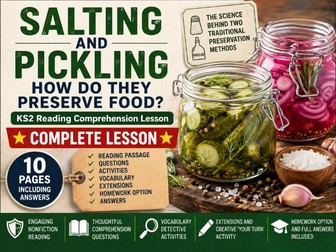
How Do Salting and Pickling Preserve Food? | KS2 Reading Comprehension | Science
How can salt and vinegar stop food from spoiling? This engaging KS2 reading comprehension lesson explores the science behind two of the oldest methods humans have used to preserve food: salting and pickling.
Designed for Years 5–6 / Upper KS2, the resource combines an accessible nonfiction reading passage with comprehension, vocabulary, creative thinking and extension activities. It can be used as a complete reading lesson, for guided or independent reading, as a science-linked literacy activity, or as cover work.
This resource includes:
Engaging nonfiction reading passage about food preservation
Before You Read activities
10 reading comprehension questions
Vocabulary Detective activities
Creative “Your Turn” task
Finished Early? extension activity
Extra Challenge
Homework activity
Full answer section
The passage explores why food spoils, how microorganisms contribute to decay, how salt removes water from food through osmosis, and how the acidity of vinegar makes it difficult for many microorganisms to survive. It also introduces the long history of salting and pickling food.
The activities encourage pupils to retrieve information, explain scientific processes, use vocabulary in context and apply what they have learned to new situations.
Suitable for Year 5, Year 6, KS2 reading comprehension, nonfiction reading, science reading, microorganisms, food preservation and cross-curricular English/science lessons.
Format: Printable PDF
Age range: 9–11 / Years 5–6
Answers included