Year 7 Maths Baseline Automated TrackerQuick View
Bsharpey123

Year 7 Maths Baseline Automated Tracker

(0)
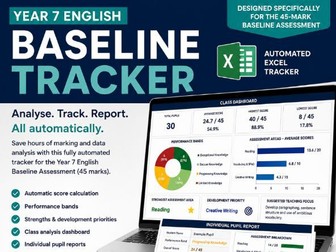
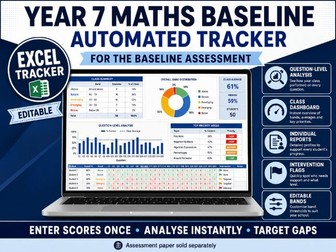
Automated Excel tracker designed specifically for the Year 7 Maths Baseline Assessment. Enter question-level marks and the workbook instantly produces class analysis, pupil reports and intervention priorities. This editable Excel tracker has been created to accompany the Sharpe Education Year 7 Maths Baseline Assessment and Mark Scheme, available separately. Teachers enter each pupil’s question-level marks once. The spreadsheet then automatically calculates totals, percentages, curriculum-strand performance, diagnostic bands and suggested intervention priorities. Included features Data-entry space for up to 40 pupils Question-level mark entry Automatic total score out of 50 Automatic overall percentage Editable diagnostic performance bands Curriculum-strand scores and percentages Number analysis Fractions, decimals and percentages analysis Geometry and measures analysis Algebra and ratio analysis Reasoning and problem-solving analysis Automatic identification of each pupil’s primary area for development High, medium and routine intervention flags Whole-class dashboard Question-level class analysis Performance-band distribution Individual pupil reports Suggested next steps Filterable intervention overview Editable thresholds and question mapping Suitable for Year 6 to Year 7 transition September baseline assessment Class and cohort analysis Intervention planning Pupil progress meetings Mathematics subject leaders Tutors and home educators Important information This tracker is designed specifically for the corresponding Year 7 Maths Baseline Assessment. The assessment paper and mark scheme are not included with this tracker and must be purchased separately. The workbook uses standard Excel formulas and does not require macros or external add-ins. Performance bands are diagnostic categories rather than nationally standardised thresholds and can be edited to match a school’s assessment approach.
Editable Teacher Feedback & Improvement SheetQuick View
Bsharpey123

Editable Teacher Feedback & Improvement Sheet

(0)
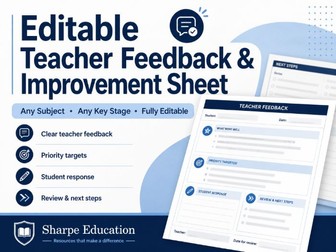
Editable teacher feedback and improvement sheet for any subject or key stage. Includes strengths, targets, next steps, pupil response and follow-up. This professional, one-page feedback template is designed to make marking clear, purposeful and easy for pupils to act upon. The sheet can be edited and reused across different subjects, year groups and assessment types. It provides a consistent structure for recording teacher feedback while giving pupils dedicated space to respond and improve their work. Included sections Pupil and assessment details Assessment criteria Strengths and successes One clear priority target Actionable next steps Pupil reflection and response Improvement work Teacher follow-up and review Suitable for KS2, KS3, KS4 and KS5 Any curriculum subject Formative assessment End-of-unit assessments Homework feedback Book marking DIRT and improvement lessons Department-wide feedback systems Pupil progress reviews Resource features Fully editable Word document Clean, professional A4 layout Printer and photocopier friendly Suitable for handwritten or typed feedback Easy to adapt to department assessment criteria Helps pupils understand exactly how to improve This resource supports a simple feedback cycle: Identify strengths → set a priority target → complete an improvement task → review progress Ideal for teachers looking for a consistent feedback format that encourages meaningful pupil response rather than feedback being read once and then ceremonially ignored forever.
Year 7 Maths Baseline & Mark SchemeQuick View
Bsharpey123

Year 7 Maths Baseline & Mark Scheme

(0)
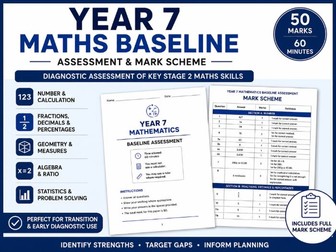
Year 7 maths baseline assessment and mark scheme for assessing KS2 knowledge on entry to secondary school. Includes a 50-mark, 60-minute paper. This professionally designed diagnostic assessment helps teachers identify pupils’ mathematical strengths and areas for development at the beginning of Year 7. The assessment is aligned to key objectives from the Key Stage 2 Mathematics National Curriculum for England and progresses from accessible fluency questions to more challenging reasoning and problem-solving tasks. Content assessed Number and place value Addition, subtraction, multiplication and division Rounding and calculation fluency Fractions, decimals and percentages Geometry and measures Perimeter and area Coordinates and reflection Algebra and sequences Ratio and proportion Statistics, money and time Mathematical reasoning and multi-step problem solving Included in this resource 50-mark Year 7 baseline assessment 60-minute non-calculator paper Clear pupil instructions Accessible and progressively challenging questions Full teacher mark scheme Detailed method-mark guidance Section-by-section mark totals Teacher recording grid The assessment is suitable for use: During Year 6 to Year 7 transition At the beginning of the autumn term As an initial diagnostic assessment To support class planning, intervention and pupil grouping In mainstream, intervention, tutoring and home-education settings The assessment has been designed to provide useful diagnostic information without requiring pupils to have studied the Year 7 curriculum already. A complete toolkit containing an automated Excel tracker, question-level analysis, curriculum mapping, class analysis and individual pupil reports is also being developed separately.
Year 7 English Baseline Automated TrackerQuick View
Bsharpey123

Year 7 English Baseline Automated Tracker

(0)
Designed specifically to accompany the Sharpe Education Year 7 English Baseline Assessment (45 marks). This automated Excel tracker instantly analyses pupil performance, assigns performance bands, identifies strengths and development priorities, and generates both class and individual reports with minimal teacher input. Please note: This tracker has been created specifically for the accompanying 45-mark Year 7 English Baseline Assessment and is not intended as a generic assessment tracker. What’s Included: Fully automated Excel tracker Automatic score calculation Automatic percentage calculation Performance band allocation Class analysis dashboard Individual pupil reports Assessment area analysis Suggested teaching focus Editable workbook Protected formulas to prevent accidental editing Perfect For: English Departments Heads of English KS3 Leads Year 7 Transition September Baseline Testing Data Analysis Progress Meetings
KS3 Year 7 English Baseline Assessment Toolkit | Assessment, Mark Scheme & TrackerQuick View
Bsharpey123

KS3 Year 7 English Baseline Assessment Toolkit | Assessment, Mark Scheme & Tracker

(0)
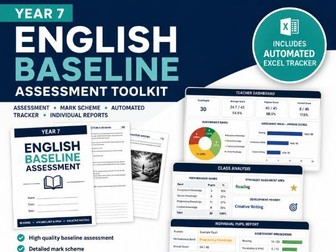
Save hours of marking and data analysis with this complete Year 7 English Baseline Assessment Toolkit. This professionally designed resource includes a high-quality baseline assessment, detailed mark scheme and a fully automated Excel tracker that instantly calculates scores, assigns performance bands, identifies strengths and development priorities, generates intervention recommendations and produces whole-class and individual pupil reports.
Year 7 Musical Elements & Keyboard AssessmentQuick View
Bsharpey123

Year 7 Musical Elements & Keyboard Assessment

(0)
Complete 50-mark Year 7 Music assessment covering musical elements, notation, keyboard performance and evaluation, with differentiated sheet music for Für Elise. This ready-to-use assessment is designed to assess pupils’ knowledge, practical performance skills and ability to evaluate their own musical work. Assessment structure AO1: Musical Knowledge and Recall – 18 marks Questions assess pupils’ understanding of key musical elements, notation and subject-specific vocabulary. AO2: Keyboard Performance – 18 marks Pupils perform an arrangement of Für Elise on the keyboard using the differentiated sheet music provided. AO3: Performance Evaluation – 14 marks Pupils reflect on their performance, identify strengths and explain how they could improve their accuracy, fluency and expression. Included in this resource Complete 50-mark Year 7 Music assessment Musical elements and notation questions Practical keyboard performance task Differentiated Für Elise sheet music Accessible arrangements for different ability levels Performance assessment criteria Structured pupil evaluation task Clear AO1, AO2 and AO3 mark allocation The differentiated sheet music allows pupils to complete the same core performance task at an appropriate level of challenge, making the assessment suitable for mixed-attainment Year 7 classes. This resource is ideal for: End-of-unit assessment Musical elements and notation units Keyboard performance units KS3 progress assessment Cover lessons with a practical component Supporting consistent assessment across multiple classes
KS3 Instruments of the Orchestra AssessmentQuick View
Bsharpey123

KS3 Instruments of the Orchestra Assessment

(0)
Complete KS3 Instruments of the Orchestra assessment covering instrument families, orchestral layout, musical characteristics and listening skills. This ready-to-use end-of-unit assessment is ideal for evaluating pupils’ understanding of the orchestra at Key Stage 3. The resource assesses pupils’ knowledge of: The four orchestral instrument families String, woodwind, brass and percussion instruments Instrument names and characteristics How instruments produce sound The layout of the orchestra Identifying instruments from descriptions Applying knowledge to listening and musical contexts Question types include Multiple-choice questions Short-answer questions Instrument identification Orchestral-family classification Listening-response activities Applied knowledge questions Suitable for Year 7 Music KS3 classroom assessment End-of-unit assessment Retrieval and revision Cover lessons Homework Non-specialist Music teachers Assessing prior knowledge before an orchestra unit The assessment provides a clear overview of pupils’ factual knowledge and their ability to apply their understanding of orchestral instruments. It can be completed independently and used to support future planning, intervention and curriculum review.