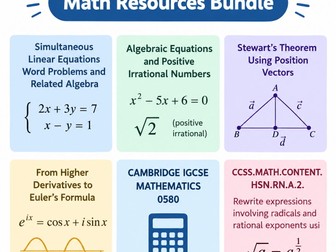
Covers the full Grade 12 Set Theory curriculum: Sets & Notation, Types & Subsets, Power Sets, Set Operations, Venn Diagrams, Cardinality & Inclusion–Exclusion, Set Laws & De Morgan’s Laws, Algebra of Sets, Cartesian Products, Relations & Functions.
Up graded.
Master Projectile Motion with Complete, Step-by-Step Solutions!
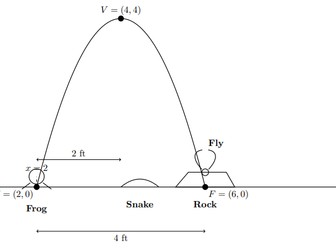
Looking for clear, exam-focused notes on Projectile Motion? This comprehensive set covers the complete theory along with 20 important questions and fully worked solutions, making it an ideal resource for students preparing for physics and mathematics exams. From the basic equations of projectile motion, trajectory, range, maximum height, and time of flight to advanced concepts such as the parabola of safety, inclined-plane range, minimum initial speed, moving targets, explosions, and relative motion, every problem is explained step by step with the necessary mathematical derivations. The notes are professionally formatted in LaTeX and include helpful diagrams, key formulas, and boxed final results for quick revision. Save time, strengthen your concepts, and prepare confidently for your exams with this all-in-one Projectile Motion solution guide!
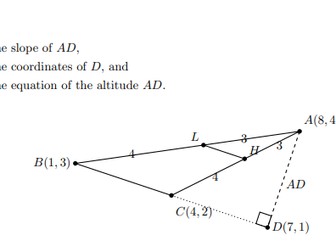
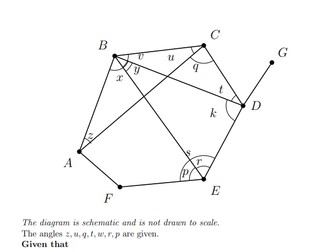
A Distinctive Problem-Solving Resource for Algebra, Trigonometry and Geometry
Comprising 283 carefully selected and thoughtfully structured problems in Algebra, Trigonometry, and Geometry, this book offers a distinctive approach to mathematical problem solving. It is designed not merely as a collection of questions, but as a source of mathematical ideas, strategies, and further problems.
Many of the problems are deliberately chosen so that they can serve as a starting point for creating new questions, exploring alternative methods, and discovering deeper mathematical connections. In this way, the book encourages learners to move beyond finding answers and towards understanding how mathematical problems are constructed and solved.
With the demands of international curricula in mind, the book brings together a broad range of problems that develop conceptual understanding, logical reasoning, creativity, and mathematical maturity. Particular emphasis is placed on the strategy behind a solution—how to recognize the structure of a problem, select an appropriate method, overcome obstacles, and extend an idea to unfamiliar situations.
The aim is therefore not simply to provide solutions, but to equip learners with a repertoire of problem-solving strategies that can be transferred to challenging and unfamiliar problems.
Whether used for independent study, classroom enrichment, mathematical competitions, or advanced practice, this book is intended to be more than a problem book. It is an invitation to think mathematically, investigate ideas, and develop the confidence to tackle challenging problems.
I believe that readers will discover within these pages a richer and more purposeful approach to mathematical problem solving than can be conveyed by a brief description alone.
Master Electric Fields with confidence using this comprehensive Cambridge International AS & Edexcel International A Level Physics Worksheet. Designed to build deep conceptual understanding and strong exam-solving skills, this worksheet features carefully selected, exam-style questions with fully worked step-by-step solutions, clear explanations, and professional diagrams to make even challenging topics easy to understand. Covering point charges, electric fields, electric potential, capacitors, Millikan’s oil-drop experiment, Bohr’s model, and more, it is an excellent resource for classroom learning, self-study, revision, and exam preparation. Whether you’re aiming for top grades in Cambridge, Edexcel, or other international curricula, this worksheet will help you strengthen your problem-solving skills and boost your confidence before the exam.
Grade 8 Angle Relationships – Complete Teaching & Practice Workbook (Cambridge Lower Secondary Checkpoint)
Save hours of lesson planning with this professionally designed Grade 8 Angle Relationships Workbook, created specifically for the Cambridge Lower Secondary Checkpoint curriculum. This comprehensive resource includes clear explanations of interior, exterior, adjacent, vertically opposite, supplementary, linear pair, and reflex angles, supported by high-quality diagrams, worked examples, progressive practice exercises, challenge questions, and a complete answer key. Every mathematical concept has been carefully checked for accuracy, making it a reliable classroom resource for teachers, homeschool educators, tutors, and independent learners. Whether used for classroom instruction, homework, revision, or exam preparation, this printable workbook helps students build confidence and master angle relationships through structured, curriculum-aligned practice.
Modified Euler’s Method – Fully Solved Numerical Analysis Worksheet with Graphs (College / University Mathematics)
Strengthen students’ understanding of the Modified Euler’s Method (Predictor–Corrector Method) with this comprehensive, step-by-step worked example. Designed for undergraduate mathematics, engineering, and numerical analysis courses, this resource demonstrates every stage of the numerical solution process in a clear and systematic manner. It includes detailed calculations, summary tables, comparison with the exact solution (where available), error analysis, professionally drawn graphs using LaTeX (PGFPlots), and analytical solution hints. The well-organised layout makes it an excellent classroom handout, assignment solution, revision guide, or self-study resource for students preparing for quizzes, examinations, and university-level coursework.
Topics Covered: Modified Euler’s Method (Predictor–Corrector), Numerical Approximation of Initial Value Problems, Exact Solution Comparison, Error Analysis, Graphical Interpretation, and Complete LaTeX Source Code.
Back Cover Description
Spot the Misconceptions in Mathematics is a carefully designed practice book for Grades 8–10, O Level, IGCSE, and GCSE Mathematics. It features a rich collection of misconception-based questions that challenge students to identify common mathematical errors and replace them with correct reasoning. Each question is accompanied by a clear, step-by-step solution that strengthens conceptual understanding rather than rote memorization. Covering essential topics such as number systems, sets, algebra, radicals, logarithms, polynomials, equations, and functions, this book is ideal for classroom learning, homework, revision, and exam preparation. With its high-quality, curriculum-aligned content and emphasis on mathematical reasoning, it helps students build confidence, improve accuracy, and achieve success in school and board examinations.
This book is far more than a collection of worked solutions—it is a comprehensive problem-solving strategy designed to equip learners with the ability to know how to know. Developed in line with secondary school and pre-university mathematics curricula, it is particularly valuable for students preparing for school examinations, national examinations, and entrance tests. Beyond solving individual questions, it reveals the underlying structures and methods that generate entire families of problems. Readers learn how to control the conditions of a question, predetermine the nature of its solutions (equal roots, distinct rational roots, distinct irrational roots, and more), and understand the mathematical principles before the question is even posed. This powerful question-generation approach provides an almost unlimited source of carefully structured exercises with known outcomes, making it an invaluable resource for content writers, textbook authors, examination setters, teachers, tutors, and independent learners. By transforming routine exercises into systematic mathematical investigations, the book fosters deep conceptual understanding, creativity, and confidence, enabling learners not merely to solve problems, but to master the art of constructing, analysing, and extending them.
This complete set of advanced notes and worked examples is tailored for students preparing for Grade 12 / A‑level assessments and covers the exact requirements of major exam specifications including Edexcel and other international syllabi such as Cambridge 9709/9231 and IB HL Calculus; it presents clear definitions, step‑by‑step proofs, and exam‑style problems on special functions (Gamma and Beta), trigonometric reduction formulas, and standard integral techniques to build both procedural fluency and exam confidence. The material maps directly to common exam curriculum objectives—proof and derivation, substitution and change of variables, and recognition of standard forms—so students following Edexcel or equivalent curricula will find it immediately usable for revision and past‑paper practice. Designed with graded difficulty (skill checks, challenging questions, and full solutions), this resource is ideal for teachers, tutors, and students aiming for top marks in terminal examinations and university‑level preparation.
Empower students with a comprehensive Mathematics curriculum designed to meet USA and UK educational standards. Covering Grades 1–12, these high-quality resources align with leading curricula and exam requirements, making them ideal for schools, teachers, tutors, and homeschooling. Each lesson is carefully structured to build strong mathematical foundations, enhance critical thinking, and prepare learners for classroom assessments, standardized tests, and international examinations. Whether you’re teaching elementary arithmetic, algebra, geometry, calculus, or advanced problem-solving, these curriculum-aligned materials provide engaging, effective, and exam-focused learning for every grade level.
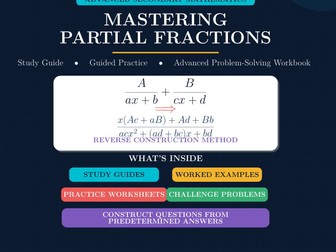
This A-Level Mathematics Partial Fractions Mastery Workbook is designed for learners following UK Mathematics curricula (GCSE Higher Tier, A-Level Mathematics, Further Mathematics, and international programmes aligned with UK standards). It develops deep understanding of partial fractions through structured examples, progressive difficulty levels, exam-style questions, and fully worked solutions.
The unique feature of this resource is that it teaches how mathematics content is created, not only how questions are solved. Teachers can use the algebraic frameworks, parameter-based models, and predetermined-answer techniques to generate unlimited variations of high-quality practice questions while controlling difficulty, structure, and final answers. Independent learners can use the same methods to practise creating their own question banks, checking solutions, and developing stronger algebraic reasoning.
Aligned with key UK curriculum skills including algebraic manipulation, factorisation, rational expressions, polynomial division, decomposition of functions, and proof-style reasoning, this resource supports classroom teaching, intervention programmes, revision planning, and self-directed mastery.
Whether you are a teacher building worksheets, a tutor designing assessments, or a student preparing for advanced mathematics examinations, this is more than a workbook — it is a mathematical question-engineering toolkit for creating, practising, and mastering partial fractions.
Solving Equations Reducible to Quadratic Form is a research-oriented enrichment resource designed for advanced secondary and pre-university mathematics students (ages 16–19, Grades 11–13). The book is closely aligned with Cambridge International AS & A Level Mathematics (9709), Pearson Edexcel International A Level Mathematics, Cambridge International AS & A Level Further Mathematics, IB Mathematics: Analysis and Approaches HL, and is highly relevant to advanced UK A Level and USA AP Precalculus, AP Calculus, Honors Algebra II, and college-preparatory mathematics curricula wherever quadratic equations, rational equations, discriminants, and parameter-based problem solving are studied. Unlike traditional textbooks, this resource introduces a systematic, research-based framework for generating unlimited original examination-quality questions by controlling the discriminant and varying parameters, enabling precise construction of equations with prescribed root types—real, repeated, rational, irrational, or complex. It empowers teachers to create differentiated worksheets, parallel assessments, investigations, and classroom explorations; assists content writers and curriculum developers in producing original, plagiarism-free, standards-aligned assessment materials; and supports independent learners in developing deeper conceptual understanding through mathematical experimentation and discovery. By transforming the discriminant from a simple classification tool into a powerful engine for question design, this innovative resource bridges theory, pedagogy, and assessment, making it an invaluable companion for examination preparation, enrichment programmes, mathematical research projects, and advanced problem-solving.
Teach complex numbers with confidence using this comprehensive, classroom-tested resource that goes far beyond a traditional worksheet pack. Students are guided from fundamental concepts to advanced applications through clear study guides, carefully sequenced worked examples, printable worksheets, homework assignments, extension activities, and complete answer keys. Topics include complex arithmetic, complex conjugates, square roots of complex numbers, polynomial factorization, the Fundamental Theorem of Algebra, the Rational Root Theorem, finding polynomials from given zeros, cube roots of unity, and challenging proof-based problems. A standout feature is the collection of original teacher guides that show how to create unlimited new questions with predetermined answers, enabling you to produce fresh worksheets, quizzes, homework, revision materials, and assessments in minutes. Whether used for whole-class instruction, independent learning, revision, enrichment, or examination preparation, this resource promotes deep conceptual understanding, mathematical reasoning, and confident problem-solving. Ideal for A Level, IB, AP, Pre-University, and first-year university mathematics courses.
Maximum and Minimum Values of Quadratic Functions – Complete International Mathematics Resource
This comprehensive mathematics resource is designed for students aged 15–19 studying advanced secondary mathematics and early university-level courses. It is suitable for Grade 10–12, GCSE (Higher Tier), IGCSE, O Level, AS & A Level Mathematics, IB Mathematics, AP Precalculus, and First-Year University Mathematics curricula.
The resource provides a complete, exam-focused approach to finding the maximum and minimum values of quadratic functions using the completing the square method. It develops students’ understanding of vertex form, turning points, maximum/minimum conditions, graphical interpretation of parabolas, and real problem-solving techniques.
It includes clear theory explanations, summary tables, worked examples, step-by-step solutions, and graph-based visual learning to support students preparing for Cambridge International, Pearson Edexcel, OxfordAQA, GCSE, IB, AP, and other international mathematics examinations. The carefully structured exercises progress from fundamental quadratic concepts to more challenging problems involving parameters, surds, and domain restrictions, making it an ideal resource for classroom teaching, revision, homework, and exam preparation.
Master Polar Form of Complex Numbers with Confidence
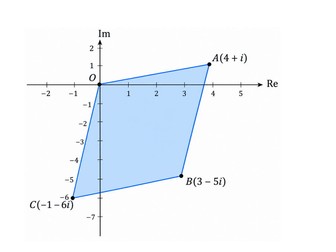
This comprehensive guide is designed for Cambridge AS & A Level, Edexcel A Level, IB Diploma Mathematics, and first-year university students who want to develop a deep understanding of the polar form of complex numbers. Beginning with the fundamentals of complex numbers and the Argand diagram, the book gradually builds to modulus, argument, polar representation, multiplication and division in polar form, and De Moivre’s Theorem. Every concept is explained in a clear, step-by-step manner with carefully worked examples, examination-style questions, detailed solutions, and high-quality diagrams. Whether you are preparing for school examinations, university entrance, or strengthening your mathematical foundation, this book provides a structured and student-friendly approach that makes even challenging topics easy to understand and master.