Include: Cover Booklets, Homework Booklets, Retrieval Booklets, and Mastery Booklets.
Save 100+ Hours of Planning | The All-in-One Solution for Biology, Chemistry, and Physics
Planning for KS3 Science across two or three years can be overwhelming. This comprehensive, departmental-level bundle contains every resource you need to teach the complete National Curriculum with confidence. Every worksheet is ready to print.
Perfect for: Heads of Department, Early Career Teachers (ECTs), NQTs, and busy Science teachers looking to regain their work-life balance.
NCFE Child Development Full Specification Revision Booklets with Answers – Ideal for Low-Stakes Testing & Exam Prep
This printable and editable revision booklet covers the entire specification for NCFE Child Development . It’s packed with varied, student-friendly tasks designed to boost knowledge, improve exam technique, and support retrieval practice in a low-pressure format.
This resource is for one subject but each specification point has a revision booklet and answers that fully align with the relevant GCSE.
Included in this resource:
5 multiple choice questions
Two batches of true or false statements
Gap-fill paragraph with word bank
Keyword match-up activity
Spot the mistake exam-style task
5 short answer questions
2 explain-with-example questions
1 ranking activity
Concept sorting table
Mini retrieval quiz (3×3 format)
Command word practice template
Whiteboard Q&A (10 questions)
2 mini case study application tasks
Full answer sheet included
Perfect for independent revision, in-class consolidation, or homework. Ideal for preparing students for topic tests, mock exams or final assessments.
revision booklet, GCSE, full specification, low stakes testing, retrieval practice, exam questions, answer sheet, command words, KS4 revision, printable booklet, editable Word resource Ai was used to help make these resources.
One booklet for each of the following specification points:
Child Development and Early Years Summary
Holistic Development and Influences
Aspects of Growth: Covers physical, cognitive, communication, and social/emotional development.
Key Factors: Analysis of nature versus nurture, biological and environmental influences, and how transitions impact a child’s progress.
Practical Care and Play
Routines and Needs: Focuses on meeting basic care needs and implementing daily routines.
Role of Play: The practitioner’s responsibility in facilitating play activities to support learning and development.
Professional Frameworks and Provision
Settings: The purpose and variety of early years provisions.
Legislation: Understanding safeguarding, health and safety, equality, and confidentiality procedures.
Professionalism: Expectations regarding behavior, appearance, and timekeeping.
Roles: The importance of partnership working and the involvement of specialists.
Observation and Planning
Observation Methods: Techniques for recording progress, distinguishing between objective and subjective data.
Planning Cycle: Using a child-centered approach to observe, assess, and plan for future development needs.
This KS3 Science Independent Study Booklet Series provides a full three-year KS3 science curriculum of ready-to-use homework and cover work booklets, with one booklet for every part of the KS3 specification. Designed by an outstanding UK science teacher and created with support from AI, these booklets allow students to work independently while maintaining high academic standards.
Each booklet is carefully structured to guide students through a complete topic without teacher input, making them ideal for cover lessons, homework, remote learning, intervention, and independent study. Written in clear, student-friendly language for ages 11–14, the booklets support all abilities while reinforcing key scientific knowledge and vocabulary.
Every booklet includes 10 structured learning sections:
• Topic Summary & Key Concepts
• Student Reflection Tasks
• Keyword Definitions
• Gap-Fill Knowledge Check
• “Why? Why? Why?” Deep Thinking Questions
• Tiered Learning (Define, Explain, Apply, Evaluate)
• Mini Retrieval Quiz
• Spot the Mistake
• Ranking Challenge
• Exam-style PEE Paragraph Builder
• True or False Knowledge Check
The series covers all Biology, Chemistry and Physics topics across Years 7–9, including cells, human body systems, ecosystems, energy, electricity, forces, magnetism, chemical reactions, particles, acids & alkalis, climate, Earth structure, space, and more.
These booklets require no preparation, are fully printable, and provide meaningful learning when students are working independently. Perfect for non-specialist cover staff, absent teachers, homework setting, and maintaining curriculum continuity.
This resource series provides full coverage of the KS3 Science curriculum across Biology, Chemistry and Physics.
Biology Topics:
Cells and Microscopy
Specialised Cells
Organisation of the Body
Skeletal and Muscular Systems
Gas Exchange and Breathing
Respiration
Digestion
Nutrition and Diet
Human and Plant Reproduction
Variation and Inheritance
Genetics and DNA
Evolution and Natural Selection
Adaptations
Interdependence
Food Chains and Food Webs
Ecosystems
Photosynthesis
Plant Mineral Nutrition
Disease and the Immune System
Health and Lifestyle
Chemistry Topics:
States of Matter
Changes of State
Particle Model
Elements, Compounds and Mixtures
Separating Techniques
Atoms and the Periodic Table
Metals and Non-Metals
Acids, Alkalis and Indicators
Neutralisation
Chemical Reactions
Combustion
Earth’s Structure and Atmosphere
Climate and Climate Change
Greenhouse Gases
Fuels and Energy Resources
Environmental Chemistry
Physics Topics:
Forces
Contact and Non-Contact Forces
Speed and Distance-Time Graphs
Motion
Energy Stores and Transfers
Work and Power
Heating and Cooling
Thermal Energy
Electricity
Circuits
Current, Voltage and Resistance (KS3)
Magnetism
Electromagnets
Uses of Magnetism
Waves
Sound
Light
Reflection and Refraction
Space
The Solar System
Gravity and Orbits
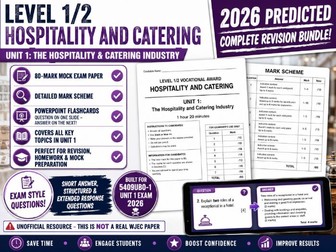
Prepare your students for the WJEC Level 1/2 Hospitality and Catering Unit 1: The Hospitality and Catering Industry exam with this complete predicted-style revision bundle.
This resource includes a full 80-mark mock exam paper, a detailed teacher mark scheme, and a set of PowerPoint revision flashcards to support exam preparation, retrieval practice and independent revision.
The mock paper has been written in the style of the current WJEC 5409UB0-1 Unit 1 exam and is suitable for students preparing for the Hospitality and Catering external assessment.
Included in this resource:
Full 80-mark predicted-style mock paper
Teacher mark scheme with suggested answers
PowerPoint flashcards with question-and-answer format
Exam-style short answer questions
Structured questions
Extended response practice
Student-friendly revision questions
Useful for classroom revision, homework, intervention and mock exam preparation
Topics covered include:
Commercial and non-commercial provisions
Residential and non-residential establishments
Food service methods
Job roles and responsibilities
Personal attributes in hospitality and catering
Employment contracts and staff benefits
Dress code and personal presentation
Customer needs
Environmental sustainability
Food safety and hygiene
Food-related illness and contamination
Kitchen equipment
Workflow and kitchen operations
Factors affecting hospitality and catering businesses
Costs, profit and business success
This resource is ideal for:
Year 10 and Year 11 revision
WJEC Hospitality and Catering Unit 1 exam preparation
Mock exams
Cover lessons
Intervention sessions
Retrieval practice
Flashcard revision
Independent study
Last-minute revision before the external exam
The PowerPoint flashcards are designed so that the question appears on one slide and the answer appears on the next slide, making them ideal for whole-class questioning, paired revision or self-testing. Created by ai and a teacher who thas taught food for over 10 years.
This is a practical, ready-to-use resource designed to save teachers time while giving students focused exam practice for the WJEC Level 1/2 Hospitality and Catering Unit 1 exam.
Please note: This is an independently created predicted-style revision resource. It is not an official WJEC paper and is not endorsed by WJEC.
WJEC Level 1/2 Construction and the Built Environment Unit 1 Predicted Mock Paper + PowerPoint Flashcards
This resource has been designed to support students preparing for the WJEC Level 1/2 Award in Construction and the Built Environment – Unit 1: Introduction to the Built Environment external assessment.
It includes a full 80-mark predicted-style mock paper and a set of PowerPoint revision flashcards to help students practise key knowledge, exam technique and short-answer responses.
The mock paper has been created in the style of recent WJEC papers and covers a broad range of likely Unit 1 content, including:
Construction professionals and trades
Building types and building elements
Substructure and superstructure
Brownfield sites and sustainability
Renewable technologies
PPE and health and safety
Risk control measures
Building maintenance and operation
Materials, reuse and environmental considerations
Extended response exam practice
What is included:
1 full student mock paper
1 teacher mark scheme
PowerPoint flashcards with question-and-answer format
80-mark exam-style structure
Short-answer, structured and extended-response questions
Student-friendly wording suitable for revision lessons, homework or intervention
This resource is ideal for:
Year 10 and Year 11 revision
Mock exam preparation
Cover lessons
Intervention sessions
Independent study
Last-minute exam practice
Whole-class retrieval activities
The flashcards can be used on screen as a class quiz, printed for revision, or used by students independently to test themselves.
This is a AI and teacher-created revision resource designed to give students focused and realistic practice before their Unit 1 assessment.
Please note: This is an independently created predicted-style resource and is not an official WJEC paper or endorsed by WJEC.
This fully editable NCFE Child Development worksheet is designed to closely match the specification and is ideal for homework, cover lessons, independent study, and revision. Each task is carefully structured to help students consolidate key content, deepen understanding, and apply knowledge effectively.
The worksheet supports a range of teaching and learning approaches, including retrieval practice, flipped learning, home learning, and in-class support. Clear instructions and scaffolded activities allow students to work independently, making it suitable for use by non-specialist cover staff as well as subject teachers.
This is a no-prep resource, saving valuable teacher time while still providing meaningful, curriculum-linked learning. Activities are accessible and engaging, supporting progress across a range of abilities.
AI was used to help create and structure this resource, ensuring clarity, consistency, and alignment with the NCFE Child Development specification, while professional teacher oversight ensures it remains classroom-ready and student-friendly.
Perfect for maintaining progress when teaching time is limited, and for reinforcing learning throughout the course.
Child Development and Early Years Summary
Holistic Development and Influences
Aspects of Growth: Covers physical, cognitive, communication, and social/emotional development.
Key Factors: Analysis of nature versus nurture, biological and environmental influences, and how transitions impact a child’s progress.
Practical Care and Play
Routines and Needs: Focuses on meeting basic care needs and implementing daily routines.
Role of Play: The practitioner’s responsibility in facilitating play activities to support learning and development.
Professional Frameworks and Provision
Settings: The purpose and variety of early years provisions.
Legislation: Understanding safeguarding, health and safety, equality, and confidentiality procedures.
Professionalism: Expectations regarding behavior, appearance, and timekeeping.
Roles: The importance of partnership working and the involvement of specialists.
Observation and Planning
Observation Methods: Techniques for recording progress, distinguishing between objective and subjective data.
Planning Cycle: Using a child-centered approach to observe, assess, and plan for future development needs.
NCFE Child Development Full Specification Activity Booklets with Answers Ideal for Low-Stakes Testing & Exam Prep
This printable and editable activities booklet covers the entire specification for NCFE Child Development. It’s packed with varied, student-friendly tasks designed to build confidence, support retrieval practice, and deepen understanding through structured and engaging activities.
This resource is for one subject but each specification point has an activities booklet and answers that fully align with the relevant GCSE.
Included in this resource:
Summary comprehension task
3 things you learnt reflection
Real-world examples task
Keyword identification and definition
Gap-fill paragraph with word bank
“Why? Why? Why?” thinking questions
Tiered learning: define, explain, apply, evaluate
Find the fib (true/false analysis)
Mini retrieval quiz
Mastering the exam question (sample answers with improvement tasks)
What if? creative thinking scenarios
Full answer sheet included
Perfect for independent study, in-class consolidation, or homework. Ideal for preparing students for topic tests, mock exams or final assessments.
activities booklet, GCSE, full specification, low-stakes testing, retrieval practice, exam questions, answer sheet, KS4 revision, printable booklet, editable Word resource Ai was used to help make these resources.
One booklet for each of the following specification points:
Child Development and Early Years Summary
Holistic Development and Influences
Aspects of Growth: Covers physical, cognitive, communication, and social/emotional development.
Key Factors: Analysis of nature versus nurture, biological and environmental influences, and how transitions impact a child’s progress.
Practical Care and Play
Routines and Needs: Focuses on meeting basic care needs and implementing daily routines.
Role of Play: The practitioner’s responsibility in facilitating play activities to support learning and development.
Professional Frameworks and Provision
Settings: The purpose and variety of early years provisions.
Legislation: Understanding safeguarding, health and safety, equality, and confidentiality procedures.
Professionalism: Expectations regarding behavior, appearance, and timekeeping.
Roles: The importance of partnership working and the involvement of specialists.
Observation and Planning
Observation Methods: Techniques for recording progress, distinguishing between objective and subjective data.
Planning Cycle: Using a child-centered approach to observe, assess, and plan for future development needs.
NCFE Child Development Full Specification Homework Booklets with Answers — Includes Answers
Give students purposeful practice across the entire specification while keeping workload low. Each homework page is student-friendly, builds from recall to application and evaluation, and comes with a complete answer set for self-marking or rapid feedback. Ideal for weekly homework, intervention, cover and revision. Develops recall, application, analysis and evaluation, with explicit command-word practice and clear “how to answer” steps. A4, black-and-white friendly, minimal prep. Save hours of planning: fully mapped to the whole specification, print-and-go, with answers included. Developed by an experienced UK teacher with the support of AI-assisted planning tools to ensure consistency, clarity and full-spec coverage. This is for secondary classes needing structured homework, retrieval, intervention or revision across a full course specification. Set one page per week or build half-term packs. Use self-check and answers for independent marking, or project answers for whole-class feedback. Mix and match tasks for targeted practice.
What’s inside
Whole-spec coverage: all topics and sub-topics mapped in detail.
Consistent structure per task set:
• Quick Recall (core facts)
• Core Practice (structured questions using varied command words)
• Apply It (realistic scenario, parts A–C)
• PIXL Mini-Task (Odd One Out / Always–Sometimes–Never / Convince Me)
• Literacy Boost (command words with one-line meanings plus an exam-style question with marks and step-by-step “How to answer”)
• Reduce It 30–3–2–1 (summarise and select key information)
• Self-Check (success criteria)
• Stretch Challenge (higher-order task)
Answers included: model points, indicative methods and concise mark guidance.
Editable file (Word/Docs) + ready-to-print PDF
Student homework pages covering the whole specification in detail
Complete answer pack for every task
Child Development and Early Years Summary
Development and Influences Covers holistic growth, including physical, cognitive, communication, and social/emotional aspects. It examines nature versus nurture, biological and environmental factors, and the impact of life transitions on a child’s progress.
Care, Play, and Provision Focuses on meeting basic care needs through routines and play. It details the practitioner’s role in facilitating activities and explores the different types, purposes, and settings of early years provision.
Legislation and Professionalism Outlines legal frameworks for safeguarding, health and safety, and equality. It also covers professional expectations—such as behavior and attendance—and the importance of partnership working with specialists.
Observation and Planning Explores objective and subjective observation methods used to track development. It emphasizes the child-centered planning cycle to observe, assess, and plan for a child’s individual needs.
This NCFE Child Development Critical Thinking Booklet Series provides a complete set of high-challenge learning resources, with one booklet for each part of the NCFE Child Development specification. Designed by an outstanding UK classroom teacher, these booklets develop students’ ability to reason, evaluate evidence, challenge assumptions, and justify decisions within realistic childcare and early years contexts.
Each booklet moves beyond simple recall and focuses on structured critical thinking, helping students strengthen the higher-order skills required for extended responses, applied questions, and coursework-style tasks. All booklets include a full answer sheet, making them suitable for independent work, homework, cover lessons, intervention, and exam preparation.
Each Critical Thinking Booklet includes activities such as:
Claim–Evidence–Reasoning (CER) tasks linked to childcare practice
Spot the fallacy activities to identify weak or flawed reasoning
Causation vs correlation questions using realistic early years scenarios
Assumption hunts to uncover hidden premises in statements
Counterargument and rebuttal writing tasks
Decision matrices to weigh options and justify professional choices
“If this is the answer, what’s the question?” challenges
Reduction tasks (30–3–2–1) to summarise complex ideas
Mini retrieval quizzes in mixed formats
Extension tasks that push evaluation and judgement skills
The series covers all areas of the NCFE Child Development specification, including planning cycles, observation and assessment, child development, partnership working, safeguarding, and professional practice.
These booklets are fully printable, clearly structured, and require no preparation, making them ideal for teachers seeking meaningful, specification-linked activities that promote deep thinking rather than surface learning.
A highly effective resource for developing confident, analytical learners in NCFE Child Development.
Child Development and Early Years Summary
Development and Influences Covers holistic growth, including physical, cognitive, communication, and social/emotional aspects. It examines nature versus nurture, biological and environmental factors, and the impact of life transitions on a child’s progress.
Care, Play, and Provision Focuses on meeting basic care needs through routines and play. It details the practitioner’s role in facilitating activities and explores the different types, purposes, and settings of early years provision.
Legislation and Professionalism Outlines legal frameworks for safeguarding, health and safety, and equality. It also covers professional expectations—such as behavior and attendance—and the importance of partnership working with specialists.
Observation and Planning Explores objective and subjective observation methods used to track development. It emphasizes the child-centered planning cycle to observe, assess, and plan for a child’s individual needs.
PIXL “Thinking Hard” Booklets NCFE Child Development Whole Specification in Detail — Includes Answers
Give your class a rigorous thinking workout while ensuring complete specification coverage. This printable booklet turns every part of the spec into clear, student-friendly tasks with built-in Grade 9 extensions. You also get a full answer set to support self-marking, quick feedback, and targeted intervention. Developed by an experienced UK teacher with the support of AI-assisted planning tools to ensure consistency, clarity and full-spec coverage. Save hours of planning: fully mapped to the whole specification, print-and-go, with answers included.
What’s inside
Whole-spec coverage: all topics, sub-topics, must-know content, misconceptions and key vocabulary mapped across the entire specification in detail.
PIXL strategies: Odd One Out • Always / Sometimes / Never True • Why? Why? Why? (5-deep) • Spot the Mistake • Diamond 9 / Ranking • Link It Up / Connections • Convince Me • What If? • Mini Retrieval (plus optional extras: If This Is the Answer…, Reduce It 30–3–2–1, Causation vs Correlation, Assumption Hunt).
Child Development and Early Years Summary
Development and Influences Covers holistic growth, including physical, cognitive, communication, and social/emotional aspects. It examines nature versus nurture, biological and environmental factors, and the impact of life transitions on a child’s progress.
Care, Play, and Provision Focuses on meeting basic care needs through routines and play. It details the practitioner’s role in facilitating activities and explores the different types, purposes, and settings of early years provision.
Legislation and Professionalism Outlines legal frameworks for safeguarding, health and safety, and equality. It also covers professional expectations—such as behavior and attendance—and the importance of partnership working with specialists.
Observation and Planning Explores objective and subjective observation methods used to track development. It emphasizes the child-centered planning cycle to observe, assess, and plan for a child’s individual needs.
Mystery Cards Activity Bundle – problem-solving worksheets to build reasoning, application, and exam-ready skills.
This resource uses a Mystery Cards (Cause and Effect Reasoning) activity to help students piece together clues, identify relationships, and build logical explanations. Learners sort clues into cause, effect, and context, then create their own mystery question and answer supported by a cause–effect chain. Extension tasks encourage them to test or challenge their answers with new evidence.
Perfect for exam writing practice, tackling extended response questions, and improving essay structure and writing skills, this activity develops analytical thinking and ensures students can apply knowledge to unfamiliar scenarios.
These revision worksheets are designed as flexible printable resources for classroom activities, group work, or independent learning. By reasoning through clues, learners practise active recall and retrieval practice, while reinforcing full specification coverage.
Teachers save valuable planning time with these ready-to-use, time-saving resources, while students benefit from engaging activities that make knowledge application interactive and memorable.
Hidden within the creation process, AI helped to create these time saving resources – ensuring they are professional, consistent, and student-friendly.
Suitable for all students, this Mystery Cards bundle makes revision interactive, challenging, and exam-focused.
One worksheet per specification point:
Child Development and Early Years Summary
Holistic Development and Influences
Aspects of Growth: Covers physical, cognitive, communication, and social/emotional development.
Key Factors: Analysis of nature versus nurture, biological and environmental influences, and how transitions impact a child’s progress.
Practical Care and Play
Routines and Needs: Focuses on meeting basic care needs and implementing daily routines.
Role of Play: The practitioner’s responsibility in facilitating play activities to support learning and development.
Professional Frameworks and Provision
Settings: The purpose and variety of early years provisions.
Legislation: Understanding safeguarding, health and safety, equality, and confidentiality procedures.
Professionalism: Expectations regarding behavior, appearance, and timekeeping.
Roles: The importance of partnership working and the involvement of specialists.
Observation and Planning
Observation Methods: Techniques for recording progress, distinguishing between objective and subjective data.
Planning Cycle: Using a child-centered approach to observe, assess, and plan for future development needs.
NCFE Child Development Diamond 9 Activity Bundle Whole Specification Covered and answers. Diamond 9 Activity Bundle – evaluative ranking worksheets to build analysis, justification, and exam-ready skills.
This resource uses a Diamond 9 ranking activity to help students prioritise key ideas, evaluate importance, and justify decisions. Learners rank nine statements into a diamond shape (most important at the top, least at the bottom) before explaining their top choices. Extension tasks push learners to compare and justify decisions in more depth.
Perfect for exam writing practice, tackling extended response questions, and strengthening essay structure and writing skills, this activity supports evaluative thinking and prepares students for higher-level exam responses.
These revision worksheets are flexible printable resources, ideal for classroom tasks, group discussions, homework, or independent learning. By ranking and justifying, students practise active recall and retrieval practice while covering the full specification coverage.
Teachers save planning time with these ready-to-use, time-saving resources, while students gain confidence in evaluation and justification – essential skills for top-grade performance.
Hidden within the creation process, AI helped to create these time saving resources – ensuring they are consistent, professional, and student-friendly.
Suitable for all students, this Diamond 9 bundle makes revision interactive, evaluative, and exam-focused.
One worksheet per specification point:
Child Development and Early Years Summary
Holistic Development and Influences
Aspects of Growth: Covers physical, cognitive, communication, and social/emotional development.
Key Factors: Analysis of nature versus nurture, biological and environmental influences, and how transitions impact a child’s progress.
Practical Care and Play
Routines and Needs: Focuses on meeting basic care needs and implementing daily routines.
Role of Play: The practitioner’s responsibility in facilitating play activities to support learning and development.
Professional Frameworks and Provision
Settings: The purpose and variety of early years provisions.
Legislation: Understanding safeguarding, health and safety, equality, and confidentiality procedures.
Professionalism: Expectations regarding behavior, appearance, and timekeeping.
Roles: The importance of partnership working and the involvement of specialists.
Observation and Planning
Observation Methods: Techniques for recording progress, distinguishing between objective and subjective data.
Planning Cycle: Using a child-centered approach to observe, assess, and plan for future development needs.
Misconception Buster Activity Bundle – engaging worksheets to correct misunderstandings and build exam accuracy.
This resource helps students tackle common misconceptions in key topics through a Misconception Buster activity. Learners are presented with incorrect statements, which they must rewrite in full, accurate sentences. This improves subject knowledge, strengthens exam writing, and prevents avoidable mistakes in assessments.
Perfect for exam writing practice, extended response questions, and improving essay structure and writing skills, the activity encourages learners to think critically, identify errors, and provide accurate corrections supported by subject-specific vocabulary.
These revision worksheets are designed as flexible printable resources, suitable for classroom activities, homework, or independent learning. By identifying and correcting false ideas, students engage in active recall and retrieval practice, while ensuring full specification coverage.
Teachers save planning time with these ready-to-use, time-saving resources, while students gain confidence in applying knowledge accurately under exam conditions.
Hidden within the creation process, AI helped to create these time saving resources – ensuring they are consistent, professional, and student-friendly.
Suitable for all students, this Misconception Buster bundle makes revision interactive, challenging, and exam-focused.""
One worksheet per specification point:
Child Development and Early Years Summary
Holistic Development and Influences
Aspects of Growth: Covers physical, cognitive, communication, and social/emotional development.
Key Factors: Analysis of nature versus nurture, biological and environmental influences, and how transitions impact a child’s progress.
Practical Care and Play
Routines and Needs: Focuses on meeting basic care needs and implementing daily routines.
Role of Play: The practitioner’s responsibility in facilitating play activities to support learning and development.
Professional Frameworks and Provision
Settings: The purpose and variety of early years provisions.
Legislation: Understanding safeguarding, health and safety, equality, and confidentiality procedures.
Professionalism: Expectations regarding behavior, appearance, and timekeeping.
Roles: The importance of partnership working and the involvement of specialists.
Observation and Planning
Observation Methods: Techniques for recording progress, distinguishing between objective and subjective data.
Planning Cycle: Using a child-centered approach to observe, assess, and plan for future development needs.
Cloze Notes with Hints Activity Bundle – scaffolded worksheets to support recall, understanding, and exam success.
This resource uses a Cloze Notes with Hints activity, where students complete missing words in a paragraph using clues provided. This structure helps learners recall key knowledge, apply it in context, and build confidence in using subject-specific vocabulary.
Perfect for exam writing practice, tackling extended response questions, and supporting essay structure and writing skills, these worksheets allow students to practise applying knowledge in a guided but challenging format.
These revision worksheets are flexible printable resources for classroom tasks, homework, or independent learning. By filling in the blanks with accurate terminology, students engage in active recall and retrieval practice, while reinforcing full specification coverage.
Teachers benefit from ready-to-use, time-saving resources, while students gain confidence in recognising and using the correct terms to produce accurate exam answers.
Hidden within the creation process, AI helped to create these time saving resources – ensuring they are consistent, professional, and student-friendly.
Suitable for all students, this Cloze Notes with Hints bundle makes revision structured, accessible, and exam-focused.
One worksheet per specification point:
Child Development and Early Years Summary
Holistic Development and Influences
Aspects of Growth: Covers physical, cognitive, communication, and social/emotional development.
Key Factors: Analysis of nature versus nurture, biological and environmental influences, and how transitions impact a child’s progress.
Practical Care and Play
Routines and Needs: Focuses on meeting basic care needs and implementing daily routines.
Role of Play: The practitioner’s responsibility in facilitating play activities to support learning and development.
Professional Frameworks and Provision
Settings: The purpose and variety of early years provisions.
Legislation: Understanding safeguarding, health and safety, equality, and confidentiality procedures.
Professionalism: Expectations regarding behavior, appearance, and timekeeping.
Roles: The importance of partnership working and the involvement of specialists.
Observation and Planning
Observation Methods: Techniques for recording progress, distinguishing between objective and subjective data.
Planning Cycle: Using a child-centered approach to observe, assess, and plan for future development needs.
NCFE Child Development Pros and Cons Activity Bundle Whole Specification Covered and answers. Pros and Cons Activity Bundle – evaluative worksheets to develop reasoning, decision-making, and exam technique.
This resource uses a Pros and Cons Grid to help students weigh up arguments, evaluate evidence, and justify decisions. Learners sort statements into positive and negative points before deciding which side is stronger overall. This encourages analytical thinking, structured writing, and exam-ready evaluation.
Perfect for exam writing practice, tackling extended response questions, and strengthening essay structure and writing skills, the activity pushes students to develop balanced arguments and provide justified conclusions.
These revision worksheets are designed as flexible printable resources, suitable for class debates, homework, or independent learning. By comparing strengths and weaknesses, students practise active recall and retrieval practice while achieving full specification coverage.
Teachers save valuable planning time with ready-to-use, time-saving resources, while students gain confidence in writing evaluative answers that meet higher-level mark scheme demands.
Hidden within the creation process, AI helped to create these time saving resources – ensuring they are consistent, professional, and student-friendly.
Suitable for all students, this Pros and Cons bundle makes revision analytical, interactive, and exam-focused.
One worksheet per specification point:
Child Development and Early Years Summary
Holistic Development and Influences
Aspects of Growth: Covers physical, cognitive, communication, and social/emotional development.
Key Factors: Analysis of nature versus nurture, biological and environmental influences, and how transitions impact a child’s progress.
Practical Care and Play
Routines and Needs: Focuses on meeting basic care needs and implementing daily routines.
Role of Play: The practitioner’s responsibility in facilitating play activities to support learning and development.
Professional Frameworks and Provision
Settings: The purpose and variety of early years provisions.
Legislation: Understanding safeguarding, health and safety, equality, and confidentiality procedures.
Professionalism: Expectations regarding behavior, appearance, and timekeeping.
Roles: The importance of partnership working and the involvement of specialists.
Observation and Planning
Observation Methods: Techniques for recording progress, distinguishing between objective and subjective data.
Planning Cycle: Using a child-centered approach to observe, assess, and plan for future development needs.
Agree/Disagree Continuum Activity Bundle – interactive worksheets to develop reasoning, evaluation, and exam technique.
This resource uses an Agree/Disagree Continuum to help students explore key statements, form opinions, and justify their reasoning with evidence. Learners place ideas on a scale (from strongly disagree to strongly agree) and then provide reasons to support their choice. Extension tasks encourage students to consider both sides of an argument, building higher-level evaluative skills.
Perfect for exam writing practice, tackling extended response questions, and improving essay structure and writing skills, this activity supports learners in developing balanced, analytical answers that match top band exam criteria.
These revision worksheets are flexible printable resources, suitable for group discussion, classroom debates, homework, or independent learning. By requiring learners to justify positions with subject knowledge, the activity promotes active recall and retrieval practice, while reinforcing full specification coverage.
Teachers save valuable planning time with these ready-to-use, time-saving resources, while students benefit from a framework that improves critical thinking and exam performance.
Hidden within the creation process, AI helped to create these time saving resources – ensuring they are consistent, professional, and student-friendly.
Suitable for all students, this Agree/Disagree bundle makes revision interactive, evaluative, and exam-focused.
One worksheet per specification point:
Child Development and Early Years Summary
Holistic Development and Influences
Aspects of Growth: Covers physical, cognitive, communication, and social/emotional development.
Key Factors: Analysis of nature versus nurture, biological and environmental influences, and how transitions impact a child’s progress.
Practical Care and Play
Routines and Needs: Focuses on meeting basic care needs and implementing daily routines.
Role of Play: The practitioner’s responsibility in facilitating play activities to support learning and development.
Professional Frameworks and Provision
Settings: The purpose and variety of early years provisions.
Legislation: Understanding safeguarding, health and safety, equality, and confidentiality procedures.
Professionalism: Expectations regarding behavior, appearance, and timekeeping.
Roles: The importance of partnership working and the involvement of specialists.
Observation and Planning
Observation Methods: Techniques for recording progress, distinguishing between objective and subjective data.
Planning Cycle: Using a child-centered approach to observe, assess, and plan for future development needs.
NCFE Child Development Full Specification retrieval practice Booklets with Answers. This GCSE Retrieval Practice and Revision Workbook series has been created by an outstanding UK classroom teacher, with support from AI technology, to give you ready-to-use retrieval worksheets, revision tasks, and independent study resources for every GCSE specification point.
Each booklet targets one topic from the GCSE specification, providing structured low-stakes recall, exam-style practice, and knowledge organiser summaries that strengthen memory and boost exam confidence.
Perfect for classwork, homework, intervention, or revision lessons, these booklets help students close gaps, recall key content, and prepare effectively for assessments.
Each booklet includes:
Knowledge Snapshots – short topic summaries for quick revision.
Retrieval Grid (4×4) – sixteen recall questions for active practice.
Gap-Fill Paragraphs – vocabulary and context application.
Mixed Retrieval Quiz – multiple-choice, short-answer, and matching questions.
True or False + Correct It – correct misconceptions and test understanding.
Retrieval Pyramid & Mini Test – increasing challenge and scaffolding.
Retrieval Sorting Cards – interactive cut-and-sort revision activity.
Reflection Section – self-assessment and metacognitive review.
Complete Answer Booklet Included – ideal for self-marking or teacher feedback.
A complete, printable GCSE retrieval practice resource designed to save planning time, improve recall, and support confident exam performance across the full specification.
Child Development and Early Years Summary
Development and Influences Covers holistic growth, including physical, cognitive, communication, and social/emotional aspects. It examines nature versus nurture, biological and environmental factors, and the impact of life transitions on a child’s progress.
Care, Play, and Provision Focuses on meeting basic care needs through routines and play. It details the practitioner’s role in facilitating activities and explores the different types, purposes, and settings of early years provision.
Legislation and Professionalism Outlines legal frameworks for safeguarding, health and safety, and equality. It also covers professional expectations—such as behavior and attendance—and the importance of partnership working with specialists.
Observation and Planning Explores objective and subjective observation methods used to track development. It emphasizes the child-centered planning cycle to observe, assess, and plan for a child’s individual needs.
This NCFE Child Development Complete Resource Bundle includes all resources required to teach and support the full NCFE Child Development specification, with one resource for each part of the course. Designed by an experienced UK classroom teacher, with support from AI-assisted resource development, this bundle provides a consistent, high-quality set of materials for teaching, homework, cover lessons, revision, and independent study.
All resources are fully editable, clearly structured, and written in accessible language suitable for a wide range of learners. The bundle is ideal for non-specialist cover staff, intervention sessions, independent learning, and exam preparation, while also supporting strong curriculum alignment and progression throughout the course.
What’s included in the bundle:
• Independent Study Booklets for every specification point
• Mastery & Intervention Booklets targeting misconceptions and key skills
• Retrieval Practice and Low-Stakes Assessment resources
• Critical Thinking Booklets focused on evaluation, justification, and applied understanding
• Fully completed answer sheets for all resources
• Printable and digital formats suitable for classroom and home use
How the resources support learning:
Each resource is designed to help students consolidate knowledge, deepen understanding, and apply learning to realistic child development contexts. Activities include structured questions, retrieval tasks, extended responses, evaluative thinking, and reflection, supporting both coursework-style tasks and exam preparation.
This is a no-prep bundle that saves significant planning time while ensuring meaningful, specification-linked learning continues in lessons, at home, or during cover.
Perfect for departments looking for a complete, consistent NCFE Child Development resource pack that supports progress, independence, and confidence across the full course.
For each style of worksheet or booklet each part of the specification is covered.
Child Development and Early Years Summary
Holistic Development and Influences
Aspects of Growth: Covers physical, cognitive, communication, and social/emotional development.
Key Factors: Analysis of nature versus nurture, biological and environmental influences, and how transitions impact a child’s progress.
Practical Care and Play
Routines and Needs: Focuses on meeting basic care needs and implementing daily routines.
Role of Play: The practitioner’s responsibility in facilitating play activities to support learning and development.
Professional Frameworks and Provision
Settings: The purpose and variety of early years provisions.
Legislation: Understanding safeguarding, health and safety, equality, and confidentiality procedures.
Professionalism: Expectations regarding behavior, appearance, and timekeeping.
Roles: The importance of partnership working and the involvement of specialists.
Observation and Planning
Observation Methods: Techniques for recording progress, distinguishing between objective and subjective data.
Planning Cycle: Using a child-centered approach to observe, assess, and plan for future development needs.
This complete KS3 Science Retrieval & Revision Workbook Bundle covers every Biology, Chemistry and Physics topic in the KS3 curriculum, with one retrieval booklet per specification point. Developed by an outstanding UK science teacher, supported by AI-assisted resource creation, this bundle delivers high-quality, ready-to-use retrieval practice for every lesson across Years 7, 8 and 9.
Each booklet is written in student-friendly language (ages 11–14) and designed to strengthen long-term memory through structured recall tasks, varied question types and clear scientific vocabulary. All booklets include a fully completed teacher answers version, making them ideal for classwork, homework, independent study, intervention, revision, or cover lessons.
Topics included across the full KS3 Science course
(Complete Biology, Chemistry and Physics coverage)
Biology:
• Cells & Microscopy
• Body Systems & Organs
• Gas Exchange & Breathing
• Respiration
• Digestion
• Reproduction (Human & Plant)
• Health, Lifestyle & Diet
• Microbes & Disease
• Ecology & Food Webs
• Adaptations
• Interdependence
• Photosynthesis
• Inheritance & Variation
• Genetics
• Evolution
Chemistry:
• States of Matter
• Particle Model
• Elements, Compounds & Mixtures
• Separating Techniques
• Atoms, Elements & Periodic Table
• Acids, Alkalis & Indicators
• Chemical Reactions
• Metals & Non-Metals
• Combustion
• Earth & Atmosphere
• Climate Science
• Fuels & Energy Resources
• Environmental Chemistry
Physics:
• Forces
• Motion
• Speed & Distance-Time Graphs
• Energy Stores & Transfers
• Work & Power
• Heating & Cooling
• Electricity
• Circuits
• Magnetism & Electromagnets
• Waves
• Sound
• Light
• Space & Solar System
Every major KS3 science theme is fully covered.
Each booklet includes 10–12 retrieval activities, such as:
• Knowledge Snapshots (key facts for each topic)
• 4×4 Retrieval Grid (16 recall questions)
• Last Lesson & Last Week Recall
• Gap-Fill Summary with Word Bank
• Mixed Retrieval Quiz (MCQs, short answers, matching)
• True/False + Correct It (fix misconceptions)
• Retrieval Pyramid (Recall → Explain → Apply)
• Mini Test (12 marks)
• Retrieval Sorting Cards (cut-and-sort activity)
• Reflection & Review (metacognition)
These activities build retrieval strength, reinforce vocabulary, and help students secure the fundamental concepts needed for GCSE success.
What’s included in the full download
• One fully editable booklet per KS3 science topic
• Student version (no answers)
• Full teacher answers version
• Printable PDFs included
• Complete three-year KS3 retrieval curriculum in one bundle
Perfect for departments seeking a consistent, high-impact retrieval routine across the whole of KS3 Science. Saves hours of planning and provides a ready-made system for recall, assessment and intervention.
NCFE Independent Study Booklets | Created Using AI and UK Teacher Expertise | 10 Structured Activities for Revision, Retrieval and Homework, Whole specification covered & answers
This NCFE Independent Study Booklet was created using advanced AI technology in collaboration with an outstanding UK teacher. It combines the accuracy of AI-generated structure with classroom expertise to provide high-quality, ready-to-use learning materials. Each booklet includes ten carefully designed sections that build knowledge, retrieval practice and exam-ready thinking. Written at a reading age of 14–16, the booklet is ideal for homework, revision, intervention or cover lessons.
The resource develops confidence through scaffolded activities and PIXL-style reasoning tasks that encourage students to explain, apply and evaluate their understanding. Teachers can use it in any GCSE subject or exam board, including AQA, Edexcel, OCR and WJEC.
Contents include: Summary paragraph, Gap-fill, Why? Why? Why? reasoning, Tiered learning (define, explain, apply, evaluate), Mini retrieval quiz, Spot the mistake, Ranking challenge, Keyword match-up, PEE paragraph builder and Quick-fire true or false relay. Answers to all questions included.
This booklet saves preparation time, supports independent learning and provides clear evidence of retrieval and metacognition. It is fully editable, printable and adaptable for classroom, homework or remote learning use.
GCSE independent study booklet, AI teaching resource, teacher-created, revision workbook, retrieval practice, PIXL thinking hard, GCSE homework, intervention, mastery learning, printable GCSE resource, KS4 study guide.
Child Development and Early Years Summary
Holistic Development and Influences
Aspects of Growth: Covers physical, cognitive, communication, and social/emotional development.
Key Factors: Analysis of nature versus nurture, biological and environmental influences, and how transitions impact a child’s progress.
Practical Care and Play
Routines and Needs: Focuses on meeting basic care needs and implementing daily routines.
Role of Play: The practitioner’s responsibility in facilitating play activities to support learning and development.
Professional Frameworks and Provision
Settings: The purpose and variety of early years provisions.
Legislation: Understanding safeguarding, health and safety, equality, and confidentiality procedures.
Professionalism: Expectations regarding behavior, appearance, and timekeeping.
Roles: The importance of partnership working and the involvement of specialists.
Observation and Planning
Observation Methods: Techniques for recording progress, distinguishing between objective and subjective data.
Planning Cycle: Using a child-centered approach to observe, assess, and plan for future development needs.
This KS3 Science Mastery & Intervention Booklet Series provides a complete set of targeted support and challenge resources for every topic across the full KS3 Biology, Chemistry and Physics curriculum. Each booklet focuses on one specific science topic, making them ideal for intervention, catch-up, revision, homework, cover work, and targeted support sessions.
Designed by an outstanding UK science teacher, with support from AI-assisted resource development, these booklets are structured to identify misconceptions, strengthen core understanding, and build confidence in exam-style responses. All booklets include a fully completed teacher answers version, making them suitable for self-marking, peer assessment, or guided teacher feedback.
Each Mastery & Intervention booklet includes:
Knowledge Boost Notes with clear, student-friendly explanations
Diagnostic Starter Questions to assess prior knowledge
Keyword Definition Tasks linked directly to the specification
Step-by-Step Scaffolded Explanations for key processes
Fill-In Model Answers and Exam Technique Practice
Spot the Mistake Activities to address misconceptions
Scaffolded Practice Questions with guided hints
Independent “Now Try It Yourself” Questions
Misconception Match-Up Tasks
Exam-Style Questions with Command Word Focus
Reflection and Confidence Review Tasks
The series covers all KS3 Science topics, including:
Cells and body systems, ecosystems, photosynthesis, inheritance and evolution, states of matter, particle model, chemical reactions, acids and alkalis, forces, energy, electricity, magnetism, electromagnets, waves, light, sound, space, and all other core KS3 Biology, Chemistry and Physics content.
These booklets require no preparation, are fully printable, and are ideal for use by non-specialist cover staff, intervention tutors, and classroom teachers who need meaningful, structured work that leads to real progress.
Perfect for closing gaps, building mastery, and preparing students for GCSE science from the very start of KS3.
This resource provides full coverage of the KS3 Science curriculum across Biology, Chemistry and Physics.
Biology includes: cells and microscopy, body systems, breathing and respiration, digestion, nutrition, human and plant reproduction, variation and inheritance, genetics, evolution, adaptations, food chains, ecosystems, photosynthesis, plant nutrition, disease, immunity, health and lifestyle.
Chemistry includes: states of matter, particle model, elements, compounds and mixtures, separating techniques, periodic table, metals and non-metals, acids and alkalis, neutralisation, chemical reactions, combustion, Earth’s atmosphere, climate change, greenhouse gases, fuels and environmental chemistry.
Physics includes: forces, motion, speed, energy stores and transfers, work and power, heating, electricity, circuits, magnetism, electromagnets, waves, sound, light, space and gravity.


 Quick View