Early Childhood Foundation Workbook: Literacy and Numeracy BundleQuick View
Orchid_lala

Early Childhood Foundation Workbook: Literacy and Numeracy Bundle

4 Resources
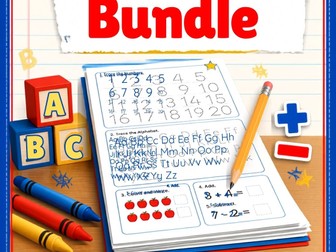
This structured worksheet bundle is designed to support the development of fine motor skills and early mathematical fluency. Each page provides ample space for guided practice, making it an excellent resource for intervention, homework, or morning work. Bundle Contents: Alphabet Tracing: Systematic letter formation practice. Number Formation (1–20): Targeted tracing for handwriting development. Numeracy Foundations (1–10): Activities connecting quantities to symbols. Arithmetic Drills: A progressive sequence of addition and subtraction problems (sum/difference range 1–10) to strengthen fact fluency.
Printable Worksheet Tracing Alphabet A - ZQuick View
Orchid_lala

Printable Worksheet Tracing Alphabet A - Z

(0)
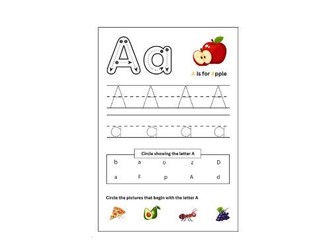
A printable Alphabet Tracing Worksheet (A-Z) is a fundamental educational tool designed to help early learners develop fine motor skills and letter recognition. These worksheets provide a structured path for children to practice writing both uppercase and lowercase letters. Key Features of A-Z Tracing Worksheets Guided Paths: Each letter is typically presented with directional arrows and dashed lines, showing the child exactly where to place the pencil and the sequence of strokes to form the letter correctly. Uppercase and Lowercase Pairs: Most worksheets include both the capital (e.g., A) and the small (e.g., a) forms, allowing students to learn the relationship between the two. Visual Associations: To enhance memory, each letter is usually accompanied by a corresponding illustration (e.g., “A is for Apple”), which helps children associate the letter shape with its phonetic sound and real-world objects.
10 Pages Printable Worksheet for Kindergarten: Numbers to 10Quick View
Orchid_lala

10 Pages Printable Worksheet for Kindergarten: Numbers to 10

(0)
This worksheet is designed to transform abstract numbers into concrete, manageable concepts for young children. By incorporating multiple learning modalities, the worksheet ensures students move beyond rote memorization to truly understanding how numbers function. Key Learning Sections Numeral and Word Writing: Students practice writing numbers from 1 to 10 in both digit form (e.g., “3”) and word form (e.g., “three”). Counting from Pictures: Using colorful, relatable illustrations (such as apples, stars, or animals), students develop one-to-one correspondence. They practice counting objects and writing the corresponding numeral, reinforcing the link between quantities and symbols. Comparing Numbers: Students learn to analyze the relationship between two numbers. Using visual cues, they identify whether a set is “greater than,” “less than,” or “equal to” another, often using simple comparison operators. Simple Addition: This section introduces the concept of combining two sets to create a whole. By counting items in two distinct groups, students transition into creating their first basic addition sentences (e.g., 2 + 1 = 3). Number Bonds: A core foundational tool, number bonds show how a whole number can be decomposed into smaller parts. This is essential for developing “number sense” and early mental math capabilities.
7-Page Worksheet Long Division with 1-Digit DivisorQuick View
Orchid_lala

7-Page Worksheet Long Division with 1-Digit Divisor

(0)
This seven-page worksheet series is structured to build mastery in long division by systematically increasing the number of digits in the dividend, allowing students to gain confidence through a consistent, scaffolded approach. Worksheet Series: Mastering Long Division (One-Digit Divisors) Each page utilizes the DMSB mnemonic (Divide, Multiply, Subtract, Bring Down) to help students internalize the procedural flow of long division. Page-by-Page Curriculum Pages 1–2: Two-Digit Dividends. Focuses on the basics. Students divide 2-digit numbers by 1-digit divisors (e.g., 70 ÷ 2). These pages emphasize alignment and the initial steps of the algorithm. Pages 3–4: Three-Digit Dividends. Increases complexity to 3-digit numbers (e.g., 250 ÷ 5). Students practice the “Bring Down” step multiple times, reinforcing the cyclic nature of the process. Pages 5–6: Four-Digit Dividends. These pages introduce 4-digit numbers (e.g., 2895 ÷ 5). This section is crucial for teaching students how to maintain precision over longer sequences and how to manage place values correctly. Page 7: Mixed Practice. A comprehensive review page featuring a variety of problems (2, 3, and 4-digit dividends). This page is designed to test fluency and ensure students can transition between different problem lengths without guidance.
Worksheet Activity for Kindergarten - Tracing Numbers 1 to 20Quick View
Orchid_lala

Worksheet Activity for Kindergarten - Tracing Numbers 1 to 20

(0)
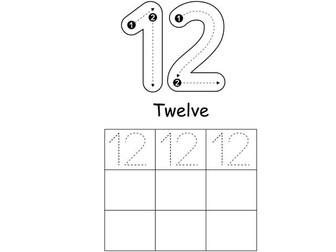
This structured activity page is designed to help kindergarten students master the writing of the number fifteen. The worksheet features two distinct learning phases: Guided Stroke Demonstration: The top section presents the number in a large, hollow-letter format. It utilizes a clear numerical sequence (1, 2, 3) and directional arrows to teach the correct stroke order and path for writing the numbers. Sequential Handwriting Practice: The lower section provides a scaffolded grid. The top row contains dashed-line templates for the student to trace, reinforcing muscle memory, while the rows below provide empty boxes, allowing the student to transition to independent writing of the numeral. , Educational Focus: Stroke Order: Teaches the correct sequence of pencil movements for numeral construction. Fine Motor Development: Enhances pen control through tracing and freehand writing within defined boundaries. Numeral Identification: Associates the visual symbol “15” with its written word form (“Fifteen”).
5 Pages Printable Worksheet : Time (For Kindergarten and Primary 1)Quick View
Orchid_lala

5 Pages Printable Worksheet : Time (For Kindergarten and Primary 1)

(0)
This worksheet is designed to introduce young learners to the basics of reading an analog clock. It breaks down the concept of time into manageable, interactive steps, helping children build confidence as they learn to navigate a clock face. Key Learning Sections Telling Time: Students are introduced to reading time to the hour and half-hour. This section uses clear, large clock faces to help students identify the positions of the hour and minute hands. Drawing Hands: This hands-on activity requires students to draw the hour and minute hands on blank clock faces based on specific times provided. This reinforces the relationship between the hands and the numbers on the clock. Word Problems: Write the correct time based on the pictures or story given.
15 Pages Printable Multiplication Shuffle DrillQuick View
Orchid_lala

15 Pages Printable Multiplication Shuffle Drill

(0)
Tired of repetitive multiplication practice? Get our 15 Pages Printable Multiplication Shuffle Drill to help children sharpen their math skills! Featuring problems arranged in random order, this worksheet is highly effective for training reflexes and mental math speed without relying on number sequences.
Printable Comprehensive Multiplication Table Practice (1-10)Quick View
Orchid_lala

Printable Comprehensive Multiplication Table Practice (1-10)

(0)
This worksheet serves as a structured drill designed to reinforce multiplication fluency. It covers all basic multiplication facts from 1 through 10, organized into sequential columns. The layout is optimized for systematic practice, allowing students to develop mental math speed and accuracy by working through the complete table of factors. The inclusion of fields for name, class, and score makes it an effective tool for both daily assessment and classroom progress tracking.
Printable Worksheet - Multiplication TableQuick View
Orchid_lala

Printable Worksheet - Multiplication Table

(0)
The grid is intended to be filled in by a student to help them learn, practice, and memorize multiplication facts from 1 × 1 up to 10 × 10. How it works: To use this, a student finds a number in the top row and a number in the left column. They then move their finger down from the top number and across from the side number until they meet at the corresponding empty square. The product of those two numbers is then written in that square. Educational Use: This is a classic foundational tool in mathematics education. Filling it out manually helps students recognize patterns in multiplication (such as the commutative property, where 3 × 4 is the same as 4 × 3) and reinforces numerical fluency.