Pre-GCSE Non-fiction Workbook: Life in Victorian London – The Watercress GirlQuick View
porthwayeducation

Pre-GCSE Non-fiction Workbook: Life in Victorian London – The Watercress Girl

(0)
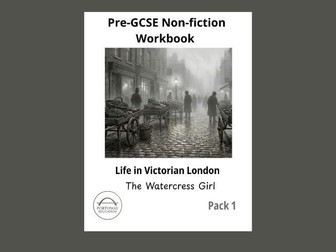
A complete, ready-to-use non-fiction reading resource for KS3 (Years 7–9). This structured workbook is based on Henry Mayhew’s account The Watercress Girl and is ideal for developing essential reading and analytical skills at KS3. Students explore Victorian London, child labour and poverty through accessible tasks that build confidence and deepen understanding of non-fiction texts. Suitable for English lessons, literacy intervention, homework, cover lessons or cross-curricular work with History. What’s Included 11-page student workbook (A4)* Context and warm-up questions Adapted extract Retrieval questions Vocabulary tasks (matching, word class, effects) Inference questions with sentence starters Writer’s methods: description, emotion, dialogue Narrator viewpoint and writer’s intention One-sentence summary task Creative writing task (two options)* ** Teacher’s Guide** *Clear learning objectives Suggested answers* Skills Covered Reading comprehension Retrieval Inference and evidence selection Analytical writing Vocabulary development Understanding writer’s craft Summary and extended writing Historical context within Victorian London **Why Teachers Use This Resource No preparation required Clear, accessible layout for a wide range of learners Supports literacy, EAL and mixed-ability classes Strong scaffolding for less confident readers Suitable for English, Humanities or whole-school literacy File Format A4 and US Letter PDF workbook A4 and US Letter PDF teacher guide Both files are flattened and ready for printing. Ideal For KS3 English (Years 7–9) Non-fiction units Victorian London or social history work Literacy intervention Homework or cover lessons
Free word class gap-fill stories: 5 funny grammar stories for Year 6 SATsQuick View
porthwayeducation

Free word class gap-fill stories: 5 funny grammar stories for Year 6 SATs

(0)
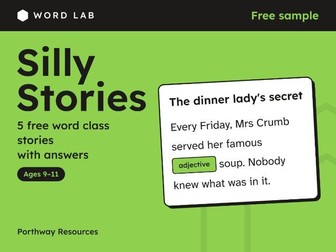
Five funny gap-fill stories to try with your class, free. Children choose a word for each prompt without seeing the story, copy their words into the gaps, then read their story aloud. The 16-page PDF includes the five stories, each with a word class helper and a SATs-style question, a word class guide page, answers with example words, and notes for teachers and parents. These five stories aren’t in Book 1, so you can use both. Book 1 has 30 more, in six themed sets.
Silly Stories Book 1Quick View
porthwayeducation

Silly Stories Book 1

(0)
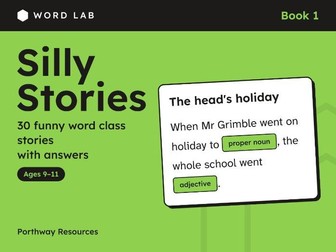
Thirty funny gap-fill stories that practise the word classes in the KS2 grammar, punctuation and spelling test. Pupils fill in a word list without seeing the story, copy their words into the gaps, and read the result aloud. How it works Every gap names a word class, sometimes with a fun twist: an abstract noun, a colour, something in a bedroom. Pupils choose their words first, so the finished story is a surprise. If a sentence sounds wrong when they read it aloud, they check whether the word really belongs to that word class. That check is where the learning happens. What’s included • A 75-page A4 PDF • 30 stories in six themed sets of five: school chaos, animal antics, food fights, big adventures, out and about, and magic and monsters • Each story as a two-page spread: the word list and word class helper on the left, the story on the right • A word class helper beside every list, with examples for each word class in that story • A SATs-style grammar question with every story • A word class guide page with a definition and examples of every word class in the book • Answers for every story: the word class of each gap, a set of example words, the SATs answer and a Talk about question • Notes for teachers: how to play alone or in pairs, making it easier or harder, and supporting pupils with dyslexia Word classes covered Nouns (plural, proper, abstract and collective), adjectives (comparative and superlative), verbs (past tense and -ing), modal verbs, adverbs, prepositions, determiners, pronouns, conjunctions, expanded noun phrases and fronted adverbials. Ways to use it SATs revision, grammar starters, booster groups, homework, wet play and the end of term. In pairs, one pupil reads out the prompts and writes down the answers without showing the story. Accessible by design Made by a specialist dyslexia teacher. Pages are clear and uncluttered, set in Atkinson Hyperlegible. Pupils can say their word aloud first, or a partner can scribe. Try the free sample first: five different stories with answers.