Globalisation and Health  Case Study– The Walk to the Clinic | KS3 GeographyQuick View
TheHumanitiesHub

Globalisation and Health Case Study– The Walk to the Clinic | KS3 Geography

(0)
This engaging reading comprehension resource explores the global issue of healthcare access through an original short story, The Walk to the Clinic. Students follow Lani and her mother as they face the challenges of accessing medical care in a rural community, highlighting issues of inequality, perseverance, and the importance of healthcare services. The resource includes a 6-page reading passage followed by a range of comprehension and critical thinking questions designed to develop reading, analysis, inference, and evidence-based writing skills. Topics covered: • Healthcare access • Global inequalities • Rural communities • Health and well-being • Social responsibility • Perseverance and resilience • Sustainable development Question types include: • Main idea and theme • Character development • Setting and conflict • Evidence-based questions • Inference questions • Extended written response Students will examine the challenges faced by people living in remote areas, evaluate barriers to healthcare, and consider the importance of fairness and access to essential services. The resource encourages critical thinking about global health issues while developing literacy and analytical skills. This resource is ideal for KS3 Geography, Global Issues, Health Studies, Social Studies, ESL learners, and cross-curricular literacy activities. Suitable for Year 7–9 / KS3.
Pollution Case Study – The Weight of the Sky | KS3 GeographyQuick View
TheHumanitiesHub

Pollution Case Study – The Weight of the Sky | KS3 Geography

(0)
This engaging reading comprehension resource explores the issue of air pollution through an original short story. Students follow Hamad as he witnesses the effects of worsening air quality on his community and takes action to raise awareness about environmental issues. The resource includes a 7-page reading passage and a range of comprehension and critical thinking questions designed to develop reading, analysis, inference, and evidence-based writing skills. Topics covered: • Air pollution • Environmental responsibility • Community action • Human impacts on the environment • Environmental awareness campaigns • Cause and effect Question types include: • Main idea and theme • Character development • Setting and conflict • Evidence-based questions • Inference questions • Extended written response This resource is ideal for KS3 Geography, Environmental Studies, Social Studies, ESL learners, and cross-curricular literacy activities. Suitable for year 7–9 / KS3.
The Growing Crisis of Plastic Pollution | KS3 Geography Reading & ComprehensionQuick View
TheHumanitiesHub

The Growing Crisis of Plastic Pollution | KS3 Geography Reading & Comprehension

(0)
This engaging reading comprehension resource explores the growing global issue of plastic pollution and its impact on ecosystems, wildlife, and human health. Students will investigate why plastic pollution has become a major environmental challenge and examine the actions individuals, communities, and governments can take to reduce its effects. The resource includes an informative reading passage followed by comprehension, vocabulary, analysis, and extended writing activities designed to develop literacy, critical thinking, and geographical understanding. Topics covered: • Plastic pollution • Microplastics • Marine pollution • Ecosystems and biodiversity • Human impacts on the environment • Sustainability • Environmental responsibility Question types include: • Main idea and detail questions • Vocabulary in context • Inference and analysis • Vocabulary matching • Extended written responses • Opinion and evaluation tasks Students will explore the causes and consequences of plastic pollution, evaluate its impact on both wildlife and humans, and consider practical solutions to reduce environmental damage. The resource encourages critical thinking while strengthening reading comprehension and written communication skills. This resource is ideal for KS3 Geography, Environmental Studies, Social Studies, ESL learners, and cross-curricular literacy activities. Suitable for Year 7–9 / KS3.
Pollution Case Study – The River That Could No Longer Breathe | KS3 GeographyQuick View
TheHumanitiesHub

Pollution Case Study – The River That Could No Longer Breathe | KS3 Geography

(0)
This engaging reading comprehension resource explores the issue of water pollution through an informative passage, The River That Could No Longer Breathe. Students investigate how human activities can damage rivers and ecosystems, while examining the impacts of pollution on wildlife, communities, and the environment. The resource includes a reading passage followed by comprehension, vocabulary, critical thinking, and extended writing tasks designed to develop literacy and geographical understanding. Topics covered: • Water pollution • Human impacts on the environment • Ecosystems • Environmental responsibility • Sustainable development • Conservation • Pollution and public health Question types include: • Multiple-choice questions • Vocabulary in context • Opinion writing • Real-world research task • Reflection and evaluation Students will explore the causes and consequences of water pollution, consider who is responsible for protecting natural resources, and make connections between the text and real-world environmental issues. The resource encourages critical thinking while developing reading comprehension and written communication skills. This resource is ideal for KS3 Geography, Environmental Studies, Social Studies, ESL learners, and cross-curricular literacy activities. Suitable for Year 7–9 / KS3. Pages: 3 Format: Reading passage with comprehension questions, vocabulary tasks, opinion writing, and reflection activities.
Pollution Case Study – Midway Island | KS3 GeographyQuick View
TheHumanitiesHub

Pollution Case Study – Midway Island | KS3 Geography

(0)
This engaging reading comprehension resource explores the environmental impact of plastic pollution through the real-world case study of Midway Island in the Pacific Ocean. Students learn how pollution can travel across the globe and affect ecosystems, wildlife, and marine environments, even in remote locations. The resource includes an informative reading passage followed by comprehension questions designed to develop reading, analysis, inference, and critical thinking skills. Topics covered: • Plastic pollution • Marine ecosystems • Environmental responsibility • Human impacts on the environment • Ocean currents • Wildlife conservation • Sustainability Question types include: • Multiple-choice questions • Short-answer responses • Evidence-based thinking • Creative writing task • Environmental analysis Students will investigate how plastic pollution affects seabirds, sea turtles, coral reefs, and the wider ecosystem while considering the role humans play in protecting the environment. This resource is ideal for KS3 Geography, Environmental Studies, Social Studies, ESL learners, and cross-curricular literacy activities. Suitable for Year 7–9 / KS3.
Habitat Preservation Case Study – Namibia Wildlife Conservation | KS3 GeographyQuick View
TheHumanitiesHub

Habitat Preservation Case Study – Namibia Wildlife Conservation | KS3 Geography

(0)
Habitat Preservation Case Study – Namibia Wildlife Conservation | KS3 Geography Reading & Comprehension This engaging case study explores how Namibia became a global success story in wildlife conservation and habitat preservation. Students will investigate the challenges facing biodiversity, including poaching, drought, habitat loss, and overconsumption, while examining how local communities helped protect endangered species and restore wildlife populations. The resource includes a detailed reading passage, key vocabulary activities, spot checks, and comprehension questions designed to develop literacy, geographical understanding, and critical thinking skills. Topics covered: • Habitat preservation • Wildlife conservation • Biodiversity • Poaching • Sustainable development • Ecotourism • Community-led conservation • Human impacts on the environment Question types include: • Vocabulary development • Reading comprehension • Short-answer questions • Knowledge checks • Evidence-based responses • Critical thinking tasks Students will explore the importance of protecting habitats, evaluate the causes of wildlife decline, and investigate how communal conservancies have helped Namibia become a model for conservation success. The resource encourages students to consider the relationship between people, wildlife, and the environment. This resource is ideal for KS3 Geography, Environmental Studies, Social Studies, ESL learners, and habitat preservation units. Suitable for Year 7–9 / KS3.
Globalisation Complete Unit Bundle | KS3 Geography (6 Lessons, Project & Assessment)Quick View
TheHumanitiesHub

Globalisation Complete Unit Bundle | KS3 Geography (6 Lessons, Project & Assessment)

11 Resources
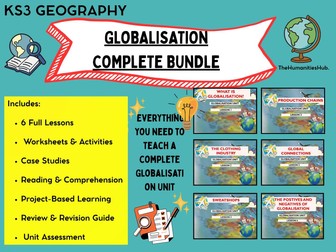
This complete KS3 Geography Globalisation Unit includes everything needed to teach a full scheme of work on globalisation. The unit includes 6 full lessons, assessment tasks, case studies, revision materials, and a research project, exploring the causes, impacts, and real-world examples of globalisation. It also includes a detailed observation lesson, making it ideal for formal observations or model teaching. Topics include: • What globalisation is • Global production chains • Sweatshops and ethical trade • Job sectors and economic change • Global connections • The impacts of globalisation Students also analyse real-world case studies from China, Poland, and Thailand to understand how globalisation affects different countries and communities. Included in this bundle: • 6 complete KS3 Geography lessons (including an observation lesson) • Globalisation essay assessment lesson • Globalisation research project • 3 real-world case studies • Revision guide and review questions Perfect for KS3 Geography, ESL learners, and globalisation units.
Globalisation Lesson 4 – Production Chains & Job Sectors | KS3 GeographyQuick View
TheHumanitiesHub

Globalisation Lesson 4 – Production Chains & Job Sectors | KS3 Geography

(0)
This engaging KS3 Geography lesson explores how global production chains work and how different economic sectors contribute to the production of goods. Students learn about the four main economic sectors (primary, secondary, tertiary and quaternary) and investigate how products such as clothing are made through global supply chains. The lesson also explores how profits and costs are distributed between factories, brands, transport companies and retailers. Students complete a range of activities including sorting tasks, comprehension questions, and production chain analysis to develop their understanding of how global industries operate. This resource includes: • Full lesson PowerPoint • Production chains worksheet • Job sectors comprehension activity • Job sectors sorting task • Discussion questions and activities Topics covered • Production chains and supply chains • The life of a t-shirt • Primary, secondary, tertiary and quaternary sectors • Global manufacturing and trade • Profit distribution in global industries This engaging KS3 Geography lesson explores how global production chains work and how different economic sectors contribute to the production of goods. Students learn about the four main economic sectors (primary, secondary, tertiary and quaternary) and investigate how products such as clothing are made through global supply chains. The lesson also explores how profits and costs are distributed between factories, brands, transport companies and retailers. Students complete a range of activities including sorting tasks, comprehension questions, and production chain analysis to develop their understanding of how global industries operate. This resource includes: • Full lesson PowerPoint • Production chains worksheet • Job sectors comprehension activity • Job sectors sorting task • Discussion questions and activities Topics covered • Production chains and supply chains • The life of a t-shirt • Primary, secondary, tertiary and quaternary sectors • Global manufacturing and trade • Profit distribution in global industries
Globalisation Case Study – The Suksawat Family in Thailand | KS3 Geography Reading & ComprehensionQuick View
TheHumanitiesHub

Globalisation Case Study – The Suksawat Family in Thailand | KS3 Geography Reading & Comprehension

(0)
This engaging KS3 Geography globalisation case study worksheet explores how globalisation affects the everyday lives of a family living in Chiang Mai, Thailand. Students read a narrative case study about the Suksawat family and analyse how globalisation influences tourism, small businesses, social media, culture, and economic change. The story highlights how globalisation can bring both new opportunities and new challenges for families and communities. Students then complete a wide range of comprehension and critical thinking activities. Included • Globalisation case study story • Reading comprehension questions • Vocabulary in context questions • Cause and effect questions • Problem and solution analysis • Higher-order critical thinking questions Skills Developed Students practice: • Reading comprehension • Analysing globalisation impacts • Critical thinking • Identifying cause and effect • Evaluating global change Perfect for • KS3 Geography • Globalisation units • ESL learners • Homework tasks • Cover lessons • Reading comprehension activities This resource is also included in my Globalisation Complete Unit Bundle.
Globalisation Case Study – China’s Growing Middle Class | KS3 Geography Reading & ComprehensionQuick View
TheHumanitiesHub

Globalisation Case Study – China’s Growing Middle Class | KS3 Geography Reading & Comprehension

(0)
This KS3 Geography Globalisation Case Study Worksheet explores the rise of the middle class in China and how globalisation has transformed the country’s economy and society. Students read a real-world case study and answer comprehension questions examining how globalisation has influenced jobs, consumer behaviour, environmental challenges, and economic growth. The worksheet introduces students to key globalisation themes such as: • The growth of China’s middle class • The role of foreign investment and global companies • Changes in employment and manufacturing • Environmental impacts of economic growth • Global demand for consumer goods Students then answer comprehension questions and a challenge question that encourages critical thinking about the benefits and challenges of globalisation. Included • Case study reading • 10 comprehension questions • Higher-order challenge question Perfect for • KS3 Geography • Globalisation units • Reading comprehension • Homework tasks • Cover lessons • ESL learners This resource is also included in my Globalisation Complete Unit Bundle.
Globalisation Revision Guide & Review Questions | KS3 GeographyQuick View
TheHumanitiesHub

Globalisation Revision Guide & Review Questions | KS3 Geography

(0)
This KS3 Geography Globalisation Review Worksheet helps students consolidate their understanding of key concepts from a Globalisation unit. The resource includes a clear summary of globalisation along with key vocabulary, revision questions, and source analysis tasks to help students review important ideas before an assessment. Students revise topics including: • What globalisation is and how countries are connected • The role of Transnational Corporations (TNCs) • Differences between HICs and LICs • The positive effects of globalisation such as economic growth and cultural exchange • The negative effects including sweatshops, environmental damage, and inequality Students also complete questions analysing how globalisation affects everyday life and global trade. Included • Globalisation revision reading • Key vocabulary review • Positive and negative effects summary • Sweatshop case study questions • Source analysis questions Perfect for: • KS3 Geography revision • Globalisation unit review • Homework tasks • Pre-test revision This resource is also included in my Globalisation Complete Unit Bundle.
Globalisation Observation Lesson 5 | Global Connections: How Linked Are We? | KS3 GeographyQuick View
TheHumanitiesHub

Globalisation Observation Lesson 5 | Global Connections: How Linked Are We? | KS3 Geography

(0)
This fully resourced and detailed KS3 Geography lesson explores how globalization connects people, cultures, economies, and countries across the world. Students investigate how everyday activities are linked to global trade, communication, labour, culture, and transport. Using a story-based case study, students analyse how globalization influences daily life and examine both the positive and negative impacts of an increasingly connected world. The lesson includes interactive activities, discussion tasks, and movement-based learning to help students critically evaluate the effects of globalization. This resource includes: • Full lesson PowerPoint • Reading activity – A Story of Globalization • Matching activity – The Six Elements of Globalization • Positive vs Negative globalization worksheet • Globalisation scavenger hunt starter activity • Movement activity – “Vote with your Feet” discussion task • Full observation lesson plan with differentiation and assessment strategies Topics covered • Global connections in everyday life • The six elements of globalization • Trade, labour, transport, culture, communication and politics • Positive and negative impacts of globalization • Global inequality and development This resource is also included in my Globalisation Complete Unit Bundle.
Globalisation Lesson 3 – What Is It Like in a Sweatshop? | KS3 GeographyQuick View
TheHumanitiesHub

Globalisation Lesson 3 – What Is It Like in a Sweatshop? | KS3 Geography

(0)
This engaging KS3 Geography lesson explores sweatshops and the working conditions faced by factory workers in the global clothing industry. Students examine how globalisation connects rich and poor countries and investigate why many clothing companies produce goods in low-income countries. The lesson encourages students to think critically about ethical consumption, labour rights, and the responsibilities of global companies. Students complete source analysis, role-play activities, and discussion tasks to explore the perspectives of different stakeholders involved in the clothing industry. This resource includes: • Full lesson PowerPoint • Source analysis exam practice activity • Sweatshop role-play stakeholder cards • Inference diagram starter activity • Homework task exploring sweatshop conditions • Discussion and debate activities Topics covered • Sweatshops and working conditions • Global clothing industry • Ethical consumption • Global inequality • Responsibilities of companies and consumers This resource is also included in my Globalisation Complete Unit Bundle.
Globalisation Lesson 6 – The Effects of Globalisation | PEEL Essay Lesson & AssessmentQuick View
TheHumanitiesHub

Globalisation Lesson 6 – The Effects of Globalisation | PEEL Essay Lesson & Assessment

(0)
This fully resourced KS3 Geography lesson explores the positive and negative effects of globalisation and guides students through planning and writing a structured PEEL essay assessment. Students first analyse sources and examples of globalisation before completing a structured planning task. They then write a PEEL essay answering the question: “What are the negative effects of globalization and how can they be minimized?” The lesson includes scaffolding and writing frames to support ESL learners while developing analytical and extended writing skills. This lesson works well as a final assessment for a Globalisation unit. Included in this resource • Bell work activities • Source analysis task • Globalisation effects table activity • PEEL essay planning scaffold • PEEL writing frame with sentence starters • Essay rubric for grading • Structured mark scheme and mark distribution • Mark Distribution Students develop skills in: • Critical thinking • Essay writing using PEEL • Evaluating globalisation • Using evidence to support arguments This resource is also included in my Globalisation Complete Unit Bundle.
Globalisation Lesson 2 – Why Are Our Clothes Made in Different Countries? | KS3 GeographyQuick View
TheHumanitiesHub

Globalisation Lesson 2 – Why Are Our Clothes Made in Different Countries? | KS3 Geography

(0)
This engaging KS3 Geography lesson explores why clothing companies manufacture their products in different countries and introduces students to the role of transnational corporations (TNCs) in globalisation. Students investigate the global clothing industry using Nike as a case study and explore how companies reduce costs and increase profits by producing goods overseas. The lesson also encourages students to think critically about the social impacts of globalisation, including labour conditions and inequality between developed and developing countries. This resource includes: • Full lesson PowerPoint • Source analysis exam practice activity • Nike case study • Profit and cost analysis task • Discussion questions and critical thinking activities Topics covered • Transnational Corporations (TNCs) • Global supply chains • Why companies manufacture overseas • Profit, costs and production • Exploitation and sweatshop labour • Global inequality This resource is also included in my Globalisation Complete Unit Bundle.
Globalisation Lesson 1: What is Globalisation? | KS3 GeographyQuick View
TheHumanitiesHub

Globalisation Lesson 1: What is Globalisation? | KS3 Geography

(0)
This engaging KS3 Geography lesson introduces students to the concept of globalisation and explores how the world has become increasingly connected through trade, communication, travel and multinational companies. Students explore how globalisation affects everyday life and examine both the positive and negative impacts on countries around the world. The lesson includes source analysis activities, discussion tasks, and real-world examples to help students understand global connections and inequality between countries. This resource includes: • Full lesson PowerPoint • Source analysis exam practice activity • Globalisation notes template • Homework task – Where are my clothes from? • Global Jeans globalisation worksheet and mapping task Topics covered • What globalisation means • How the world has become more connected • Transnational corporations (TNCs) • Positive impacts of globalisation • Negative impacts of globalisation • Inequality between rich and poor countries This resource is also included in my Globalisation Complete Unit Bundle.
Climate Change Unit Test | KS3 Geography AssessmentQuick View
TheHumanitiesHub

Climate Change Unit Test | KS3 Geography Assessment

(0)
This end-of-unit assessment evaluates students’ understanding of key climate change concepts taught throughout a Climate Change unit. The test includes a variety of question types including multiple choice, short answer, extended responses, and a diagram labeling task. The assessment is designed for KS3 Geography students and helps teachers evaluate both knowledge and deeper understanding of climate science concepts. Topics assessed include: • Climate vs Weather • Evidence of Climate Change • Greenhouse Gases • The Greenhouse Effect • Natural Causes of Climate Change • Human Causes of Climate Change • Environmental impacts This resource works well as a formal assessment, end-of-unit test, or revision activity. Included: • Climate Change Unit Test • Multiple Choice Questions • Short Answer Questions • Extended Response Questions • Diagram Labeling Task • Editable Word document Suitable for KS3 Geography
Globalisation Case Study – Poland & the European Union | KS3 Geography ComprehensionQuick View
TheHumanitiesHub

Globalisation Case Study – Poland & the European Union | KS3 Geography Comprehension

(0)
This KS3 Geography Globalisation Case Study Worksheet explores how globalization transformed Poland’s economy after the fall of communism and its entry into the European Union. Students read a real-world case study examining how global trade, foreign investment, and EU membership changed businesses, employment, and economic growth in Poland. The case study explores: • How globalization helped businesses expand into new countries • Poland’s transition from communism to democracy • The role of the European Union in economic growth • The benefits of foreign investment and tourism • Challenges faced by workers and farmers during economic change Students then complete comprehension questions and discussion tasks analysing the positive and negative effects of globalization. Case Study- Poland and Globaliz… Included • Case study reading • 6 comprehension questions • 3 discussion / critical thinking questions Perfect for • KS3 Geography • Globalisation units • Reading comprehension • Homework tasks • Cover lessons • ESL learners This resource is also included in my Globalisation Complete Unit Bundle.
Globalisation Project – Research & Poster Assessment | KS3 GeographyQuick View
TheHumanitiesHub

Globalisation Project – Research & Poster Assessment | KS3 Geography

(0)
This engaging KS3 Geography Globalisation Project allows students to investigate how globalisation connects countries, cultures, and economies across the world. Students research examples of globalisation and analyse its social, economic, and environmental impacts before presenting their findings in a creative poster or presentation. This project works well as a final assessment at the end of a Globalisation unit. Students will explore questions such as: • What is globalisation? • How do products we use every day show global connections? • What are the positive and negative effects of globalisation? • How does globalisation affect culture, jobs, and the environment? • How does globalisation impact young people around the world? Students then present their research in a creative poster project, including examples of global brands, global connections, and cultural exchange. Included in this resource • Globalisation research project instructions • Inquiry questions to guide research • Creative poster project task • Student example prompts • Project assessment rubric for grading research and presentation Skills Developed • Research and inquiry • Critical thinking • Geography analysis • Creativity and presentation skills • Understanding global connections This resource is also included in my Globalisation Complete Unit Bundle.
Climate Change Unit Review & Study GuideQuick View
TheHumanitiesHub

Climate Change Unit Review & Study Guide

(0)
This resource is designed to help students review key concepts before a quiz, test, or exam on climate change. Students revise essential vocabulary, explore examples of species that survived past climate changes, and review the scientific evidence that shows the Earth’s climate is changing today. The worksheet helps students consolidate their understanding of important climate change concepts while preparing them for assessments. This resource includes: • Climate and weather definitions • Key climate change vocabulary • Explanation of global warming • Examples of species that survived climate change • Evidence of climate change • Review notes suitable for revision or homework This worksheet works well as: • A review lesson • A revision sheet before a test • A homework assignment • A study guide for climate change units Suitable for: Ages 11–14 | Grade 7–9 | Geography / Social Studies This resource is also included in my Climate Change Complete Unit Bundle.
Climate Change Lesson 4: Natural Causes of Climate ChangeQuick View
TheHumanitiesHub

Climate Change Lesson 4: Natural Causes of Climate Change

(0)
A fully resourced lesson exploring the natural causes of climate change. Students investigate how natural processes such as volcanic eruptions, sunspot activity, orbital changes and asteroid impacts can influence the Earth’s climate over long periods of time. Students use information cards to create a mind map explaining how each natural process affects global temperatures. The lesson also includes discussion tasks and analytical questions designed to help students understand the difference between natural climate change and human-caused climate change. The lesson develops geographical thinking by encouraging students to explain processes, evaluate evidence and use key climate vocabulary. This resource includes: • Complete lesson PowerPoint • Natural causes of climate change information cards • Structured mind map activity • Discussion and critical thinking tasks • Extended writing / explanation task • Teacher guidance and examples The lesson is designed to be engaging and accessible and works well in Middle School Geography or Social Studies classrooms. It also supports ESL / EAL learners through structured activities and clear explanations. Suitable for: Ages 11–14 | Grade 7–9 | Middle School Geography Topics covered: • Natural causes of climate change • Volcanic eruptions • Sunspot cycles • Orbital changes (Milankovitch cycles) • Asteroid impacts • Long-term climate patterns This resource is also included in my Climate Change Complete Unit Bundle.