Earth Day Classroom Activities (Individual and Group)
Discover four activities that help students understand how thoughtful consumption helps combat climate change.
Thinking before buying is the easiest way to be a planet protector. When we only buy what we use and/ or appreciate, we not only avoid disappointment but automatically reduce our carbon footprint and the number of items we place in landfills over our lifetime.
The activities below help students understand how thoughtful consumption is an upstream solution to climate change. Thinking before buying allows kids to slow down and think about a purchase’s environmental impact before spending their money or anyone else’s.
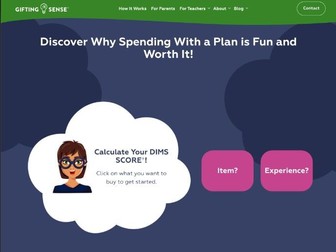
Meet the First Car DIMS – DOES IT MAKE SENSE?® Score Calculator, designed to help young people uncover the true cost of car ownership. Even a “free” first car can cost thousands a year.
Our newest permissionless mindful spending tool enables students to step back and evaluate whether a car makes sense for them and their family, given its real cost and how much they expect to use it. Like all DIMS SCORE® Calculators, it shows how powerful it can be to pause, gather information, and reflect before spending.
Calculating the DIMS SCORE® for a car isn’t about telling students whether they should or shouldn’t buy a vehicle. It’s about encouraging them to evaluate real-world decisions using facts versus opinions. Students are asked to research factors beyond the purchase price of the car they’re curious about, such as insurance, fuel, maintenance, the social responsibility of driving, and how often they expect to drive. Doing so for both practical and aspirational models can be particularly revealing.
To make the activity easy to use in the classroom, we’ve created two free resources that guide students through the process. These can also be easily adapted for conversations at home.
The Lesson Plan (downloadable) provides a structured way to explore the actual cost of owning a first car. The first half prepares students for the second half: an engaging role-playing exercise in which students take turns being either a parent or a young person discussing the possibility of purchasing a first car. Important financial decisions often involve conversations with family members.
The Student Data Collection Worksheet (downloadable) helps students gather the information they need before calculating their DIMS SCORE®, making the ensuing discussion far more meaningful. For many students, this research step produces the biggest “aha” moment as they begin to see the true costs of car ownership.
A first car is often the first significant financial commitment a young person considers. Learning how to step back and evaluate that decision thoughtfully is a habit that will serve them long after their first car is gone.
What gets measured gets done!
Help your students avoid impulse purchases by enabling them to visualize how close they are to reaching a savings goal every time they forgo an iced latte or pizza slice! It’s easy with this Worth-the-Wait Goal Tracker.
An effective “spending speed bump” that reminds young people of the trade-offs they’re making with even seemingly small purchases, which can quickly add up to the cost of that jacket you could have bought.
Can back-to-school shopping be stress-free?
Back-to-school can be stressful. In addition to new schedules and responsibilities, which can be exciting, there are almost always additional expenses. (How much are new soccer cleats?) What if there were a way to help the whole family prepare for the coming school year with as little regret about spending as possible?
Intentional shopping is stress-free shopping.
The key is getting kids to slow down long enough to ask and answer questions that build intention into the back-to-school shopping process. This teaches them to get what they need, skip what they don’t, and start the year like a boss!
This worksheet packet helps young people organize their responses to the four questions they need to answer to create an intentional back-to-school shopping list. Let’s imprint a mindful spending process that enables kids and families to get what they need, skip the rest, and start the year off right!
Free PSHE financial literacy tools for ages 9–18. The DIMS — DOES IT MAKE SENSE?® Score Calculator teaches mindful spending in real classrooms.
These free resources give students aged 9–18 a simple, repeatable framework for financial decision-making — fully aligned with the Economic Wellbeing strand of PSHE’s Living in the Wider World curriculum.
The DIMS — DOES IT MAKE SENSE?® Score Calculator walks students through a brief but structured process of pausing, gathering information, and reflecting before spending — building consumer awareness and financial confidence.
Quick to complete but never arbitrary, it ends in a shareable summary that students can keep and distribute to serve as the agenda for a relaxed, productive conversation about spending. No prior financial education background required to teach.
This upload includes:
The GiftingSense Educator Webinar (expository workshop) Slide Deck — a complete classroom presentation.
Suitable for ages 9–18. Fully adaptable. No registration, login, or paywall — ever. Students access the calculator instantly, with nothing to download or approve. Free. Forever.


 Quick View